Spain decides in November: will part of a 1.6 million tonne crop be withdrawn from the market?
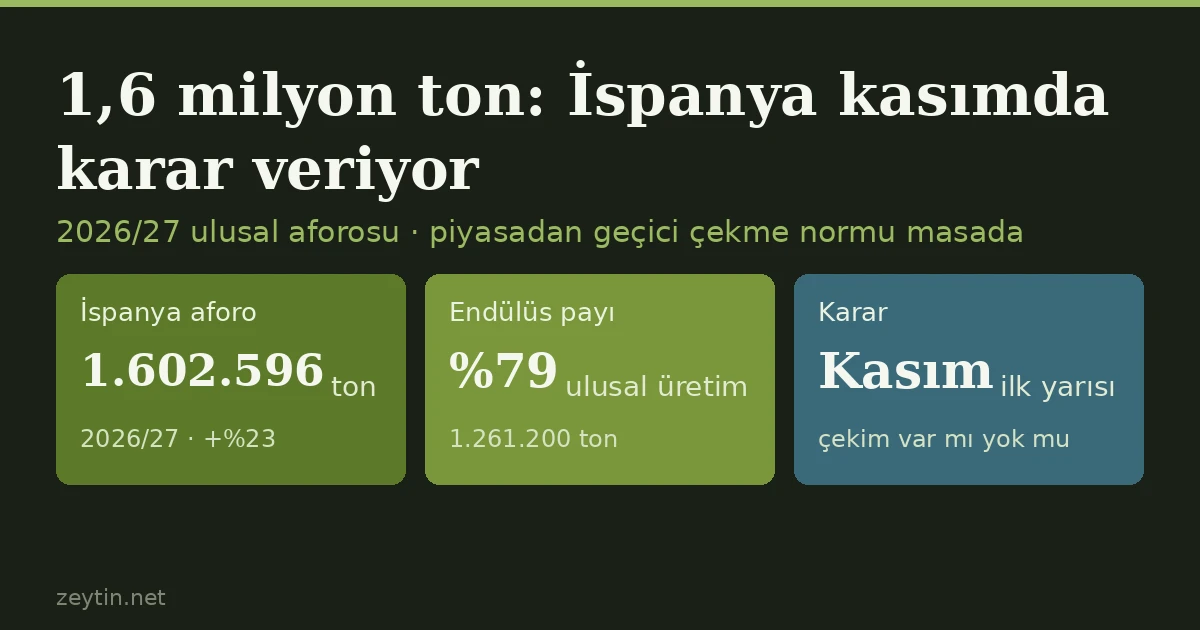
Spain's first national aforo for 2026/27 was presented in Jaén on 1 October: 1,602,596 tonnes of olive oil, 23% above last harvest. With carry-over stock, total availability approaches two million tonnes, and the Ministry of Agriculture will decide in the first half of November whether to activate a temporary withdrawal mechanism that has never been used. The ceiling on the world price Turkish exporters will face is being set here.
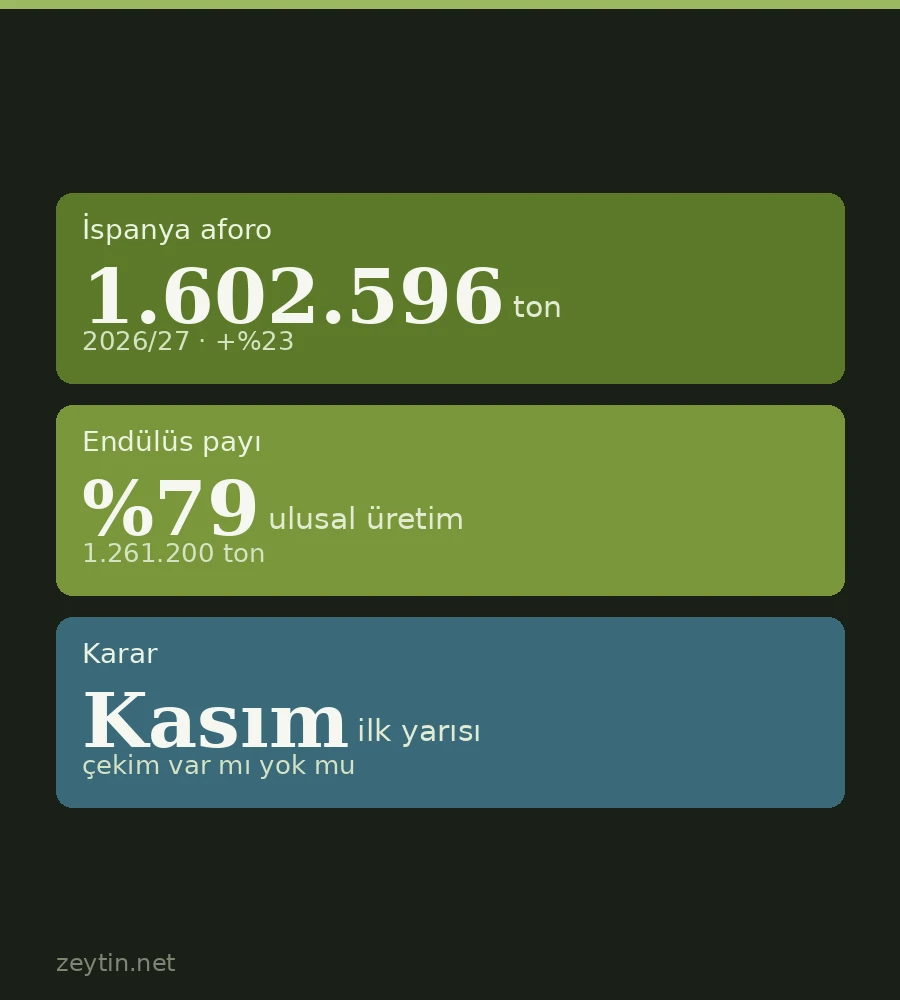
Two days ago we covered Andalusia's aforo: 1,261,200 tonnes. The national figure arrived on 1 October, and the news is not the number itself but the sentence attached to it: Madrid has put market withdrawal on the table.
Spain's Minister of Agriculture, Fisheries and Food, Luis Planas, presented the first national aforo estimate for the 2026/27 season — the official pre-harvest crop forecast — at a press conference in Jaén: 1,602,596 tonnes of olive oil, 23% above the previous harvest. The ministry describes this as a "medium-high" production year.
The number and how it breaks down
| 2026/27 aforo | Olive oil | Year on year |
|---|---|---|
| Spain | 1,602,596 t | +23% |
| Andalusia | 1,261,200 t | +29% |
| Castilla-La Mancha | 152,000 t | +10% |
| Extremadura | 97,300 t | +24% |
Andalusia alone accounts for 79% of national output. At provincial level the weight sits where it always does: Jaén at 575,000 tonnes, or 36% of the whole of Spain. According to the ministry's presentation, production is expected to fall this season in Catalonia, Aragón, the Balearic Islands, Madrid, Murcia and Navarre.
Planas tied the forecast to last spring: mild temperatures and abundant rainfall produced good flowering and fruit set. He was equally clear that the figure is preliminary — the weather of the coming weeks and, above all, the final yield of rainfed groves after a hot summer can still move it. We have written separately about when a crop estimate actually becomes final; this caveat is that same logic, now stated by the ministry itself.
The real story: the first half of November
Once carry-over stock from the current season is added, total available supply in Spain could approach two million tonnes. Against that backdrop, Planas said a decision on whether to activate the temporary withdrawal standard will be taken in the first half of November, through a resolution issued by the Directorate-General for Agricultural Productions and Markets.
The timetable is now set as well: the autonomous communities have the whole of October to adjust their aforo figures, and the definitive carry-over stock figure will be known in the middle of the month. The decision follows once both data sets are complete.
The mechanism rests on Article 167a of the EU common market organisation — a provision Spain itself pushed for before the European Commission. Where there is excess supply, part of the oil can be held off the market until the following campaign, with the option of being directed to non-food use; each operator chooses which category of oil to immobilise. Under the draft standard the ministry opened to public consultation in July, the activation criterion is specific: the norm can be triggered when opening stocks plus the production estimate reach 120% of the average of that same sum over the previous six campaigns. The standard can be adopted up to 31 October for application in the 2026/27 season.
Planas asked for "rigour" and "prudence" before activating it, recalling that this is an extraordinary measure that has never been applied, and he declined to prejudge the outcome: when the time comes, either a withdrawal will be ordered or, as happened last season, it will not. The farm organisations COAG, UPA and Asaja are the ones pressing for the article to be used — we have already set out, with figures, how production costs in Spain have risen above selling prices, and that is the picture behind their demand.
Is the import argument settled?
Planas also rejected the claim that oil arriving from countries such as Tunisia is decisive in Spanish price formation. According to the ministry's own analysis, all of those operations taken together — reduced-tariff imports under the EU agreement, ordinary imports paying full duty, and oil entering under inward processing arrangements for re-export to third countries — amount, in the highest scenario, to only 5.82% of the total volume of oil handled in Spain, counting both domestic consumption and exports. In the minister's reading, that volume essentially feeds the export market and does not meaningfully alter the course of prices at origin.
That is a direct answer to a regional argument: Andalusia's campaign against North African imports was built precisely on the opposite claim. The ministry has now put its own arithmetic against the objection raised in the region.
On price tension and the complaints of small growers facing a downward trend, Planas pointed to enforcement of the Food Chain Law, with the stated aim that farmers should not merely cover their production costs but earn a decent return on their work. He acknowledged the difficulty of balancing the interests of producers, packers, retail and consumers. On the sale of Deoleo by its owner funds, the minister avoided interfering in a private transaction, while voicing concern that industrial capacity and production centres in Spain be preserved, along with the ability to buy from and supply Spanish growers and cooperatives — a process we have followed since the veto was walked back.
What it means for Türkiye
For Türkiye, this decision translates directly into price. Using the site's current data: extra virgin olive oil was registered at ₺298.23/kg on the Edremit exchange on 25 September, while the weekly producer price in Spain stands at €3.45/kg — roughly ₺191 at the European Central Bank's 1 October rate of €1 = ₺55.3993. The gap says less about Turkish oil being expensive than about the supply pressure building in Spain.
The 500,000 to 600,000 tonnes that processors and exporters meeting in İzmir named for this season is about a third of the figure Spain has just published on its own; add the carry-over stock and the ratio falls to a quarter. The decision Madrid takes in November will be one of the factors setting the ceiling on the world price Turkish exporters meet: if a withdrawal is ordered, part of the supply is shelved for a season; if it is not, two million tonnes of availability keeps pressing the price down.
Also worth watching is what the withdrawal mechanism does to quality segmentation. Because each mill chooses which category to immobilise, a withdrawal would not remove supply evenly across extra virgin, virgin and lampante grades — and that composition, not the headline tonnage alone, is what Turkish exporters actually compete against in third markets.
One rating per visitor; you can change yours at any time. Ratings are real reader votes — no seeded or default scores.
Related
 Article
Greece opens the season at €4: no scarcity in the Mediterranean, but pressure on price
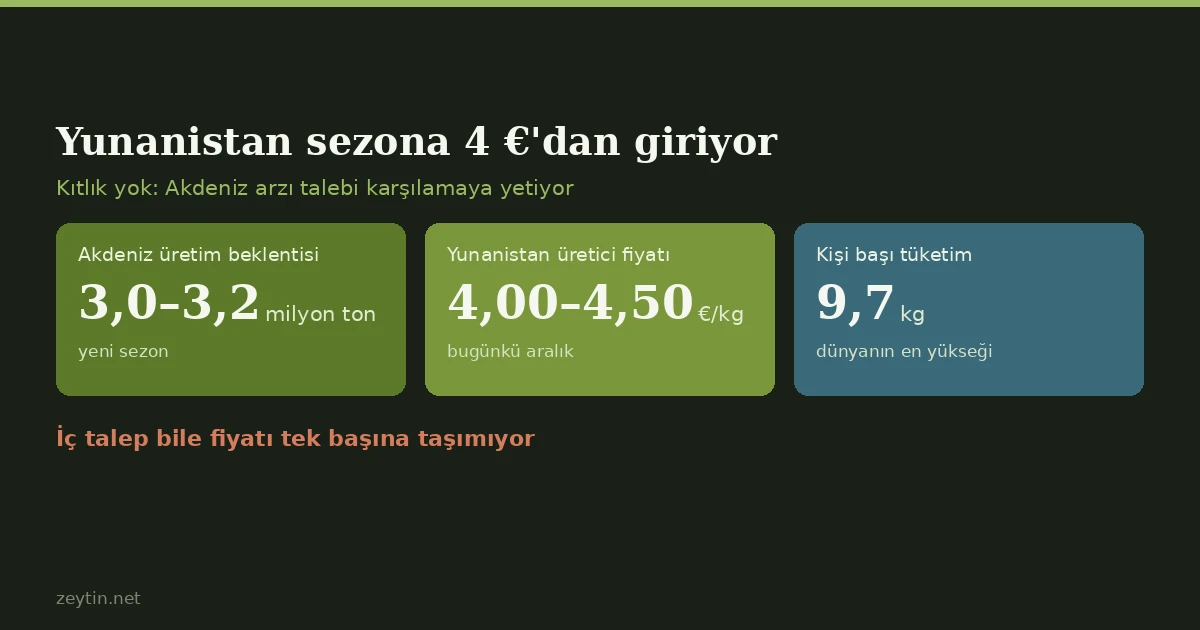
Manolis Giannoulis, president of the National Interprofessional Olive Oil Organization, expects the season to open at around €4 per kilogram. Mediterranean output is forecast at 3–3.2 million tonnes: no record, but enough to meet demand. The market is quiet, buyers are few, and costs plus North African imports keep the pressure on.
Article
Greece opens the season at €4: no scarcity in the Mediterranean, but pressure on price
Manolis Giannoulis, president of the National Interprofessional Olive Oil Organization, expects the season to open at around €4 per kilogram. Mediterranean output is forecast at 3–3.2 million tonnes: no record, but enough to meet demand. The market is quiet, buyers are few, and costs plus North African imports keep the pressure on.
 Article
Andalusia finally puts a number on it: 1.26 million tonnes of olive oil, up 24%
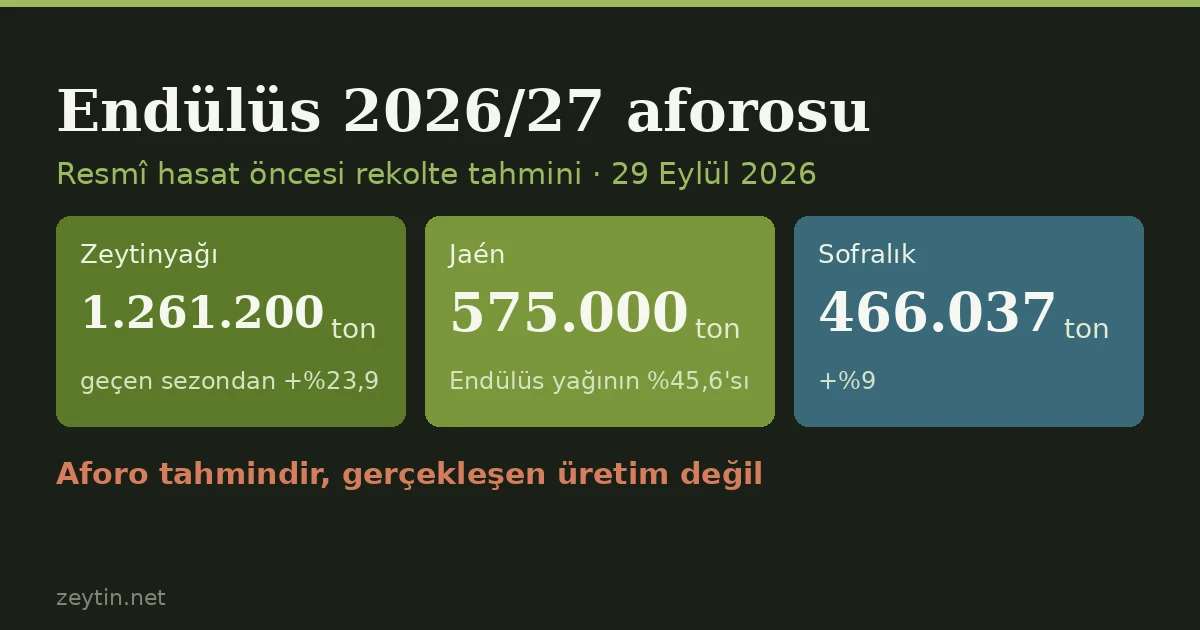
Andalusia's agriculture ministry published its 2026/27 aforo on 29 September in Mengíbar: 1,261,200 tonnes of olive oil, 23.9% above last season and 44% above the five-year average. The heat warning growers raised in early September made it into the forecast's own reasoning. Four times Turkey's entire season output is entering an already soft price environment.
Article
Andalusia finally puts a number on it: 1.26 million tonnes of olive oil, up 24%
Andalusia's agriculture ministry published its 2026/27 aforo on 29 September in Mengíbar: 1,261,200 tonnes of olive oil, 23.9% above last season and 44% above the five-year average. The heat warning growers raised in early September made it into the forecast's own reasoning. Four times Turkey's entire season output is entering an already soft price environment.
 Article
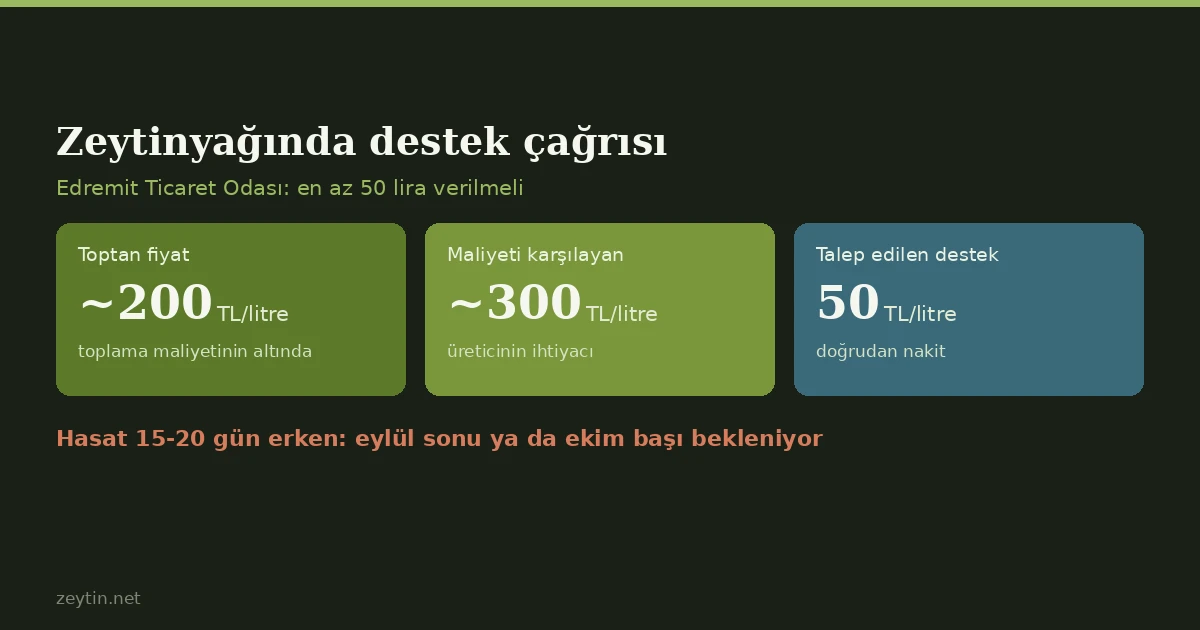
Edremit Chamber: olive oil needs at least 50 lira per litre in support
Chamber President Ahmet Çetin says the wholesale price has fallen to 200 lira, below the cost of picking. The level needed to cover costs is 300 lira. Harvest is expected 15-20 days early.
Article
Edremit Chamber: olive oil needs at least 50 lira per litre in support
Chamber President Ahmet Çetin says the wholesale price has fallen to 200 lira, below the cost of picking. The level needed to cover costs is 300 lira. Harvest is expected 15-20 days early.
 Article
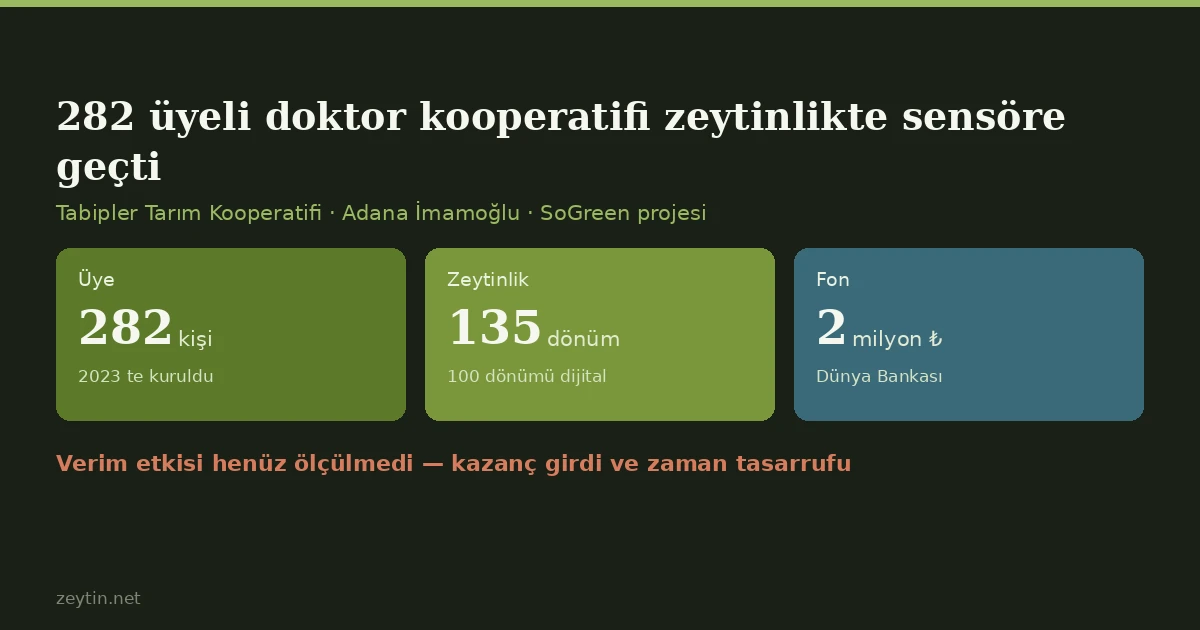
A 282-member doctors' cooperative puts sensors in the olive grove
A cooperative founded by doctors in Adana is monitoring water and fertiliser with buried sensors across 100 of its 135 dönüm of bearing olive grove, funded with 2 million lira.
Article
A 282-member doctors' cooperative puts sensors in the olive grove
A cooperative founded by doctors in Adana is monitoring water and fertiliser with buried sensors across 100 of its 135 dönüm of bearing olive grove, funded with 2 million lira.