Spain steps back from vetoing Deoleo's sale: the door opens for Italy's Coricelli
Madrid's position on the sale of the world's largest olive oil bottler has shifted: in early September a Spanish buyer was preferred, and on 18 September Italy's Coricelli was reported to be seen as the best-positioned candidate. The government's lever is a foreign investment screening regime that covers EU investors too and runs to 31 December 2026. Because Deoleo is a major bulk buyer, the outcome matters to Turkish exporters.
The needle moved in two weeks. In early September, the talk was that the Spanish government had no intention of letting Deoleo — the world's largest olive oil bottler — pass to a foreign buyer. On 18 September, Madrid was reported to have opened the door to the Italian suitor.
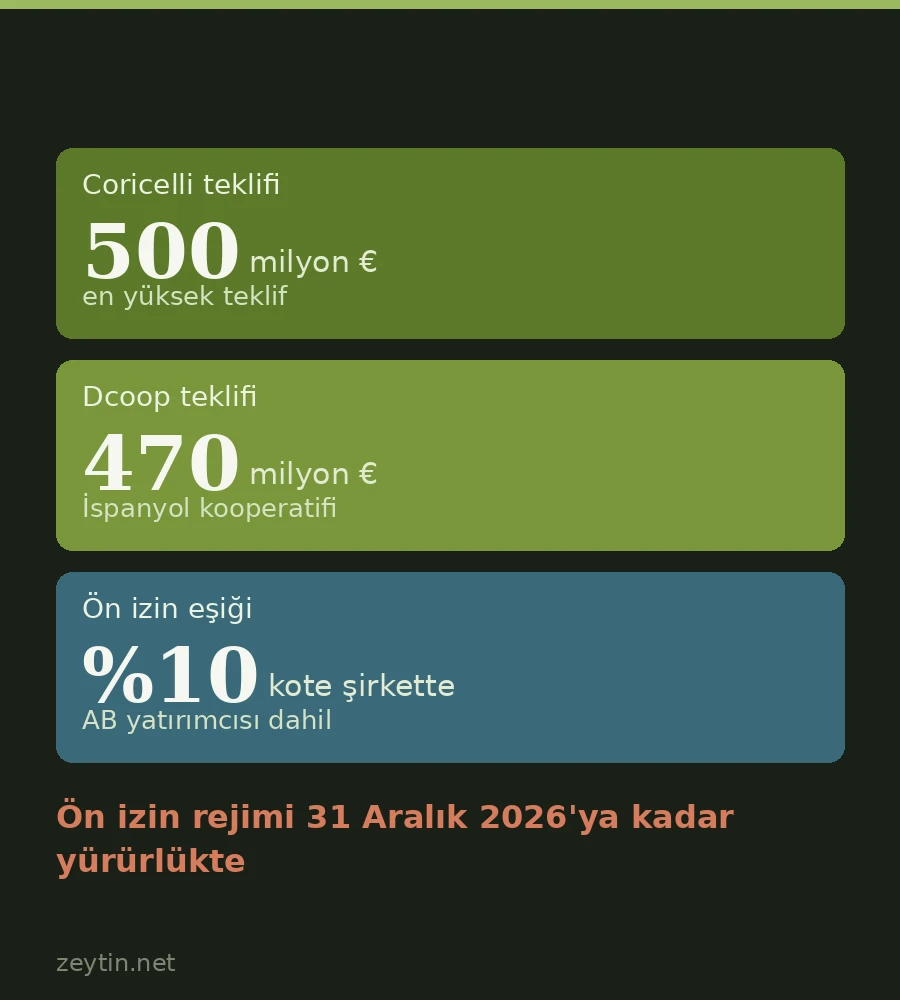
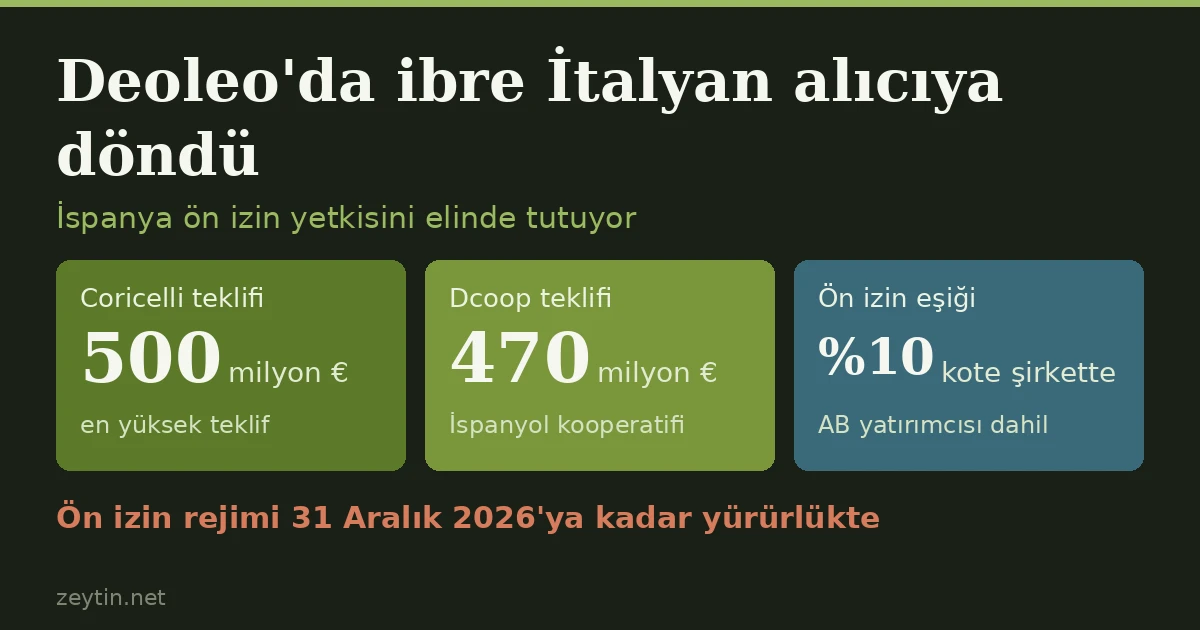
We have already covered the bid table: Italy's Coricelli at €500 million, Spain's Dcoop cooperative at €470 million, with Acesur also at the table. That piece noted that although the figures put Coricelli in front, the Spanish side was understood to regard Dcoop as better placed. That is precisely what has changed.
Five weeks, step by step
| Date | What happened |
|---|---|
| 15 August | Coricelli raised its offer to €500 million and asked for exclusivity until closing |
| 19 August | Deoleo told the market regulator CNMV that its reference shareholders were weighing "strategic alternatives", with no final decision taken |
| Early September | The Spanish suitors did not withdraw despite the exclusivity granted to the Italians |
| 15 September | The agriculture and economy ministries each left responsibility for the informal veto to the other |
| 18 September | Government sources regard Coricelli as the "best-positioned candidate" |
What lever does the government actually hold?
What Spain calls its escudo antiopas — the anti-takeover shield — sits in paragraphs 2 and 5 of article 7 bis of Law 19 of 2003. Liberalisation of certain foreign direct investments is suspended, and that suspension has been extended to 31 December 2026.
The detail that matters: the suspension covers not only non-EU investors but residents of EU and EFTA countries as well. Crossing the 10% threshold in a Spanish company that is deemed strategic and listed on the exchange requires prior government authorisation; for unlisted companies the trigger is a transaction value above €500 million. Because Deoleo is listed, an Italian buyer has to pass through that gate too. EU membership by itself grants no exemption.
Spanish press reported that the Italian side had considered presenting the bid through its subsidiary in Seville, so as to make the transaction look Spanish. The same reports said this would not remove the authorisation requirement. Coricelli's parent holding, Farmers Elite Global, does own a Spanish company, Aceites Abasa.
⚠ The softening on 18 September is not a formal decision. It rests on government sources and was reported with the caveat that any transaction "must abide by Spanish and European competition rules". The two ministries passing responsibility back and forth three days earlier belongs to the same picture: an informal veto is politically cheap but legally fragile, while a formal veto has to be reasoned and then defended.
What condition is the company in?
| Item | Position |
|---|---|
| Ownership | CVC 50.9% · Alchemy 40.3% |
| 2025 revenue | €821 million (down 18%) |
| Spanish brands | Carbonell, Hojiblanca, Koipe |
| Italian brands | Bertolli, Carapelli |
⚠ The 18% fall in revenue should not be read on its own. A bottler's turnover tracks the shelf price, and 2025 was a year in which olive oil prices came down from record levels. What is on the table is not a failing company but the largest brand portfolio in a market descending from a price peak.
One point deserves attention: the portfolio is already binational. The classics of the Spanish shelf, Carbonell and Koipe, sit under the same roof as the Italian export brands Bertolli and Carapelli. Behind the argument that "a Spanish company is going to foreigners" stands a company that has been selling Italian brands for years.
Whose side is time on?
The suspension runs to 31 December 2026. Spanish press has reported, however, that the government is preparing to extend the regime into 2027, specifically in order to keep investments by EU companies under review. The lever will therefore not expire before the sale process concludes; waiting for the calendar to close the gate is not an option for a buyer.
That detail also explains why the Spanish suitors have not walked away despite the exclusivity. A seller can decide who it will negotiate with; it is not the seller alone who decides whether the transaction happens. Exclusivity is a commercial undertaking, and it does not substitute for administrative authorisation.
⚠ No decision on the authorisation has been announced. The only established fact is that the power still stands.
What changes for Türkiye?
Deoleo is not a producer but a major bulk buyer; much of what it bottles is purchased on the market. The identity of the buyer therefore bears directly on Turkish exporters.
The rough frame is this. If a producers' cooperative acquires a bottler, it would be expected to give priority to its own members' oil, and outside bulk purchasing narrows. Italian bottlers, by contrast, operate in a country that produces less than it consumes and exports; buying bulk from abroad is structurally normal for them. Read that way, an Italian buyer means a door that stays open for the Turkish bulk exporter rather than one that closes.
⚠ This is an inference. None of the bidders has announced a sourcing policy; the process is at the exclusivity stage and no final decision has been disclosed.
After a year in which exports fell 62% by value, the question of who ends up owning Europe's largest bottler will also shape the list of buyers at the table as new-season contracts are written. The question to watch is no longer who bid more. It is whether Spain will use its authorisation power — and, if it does, what it will rest that decision on.
Sources
- Bid amounts, the exclusivity request and the stages of the process: reporting in the Spanish press on the Deoleo sale, August-September 2026.
- Ownership structure and the "strategic alternatives" review: Deoleo's filing to the CNMV dated 19 August 2026.
- Foreign investment screening: article 7 bis of Law 19/2003 and the decision extending the suspension to 31 December 2026.
- Preparation to extend the regime into 2027: reporting in the Spanish press in September 2026; no published decision text exists.
- The shift in the government's position: September 2026 reporting attributed to Spanish government sources. No official statement was issued on the matter.
One rating per visitor; you can change yours at any time. Ratings are real reader votes — no seeded or default scores.
Related
 Article
The 2026/27 season opens: first harvests in Ayvalık, Gemlik and Bozcaada
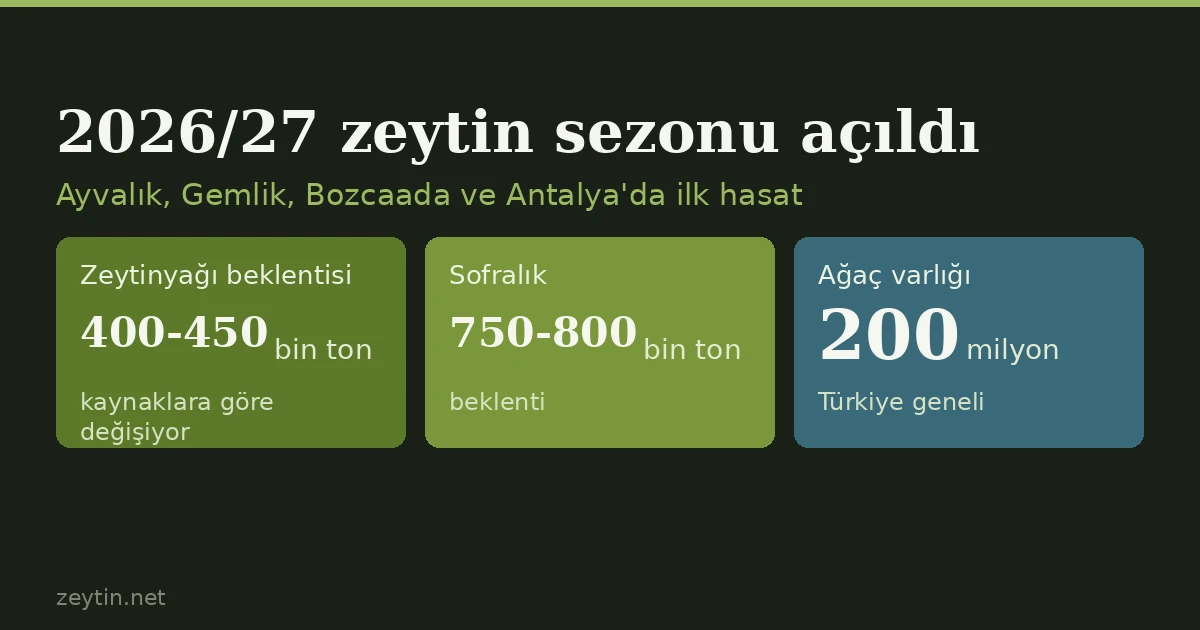
The new olive season opened with three events on 11-13 September. In Ayvalık, an on-year forecast of 400,000-450,000 tonnes of olive oil was voiced; in Gemlik the first olives were picked during the festival; and on Bozcaada the island's first olive oil was pressed with a portable system.
Article
The 2026/27 season opens: first harvests in Ayvalık, Gemlik and Bozcaada
The new olive season opened with three events on 11-13 September. In Ayvalık, an on-year forecast of 400,000-450,000 tonnes of olive oil was voiced; in Gemlik the first olives were picked during the festival; and on Bozcaada the island's first olive oil was pressed with a portable system.
 Article
Andalusia moves against North African imports: 76% of what arrives is extra virgin
Andalusia's farm sector objects that more than 76% of the olive oil imported into the region in early 2026 was extra virgin. The regional minister has requested exceptional measures under Article 195 of the EU regulation. Türkiye could meet the same door.
Article
Andalusia moves against North African imports: 76% of what arrives is extra virgin
Andalusia's farm sector objects that more than 76% of the olive oil imported into the region in early 2026 was extra virgin. The regional minister has requested exceptional measures under Article 195 of the EU regulation. Türkiye could meet the same door.
 Article
The International Olive Council grows: Iraq joins, Brazil and South Africa apply
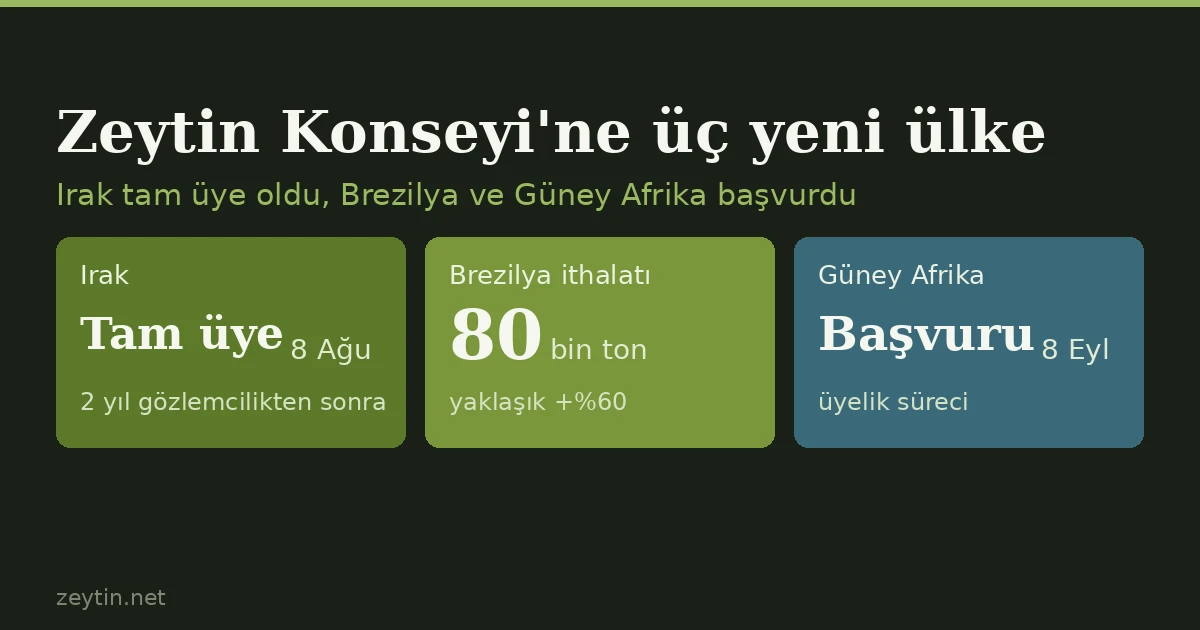
The International Olive Council (IOC) saw three developments in a month: Iraq became a full member on 8 August, South Africa submitted its membership request on 8 September and Brazil on 9 September. The expansion reflects olive oil's shift towards production and consumption areas beyond the Mediterranean.
Article
The International Olive Council grows: Iraq joins, Brazil and South Africa apply
The International Olive Council (IOC) saw three developments in a month: Iraq became a full member on 8 August, South Africa submitted its membership request on 8 September and Brazil on 9 September. The expansion reflects olive oil's shift towards production and consumption areas beyond the Mediterranean.
 Article
Olive fruit fly warning before harvest in Aydın: check groves, spray only above the threshold
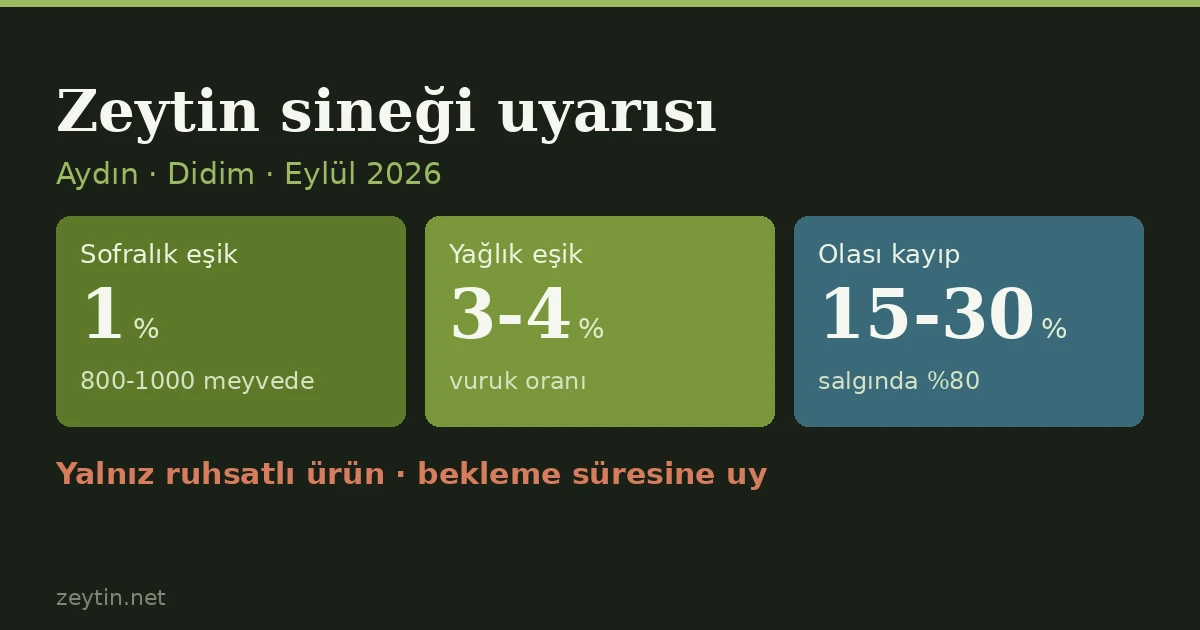
The Didim District Directorate of Agriculture and Forestry, together with the Aydın Provincial Directorate, has warned growers about the olive fruit fly ahead of the harvest. Growers were asked to check groves regularly, monitor pest density and, if needed, act only with products licensed for olives and at the right time. Fly pressure rising in autumn cuts both yield and oil quality.
Article
Olive fruit fly warning before harvest in Aydın: check groves, spray only above the threshold
The Didim District Directorate of Agriculture and Forestry, together with the Aydın Provincial Directorate, has warned growers about the olive fruit fly ahead of the harvest. Growers were asked to check groves regularly, monitor pest density and, if needed, act only with products licensed for olives and at the right time. Fly pressure rising in autumn cuts both yield and oil quality.