Italy is back at 325,000 tonnes yet is handing cash to its mills: a 40-million-euro zero-interest loan
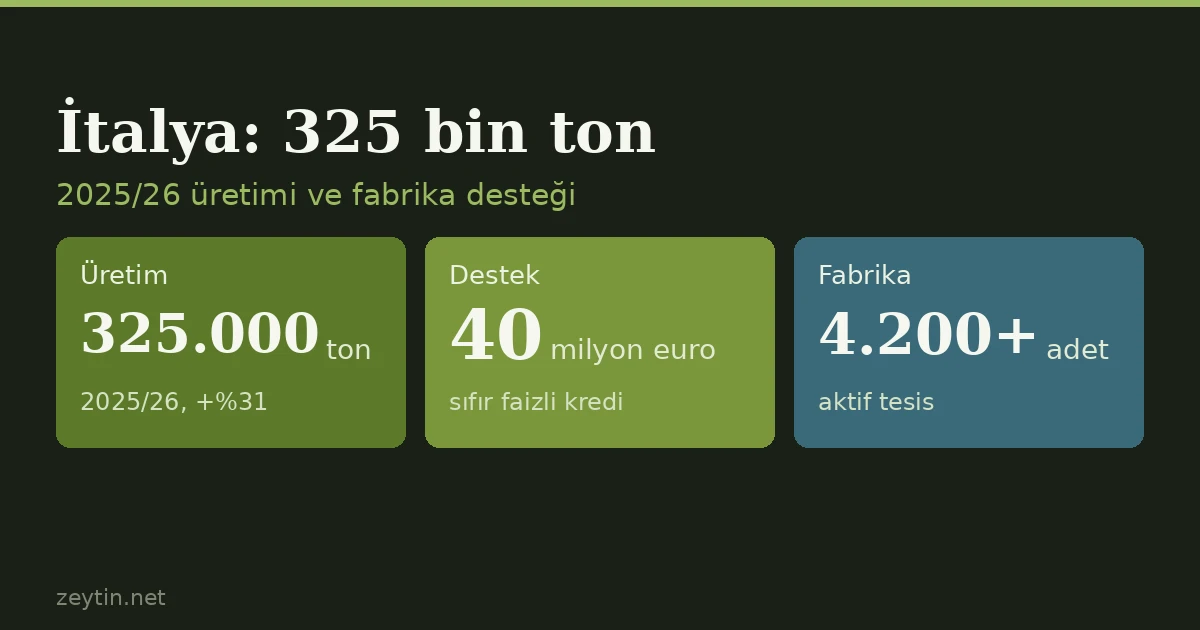
Italy produced 325,000 tonnes of olive oil in the 2025/26 campaign, up 31%, according to Ismea's sector report. Yet even as output recovers, the state is pumping liquidity into mills: the 40-million-euro "Cambiale Frantoi Oleari" offers zero-interest loans of 3,500 to 50,000 euros. The five-year national olive plan aims to lift production by 25%.
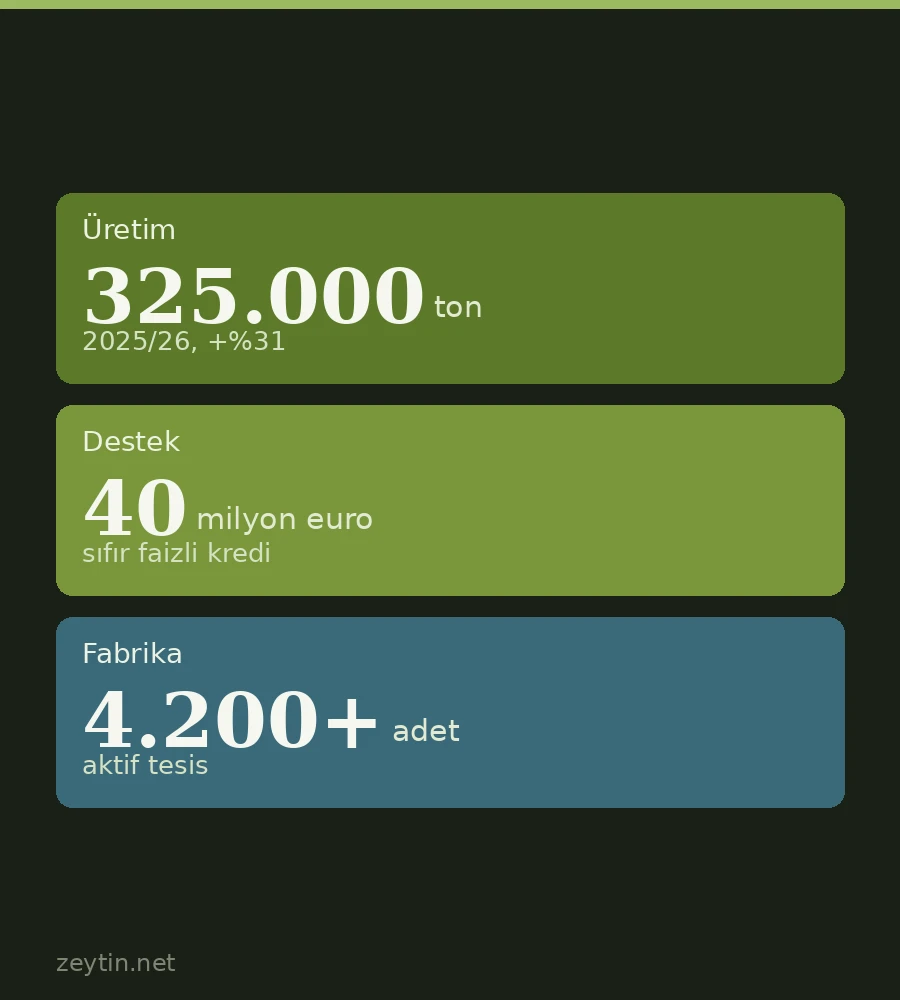
Europe's second-largest producer has recovered its output — and is lending money to its mills anyway. According to the sector report published by Ismea, Italy's institute for agricultural and food market services, the country produced 325,000 tonnes of olive oil in the 2025/26 campaign, a rise of 31 percent on the previous season. The report was presented at the Terra Madre gathering held in Turin on 24-27 September; the session titled "Italian olive oil, toward the new campaign" was led by Ismea president Livio Proietti and Tiziana Sarnari, head of the institute's geographical indications unit.
The second file opened alongside that recovery is cash. On 18 September the Ministry of Agriculture, Food Sovereignty and Forests announced a 40-million-euro measure to be administered by Ismea, called "Cambiale Frantoi Oleari": zero-interest loans of 3,500 to 50,000 euros for olive oil mills and small and medium-sized enterprises in the sector.
The figures
| Item | Value |
|---|---|
| 2025/26 production | 325,000 t |
| Change on previous season | +31% |
| Olive area | more than 1 million ha |
| Organic olive groves | ~289,000 ha |
| Olive farms | ~620,000 |
| Active mills | more than 4,200 |
| Geographical indications | 51 (42 PDO, 9 PGI) |
Output up, prices down, mills squeezed
The apparent contradiction resolves in the price column. Ismea reports that prices fell during 2026, yet quotations for Italian extra virgin olive oil remained above those of Spain, Greece and Tunisia and stayed above pre-2022 levels, before the surge. Italy, in other words, has held its premium position in the market — but a supply chain that operated on record prices for two years is now carrying high stocks into a falling market.
The mill is the most fragile link in that chain. A pressing plant buys fruit for cash and sells oil over the following months; when prices slide, the stock in its tanks loses value exactly as the operating costs of a new campaign arrive. The conditions attached to the measure confirm that reading. The loan is open to active mills registered on the SIAN portal that hold stocks of extra virgin olive oil — a requirement that ties the money to genuine production and trading activity rather than to a company's paperwork.
Nor is the structure a one-year bridge. The loan runs for five years, with the first two years as a pre-amortisation period, and quarterly instalments starting in the third year. Applications will be taken online through the Ismea portal in October 2026. We set out step by step why a mill's cash cycle is so tight in tree to shelf: the olive oil value chain.
A shift in trade direction
In the first half of 2026 imports fell: with more oil available domestically, Italy drew less from abroad. On the export side the picture split in two. Sales to the United States and Germany declined, while growth continued in the United Kingdom, Poland, the Netherlands and Belgium.
This touches Italy's habitual role in the trade. Italy exports more than it produces — it buys in bulk oil, processes and brands it, and sells it on; we examined that structure in Italy: from production giant to olive oil trade hub. When domestic output rises, imports fall, and for bulk-selling origins such as Türkiye and Tunisia that is a direct loss of demand rather than a statistical curiosity. We looked at how Türkiye's exports have moved this year in olive oil exports down 62 percent in August 2026, and at the margin side in profitability in olive oil exports.
A five-year plan: 25 percent more oil
Behind the liquidity measure sits a longer line. The Piano Olivicolo Italiano 2026-2030 was adopted by ministerial decree dated 13 July 2026 and published in the official gazette on 14 August. The plan's most ambitious target is to raise national extra virgin olive oil production by 25 percent, which it defines as adding roughly 75,000 tonnes to the 2020-2024 average.
Read together, those two numbers reveal the plan's starting point. If 75,000 tonnes represents 25 percent of an average, then the 2020-2024 average in question is around 300,000 tonnes — which means the 325,000 tonnes of 2025/26 already sits above the baseline the plan takes as its reference. What the target really points to is holding that jump rather than making it: a durable level of roughly 375,000 tonnes. The plan's true subject, in other words, is not a single good year but narrowing the gap between good years and bad ones, and in olives the source of that gap is alternate bearing.
The funding, however, is still moving through the legislature. The bill known as "ColtivaItalia" passed its first reading in the Chamber of Deputies with 150 votes in favour, none against and 97 abstentions, and was sent to the Senate on 31 August 2026. Of the 900 million euros earmarked for food sovereignty, 300 million euros are allocated to the olive plan: 50 million in 2027, 200 million in 2028 and a further 50 million in 2029. The money is therefore not yet settled; until the bill clears the Senate these figures are projections rather than commitments, and it is worth stating that plainly rather than reporting them as spending.
Reading it from Türkiye
What Italy is doing is simple, and has no direct counterpart in Türkiye: as prices fall, it is offering interest-free working capital to mills rather than to growers or to consumers. Türkiye's own debate runs instead around direct support per kilogram — the demand for 50 lira of olive oil support and the Edremit chamber's call mark two stops on that argument. The distinction matters: a per-kilo payment lands on the product, while a zero-interest loan lands on the balance sheet of the business that has to hold the product.
The second difference is scale. Italy counts more than 4,200 active mills and some 620,000 olive farms, so the sector is extremely fragmented — which is precisely why loans starting at 3,500 euros make sense there. A ceiling of 50,000 euros would be a rounding error for an industrial plant; for a village mill it covers a campaign's electricity, labour and maintenance.
The third difference is registration. Fifty-one geographical indications, 42 of them PDO, are being used as the instrument that makes the price premium durable rather than seasonal. We reviewed Türkiye's own record on registrations in twenty-five GIs: what are they actually doing, and compared price levels between the two markets in is Turkish olive oil cheap? A Europe price comparison.
Across the rest of the Mediterranean, forecasts for the new season are taking shape as well: Portugal is returning to 177,000 tonnes, production is falling in Tunisia, and Greece has put a number on its cost per kilo.
One rating per visitor; you can change yours at any time. Ratings are real reader votes — no seeded or default scores.
Related
 Article
Black olive harvest paused for ten days in Akköy, Didim: a price ladder from 30 to 100 lira
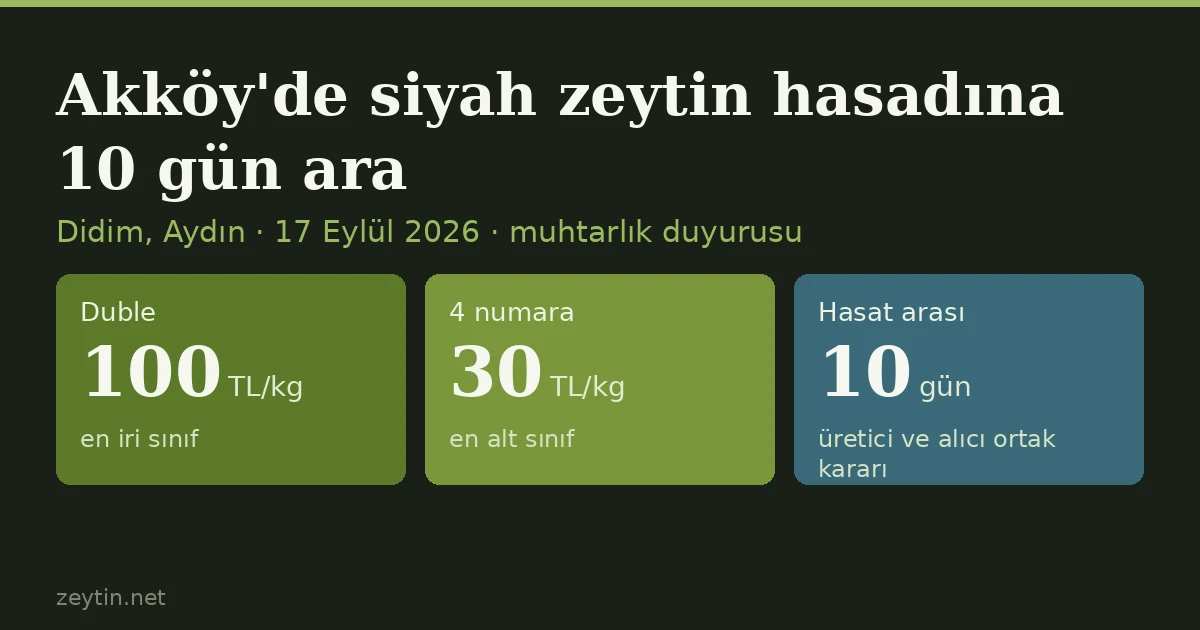
In Akköy, a village in the Didim district of Aydın, growers and olive buyers have jointly agreed to suspend black olive harvesting and buying for ten days, saying announced prices do not cover costs. The price ladder published by the village headman's office runs from 100 lira a kilo for the largest grade down to 30 lira for the smallest. Growers say picking costs alone exceed the price on the lower grades.
Article
Black olive harvest paused for ten days in Akköy, Didim: a price ladder from 30 to 100 lira
In Akköy, a village in the Didim district of Aydın, growers and olive buyers have jointly agreed to suspend black olive harvesting and buying for ten days, saying announced prices do not cover costs. The price ladder published by the village headman's office runs from 100 lira a kilo for the largest grade down to 30 lira for the smallest. Growers say picking costs alone exceed the price on the lower grades.
 Article
The 12.5% US tariff: the competitor is exempt, the Turkish exporter is not
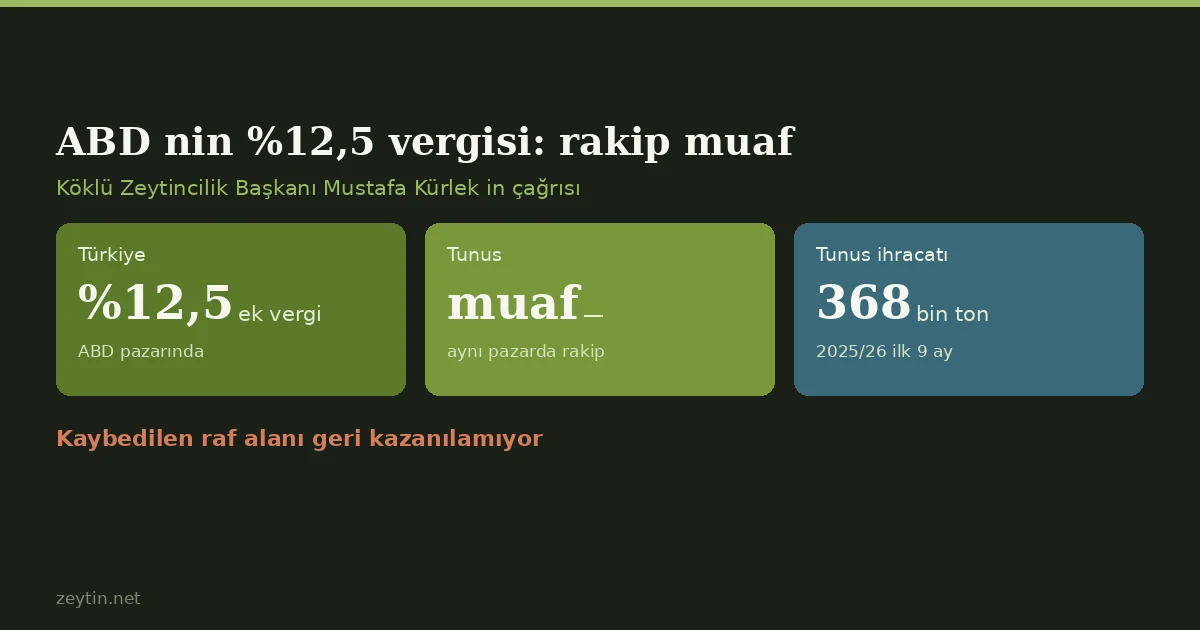
Mustafa Kürlek notes the 12.5% additional US tariff on Turkish olive products is not applied to competitors such as Tunisia, and calls for DFİF and Eximbank measures.
Article
The 12.5% US tariff: the competitor is exempt, the Turkish exporter is not
Mustafa Kürlek notes the 12.5% additional US tariff on Turkish olive products is not applied to competitors such as Tunisia, and calls for DFİF and Eximbank measures.
 Article
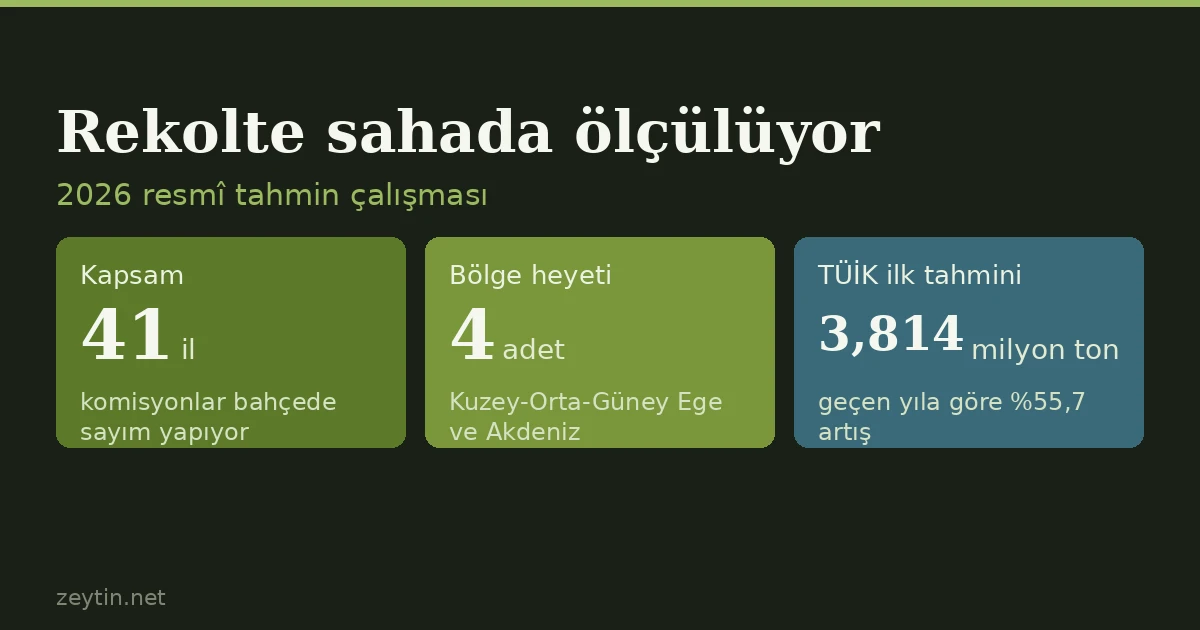
The official olive figure is measured in the grove: Türkiye's 2026 crop survey is under way
Türkiye's official olive crop figure is not produced at a desk. It comes from agricultural engineers counting fruit load tree by tree. A provincial crop estimation commission met in Denizli this week while field inspections continue in the districts. The national figure is assembled by an official delegation coordinated by the National Olive and Olive Oil Council across 41 provinces, and last season it was announced on 24 October.
Article
The official olive figure is measured in the grove: Türkiye's 2026 crop survey is under way
Türkiye's official olive crop figure is not produced at a desk. It comes from agricultural engineers counting fruit load tree by tree. A provincial crop estimation commission met in Denizli this week while field inspections continue in the districts. The national figure is assembled by an official delegation coordinated by the National Olive and Olive Oil Council across 41 provinces, and last season it was announced on 24 October.
 Article
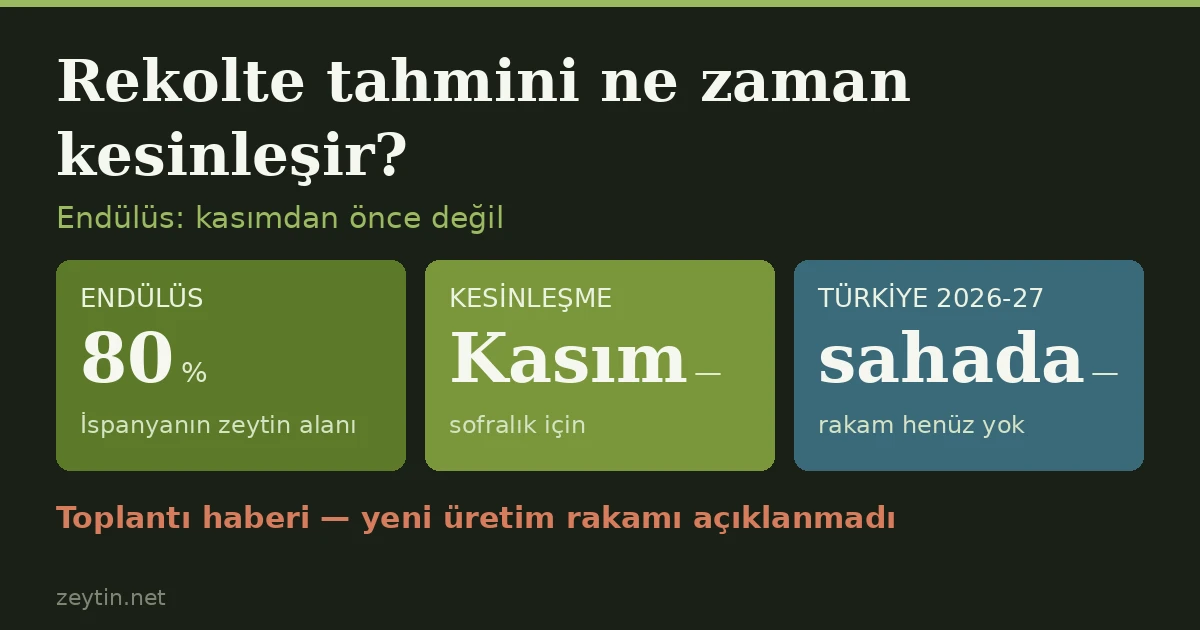
"Not definitive until November": Andalusian growers push back on the crop estimate
Andalusia's agriculture ministry called its first crop estimate "high production"; cooperatives and COAG in Seville objected: recent heat will affect the crop and the estimate is not definitive until November. Türkiye is making its 2026-27 estimate in the field the same week — the same caution applies here.
Article
"Not definitive until November": Andalusian growers push back on the crop estimate
Andalusia's agriculture ministry called its first crop estimate "high production"; cooperatives and COAG in Seville objected: recent heat will affect the crop and the estimate is not definitive until November. Türkiye is making its 2026-27 estimate in the field the same week — the same caution applies here.