Greece finally puts a number on its cost: €3-3.5 a kilo, up to €5 with labour
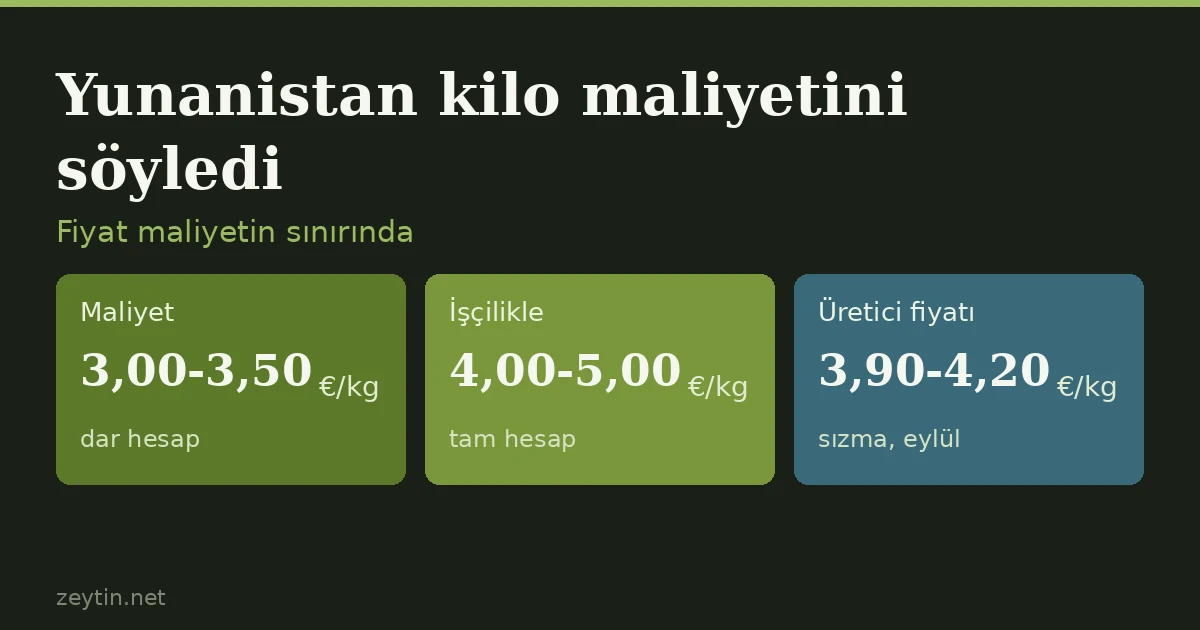
For the first time Greece has put a per-kilo figure on its olive oil production cost: €3.00-3.50, rising to €4.00-5.00 once labour is fully counted. The producer price stands at €3.90-4.20, at or below that cost. Spain's €1.70-2.00 for the same item shows where the competitive gap actually sits. Greek output for 2026/27 is estimated at 280,000-330,000 tonnes.
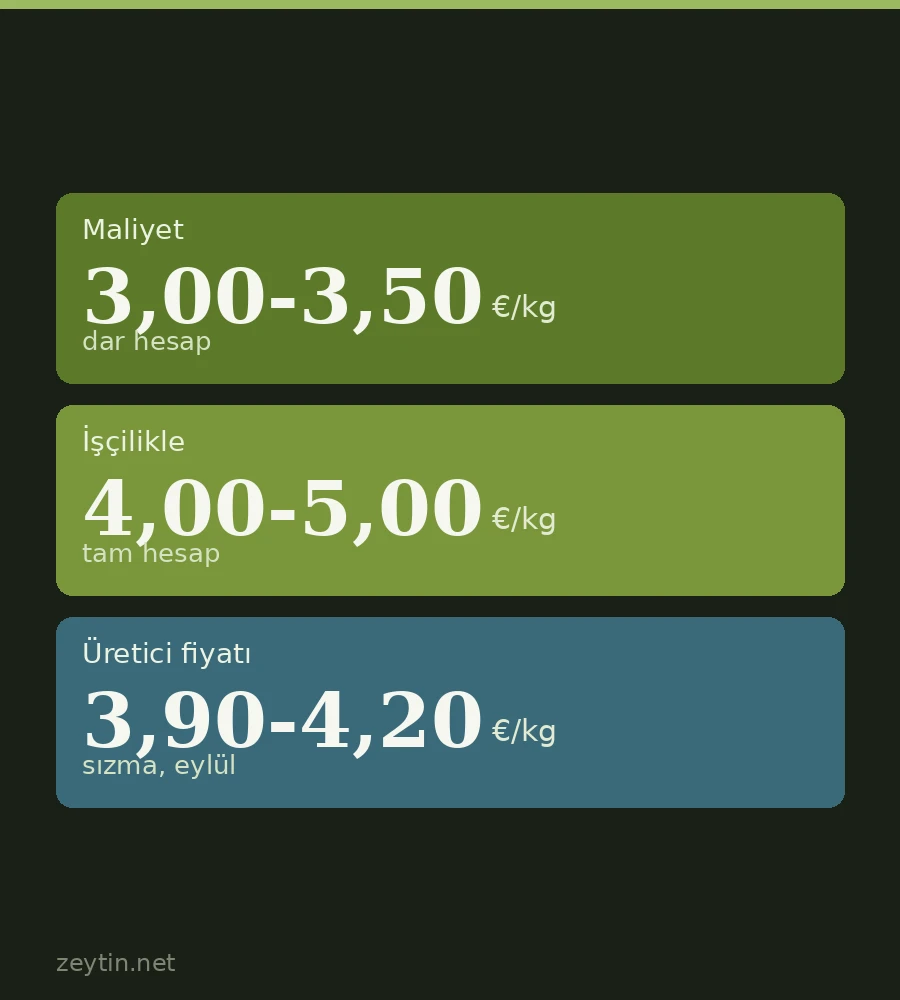
The number missing from Greece's olive oil debate for months was finally put on the table this week. In the sector's pre-harvest assessment, production cost was expressed as a per-kilogram range for the first time: €3.00-3.50. Once labour and harvesting are fully accounted for, the figure rises to €4.00-5.00.
To see why that matters, it is enough to look at the producer price in the same week. For quality extra virgin olive oil the grower receives around €3.90-4.20 per kilo. On the narrow calculation the price sits slightly above cost; on a calculation that fully counts labour, it sits below it.
When we covered this debate in Greece opens the season at €4, we noted that no comparable per-kilo cost figure was publicly available on the Greek side. That missing number now exists.
The figures
| Item | Value |
|---|---|
| Production cost (narrow) | €3.00-3.50/kg |
| Production cost (labour fully counted) | €4.00-5.00/kg |
| Producer price (extra virgin, now) | €3.90-4.20/kg |
| Peak price (2024) | €9.50/kg |
| Fall from peak | 56-59% |
| Total cost in Spain | €1.70-2.00/kg |
| Greek output estimate 2026/27 | 280,000-330,000 t |
| Most likely scenario | 300,000 t |
| Spanish estimate 2026/27 (revised) | 1.4-1.5 million t |
| Daily wage (five years ago → today) | €30-35 → €60-80 |
| Supermarket shelf | €7.30-7.80/litre |
The cost and output estimates come from the pre-harvest assessments of Kostas Koutsioumpis, president of SEVITEL, the Association of Greek Olive Oil Standardisation Industries, and Manolis Giannoulis, president of the National Interprofessional Olive Oil Organisation. The retail price index data belongs to ELSTAT, the Hellenic Statistical Authority.
The real gap is labour
The chasm between Spain's €1.70-2.00 cost and Greece's €3.00-5.00 comes down largely to one item: labour and grove structure. In Greece the daily wage is reported to have climbed from €30-35 to €60-80 within five years, more than doubling.
Spain's advantage is not merely cheaper labour but the grove itself. Irrigated, mechanically harvestable intensive and super-intensive plantings remove most of the labour line. A significant share of Greek groves, by contrast, are sloped, unirrigated and hand-picked traditional plantings. The same divide applies to Türkiye; we examined that structural difference in is Turkish olive oil cheap?.
Greece's position follows the same logic as Spain's but bites harder: in Spain, too, cost moved above price, where a traditional grove was calculated at €5.31 per kilo. The shared point is that in both countries the squeeze is happening in the traditional grove, not in modern plantings.
The shelf did not fall; the grower did
The pass-through to consumers has been partial. According to ELSTAT, the olive oil price index fell from 240.15 points in July 2024 to 134.64 points in August 2026, a decline of 43.9%. Yet the shelf price is still in a band of €7.30-7.80 per litre, reaching €9.50 for some products.
With the producer price down 56-59% from its peak and the shelf down considerably less, the fall has concentrated in the lowest link of the chain. A similar structure exists in Türkiye, which we analysed in the price gap from olive to oil.
Output is rising while the price falls
Greece closed last season with limited output: assessments based on European Commission estimates put the 2025/26 figure at 231,000-235,000 tonnes. The 300,000 tonnes now cited as the most likely scenario for 2026/27 therefore represents a clear increase. It is hard to expect the price to turn upward against that backdrop: despite the Spanish revision, both of the Mediterranean's largest producers are adding to supply.
Consumption, on the other hand, is responding to the fall in price. Greek supermarket sales rose from 14.46 million litres in 2024 to 17.3 million litres in 2025; in the first eight months of 2026 the figure stands at 11.15 million litres, an increase of about 6 percent. Cheaper oil sells better on the shelf, but that recovery is not enough to lift the producer price. Exports of standardised, that is packaged, Greek olive oil come to roughly 50,000 tonnes, meaning only a limited share of output reaches the market as branded product.
Read together, these three figures show a familiar olive oil cycle in its current form: when the price falls consumption recovers, but the recovery never moves fast enough to cover the grower's loss. We reported the swing on the Turkish export side in olive oil exports in August 2026.
Why it matters for Türkiye
The first point concerns supply. Spain's 2026/27 expectation has been pulled back from an initial 1.8 million tonnes to 1.4-1.5 million tonnes because of summer heat and drought, with temperatures reaching 42-44 °C in parts of Andalusia proving decisive. A revision in the single largest component of world supply sets the floor for Turkish export pricing as well. We covered how Andalusian weather transmits into Turkish prices in drought in Andalusia, prices in Türkiye, and when the official Andalusian estimate becomes firm in when does the crop estimate become firm.
The second point concerns the cost benchmark. By putting a per-kilo figure on its cost, Greece has handed Türkiye a measuring stick. In South Marmara this season growers speak of costs around 60 lira per kilogram against an expected oil olive price of 35-40 lira. Factoring in the conversion rate from fruit to oil, Türkiye sits inside the same scissors. The background is in costs and carry-over stock before the harvest and the profitability problem in olive oil exports.
At the other end of the Mediterranean the picture runs differently: Tunisia's 2026/27 output is falling while revenue may hold. We examined the region's out-of-phase production cycles in the Mediterranean's opposite phase.
One rating per visitor; you can change yours at any time. Ratings are real reader votes — no seeded or default scores.
Related
 Article
Algeria expects a record 150,000 tonnes: the Mediterranean supply map is shifting
Algeria's 2025/26 olive oil output is expected to exceed 150,000 tonnes — up 76% on the previous season and a third consecutive rise. With domestic consumption near 81,000 tonnes, an exportable surplus appears. In a season when Turkish exports fell 62% by value, that means new competition in the bulk market.
Article
Algeria expects a record 150,000 tonnes: the Mediterranean supply map is shifting
Algeria's 2025/26 olive oil output is expected to exceed 150,000 tonnes — up 76% on the previous season and a third consecutive rise. With domestic consumption near 81,000 tonnes, an exportable surplus appears. In a season when Turkish exports fell 62% by value, that means new competition in the bulk market.
 Article
Olive oil exports down 62% by value as a record harvest is expected
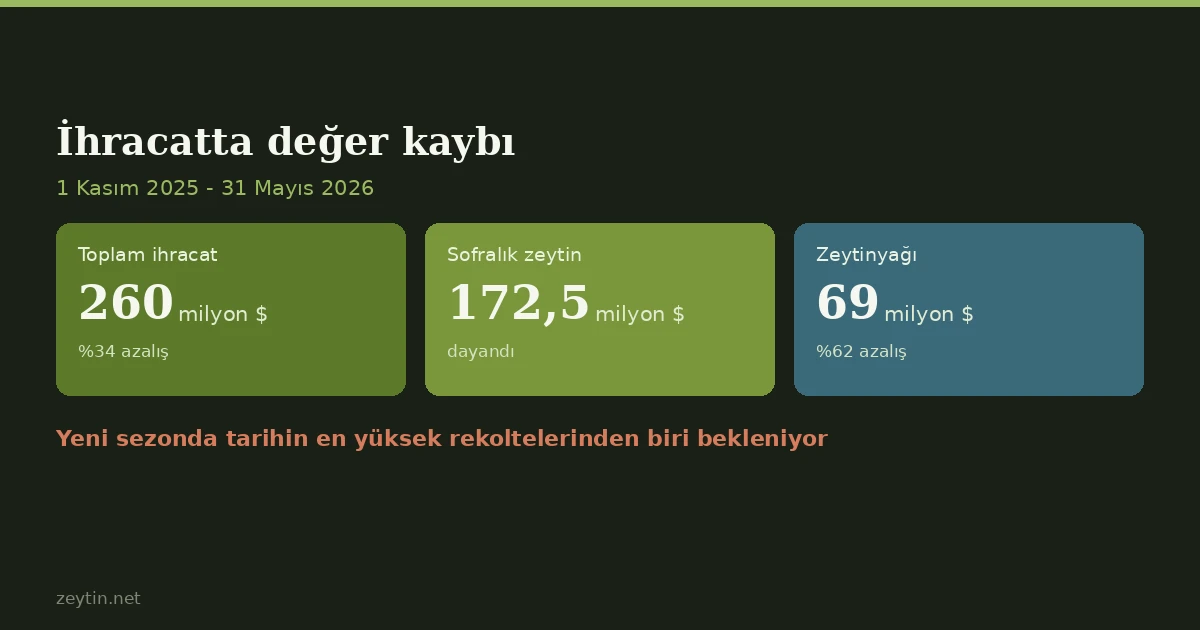
Olive and olive oil exports fell 34% to $260 million between 1 November 2025 and 31 May 2026. Table olives held at $172.5 million while olive oil dropped to $69 million. The target is a return to $1 billion.
Article
Olive oil exports down 62% by value as a record harvest is expected
Olive and olive oil exports fell 34% to $260 million between 1 November 2025 and 31 May 2026. Table olives held at $172.5 million while olive oil dropped to $69 million. The target is a return to $1 billion.
 Article
Spain steps back from vetoing Deoleo's sale: the door opens for Italy's Coricelli
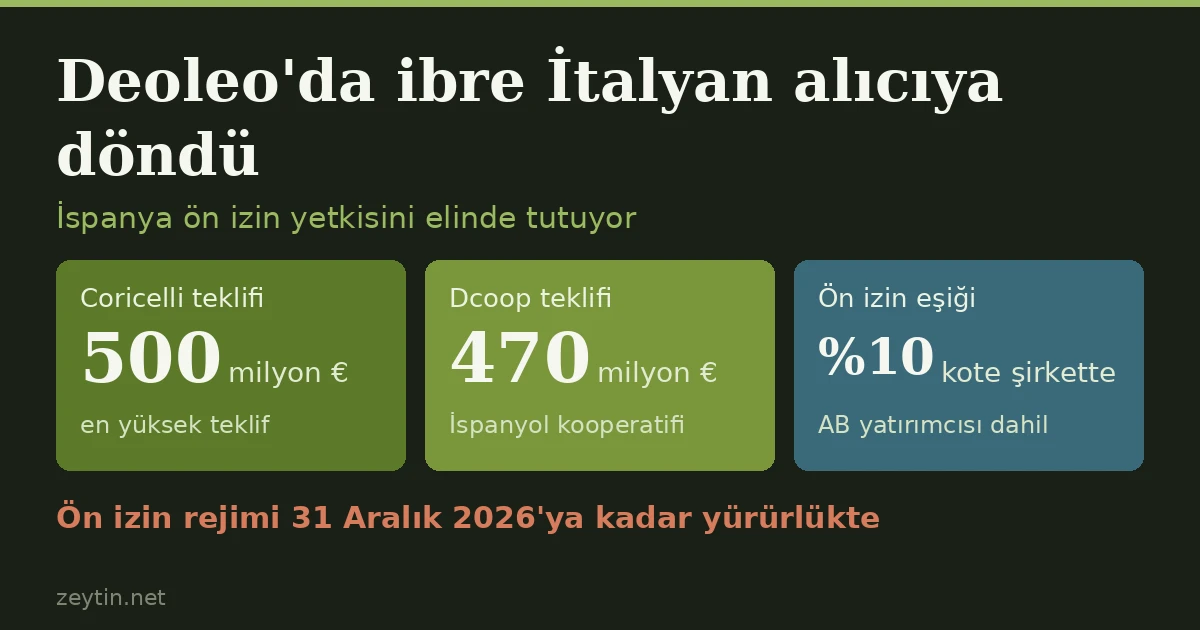
Madrid's position on the sale of the world's largest olive oil bottler has shifted: in early September a Spanish buyer was preferred, and on 18 September Italy's Coricelli was reported to be seen as the best-positioned candidate. The government's lever is a foreign investment screening regime that covers EU investors too and runs to 31 December 2026. Because Deoleo is a major bulk buyer, the outcome matters to Turkish exporters.
Article
Spain steps back from vetoing Deoleo's sale: the door opens for Italy's Coricelli
Madrid's position on the sale of the world's largest olive oil bottler has shifted: in early September a Spanish buyer was preferred, and on 18 September Italy's Coricelli was reported to be seen as the best-positioned candidate. The government's lever is a foreign investment screening regime that covers EU investors too and runs to 31 December 2026. Because Deoleo is a major bulk buyer, the outcome matters to Turkish exporters.
 Article
Adulterated olive oil costs more than the real thing: price is no longer a sign of authenticity
Diker, president of the Edremit Chamber of Agriculture, says adulterated oils sold online now exceed the wholesale price of genuine oil: wholesale starts at 240 lira, the fake sells above 300. Our exchange data complicates the picture — genuine extra virgin in Aydın is already 307.60 lira.
Article
Adulterated olive oil costs more than the real thing: price is no longer a sign of authenticity
Diker, president of the Edremit Chamber of Agriculture, says adulterated oils sold online now exceed the wholesale price of genuine oil: wholesale starts at 240 lira, the fake sells above 300. Our exchange data complicates the picture — genuine extra virgin in Aydın is already 307.60 lira.