What does a kilo of olives cost? The cost sheet of 152 Aegean farms
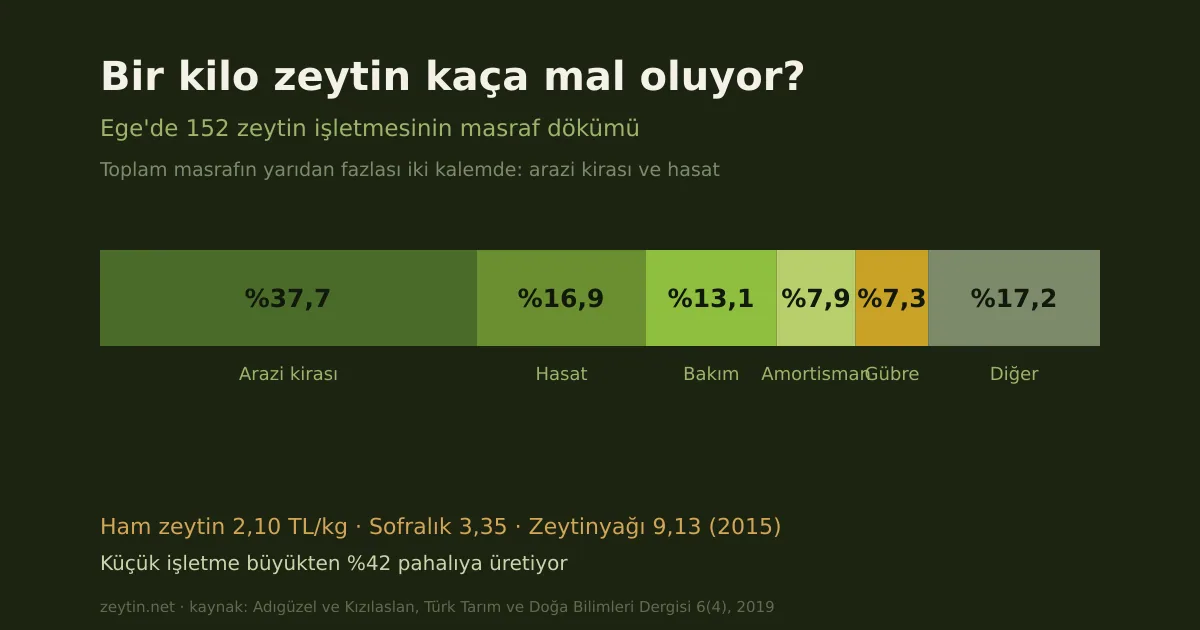
Land rent is 37.70% of cost, harvest 16.90%. In table olives 73% of processing cost is rejected fruit; in oil, 94% is the fruit itself.
We publish olive prices on this site, exchange by exchange. But a price on its own says nothing. The real question is: what does it cost the grower to produce that olive?
Türkiye has no regularly published answer. The most detailed measurement available is a face-to-face survey of 152 olive farms in the Aegean region: Adıgüzel and Kızılaslan (2019), covering Aydın, İzmir, Manisa and Muğla, with data collected during the 2015 harvest.
The study is ten years old. But its proportions still hold, and it remains the most detailed farm-level cost breakdown produced for Turkish olive growing.
What does a kilo of olives cost to produce?
| Product | Farm average | Small (1-15 da) | Large (51+ da) |
|---|---|---|---|
| Crude olives | 2.10 TL/kg | 2.48 | 1.75 |
| Table olives | 3.35 TL/kg | 4.29 | 2.99 |
| Olive oil | 9.13 TL/kg | 11.76 | 8.74 |
Source: Adıgüzel and Kızılaslan (2019). Survey conducted August-October 2015. "da" = decare (1,000 m²).
The first thing that stands out: the small farm produces 42% more expensively than the large one. Same olives, same region, same year. The only difference is scale.
For olive oil the gap is 35%, for table olives 43%.
Half the cost is fixed — and the biggest item is land rent
Of total production cost, 47.17% is variable and 52.83% fixed. Fixed costs are paid whether the tree bears or not; in an off year, when yield halves, that half stays where it is.
| Item | Share | Type |
|---|---|---|
| Land rent | 37.70 | Fixed |
| Harvest | 16.90 | Variable |
| Maintenance (tillage, pruning, hoeing) | 13.06 | Variable |
| Depreciation (buildings + machinery) | 7.90 | Fixed |
| Fertiliser | 7.27 | Variable |
| Interest on working capital | 3.68 | Variable |
| Crop protection | 3.08 | Variable |
| Annual depreciation of the grove | 2.80 | Fixed |
| Irrigation | 1.78 | Variable |
| Other (admin, tax, insurance, guarding) | 5.83 | Mixed |
Two items account for more than half of total cost: land rent and harvest.
This explains why olive growing is "work for those who own land". A grower without land begins already carrying 37.70% of the cost. For those farming their own land, the item enters as an opportunity cost — what the land would fetch if let out.
The second item, harvest, is labour. And in the study's problems section, the two things growers complain of most at harvest are exactly high cost (42.76%) and shortage of labour (26.97%). This is where the worldwide interest in mechanical harvesting comes from.
In table olives, three quarters of the cost is waste
Among farms processing table olives, the breakdown of processing cost is startling:
| Item | Share |
|---|---|
| Value of rejected fruit | 73.11 |
| Labour | 14.18 |
| Electricity, water etc. | 4.94 |
| Salt, chemicals etc. | 4.91 |
| Other | 2.86 |
Rejects are the olives sorted out during processing: bruised, worm-damaged, off-caliber, spoiled in brine. The largest cost in processing table olives is the fruit that never gets processed.
That is the other face of the price gap described in our caliber article: larger fruit means not only a higher price but less waste.
Salt and chemicals — the brine itself — are only 4.91% of cost. A table olive's cost is not in chemistry; it is in the grove and on the sorting table.
In olive oil, 94% of the cost is the fruit
Of olive oil production cost, 94.27% is the value of the olives set aside for pressing. Milling is 5.37%; transport and storage 0.36%.
That single line settles most arguments about the price of olive oil. Mill fees, bottling, haulage — together a twentieth of the total. If olive oil is expensive, it is because olives are expensive. The price is formed in the grove, not at the mill.
So what is it today?
To bring 2015 figures forward we can use the general consumer price index. In Eurostat's HICP series for Türkiye, the 2015 average is 100 and the 2025 average 1,221.2 — a factor of 12.2 in ten years.
| Product | Cost (2025 TL) | 2025 exchange avg. | Ratio |
|---|---|---|---|
| Crude olives (farm avg.) | 25.65 | 36.36 | 1.42× |
| Crude olives (small farm) | 30.29 | 36.36 | 1.20× |
| Crude olives (large farm) | 21.37 | 36.36 | 1.70× |
| Olive oil (farm avg.) | 111.50 | 156.51 | 1.40× |
| Olive oil (small farm) | 143.61 | 156.51 | 1.09× |
Exchange prices: 2025 registration averages for oil olives and crude olive oil at TOBB commodity exchanges. Costs are the 2015 survey values inflated by HICP.
The limits of this table should be stated plainly: inflating by a general index is an approximation, not a measurement. The two items making up more than half of olive-growing cost — land rent and farm labour — may have moved at a different pace from the general index. Inputs like fertiliser and diesel rose far above general inflation in some years. Real costs could therefore be higher or lower than shown. The table gives an order of magnitude, not a precise figure.
The direction is nonetheless clear: for the small farm the margin is very thin. Producing crude olives at 30 TL and selling at 36 means about 6 TL a kilo for a year's work. In a low year of alternate bearing, when yield halves while fixed costs stay put, that margin turns negative.
For the large farm the same sum reads 21 TL against 36. That difference is the difference between carrying on and clearing the grove.
Who is producing?
The farm profile is telling in itself:
- Average age of farm managers: 54.40
- Average schooling: 5.82 years
- 73.28% of labour used is family labour
- Total land per farm 91.24 decares, of which 64.54% is olive grove
- Equity as a share of total capital: 92.71% — very nearly debt-free
The last point matters. The Aegean olive farm is not indebted. But neither can it borrow. A 92.71% equity ratio is the picture of a sector without access to finance. Machinery, irrigation and dense planting cannot be funded out of that structure.
What do growers ask for?
The study's closing section lists the expectations of the 152 farms. The main ones:
- A floor price, and prices announced earlier in the season
- Reduction of the price swings caused by alternate bearing
- Shared storage facilities growers could use jointly
- Milling fees brought down to reasonable levels
- Acidity measurement not left to the buyer — a state-enforced standard for measuring instruments
- Unions and cooperatives so growers are not left dependent on merchants
The last two say the same thing: the grower has no bargaining power because they are not the party measuring their own product's quality. The buyer measures the acidity and the buyer sets the price. That is largely why the cooperative pays 16% above the exchange average.
Summary
- In the Aegean, a kilo of crude olives cost 2.10 TL in 2015; olive oil 9.13 TL/kg.
- The small farm produces 42% more expensively than the large one — purely because of scale.
- 52.83% of cost is fixed; the two largest items are land rent (37.70%) and harvest (16.90%).
- In table olives, 73.11% of processing cost is rejected fruit.
- 94.27% of olive oil cost is the olives themselves; milling is only 5.37%.
- Brought forward to today, the small farm's margin falls to roughly 6 TL a kilo.
- Farms run on 92.71% equity: debt-free, but unable to invest.
Source
t; Adıgüzel, F. and Kızılaslan, N. (2019). Costs and Problems of Olive Farms in Aegean Region. Turkish Journal of Agricultural and Natural Sciences, 6(4): 696-709. doi:10.30910/turkjans.633562
Inflation adjustment: Eurostat, Harmonised index of consumer prices (prc_hicp_midx), Türkiye, CP00, 2015=100. Exchange prices: registration records from TOBB commodity exchanges, our own compilation.
Related reading: Felling an olive grove: a ten-year decision · Caliber economics · Twenty trees per decare, or 250? · Sector prices
One rating per visitor; you can change yours at any time. Ratings are real reader votes — no seeded or default scores.
Related
 Article
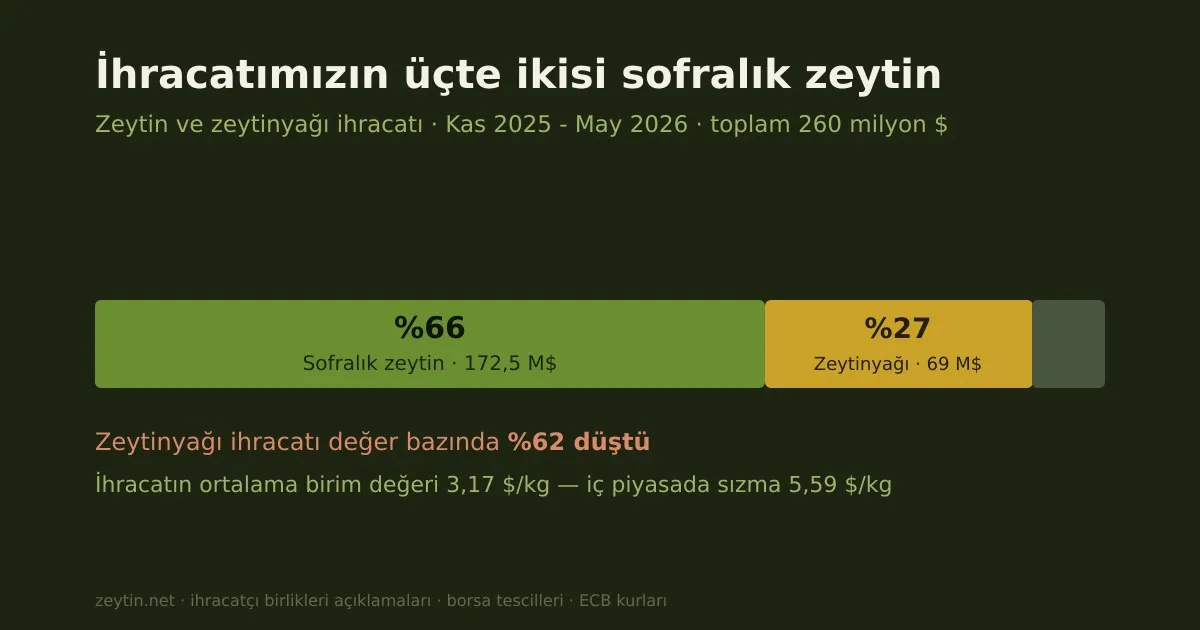
Two thirds of our exports are table olives: the $260 million picture
In 2025-26, 66% of exports were table olives and 27% oil. Average unit value $3.17/kg — the added value sits inside the packaging.
Article
Two thirds of our exports are table olives: the $260 million picture
In 2025-26, 66% of exports were table olives and 27% oil. Average unit value $3.17/kg — the added value sits inside the packaging.
 Article
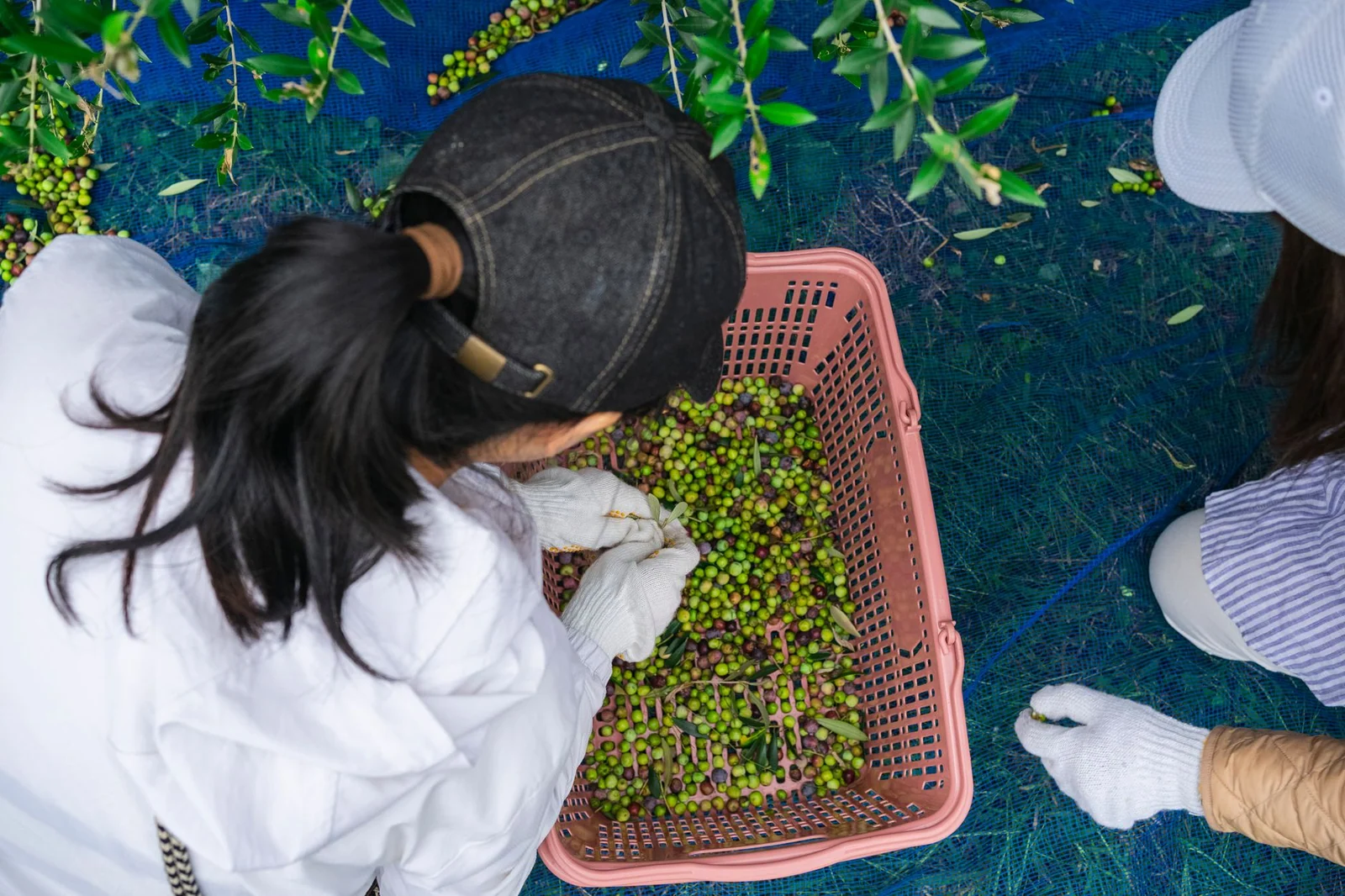
Structural problems of Turkish olive growing
157 million trees but 5% of world output: low yield, old trees, harvest mechanisation, missing data, the support gap and informality.
Article
Structural problems of Turkish olive growing
157 million trees but 5% of world output: low yield, old trees, harvest mechanisation, missing data, the support gap and informality.
 Article
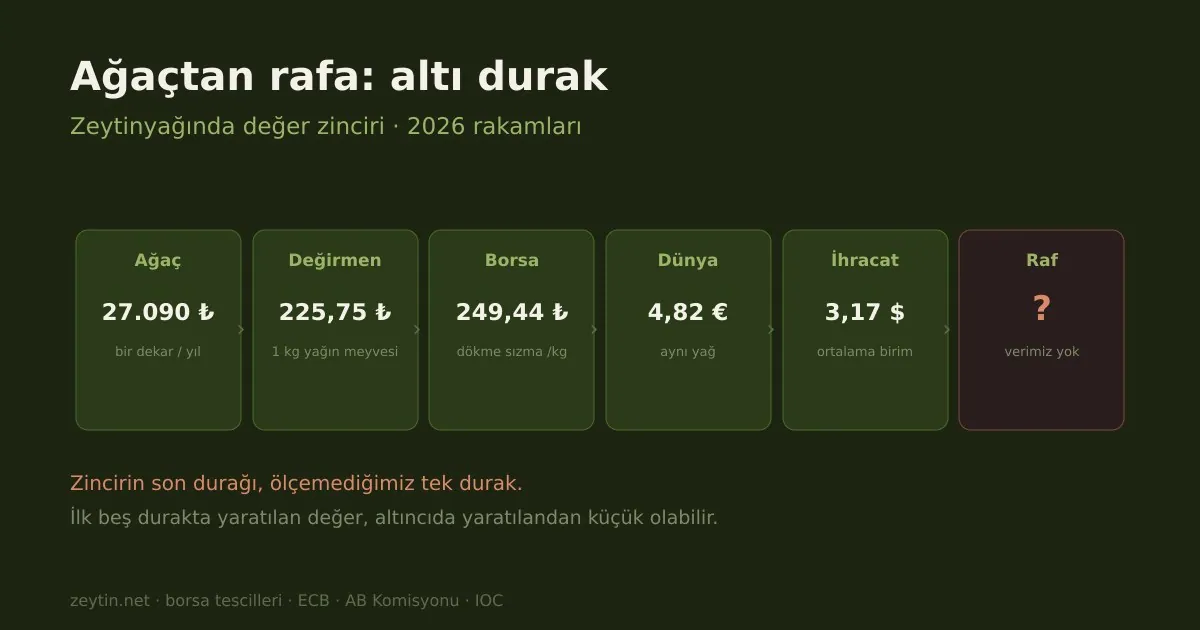
Tree to shelf: the olive oil value chain in six stops
From fruit on the tree to bottle on the shelf: how much the price multiplies at each step, and where the added value stays.
Article
Tree to shelf: the olive oil value chain in six stops
From fruit on the tree to bottle on the shelf: how much the price multiplies at each step, and where the added value stays.
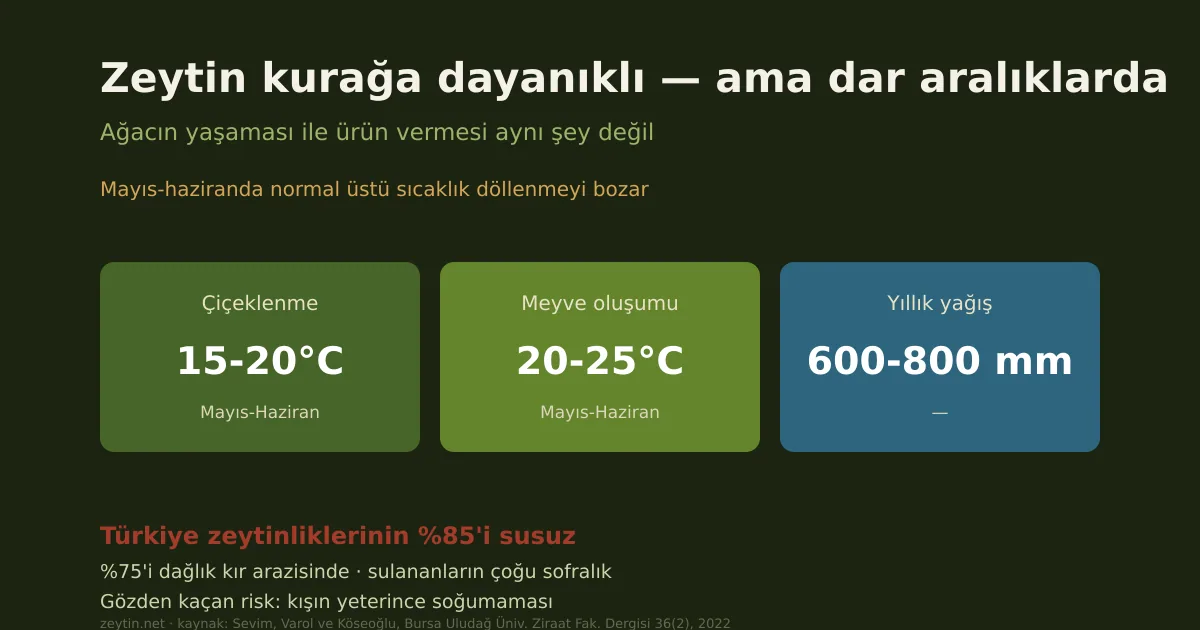 Article
Climate change and the olive: the tree survives, but will it crop?
The olive is drought-hardy but works in narrow bands. 85% of Türkiye's groves are unirrigated, 75% on mountainous land.
Article
Climate change and the olive: the tree survives, but will it crop?
The olive is drought-hardy but works in narrow bands. 85% of Türkiye's groves are unirrigated, 75% on mountainous land.