The 2026/27 season opens: first harvests in Ayvalık, Gemlik and Bozcaada
The new olive season opened with three events on 11-13 September. In Ayvalık, an on-year forecast of 400,000-450,000 tonnes of olive oil was voiced; in Gemlik the first olives were picked during the festival; and on Bozcaada the island's first olive oil was pressed with a portable system.
The 2026/27 olive season effectively opened in the second week of September with three events in the North Aegean and Marmara. All three were ceremonial; commercial harvesting is still weeks away. But each raised a different question about the season: how big the crop will be, how tradition carries on, and where production may spread.
Ayvalık: the crop forecast
On 11 September, the first olives of the season were picked in Ayvalık, Balıkesir, at the "7th Traditional First Olive Harvest of the Year" organised by Köklü Zeytincilik. Balıkesir Governor İsmail Ustaoğlu attended along with local and provincial officials.
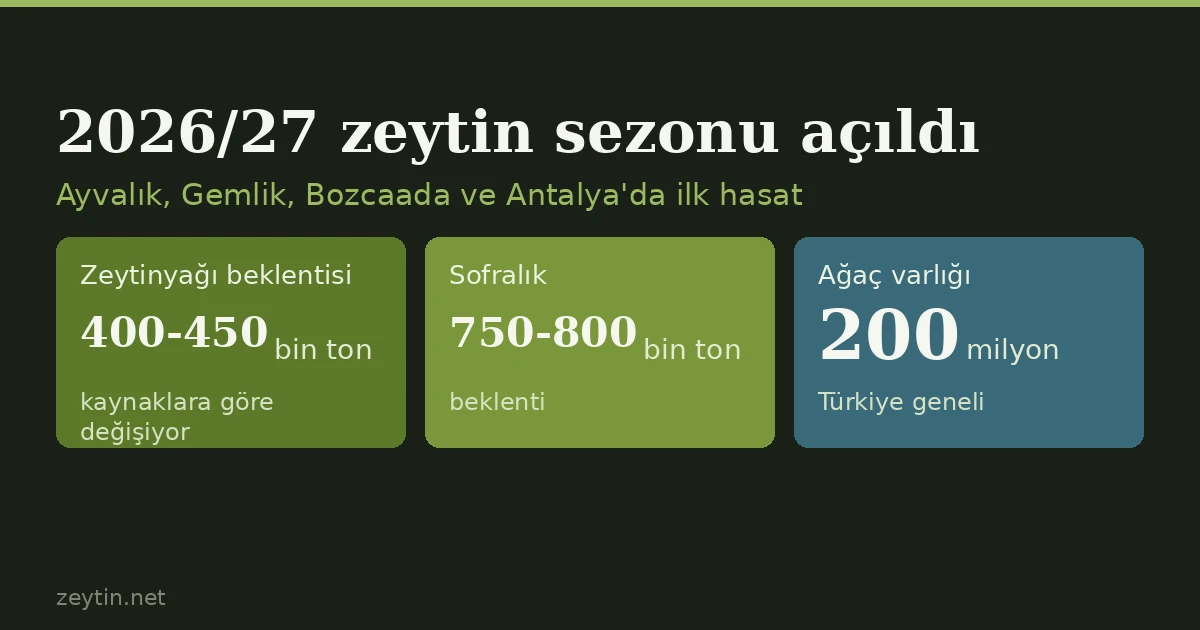
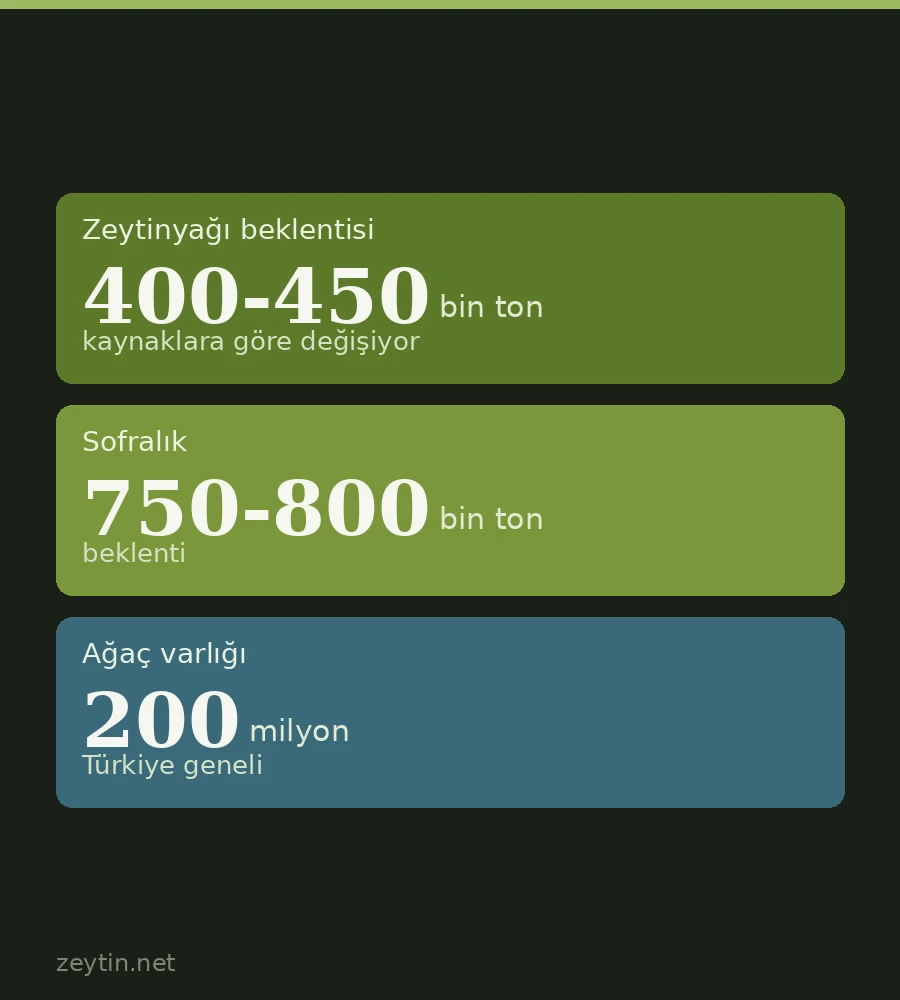
The key figures from the address by Mustafa Kürlek, chairman of Köklü Zeytincilik, were:
| Item | Stated value |
|---|---|
| Olive trees in Türkiye | about 200 million |
| Expected olive oil output | 400,000-450,000 t |
| Expected table olive output | 750,000-800,000 t |
| Balıkesir olive oil output (annual estimate) | 40,000 t |
| Per capita consumption in Türkiye | about 2 litres |
The forecast rests on an "on" year: after a heavy crop the olive tree rests, then loads up again the following year. Last season was a low-yield year; this year the trees are expected to be full.
In the same speech Kürlek listed the sector's problems: the 12.5% additional tariff the US applies to Turkish olive oil, the example of Spain's 65-cent support payment to growers, low domestic consumption, and fraud, which he called the sector's "open wound". We covered the tariff in detail in our piece on the US tariff.
Gemlik: a harvest within the festival
In Bursa, the first olives of the season were picked at the 2nd Olive Harvest Celebration, part of the 33rd International Gemlik Olive Festival. This year's theme was "Two Districts, One Heritage: Orhangazi-Gemlik Olive". The programme began in Umurbey Square, where a convoy of tractors decorated with flags and olive branches took participants to the grove chosen for the first harvest. After a prayer by Gemlik Mufti Abdullah Işık, officials picked the first olives from the branches.
Before the event, we examined the debate over the festival's name and Orhangazi's place in the registration in our festival piece, based on the registration document itself. What the Gemlik Olive designation of origin covers is set out on the Gemlik Olive GI page.
Bozcaada: the island's first olive oil
The third event took place in Çanakkale. The Zeytin 360 International Olive Summit and Harvest Festival, held on Bozcaada and in Ezine, ended on 13 September. Its most notable moment was pressing olives harvested on the island on the spot with a portable pressing system. This produced olive oil on Bozcaada for the first time, and participants tasted the fresh oil.
Festival organiser and olive grower İlayda Tanrıver Saraç said the "Zeytin 360" concept was meant to cover every side of the olive, from harvest and pressing to tasting and gastronomy, and that the event drew participants from abroad as well. The programme also included a demonstration of a new-generation harvesting machine, described as being used in Türkiye for the first time and developed to suit Turkish groves.
Portable pressing is an important option for small growing areas far from a fixed mill. The time between picking and pressing directly affects an oil's acidity and aroma; bringing the mill to the olives shortens that wait.
Antalya: a 40% rise expected
Pre-harvest expectations were not only voiced at ceremonies. At the Antalya Commodity Exchange (ATB), an Olive and Olive Oil Sector Analysis Meeting was held under Vice Chairman Halil Bülbül. Participants noted that Antalya had an "off" year last season because of drought, and that this year's crop is expected to rise by about 40%, from 50,000 to around 70,000 tonnes. Zafer Tan, vice chairman of the ATB's 4th Professional Committee, said growers expect a price of 350-400 lira per kilogram. Harvesting in the region is expected to start in early October.
The issues raised at the meeting sum up the season's wider picture: calls for a minimum olive oil price, high labour costs, the importance of quality and acidity criteria in pricing, the need for branding, and the handling of mill wastewater and by-products.
Harvest calendar: ceremony versus commerce
These mid-September harvests are mostly early harvest and symbolic. Commercial harvesting of oil olives usually intensifies from October onwards, depending on region and variety. The right moment is set by the fruit's ripeness rather than the calendar, as explained in our maturity index guide. We also worked through the effect of early harvesting on yield and price in our early harvest piece.
Read with care
⚠ The crop forecast was reported differently in different texts. Some reports of the Ayvalık speech give 400,000 tonnes of olive oil, others 450,000. That is why the table shows a range; it is an industry representative's expectation, not an official crop estimate.
⚠ An on year means a large crop, not necessarily large incomes. A big harvest can push down domestic prices; we are following that debate in our minimum price piece.
⚠ The export picture is still weak: end-of-August data show olive oil exports down 62% in volume for the season.
One rating per visitor; you can change yours at any time. Ratings are real reader votes — no seeded or default scores.
Related
 Article
Recall in Germany: MOSH/MOAH in pomace oil — not olive oil
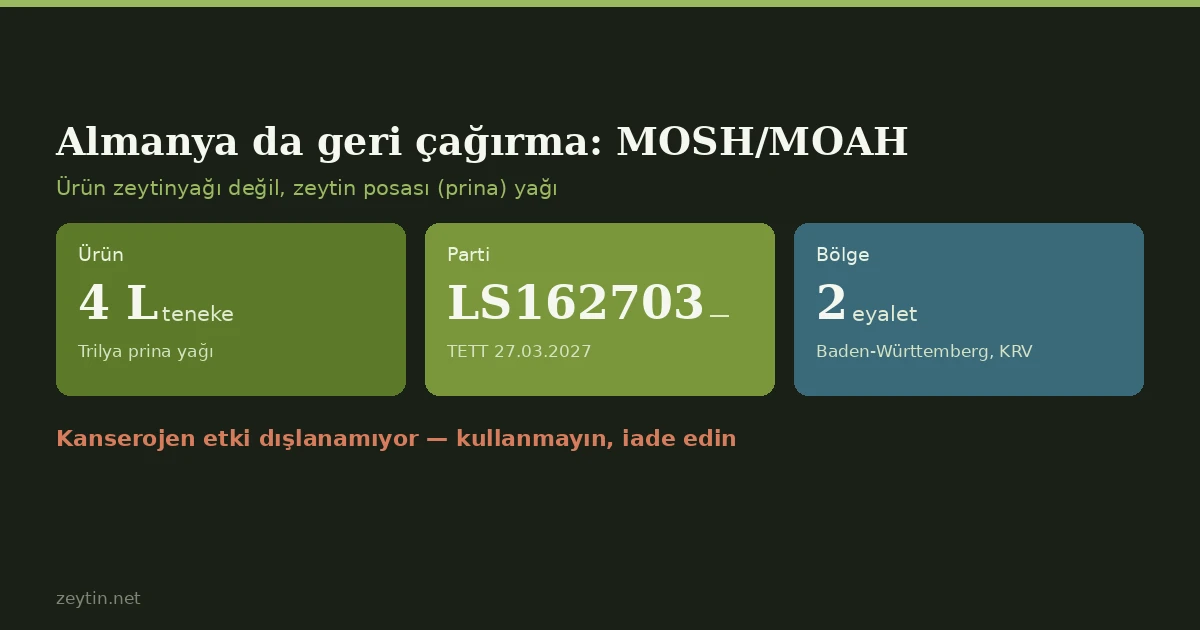
Germany's official food safety portal has recalled a 4-litre pomace oil sold in Turkish shops. The product is not olive oil but olive pomace oil; we explain the difference and what MOSH/MOAH are.
Article
Recall in Germany: MOSH/MOAH in pomace oil — not olive oil
Germany's official food safety portal has recalled a 4-litre pomace oil sold in Turkish shops. The product is not olive oil but olive pomace oil; we explain the difference and what MOSH/MOAH are.
 Article
Field study for Şarköy olive oil: Tekirdağ's pick for "81 Provinces 81 Products"
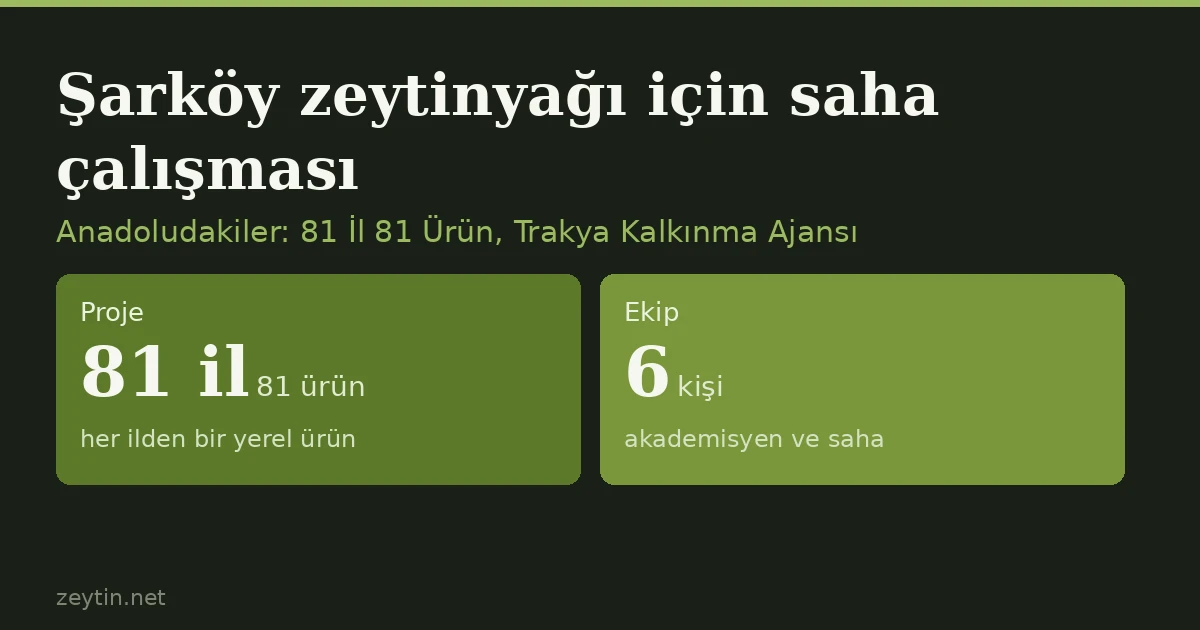
Şarköy olive oil has been chosen as Tekirdağ's product in the "Anatolians: 81 Provinces 81 Products" programme coordinated by the Ministry of Industry and Technology. The Thrace Development Agency and Namık Kemal University surveyed growers and businesses to map the value chain. The goal is branding; there is no geographical indication registration yet.
Article
Field study for Şarköy olive oil: Tekirdağ's pick for "81 Provinces 81 Products"
Şarköy olive oil has been chosen as Tekirdağ's product in the "Anatolians: 81 Provinces 81 Products" programme coordinated by the Ministry of Industry and Technology. The Thrace Development Agency and Namık Kemal University surveyed growers and businesses to map the value chain. The goal is branding; there is no geographical indication registration yet.
 Article
The UN names 2026 the Year of the Woman Farmer: in olives the labour is women's, the records are not
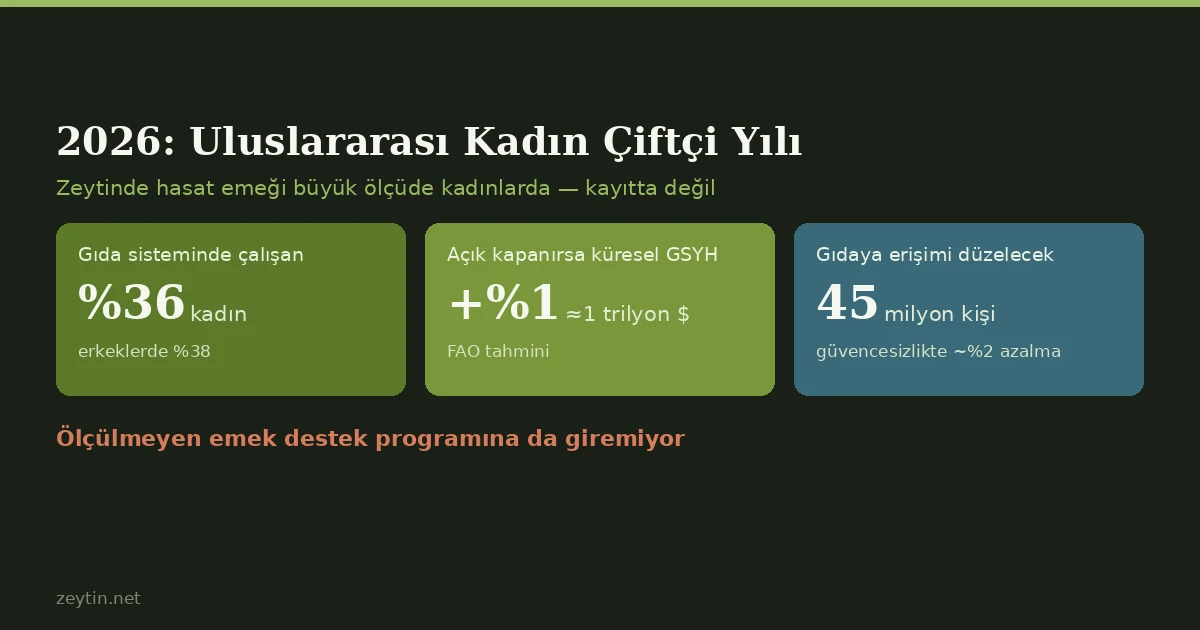
FAO reports that agrifood systems employ 36% of working women and 38% of working men; closing the gender gap would add 1% to global GDP (about $1 trillion) and improve food access for 45 million people. In olives, most harvest labour is women's — title deeds and decisions are not.
Article
The UN names 2026 the Year of the Woman Farmer: in olives the labour is women's, the records are not
FAO reports that agrifood systems employ 36% of working women and 38% of working men; closing the gender gap would add 1% to global GDP (about $1 trillion) and improve food access for 45 million people. In olives, most harvest labour is women's — title deeds and decisions are not.
 Article
Olive oil exports down 62% by value as a record harvest is expected
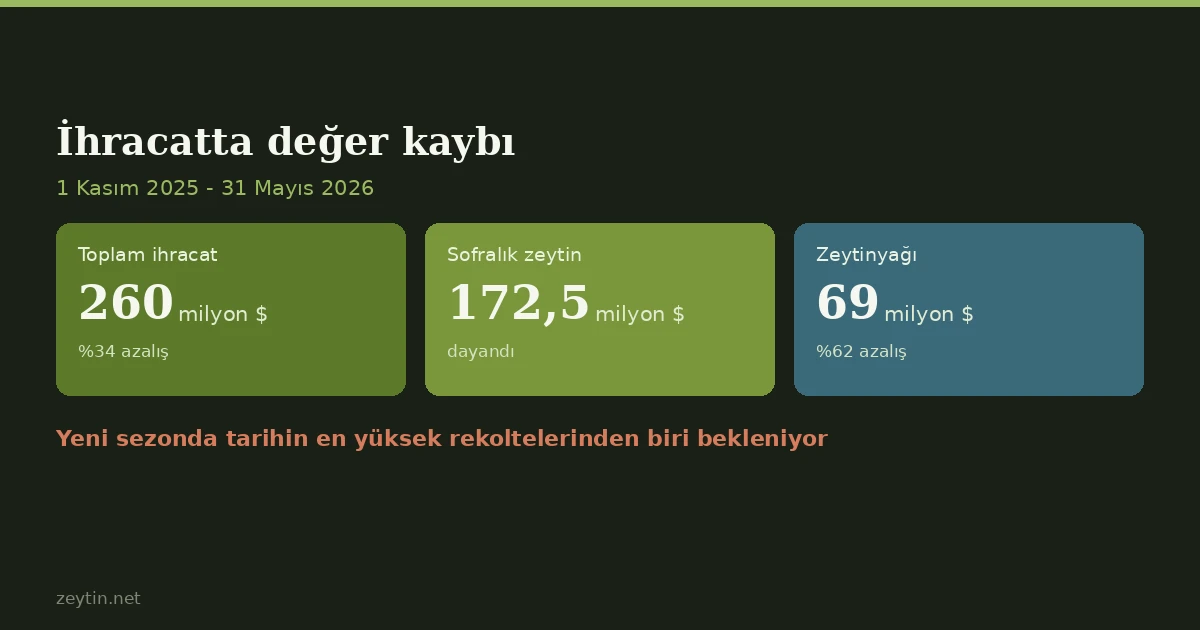
Olive and olive oil exports fell 34% to $260 million between 1 November 2025 and 31 May 2026. Table olives held at $172.5 million while olive oil dropped to $69 million. The target is a return to $1 billion.
Article
Olive oil exports down 62% by value as a record harvest is expected
Olive and olive oil exports fell 34% to $260 million between 1 November 2025 and 31 May 2026. Table olives held at $172.5 million while olive oil dropped to $69 million. The target is a return to $1 billion.