Memeli olive: characteristics, oil content and growing areas
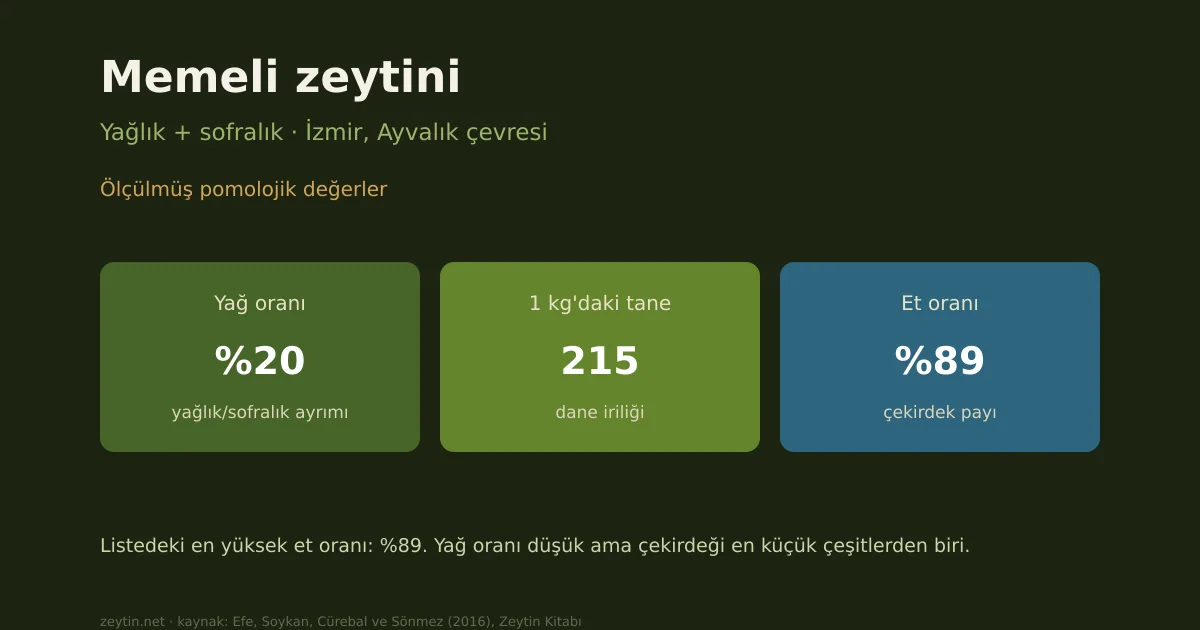
The highest flesh ratio on the list at 89%. Low in oil, but with one of the smallest stones.
Memeli has the highest flesh ratio on the list at 89% — only about a tenth of the fruit is stone. It grows around İzmir and Ayvalık.
Memeli in numbers
| Oil content | 20% |
| Fruits per kilo | 215 |
| Flesh ratio | 89% |
| Use | Oil and table |
| Main areas | İzmir and around Ayvalık |
Source: Efe, Soykan, Cürebal and Sönmez (2016), Zeytin Kitabı. Fields the source leaves blank are shown as "—"; nothing has been estimated.
Alternate bearing shrinks the fruit too
“On year / off year” — alternate bearing — is a familiar phenomenon in olives: a heavy crop one year, a light one the next. What is discussed less often is this: in the heavy year the fruit is smaller.
The measurements show it in three cultivars at once. In Memeli the difference is 17%: fruit weighing 6.64 g in the light year falls to 5.53 g in the heavy one. In Adana Topağı it is 10%, in Sivri 23%.
The logic is simple: the resource a tree can produce in a season is finite. As the number of fruits rises, the share going to each falls.
⚠ In table production this translates directly into price. Calibre — fruits per kilogram — sets the price, and in the buying prices published by Marmarabirlik the gap between 18 fruits and 41 fruits is more than threefold. In a heavy year the grower takes more kilos, but each kilo may be worth less.
The arithmetic: the economics of calibre.
A confusion of names
In some localities Memeli is called Kırma. Because cultivar naming varies from district to district in Türkiye, one cultivar can circulate under several names and different cultivars under one name.
That Ayvalık and Edremit are the same cultivar, and that Halhalı appears in three forms, are versions of the same problem. When buying trees, ask for the defined name, not the local one.
Among the local cultivars of the Aegean
Memeli appears on the list of local cultivars grown in the Aegean: Ak Zeytin, Aşıyeli, Çakır, Çekişte, Çilli, Dilmit, Erkence, Girit, Eşek (Ödemiş), Hurma Kaba, Hurma Karaca, İzmir Sofralık, Karayaprak, Kiraz, Memeli, Taşarası, Tavşanyüreği, Sarıyaprak, Yağ Zeytini, Yerli Yağlık and Yamalak.
Where it stands among measured cultivars
Its position on each axis is shown live in the comparison strip on this page, against every cultivar with a published figure. For the full ranking — and how that ranking is built — see olive variety rankings.
In short
Memeli's strength is its 89% flesh ratio; its oil content is low at 20%. Together these push it toward the table, though it is used for both purposes locally.
Memeli is also known as a good pollinator for Memecik, which is likewise pollinated by Ayvalık, Çakır, Gemlik and Erkence. For the Aegean's dominant variety, see Memecik olive.
Where it stands among measured varieties
Zeytin Kitabı — Efe, Soykan, Cürebal, Sönmez (2016), Kitabevi Yay. s.37-80
Zeytin Kitabı — Efe, Soykan, Cürebal, Sönmez (2016), Kitabevi Yay. s.37-80
Zeytin Kitabı — Efe, Soykan, Cürebal, Sönmez (2016), Kitabevi Yay. s.37-80
Zeytin Kitabı — Efe, Soykan, Cürebal, Sönmez (2016), Kitabevi Yay. s.37-80
Zeytin Kitabı — Efe, Soykan, Cürebal, Sönmez (2016), Kitabevi Yay. s.37-80
Values are those published on each variety's own page; the comparison covers only varieties with a measured figure, so it is a comparison of what is known — not of every Turkish variety. See the full ranking and how it is built →
One rating per visitor; you can change yours at any time. Ratings are real reader votes — no seeded or default scores.
Related
 Article
Olive varieties: seventeen Turkish varieties in numbers
Gemlik, Ayvalık, Memecik, Domat and the rest: Türkiye's olive varieties with oil content, fruit size, flesh ratio, region and ripening calendar.
Article
Olive varieties: seventeen Turkish varieties in numbers
Gemlik, Ayvalık, Memecik, Domat and the rest: Türkiye's olive varieties with oil content, fruit size, flesh ratio, region and ripening calendar.
 Article
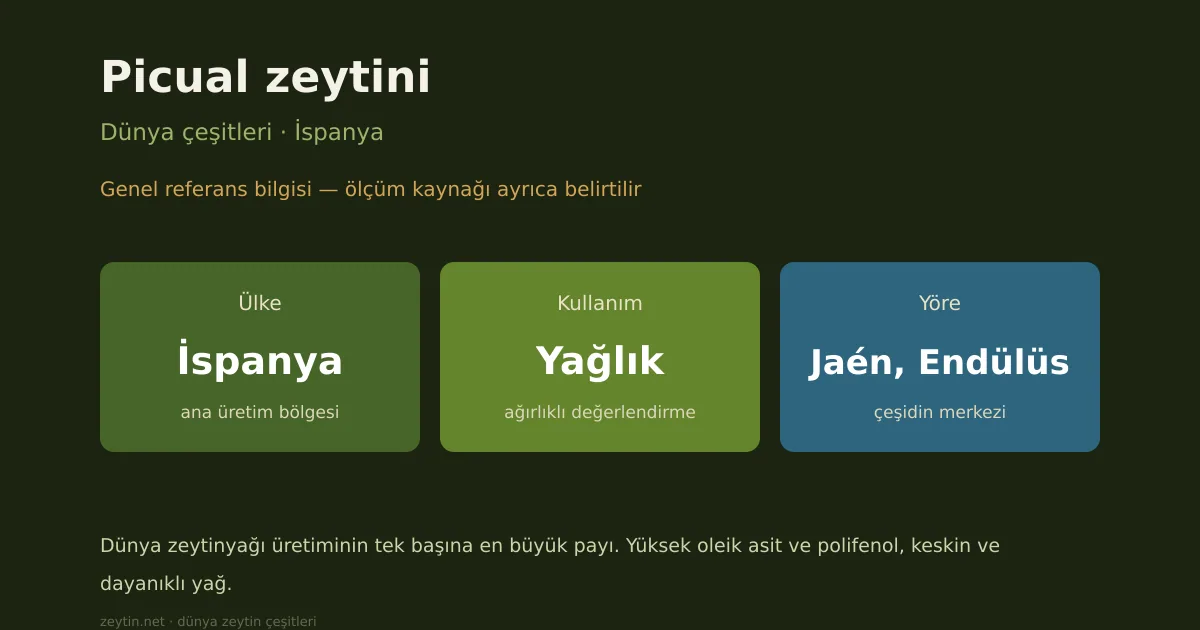
Picual olive: Spain's oil variety
The single largest share of world olive oil production. High oleic acid and polyphenols, a pungent and stable oil.
Article
Picual olive: Spain's oil variety
The single largest share of world olive oil production. High oleic acid and polyphenols, a pungent and stable oil.
 Article
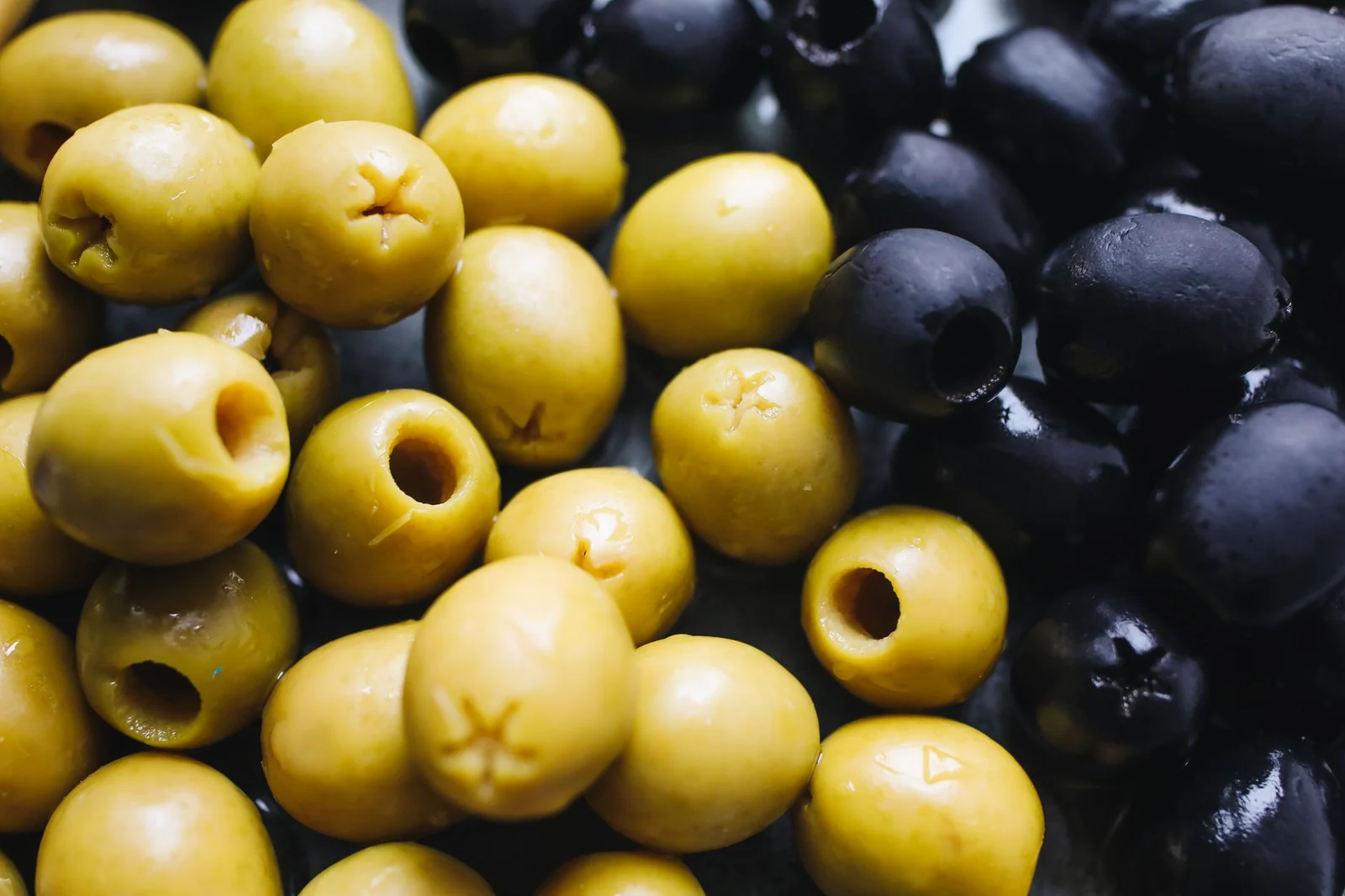
Which type of olive is better?
Table or oil, green or black — choosing a variety by purpose, with a short regional map.
Article
Which type of olive is better?
Table or oil, green or black — choosing a variety by purpose, with a short regional map.
 Article
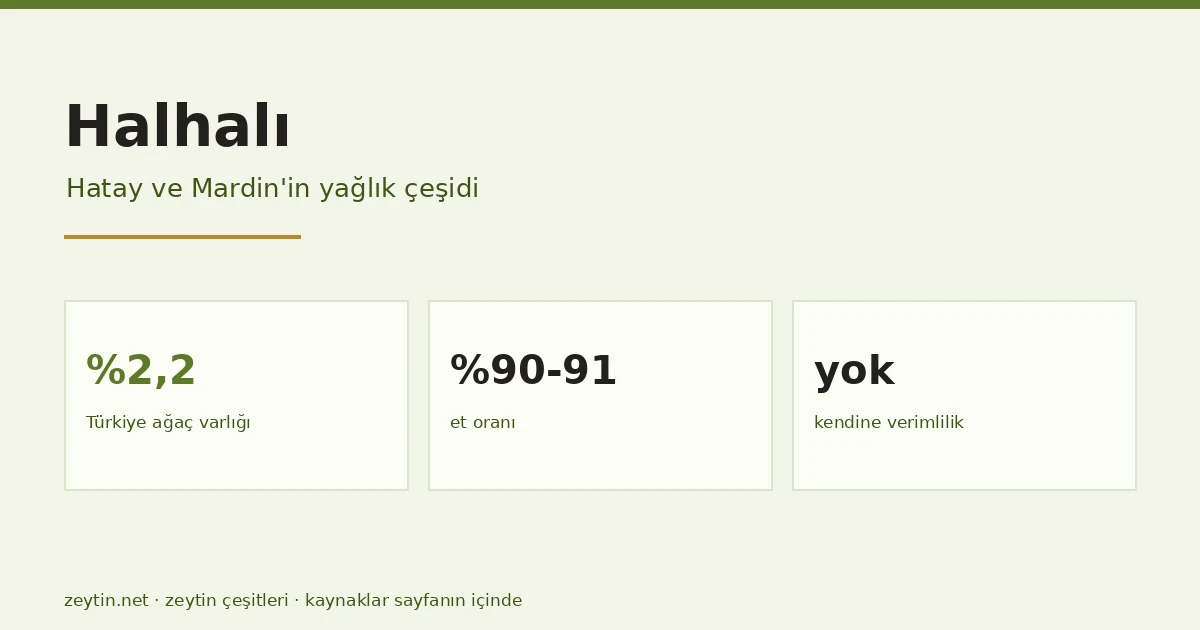
The Halhalı olive: Hatay's oil cultivar
Halhalı accounts for 2.2% of Turkey's olive trees, the main oil cultivar of Hatay and Mardin. The measured self-sterility of Yuvarlak Halhalı and what it means for orchard planning.
Article
The Halhalı olive: Hatay's oil cultivar
Halhalı accounts for 2.2% of Turkey's olive trees, the main oil cultivar of Hatay and Mardin. The measured self-sterility of Yuvarlak Halhalı and what it means for orchard planning.