Büyükbelen Tekir Olive: a table olive born from grafting two cultivars
Registered in 2024. The Eşek (Ödemiş) cultivar is grafted onto Uslu seedling rootstock. The flesh does not soften after processing, giving a long shelf life.
Most olive registrations rest on a single cultivar. Büyükbelen Tekir Olive rests on the union of two — and its definition includes the grafting method itself.
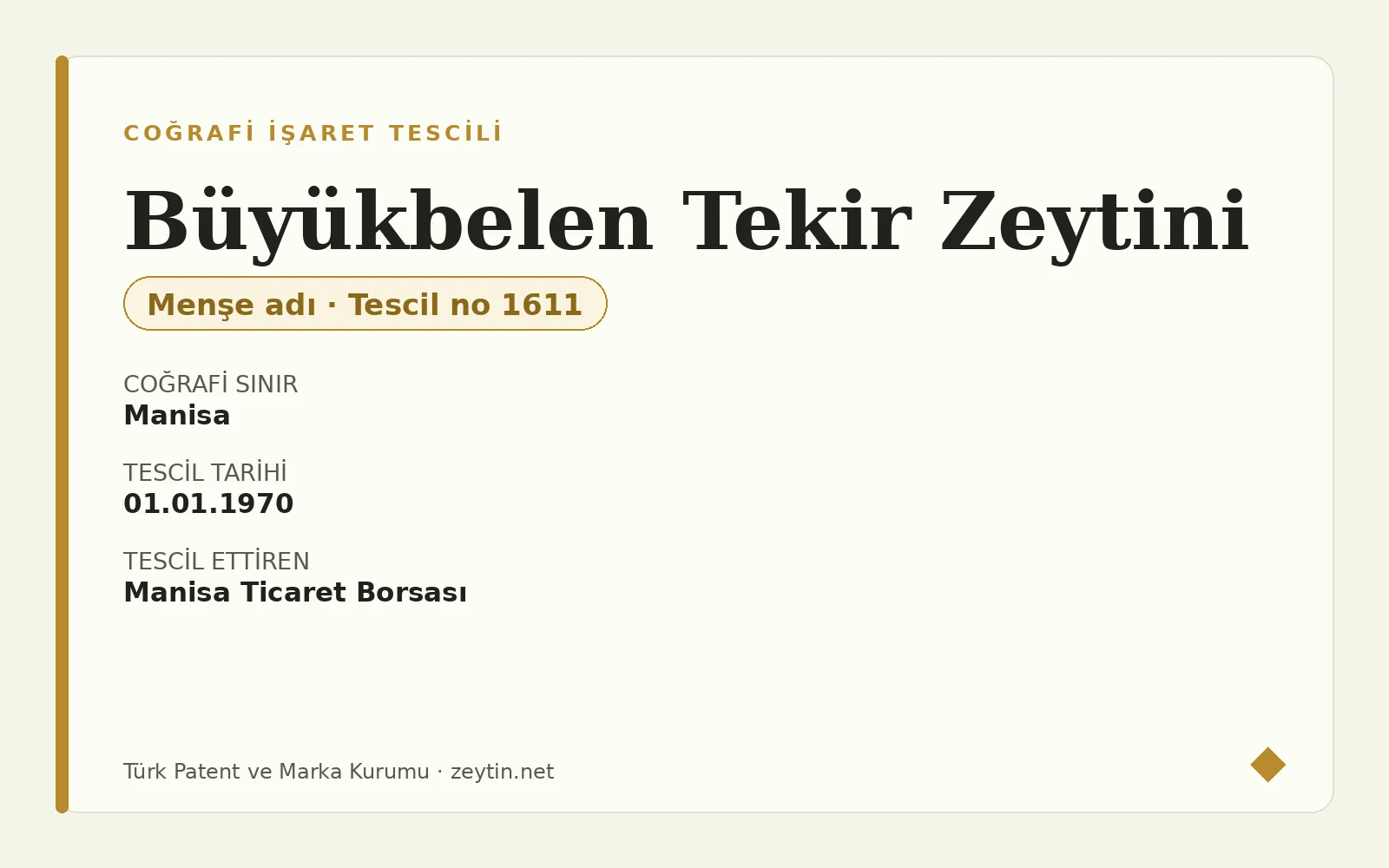
The record
| Registration no | 1611 |
| Registration date | 08.07.2024 |
| Protection from | 21.10.2021 |
| Type | Designation of origin |
| Registered by | Manisa Commodity Exchange |
| Area | The Büyükbelen and Çullugörece neighbourhoods of Saruhanlı, Manisa |
An area as narrow as two neighbourhoods is striking — among the smallest of any Turkish olive registration.
How it is obtained
The definition gives the method in one sentence: the Eşek (Ödemiş) cultivar grafted onto Uslu seedling rootstock, or grafted directly onto wild olive rootstock.
The product is therefore neither Uslu nor Eşek on its own, but a specific union of the two. We described the technique in grafting olives.
The distinguishing trait: firmness
What the certificate foregrounds is not flavour but texture:
t; The flesh is firm and does not soften after processing. Its shelf life is therefore long.
The commonest fault in table olives is softening in brine. Flesh that stays firm serves both transport and shelf life. There is a cost: the stone does not separate easily from the fruit.
Because the fruit is heavy and the stone large, it is classed as large. It reaches the market whole, unpitted, as cracked or scored olives.
Measured values
| Criterion | Value |
|---|---|
| Oil content | 6 – 12% |
| Moisture | 60 – 70% |
| Ash | 2 – 4% |
| pH | 4.5 – 5 |
| Oleuropein | 600 – 800 mg/kg |
| Oleic acid (C18:1) | 68 – 75% |
| Palmitic acid (C16:0) | 12 – 17% |
| Linoleic acid (C18:2) | 7 – 11% |
An oil content as low as 6-12% is unsurprising: this is a green table olive and does not go to oil. Fruit maturity falls in September-October, making it early.
Salt levels in the processed product differ by form: scored olives carry 4-5% brine salt and 2-4% in the fruit; cracked olives 5-6% and 3-4%.
⚠ The certificate also records the cultivar's weakness: sensitive to cold.
In short
Büyükbelen Tekir Olive is a table olive confined to two neighbourhoods, obtained by grafting, and resting its distinctiveness on flesh that stays firm after processing.
The area as the document defines it
The short line in the record does not give the registration's full boundary. The document's own definition reads:
t; Manisa ili Saruhanlı ilçesi Büyükbelen ve Çullugörece Mahalleleri
Its place in Manisa's olive production
| Item | Value |
|---|---|
| Fruit production | 623,493 t |
| — for oil | 411,412 t |
| — for the table | 212,081 t |
| Olive oil production | 64,292 t |
| Trees | 24,982 thousand |
| Yield per tree | 25.0 kg |
Oil and table production are close in this province (66% for oil); the production base is not locked to one direction.
The processing chemistry in the document
Most table olive registrations say "processed by traditional methods" and move on. This document binds the process step by step, with numbers:
| Stage | Requirement in the document |
|---|---|
| Debittering | 2-3% NaOH solution, 8-12 hours, without contact with air |
| Washing | three times in clean water |
| Holding solution | 0.4-0.6% citric acid + 7% brine |
| Resting | 15-60 days |
| Packaging | food-grade plastic, glass or tin |
Citric acid in the holding solution is a technical choice: after the NaOH stage the medium is alkaline, and the acid lowers pH, both suppressing unwanted microbial growth and preserving the firmness of the flesh. That is the mechanism behind the claim at the top of this page that the fruit does not soften after processing.
Brine acidity in the finished product also differs by form: 0.3-0.4% for scored olives, 0.4-0.5% for cracked.
Shelf life tied to packaging
The document carries one of the more unusual provisions among these registrations — it sets shelf life by packaging material:
| Packaging | Shelf life |
|---|---|
| Glass | 3 years |
| Tin | 2 years |
| Plastic | 6 months |
A sixfold spread. The reason is oxygen permeability: glass and metal are effectively impermeable, plastic is not. Storage conditions are written in too: 20-25 °C, dry with low humidity.
For the consumer this is the most practical information on the page — the same product from the same producer, with six times the life depending on the container.
The pomological record
| Measure | Value |
|---|---|
| Weight of 100 fruits | 700 – 1,200 g |
| Weight of 100 stones | 140 – 160 g |
| Flesh-to-stone ratio | 80 – 90% |
| Stone share of fruit | 12 – 15% |
| Stone length / width | 2.5 – 3.6 |
| Flowers per raceme | 10 – 18 (few) |
| Fruit set | end of May |
At 700-1,200 grams per hundred fruits, each fruit weighs 7-12 grams — above even the large class in table olives. That is the numerical counterpart of the registration's "large class" description.
The last row is a constraint: 10-18 flowers per raceme, which the document itself calls "few". Few flowers mean a naturally limited fruit set. Read together with the large fruit, this cultivar is built on fruit size rather than yield — a coherent position for a registration confined to two neighbourhoods.
All values in this section are taken from the registration certificate.
One rating per visitor; you can change yours at any time. Ratings are real reader votes — no seeded or default scores.
Related
 Article
Yağ Çelebi olive: characteristics, oil content and growing areas
Despite the name, its 21% oil puts it low on the list; its large fruit also serves the table.
Article
Yağ Çelebi olive: characteristics, oil content and growing areas
Despite the name, its 21% oil puts it low on the list; its large fruit also serves the table.
 Article
The Çelebi olive: the green table cultivar of İznik
Grown around İznik in Bursa, Çelebi is a green table cultivar. Its oil content is lower than Gemlik's — which is no drawback for a table olive.
Article
The Çelebi olive: the green table cultivar of İznik
Grown around İznik in Bursa, Çelebi is a green table cultivar. Its oil content is lower than Gemlik's — which is no drawback for a table olive.
 Article
How are green table olives made? Three methods, three results
Green olives cannot be eaten off the tree; the bitterness must be removed. The difference between Spanish-style, natural brine and scored methods sets time, texture and taste.
Article
How are green table olives made? Three methods, three results
Green olives cannot be eaten off the tree; the bitterness must be removed. The difference between Spanish-style, natural brine and scored methods sets time, texture and taste.
 Article
Koroneiki olive: Greece's oil variety
The backbone of Greek olive oil. Very small fruit, very high polyphenol content, and one of the three super-high-density varieties.
Article
Koroneiki olive: Greece's oil variety
The backbone of Greek olive oil. Very small fruit, very high polyphenol content, and one of the three super-high-density varieties.