Yağ Çelebi olive: characteristics, oil content and growing areas
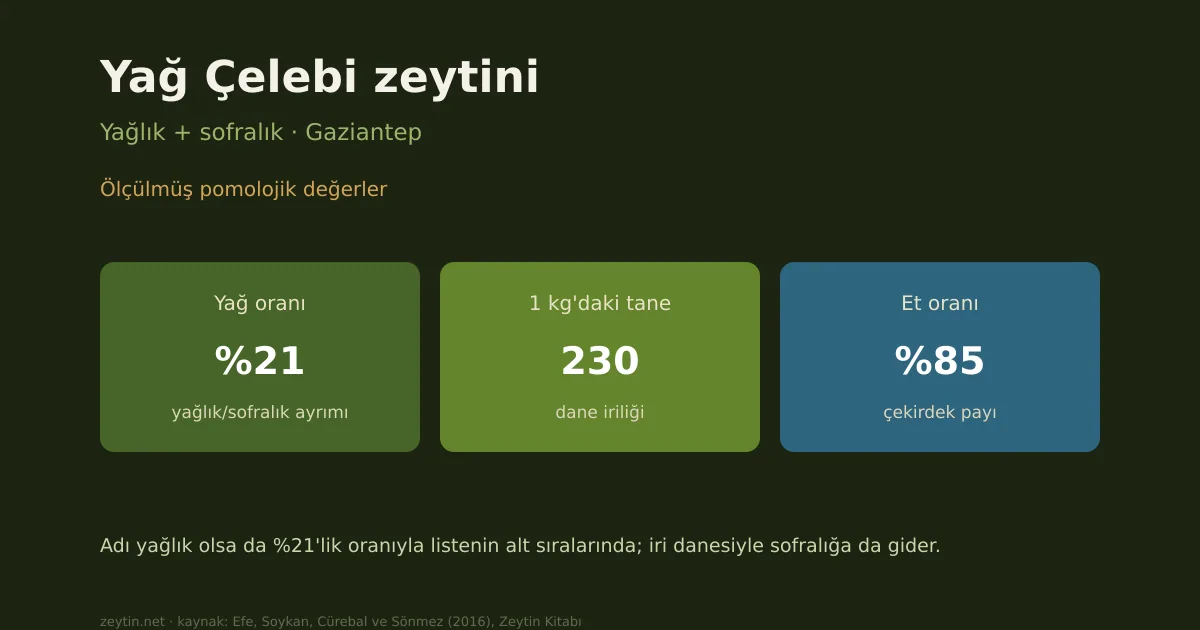
Despite the name, its 21% oil puts it low on the list; its large fruit also serves the table.
Despite the "yağ" (oil) in its name, Yağ Çelebi is not among the high-oil varieties on the list, at 21%. It grows around Gaziantep and its large fruit also serves the table.
Yağ Çelebi in numbers
| Oil content | above 22% |
| Fruits per kilo | 230 |
| Flesh ratio | 85% |
| Use | Oil and table |
| Main areas | Gaziantep |
Source: Efe, Soykan, Cürebal and Sönmez (2016), Zeytin Kitabı. Fields the source leaves blank are shown as "—"; nothing has been estimated.
The Çelebi family in numbers
The south-eastern inventory carries six separate cultivars bearing the name “Çelebi”, and their measured values diverge markedly:
| Cultivar | Oil | Flesh | Use |
|---|---|---|---|
| Halhallı Çelebi | 18-22% | 90% | table |
| Kan Çelebi | under 18% | 89% | table |
| Tesbih Çelebi | 22%+ | 88% | oil |
| Yağ Çelebi | 22%+ | 85% | oil |
| Hamza Çelebi | under 18% | 85% | oil + table |
| Yuvarlak Çelebi | under 18% | 84% | table |
| Yün Çelebi | under 18% | 83% | table |
The rule the table reveals: as the oil content rises, the flesh ratio falls. Yağ Çelebi and Tesbih Çelebi, above 22% oil, go to the mill, while the low-oil Çelebis go to the table on their high flesh ratios.
This shows that what decides the use is not the name of the cultivar but its measured value — seven cultivars from one family split into two product lines.
A caution about names
Because cultivar names repeat from district to district in Türkiye, confusion is widespread. Three similar names attach to three different cultivars here, and buying trees by the local name is how the wrong tree ends up in the ground.
The same problem appears elsewhere: Ayvalık and Edremit are one cultivar under two names, and Halhalı circulates in three forms.
The cultivar landscape of the south-east
South-eastern Anatolia is Türkiye's second centre of olive growing after the Aegean. Cultivars grown there: Eğriburun, Halhalı, Kalem Bezi, Kan Çelebi, Nizip Yağlık, Kilis Yağlık and Yağ Çelebi.
Published pomological measurements are limited for most of them, and the region holds many unnamed local genotypes besides.
Where it stands among measured cultivars
Its position on each axis is shown live in the comparison strip on this page, against every cultivar with a published figure. For the full ranking — and how that ranking is built — see olive variety rankings.
In short
Yağ Çelebi is a dual-purpose Gaziantep variety at 21% oil and 85% flesh, with large fruit at 230 per kilo. The mismatch between its name and its numbers is a reminder that olive variety names usually come from local usage, not from laboratory measurement.
Variety-specific phenology and pollination data are absent from the official sources we hold.
Where it stands among measured varieties
çeşit sayfası
çeşit sayfası
Zeytin Kitabı — Efe, Soykan, Cürebal, Sönmez (2016), Kitabevi Yay. s.37-80
Zeytin Kitabı — Efe, Soykan, Cürebal, Sönmez (2016), Kitabevi Yay. s.37-80
Zeytin Kitabı — Efe, Soykan, Cürebal, Sönmez (2016), Kitabevi Yay. s.37-80
Values are those published on each variety's own page; the comparison covers only varieties with a measured figure, so it is a comparison of what is known — not of every Turkish variety. See the full ranking and how it is built →
One rating per visitor; you can change yours at any time. Ratings are real reader votes — no seeded or default scores.
Related
 Article
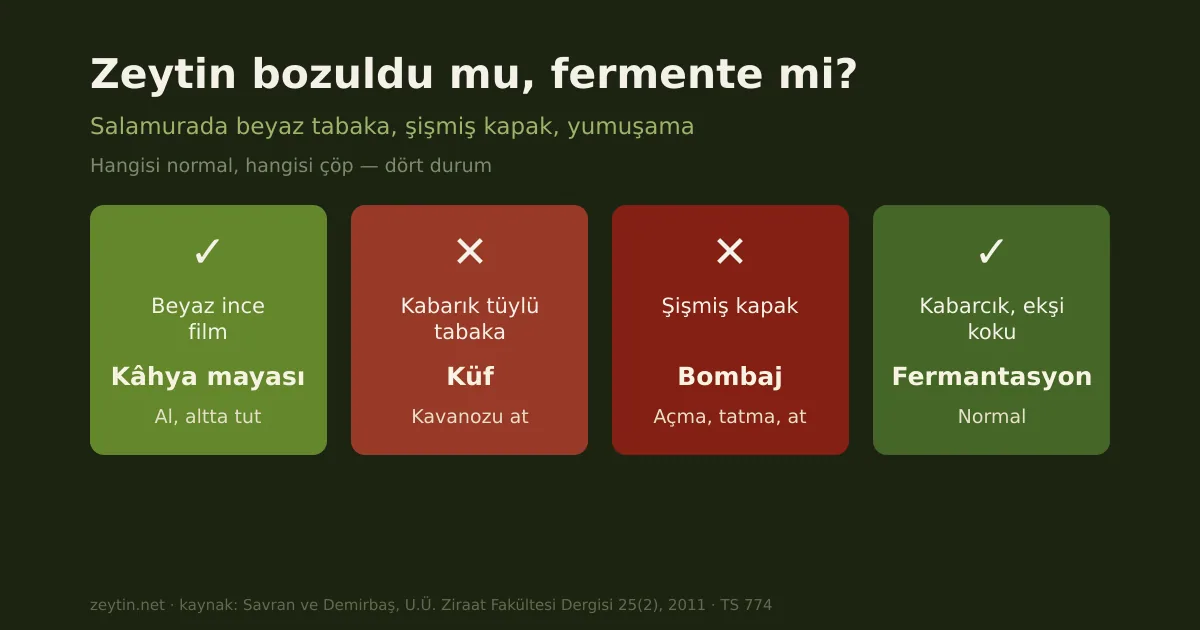
Are my olives spoiled? Mould, bulging lids and softening
A white film on brine is not always mould. But a bulging lid is not debatable: discard it unopened. How kahm yeast differs from mould.
Article
Are my olives spoiled? Mould, bulging lids and softening
A white film on brine is not always mould. But a bulging lid is not debatable: discard it unopened. How kahm yeast differs from mould.
 Article
How to store olive spread: homemade, opened jars and freezing
Homemade olive spread is kept in the fridge in a clean glass jar, covered with a thin layer of olive oil, and eaten within about a week. For opened shop-bought jars, the time on the label applies. Spread with garlic or fresh herbs should never be left at room temperature.
Article
How to store olive spread: homemade, opened jars and freezing
Homemade olive spread is kept in the fridge in a clean glass jar, covered with a thin layer of olive oil, and eaten within about a week. For opened shop-bought jars, the time on the label applies. Spread with garlic or fresh herbs should never be left at room temperature.
 Article
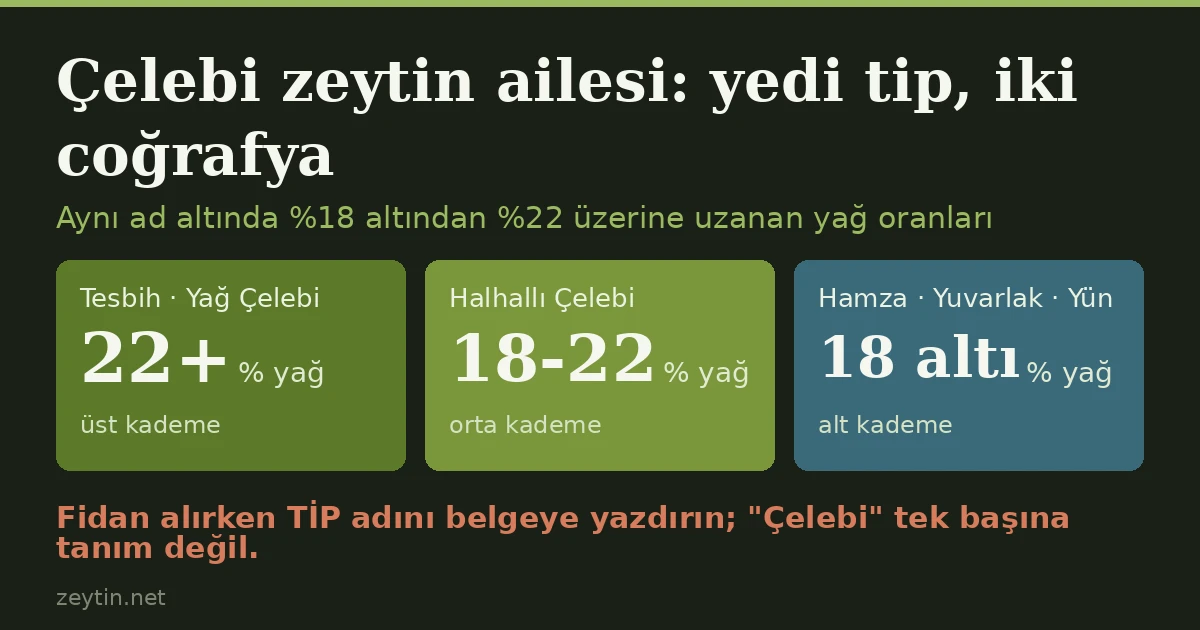
The Çelebi olive family: seven types, two separate geographies
Çelebi is not one variety but a family name. Tesbih Çelebi yields above 22 percent oil while Hamza, Yuvarlak and Yün Çelebi stay under 18. Measured values for seven types.
Article
The Çelebi olive family: seven types, two separate geographies
Çelebi is not one variety but a family name. Tesbih Çelebi yields above 22 percent oil while Hamza, Yuvarlak and Yün Çelebi stay under 18. Measured values for seven types.
 Article
Marantelli olive
Marantelli is a recorded variety of the Black Sea. Described in the source.
Article
Marantelli olive
Marantelli is a recorded variety of the Black Sea. Described in the source.