How many days after the last spray can olives be harvested? Pre-harvest interval and residues
The interval between the last spray and harvest in olives ranges from 3 to 42 days depending on the active substance; most peacock spot products carry 14–21 days. Fat-soluble residues concentrate in the oil at pressing; EU exceedances in virgin olive oil rose to 2.5% in 2024. 2026/27 is Turkey's first harvest with spraying and harvest recorded plot by plot under B-Reçete.
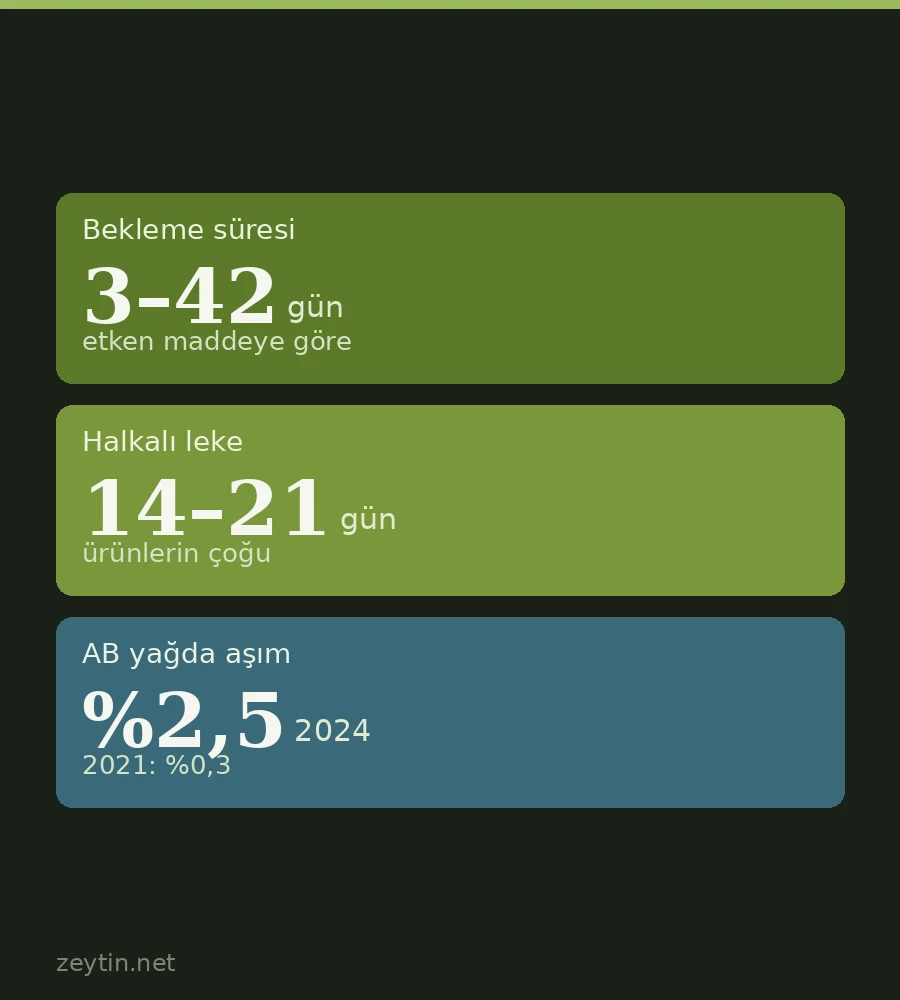
As the harvest starts in October, some groves are still receiving their last sprays: olive fruit fly treatments that continue into September, and peacock spot sprays before the autumn flush. The question is simple: how many days must pass after the last spray? The answer is not a single number. Each active substance has its own interval, and in olives it ranges from 3 to 42 days. This article explains where the interval comes from, what range applies in olives, and why the 2026/27 harvest in Turkey differs from earlier ones in this respect.
What is the pre-harvest interval?
Written on labels as the "time between last application and harvest", this number is the minimum time needed for the product to break down on the plant and for residues to fall below the legal limit. It is set separately for each product–crop pair when the product is authorised. The same active substance may be authorised in olives with one interval and in tomatoes with another.
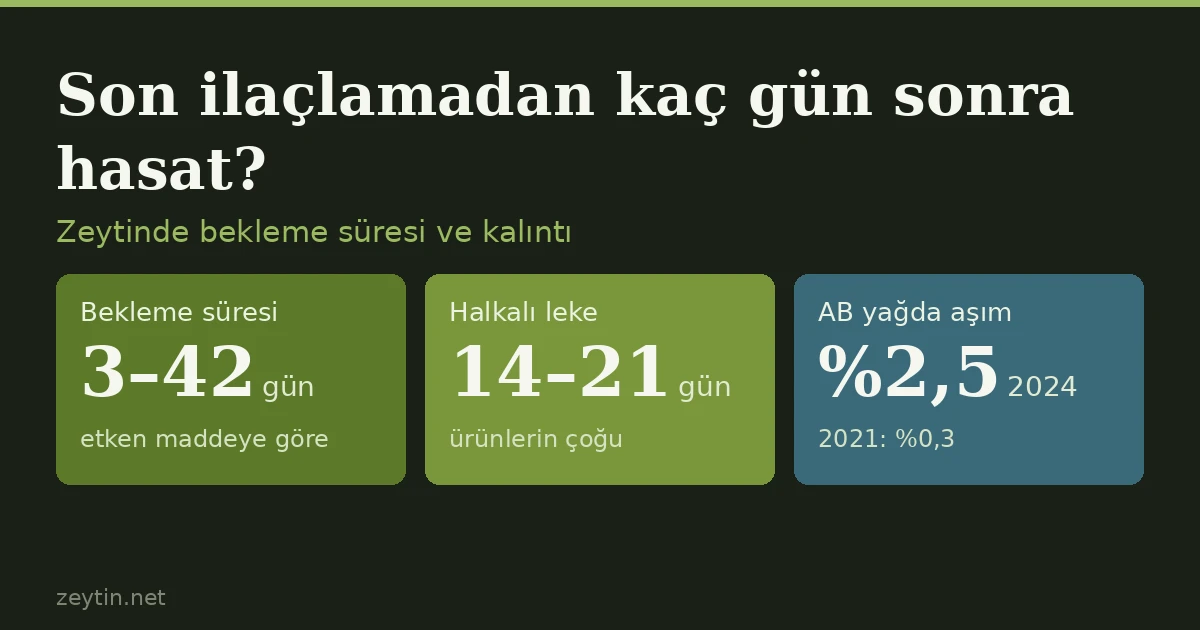
The Turkish Ministry of Agriculture and Forestry's Olive Integrated Pest Management Technical Instruction (2022) states the rule plainly: if chemical control is unavoidable, selective products must be used at the recommended dose and time, and the intervals required between last application and harvest must be respected. The same instruction lists the three causes of residues: doses above the recommendation, more applications than needed, and ignoring the interval.
Intervals in olives: from 3 to 42 days
Annex 4 of the instruction lists the active substances that may be used in integrated control of olive pests and diseases, with the interval for each. The table below shows the intervals only; we give no doses or trade names, because authorisations change over time and the label of the product in your hands is always what counts.
| Target | Active substance | Interval |
|---|---|---|
| Olive fruit fly | Azadirachtin | 3 |
| Olive fruit fly | Lambda-cyhalothrin | 3 |
| Olive fruit fly | Spinosad (with attractant) | 7 |
| Olive fruit fly | Malathion (with protein, ULV) | 7 |
| Peacock spot | Copper products | 14–21 |
| Peacock spot | Azoxystrobin + difenoconazole | 21 |
| Olive moth | Diflubenzuron | 14 |
| Olive moth | Triflumuron | 42 |
| Scale insects | Pyriproxyfen | 14 |
| Scale insects | Summer oil | 21 |
| Scale insects | Phosmet | 21 |
Two things follow from the table. First, the fly treatments used closest to harvest have short intervals: 3 to 7 days. Second, most products listed for peacock spot carry 14–21 days; a grove sprayed against peacock spot at the end of October may have to wait until mid-November, depending on the product. We cover the regional spray programme in olive peacock spot disease and the whole year in olive pest calendar and intervention thresholds.
There is one more detail for the fly: under the instruction, partial branch spraying is repeated until 20 days before harvest. So even if the label interval is 7 days, the programme itself moves the last application three weeks ahead of harvest. Thresholds and trapping are in olive fruit fly control.
Why are residues in oil a separate issue?
Many insecticides dissolve in fat. When olives are pressed, the water fraction is separated, while fat-soluble residues stay in the oil. Recall that one kilo of olives yields about 170 grams of oil on average (how much olive oil from one kilo of olives): if all the residue passed into the oil, its concentration there would be roughly 6 times that in the fruit. This is a theoretical upper bound; the real ratio varies by substance. That is why EU law assesses residues in processed products by applying a processing factor to the limit for the raw commodity (Regulation 396/2005, Article 20).
This explains why respecting the interval matters as much for oil olives as for table olives.
What turns up in oil samples in Europe?
The European Food Safety Authority (EFSA) regularly samples virgin olive oil in the member states' coordinated monitoring programme. According to the 2024 report published in May 2026:
- 487 virgin olive oil samples were analysed under the programme in 2024.
- The share of samples above the legal limit was 0.6% in 2018 and 0.3% in 2021, rising to 2.5% in 2024. The report names chicken eggs and virgin olive oil as the two products whose exceedance rates rose most.
- Virgin olive oil had the highest share of samples of unknown origin (12.5%); EFSA recommends ensuring traceability.
- Olive oil is among the main drivers of acute consumer risk for phosmet.
Phosmet is an instructive case. The EU did not renew its approval, through Implementing Regulation 2022/94; the last date for use was 1 November 2022. Residue limits in products including olives were lowered to the limit of determination by Regulation 2023/1029, applying since 15 September 2023. Yet the 2022 Turkish instruction still listed phosmet among products "temporarily recommended" against scale insects. For a consignment going to the EU, the EU limit is what applies.
Dimethoate, long used against the olive fruit fly, followed a similar path: its EU approval was not renewed in June 2019 by Regulation 2019/1090, and the Turkish ministry has announced that use of this active substance in Turkey has been ended.
What changed this harvest: B-Reçete
The Regulation on the Application and Control of Plant Protection Products, published in the Turkish Official Gazette on 13 December 2025, introduced the B-Reçete tracking system. The system records electronically, plot by plot, the plant protection products a grower buys and applies, together with harvest information. The regulation entered into force 30 days after publication in pilot provinces and on 1 July 2026 in all other provinces.
The result: 2026/27 is the first nationwide olive harvest in which spray dates and harvest dates sit side by side in the same record. The regulation also brought pre-harvest pesticide inspections within its scope and set out administrative penalties for adverse findings.
Pre-harvest checklist
1. Find the label of the last product applied in the grove and read the interval given for olives.
2. Count from the day of the last application; if two different products were used in the season, the longer interval applies.
3. Enter the harvest date and plot in the record system.
4. If the mill or buyer asks for a residue analysis, have the record showing the interval ready. For reading the lab report, see how to read an olive oil lab report.
In numbers
| Item | Value | Source |
|---|---|---|
| Range of intervals | 3–42 days | Olive IPM Technical Instruction, Annex 4 (2022) |
| Last repeat of partial branch spraying against the fly | 20 days before harvest | Same instruction |
| Copper products for peacock spot | 14–21 days | Same instruction |
| EU exceedances in virgin oil, 2018 / 2021 / 2024 | 0.6% / 0.3% / 2.5% | EFSA 2024 report (May 2026) |
| Virgin olive oil samples analysed | 487 | Same report |
| Last use of phosmet in the EU | 1 November 2022 | Regulation (EU) 2022/94 |
| B-Reçete in force in all provinces | 1 July 2026 | Official Gazette, 13.12.2025 |
In short
- In olives the pre-harvest interval ranges from 3 to 42 days depending on the active substance; the product label is what counts.
- Most peacock spot products carry 14–21 days, so the autumn spray has to be written into the harvest plan in advance.
- Fat-soluble residues concentrate in the oil at pressing, so the interval matters for oil olives too.
- In the EU, exceedances in virgin olive oil rose to 2.5% in 2024.
- 2026/27 is the first nationwide harvest in Turkey with spraying and harvest recorded plot by plot.
One rating per visitor; you can change yours at any time. Ratings are real reader votes — no seeded or default scores.
Related
 Article
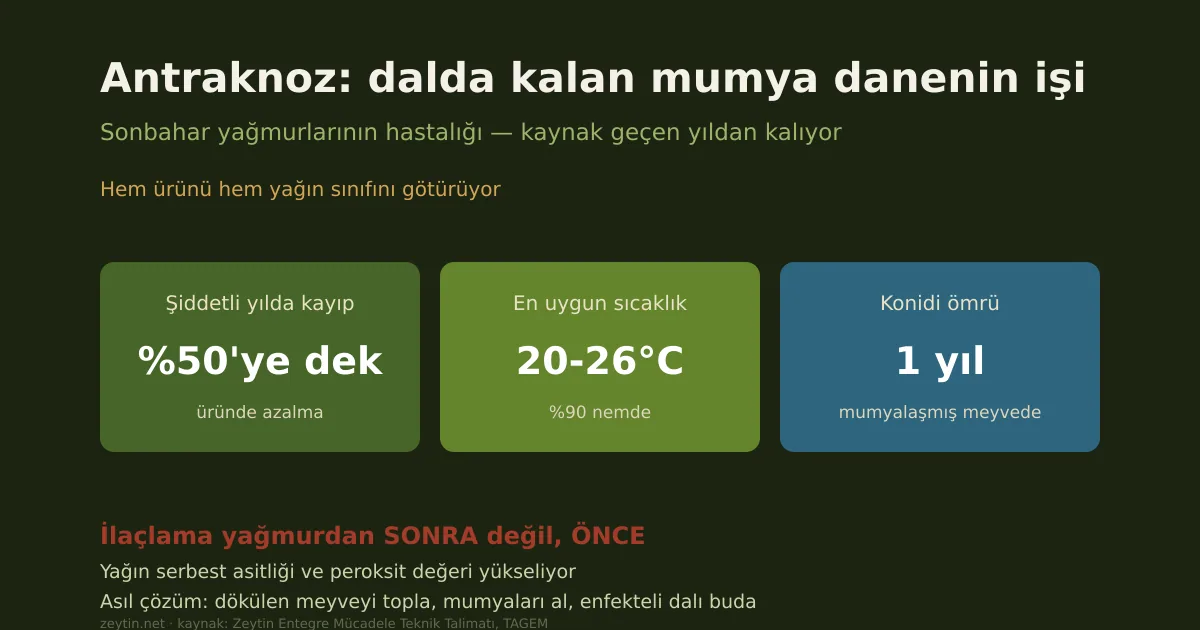
Olive anthracnose: the disease of the mummified fruit left on the branch
Up to 50% crop loss in bad years. The source is last year's mummified fruit still on the branch, and the spray goes on before the autumn rains, not after.
 Article
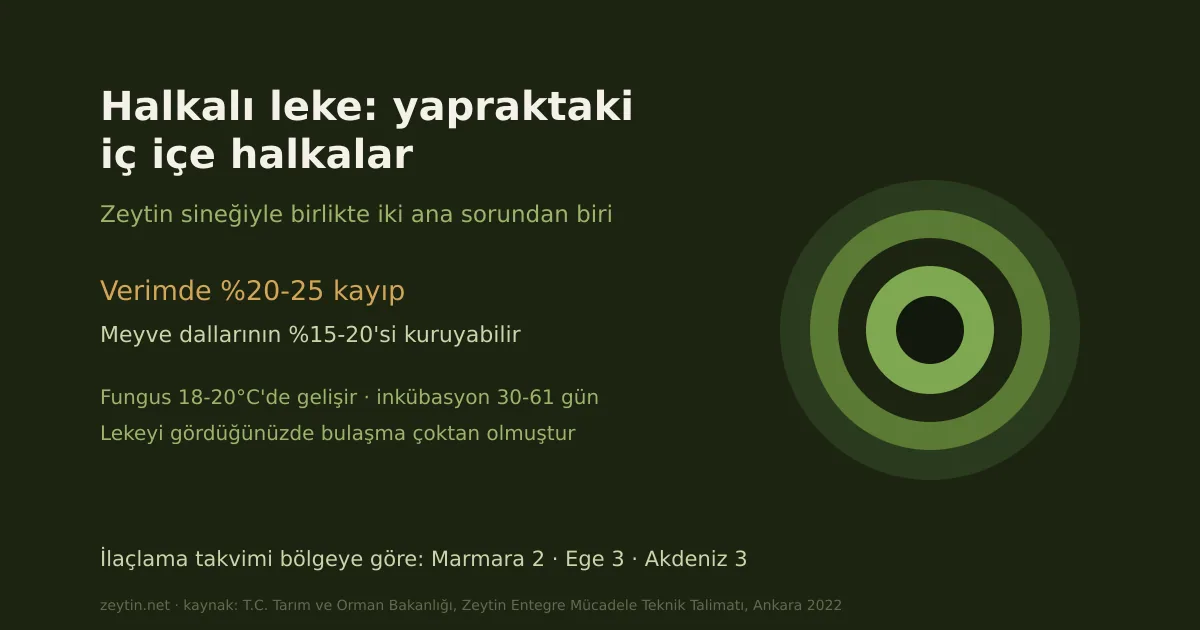
Olive peacock spot: symptoms and a region-by-region spray calendar
The commonest of olive tree diseases: concentric rings on the leaf, shedding, a shrubby tree. Yield falls 20-25%; spray timing varies by region.
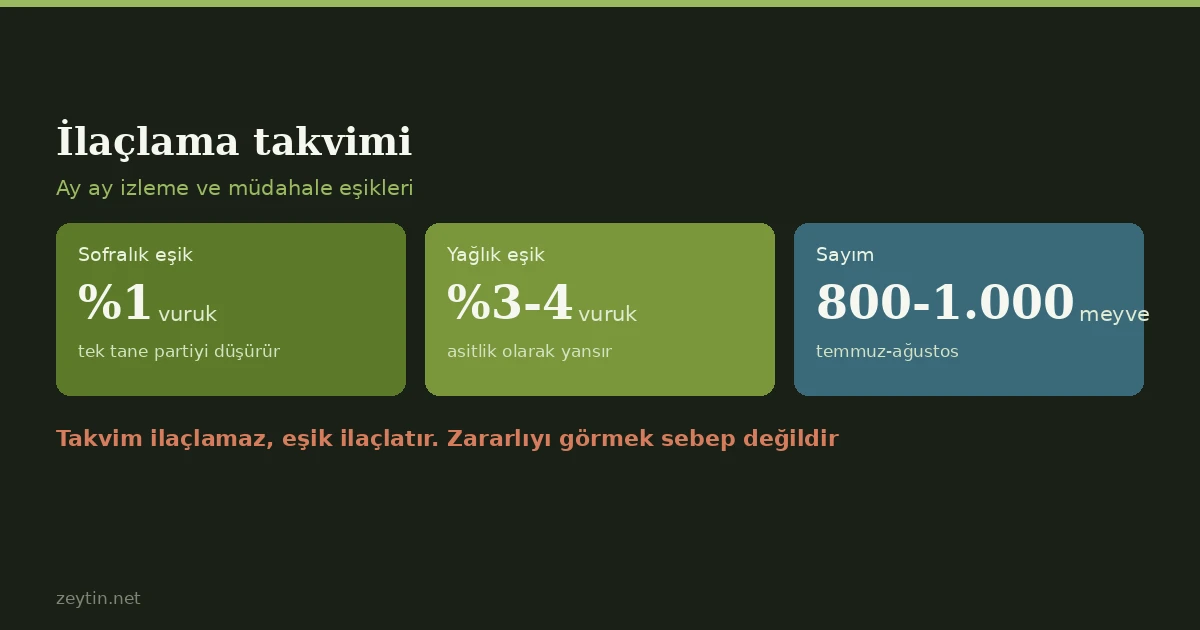 Article
The olive pest calendar and intervention thresholds
Month by month: which pest is at which stage, and when to count. Fly infestation thresholds, black scale shoot counts, and the three regional programmes for peacock spot.
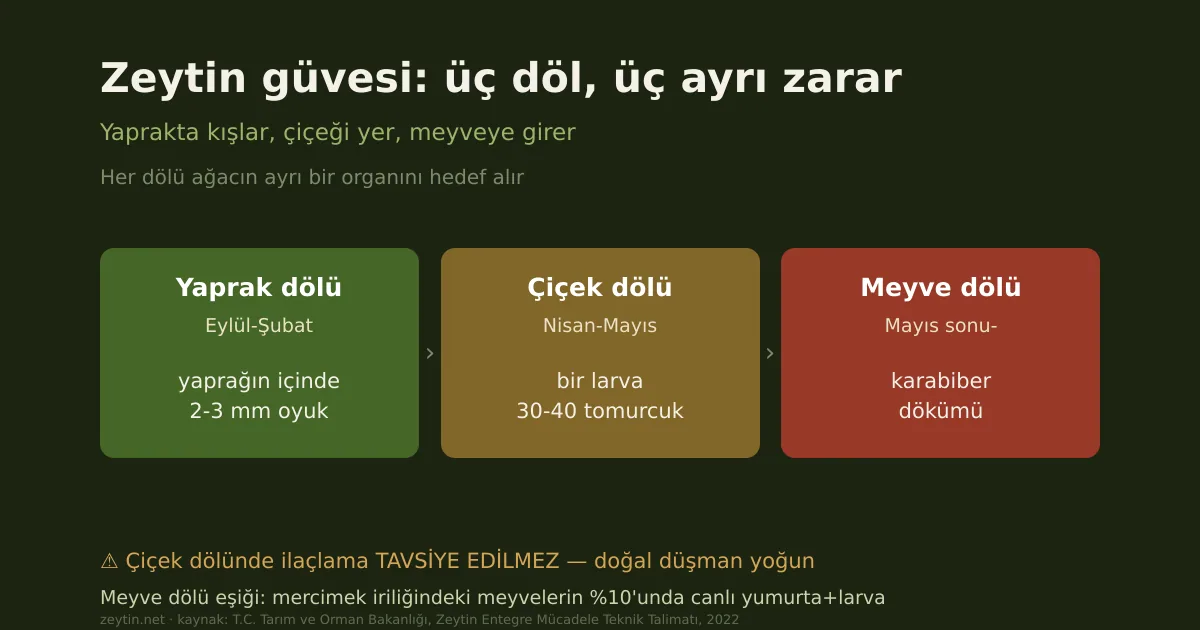 Article
The olive moth: three generations, three kinds of damage
The olive pest with three generations: it winters in the leaf, eats the flowers, enters the fruit. One larva can take 30-40 buds.