Why do olive flowers and young fruit dry up? The flower-stalk bug and the olive weevil
Two lesser-known insects can lie behind olive buds that dry up and chickpea-sized fruit that is wounded and drops: the flower-stalk bug and the olive weevil. Based on the Ministry of Agriculture's farmer booklet, the article explains how to recognise each, their year and the cultural measures.
When spring arrives the olive tree is covered in flower buds, yet by June far fewer fruits are left on the branch than you expected. Part of this is natural: an olive tree produces a great many flowers, and only a small share of them turn into fruit. But behind buds that dry up and fruit that is wounded and shrivels when it is the size of a chickpea there can be two insects: the olive flower-stalk bug and the olive weevil. Both are less well known than the moth and the fly covered in our article on fruit drop. This article is based on the booklet Farmer Training Series: Olive of the General Directorate of Food and Control at Turkey's Ministry of Agriculture and Forestry.
Olive flower-stalk bug (Calocoris trivialis)
How to recognise it
According to the booklet the body is elongated and greenish; males are darker than females. The wings are transparent with clearly visible veins. The first nymphs that hatch are green as well. Both the nymph and adult stages are spent entirely on the olive.
Its year
The pest has one generation a year. It passes the winter as eggs inside slits made in the shoots. When the weather begins to warm, in late March and early April, the eggs hatch. Both nymphs and adults feed by pushing their mouthparts into the flower buds.
What damage does it do?
The booklet describes it as a direct pest of flowers. Damage starts when the flower buds appear and swell and continues until fruit set. It begins at the nymph stage, but because the adult feeds more greedily, the damage grows. With its mouthparts the insect first sucks the calyx of the bud and then the inner organs of the flower. A circular spot appears on the calyx; over time the feeding site darkens, the flower cannot open, turns brown and the bud dries up and falls. In flowers that have already opened, the reproductive organs are destroyed.
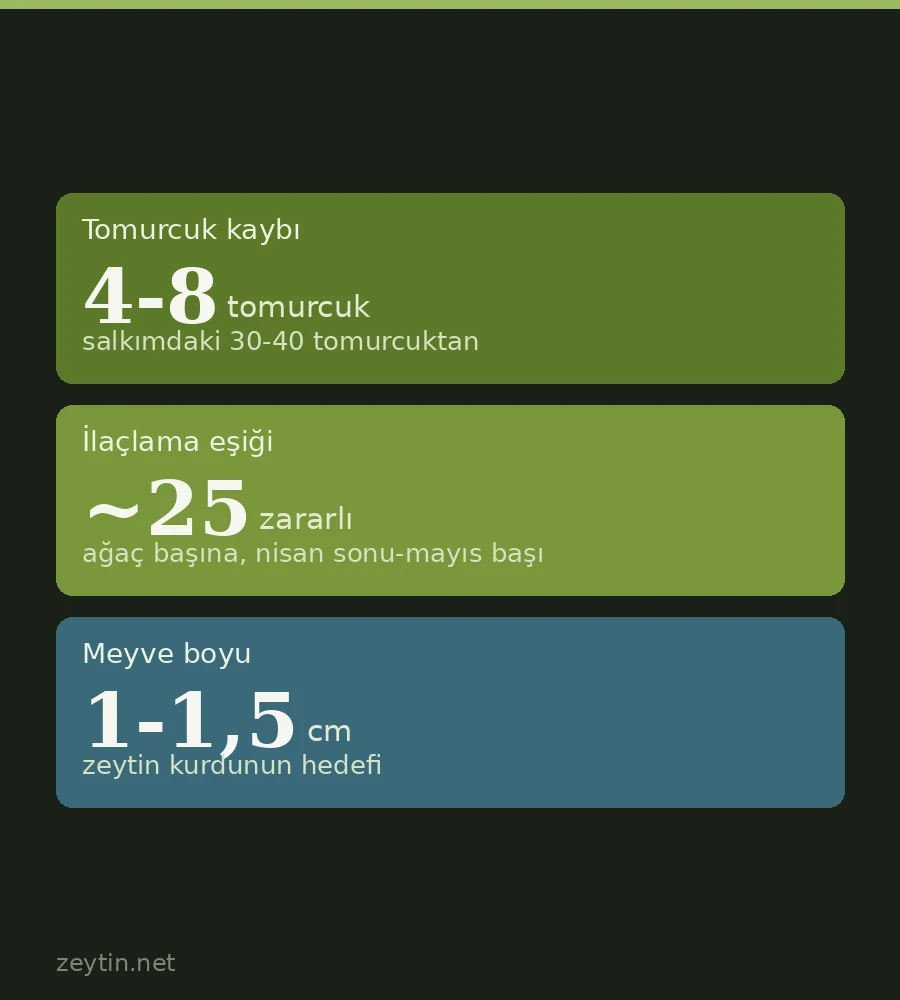
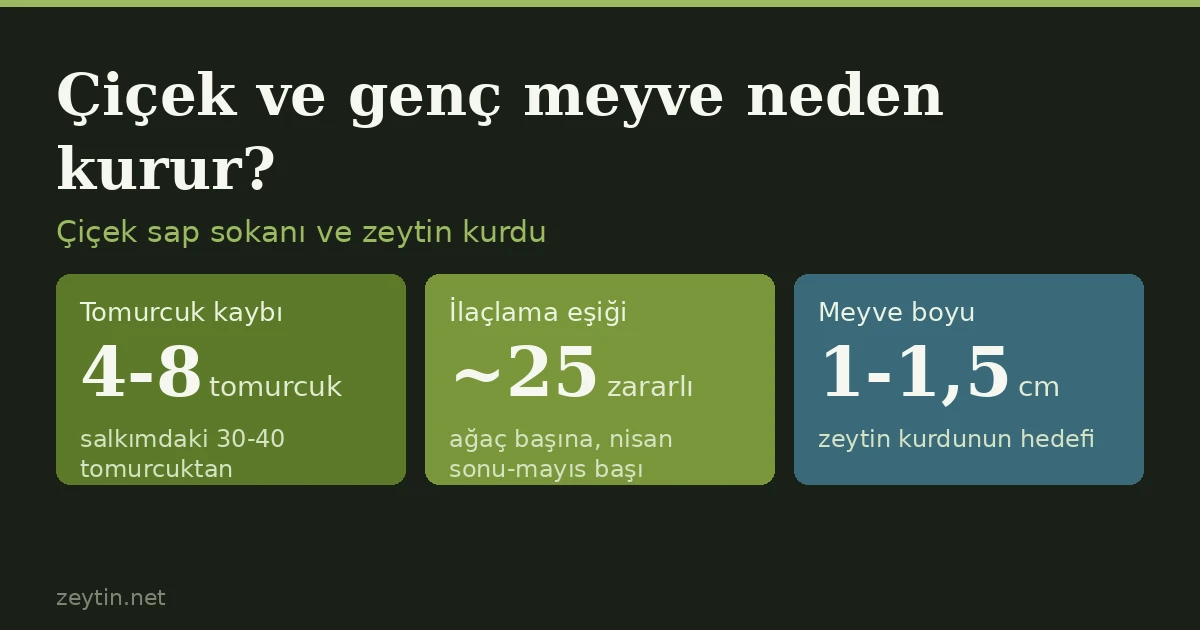
The booklet also gives a number: in normal years, 4 to 8 of the 30 to 40 buds in a flower cluster are targeted by this pest and fail to set fruit. This is an average reported by the booklet; it does not mean your own orchard will lose that share.
A second trace shows up on the shoots: the adult female makes wounds in young shoots with her egg-laying organ in order to lay eggs. For this reason the shoots look "as if hit by hail" and grow more slowly. If you see wounds that resemble hail marks on the shoots although no hail has passed over the orchard, this pest is worth suspecting.
Where is it common?
The booklet says it is widespread in the olive groves of Adana, Aydın, Balıkesir, Bursa, Çanakkale, İzmir, Manisa and Muğla. Its main host is the olive; it can also be found on herbaceous plants under the trees and on fruit trees nearby.
When to look in the orchard
The booklet's calendar tells you when: eggs hatch in late March and early April, and damage starts when the buds appear and swell and continues until fruit set. So the check belongs to the period when flower buds are visible. A circular spot on the calyx of a bud, blackened and drying buds, and slits on young shoots are the signs to look for.
Is intervention needed?
The booklet's timing is this: control of the flower-stalk bug coincides with control of the flower generation of the olive moth. In orchards where a treatment against the moth is already applied at that time, no separate treatment is needed for this pest. In orchards where there is no moth control, treatment is recommended when about 25 pests per tree are counted during flowering, at the end of April and the beginning of May, when nymphs and adults start causing damage. For product, dose and timing the booklet refers to the provincial and district directorates and to people authorised to write prescriptions; we give no product names or doses here either. For a general view of thresholds you can read our article on the treatment calendar.
Olive weevil (Coenorrhinus cribripennis)
How to recognise it
Although "worm" appears in its Turkish name, the booklet describes the adult beetle as the stage that does the damage. According to it, the body is slightly conical from head to rear and rounded, usually reddish brown and covered with dense yellowish hairs. It spends the winter in the soil as a pupa in diapause. It emerges from late March, and generally from April, depending on how early the weather warms up in a given year. It has one generation a year.
Three kinds of damage
The booklet divides the damage into three periods:
1. Fresh shoots and leaves. Adults that leave their winter quarters in late March and early April feed on young shoots and fresh leaves, because flowers and fruit have not yet formed.
2. Flowers. Feeding continues in the flowering period. A damaged bud changes colour, cannot open, and dries up and falls without setting fruit.
3. Fruit. The adults' most important damage is on the fruit. From the time the fruit is the size of a chickpea until it reaches 1 to 1.5 cm in length, their feeding leaves many wounds. Damaged fruit cannot develop, shrivels, dries and begins to fall. As it dries, the edges of the wounds swell and the centre sinks, giving a characteristic look. The booklet states that this damage causes real crop loss.
The distinction matters here. Fruit drop has many causes, including the moth, the fly, nutrient deficiency and heat or water stress. Weevil damage is recognised by sunken wounds with raised edges and by the young fruit size (1 to 1.5 cm); that is a different picture from the V-shaped slit of fly damage and from the moth's entry at the base of the stalk. If you are unsure of the diagnosis, asking the agricultural engineers of the provincial or district directorate is better than buying a treatment on a guess.
What can be done?
The booklet's cultural recommendations are interesting because they need no chemicals: the weevil drops to the ground or flies off at the slightest shake; in sunny weather it is very active, in cloudy weather sluggish. For this reason, from March and April onwards a sheet should be spread under the trees before sunrise, the trees shaken, and the insects that fall collected and destroyed. In July, August and September the olives that drop under the tree should also be collected and destroyed.
For chemical control the booklet says that treatment should begin immediately if even a single adult is seen in a survey. The booklet does not explain the reason for this strict threshold; the fact that the damage causes real crop loss may account for it (this is our interpretation). For product and dose, the official notice and prescription still apply.
The two pests side by side
| Feature | Flower-stalk bug | Olive weevil |
|---|---|---|
| Appearance | Greenish, elongated | Reddish brown, hairy, rounded |
| Winter | Eggs in shoot slits | Pupa in the soil |
| Main target | Flower bud | Shoots, flowers, fruit of 1-1.5 cm |
| Generations a year | 1 | 1 |
| Control | Coincides with moth control | Sheet-and-shake, collecting dropped fruit |
Summary
The flower-stalk bug dries out flowers by sucking the calyx of the bud; the weevil starts on shoots, moves on to flowers and small fruit, and causes real crop loss. Both have one generation a year and both appear in spring. For the flower-stalk bug the booklet says no separate treatment is needed in orchards that are already treated against the moth; for the weevil it treats even a single adult in a survey as the threshold. In both cases the choice and timing of a product are set by the official notice and by prescription. If the cause of fruit drop is unclear, look first at the general list of causes and at yield problems, and only then look for the insect.
One rating per visitor; you can change yours at any time. Ratings are real reader votes — no seeded or default scores.
Related
 Article
Other olive pests: jasmine moth, psyllid and olive scale
Three olive pests overshadowed by the fruit fly: the jasmine moth on tender shoots, the cottony psyllid, and olive scale.
 Article
Are ants harmful to olive trees? Scale, olive moth and sticky bands
Ants do not eat olive leaves or fruit; ants on a tree usually signal black scale. For the honeydew they can shield scale from parasites, yet the same ants are key predators of the olive moth and fruit fly. Measurements from Spain and Portugal, Turkey's official guidance and a spray-free approach: decide on the scale, not the ants.
 Article
Olive black scale and sooty mould: the H on its back
The olive pest behind sooty mould: a scale with an H on its back. Losses of 60-70%; if parasitism tops 50%, do not spray.
 Article
Olive knot: galls, warts and a bacterium that enters through wounds
The bacterial canker among olive tree diseases that enters through wounds: galls and warts. Pole harvest and pruning errors spread it.