Olive root rots: Armillaria and Rosellinia
Mistaking the yellowing for drought is the common error. Two soil-borne fungi kill the tree in its prime; there is no chemical cure — the work is water management and isolation.
An olive tree dies slowly, and looking upward for the cause misleads you. Yellowing leaves, fewer shoots, branches dying back — these get blamed on drought or nutrition. Underground, meanwhile, one of two fungi may be rotting the roots: Armillaria or Rosellinia.
Both are soil-borne, both kill the tree in its productive years, and neither has a chemical cure. The difference lies in diagnosis and prevention.
Why it matters
Root rot does not kill the tree quickly; it kills it in its productive prime. The grove loses the tree exactly at the age it starts paying back years of investment. That is where the economic weight lies.
It also starts in one part of the grove and walks to the neighbouring tree — caught early, the spread can be stopped.
Armillaria root rot
Armillaria mellea is a mushroom-forming fungus. It is not specific to olives: apple, pear, plum, peach, cherry, apricot, mulberry, pomegranate, vine, chestnut, walnut and forest trees (oak, conifers) are all hosts.
How to recognise it
- After the first autumn rains, yellowish-brown caps 5–15 cm across appear at the root collar and on the soil surface around it. This is the surest sign.
- Lift the bark and you find a fan-shaped white fungal layer between bark and wood. That pattern is typical of Armillaria.
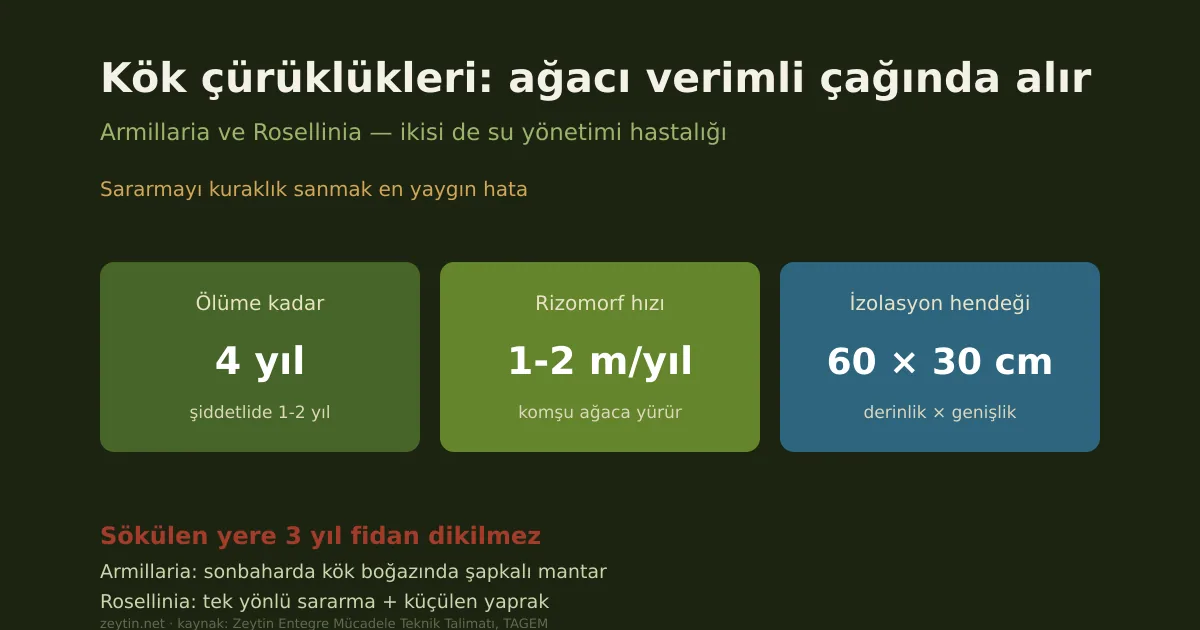
- In the soil there are rhizomorphs — thick, cylindrical mycelial strands with a brown-black rind. They grow 1–2 m a year, travel at 5–15 cm depth (rarely 30 cm), and infect healthy trees through the roots on arrival.
- The wood turns light brown at first, then yellowish or white and spongy.
How fast does it kill? Symptoms and death usually run their course within 4 years; under heavy infection a tree may dry out in 1–2 years.
Where does it appear? In groves cleared from forest or near forest, with heavy, waterlogging soils, where cultural operations are not done properly.
Rosellinia root rot
Rosellinia necatrix is also soil-borne, but it spreads through irrigation water, floods, rainwater and tillage. It forms no rhizomorphs.
How to recognise it
- The first symptom is leaf yellowing. It may cover the whole tree or, depending on where the roots are infected, only one side of it — that asymmetry is a good clue.
- Alongside yellowing, leaves become smaller. Over time they dry and drop, leaving the tree thin.
- Fruit drops before it sizes up or ripens.
- Lift the bark of an affected root and you find a net-like white mycelial mat underneath. In moist soil the same white growth can be seen on the root surface and in the soil around the collar.
- On thick roots the white mycelium darkens over time to grey and black; fine roots turn brown and rot.
- Young trees show symptoms faster; a diseased sapling pulls easily out of the ground by hand.
The short way to tell them apart
| Criterion | Armillaria | Rosellinia |
|---|---|---|
| Mushroom caps | Present at the collar in autumn | Absent |
| Under the bark | Fan-shaped white layer | Net-like white mat |
| Rhizomorphs | Present (brown-black, 1–2 m/yr) | Absent |
| Spread | Root to root via rhizomorphs | Water, floods, tillage |
| Leaf symptom | Yellowing + drop | Yellowing + smaller leaves, often one-sided |
Control: the same logic for both
With root rots the rule is: not cure, but containment and prevention.
When establishing a grove
- Do not plant on heavy, waterlogging soils.
- Cut drainage channels around the grove.
- Do not plant deep.
In management
- Do not damage roots; wounds are the door.
- Avoid flood irrigation; deliver water and fertiliser at the canopy drip line.
- Spread out soil heaped against the collar — roots must not sit deep and airless.
- In infected groves, open the root collars down to the main roots in spring and let them take sun and air through the summer.
- Destroy autumn caps and the root pieces beneath them (Armillaria).
If the disease has appeared
- Remove the dying tree with its roots and burn it. Leave no root fragments in the soil.
- Slake lime into the hole.
- Plant no fruit tree there for at least 3 years.
- If the disease is confined to one part of the grove, isolate the affected trees with trenches 60 cm deep and 30 cm wide so rhizomorphs cannot reach healthy trees.
- If neighbouring groves are infected, cut 60–70 cm deep trenches around your grove so floodwater cannot carry infected material in.
- On a newly infected tree, clean the rotting roots back to sound tissue and prune the canopy to match the root loss.
⚠ The technical instruction includes applying traditional copper preparations (Bordeaux mixture, copper sulphate) to wounds for Armillaria, and slaking lime where a tree has been removed. Consult your Provincial/District Directorate of Agriculture and Forestry for application, rates and current licensed products.
In short
Root rots are a water-management disease. Heavy waterlogging soil, deep planting, flood irrigation, soil heaped against the collar — all lead to the same place. Mushroom caps at the collar in autumn point to Armillaria; one-sided yellowing with shrinking leaves points to Rosellinia. In either case, what you are saving is not the sick tree but the healthy one beside it.
One rating per visitor; you can change yours at any time. Ratings are real reader votes — no seeded or default scores.
Related
 Article
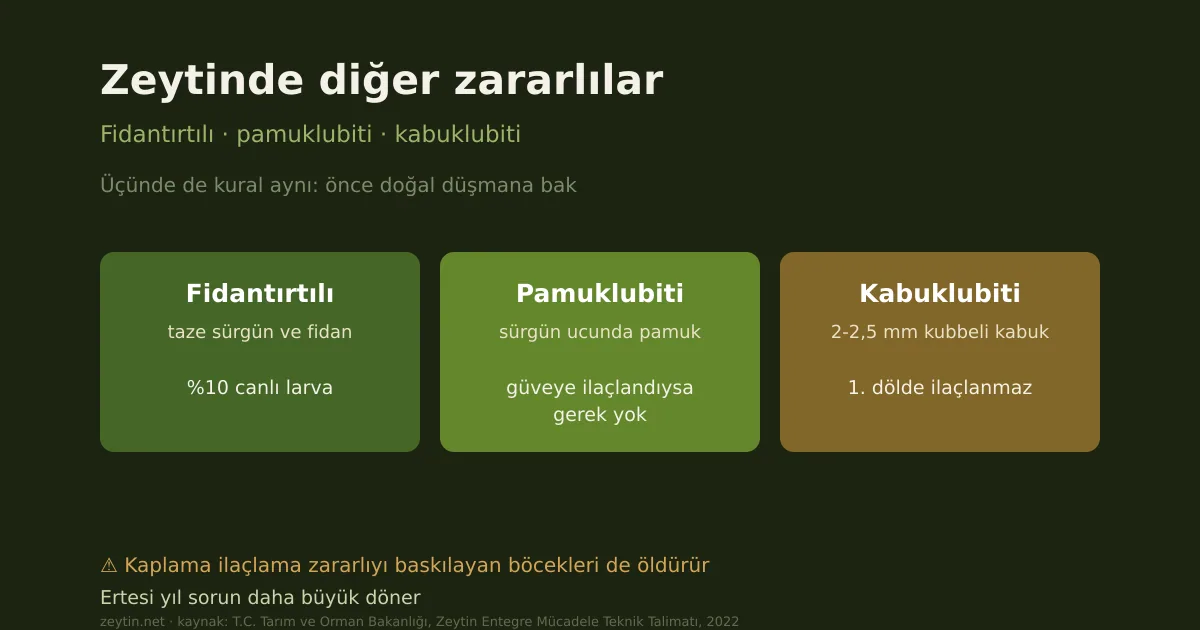
Other olive pests: jasmine moth, psyllid and olive scale
Three olive pests overshadowed by the fruit fly: the jasmine moth on tender shoots, the cottony psyllid, and olive scale.
Article
Other olive pests: jasmine moth, psyllid and olive scale
Three olive pests overshadowed by the fruit fly: the jasmine moth on tender shoots, the cottony psyllid, and olive scale.
 Article
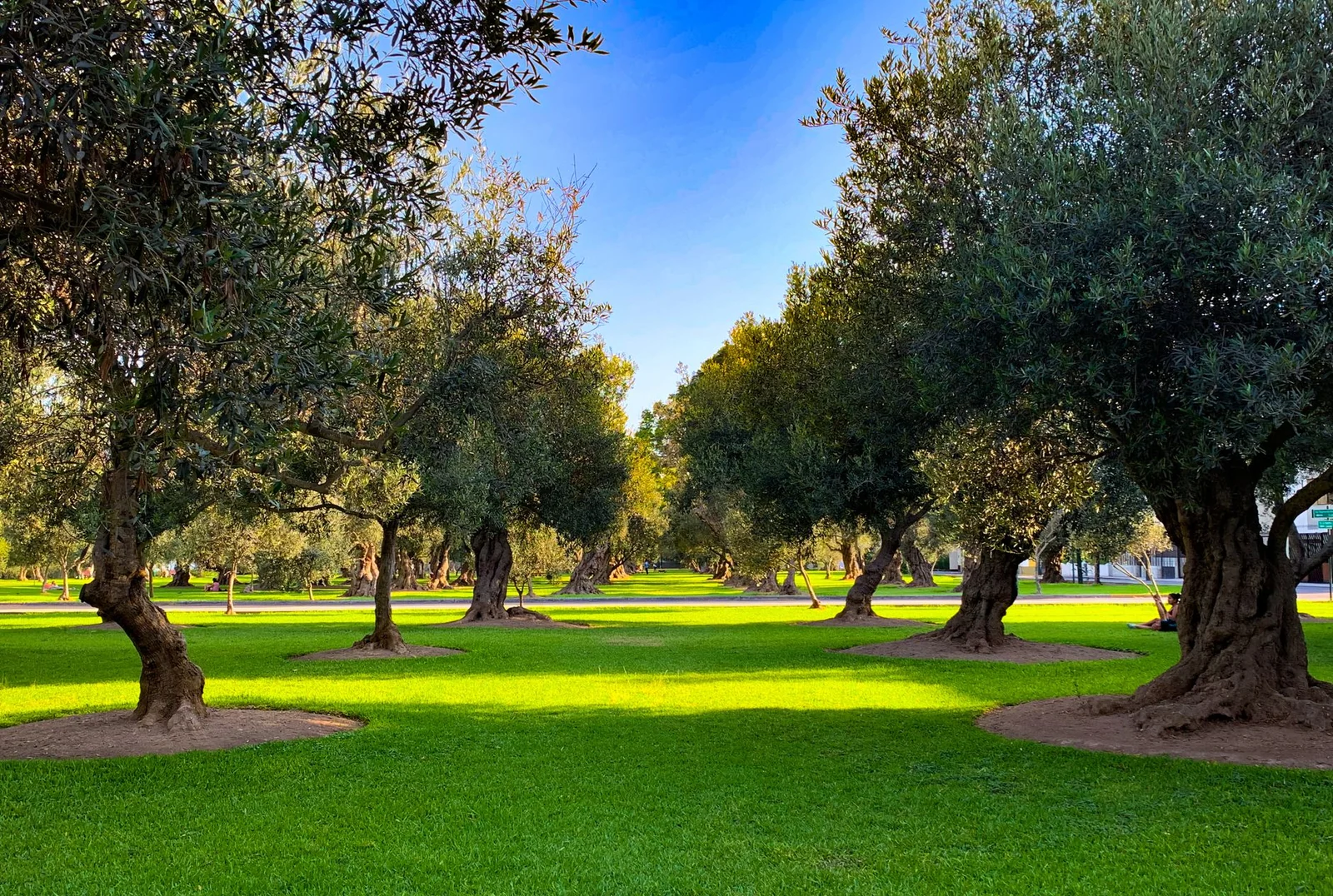
Herbicide-free weed management in olive groves: from cover crops to autonomous robots
Managing weeds rather than eliminating them: cover crops, mulch, grazing, flame weeding and AI-assisted precision farming — five tools and a practical order for combining them.
Article
Herbicide-free weed management in olive groves: from cover crops to autonomous robots
Managing weeds rather than eliminating them: cover crops, mulch, grazing, flame weeding and AI-assisted precision farming — five tools and a practical order for combining them.
 Article
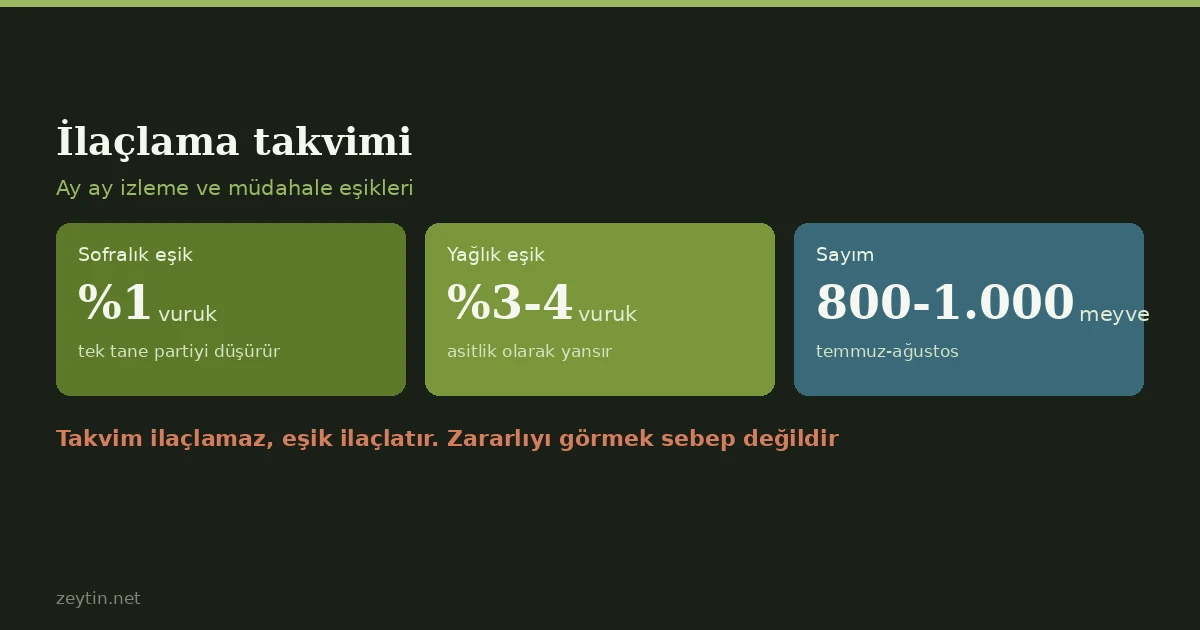
The olive pest calendar and intervention thresholds
Month by month: which pest is at which stage, and when to count. Fly infestation thresholds, black scale shoot counts, and the three regional programmes for peacock spot.
Article
The olive pest calendar and intervention thresholds
Month by month: which pest is at which stage, and when to count. Fly infestation thresholds, black scale shoot counts, and the three regional programmes for peacock spot.
 Article
Verticillium wilt: the disease that kills the tree and has no cure
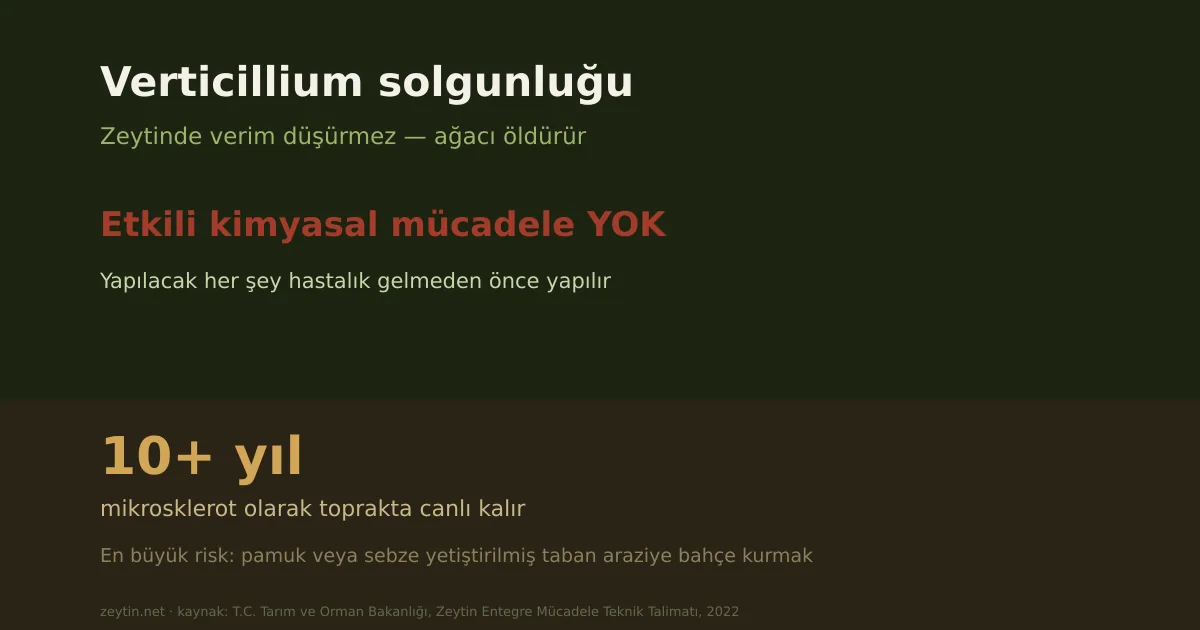
The olive tree disease that kills: it survives over 10 years in the soil, blocks the vessels, and has no effective chemical control.
Article
Verticillium wilt: the disease that kills the tree and has no cure
The olive tree disease that kills: it survives over 10 years in the soil, blocks the vessels, and has no effective chemical control.