Building a high-density olive grove: five requirements
High-density planting is not a choice of variety but a five-component system — miss one and it performs worse than a traditional grove. Spacing, yields, the overlooked oil-content trade-off, and who it does not suit.
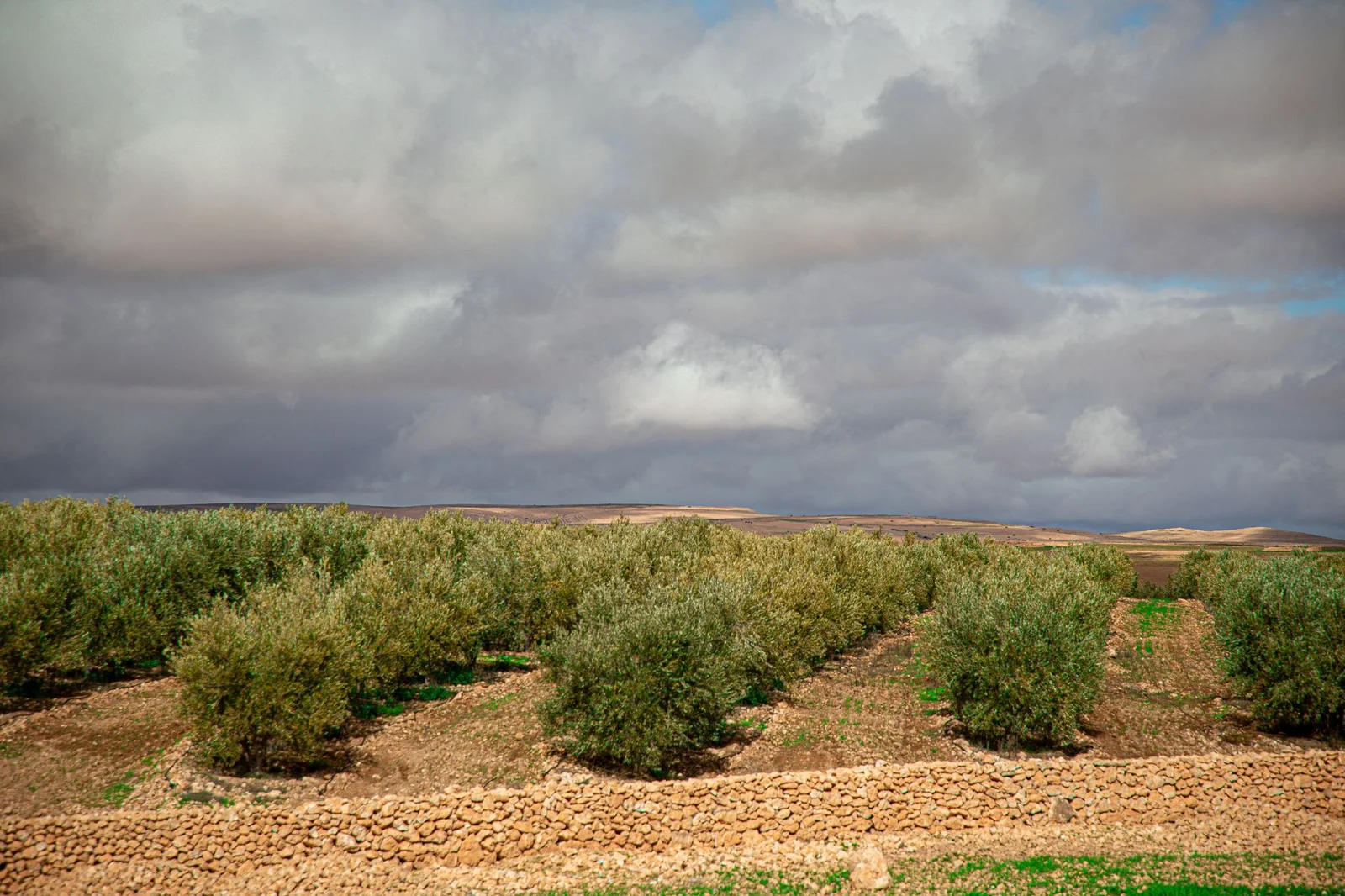
Whether a high-density olive grove pays is a separate argument — we worked through it in how many trees per decare. This article asks a different question: if you have decided to plant one, what does the system demand of you?
Because in high-density planting the most expensive mistake is taking the variety and leaving the system.
The system is a package
Super high-density planting is not "planting the trees closer together". It is a package of five parts, and if one is missing the rest stop working too:
| Component | Requirement | If missing |
|---|---|---|
| Spacing | 3-4 m between rows, 1-1.5 m within the row | the harvester cannot enter the row |
| Training pruning | tree height and canopy held to machine dimensions | the machine cannot grip the tree |
| Drip irrigation | dense planting demands water | trees compete with each other for water |
| Suitable variety | small-canopied, early bearing | the canopy closes, light never reaches the base |
| Access to a harvester | owned or shared | the entire logic of the system collapses |
The last line decides everything. Remove the harvester and what remains is "trees planted very close together, competing for light and water".
That is precisely why the first attempts in Turkey failed: groves established with Spanish varieties suited to super high density were grown in small fields, by traditional methods. The variety was right; the system was absent.
When the crop comes, and how much
With the system correctly built, the yield expectations are:
| Stage | Fruit yield |
|---|---|
| Third year (first crop) | 3-4 t/ha |
| Steady yield | 8-12 t/ha |
| Warm region + good management | up to 16 t/ha |
| Considered sustainable for Arbequina IRTA-i.18 / Arbosana | 9 t/ha fruit (≈2 t/ha oil) |
A crop in the third year is the system's strongest promise. In a traditional grove that wait is far longer.
There is a side benefit too: alternate bearing — the on-year/off-year cycle — runs milder under high density. That matters both for grower income and for the industry's supply stability.
The overlooked trade-off: oil content falls
One cost of high density does not show up in the headline figures: **as trees get denser, the oil content
of the fruit falls.** In the comparison from Morocco's unirrigated Haouz region, tree numbers rose roughly
fivefold while oil content dropped by about three points.
So the gain from high density is not "better fruit" but earlier and more fruit per unit of land.
That has to be carried into any yield calculation: using a variety's catalogue oil content for a
high-density grove overstates the real return. The measured comparison and Arbequina's values:
Who it suits, and who it does not
Given what the system requires, high density makes sense under these conditions:
Suitable:
- Flat or gently sloping land — the machine must be able to work
- Access to irrigation — drip irrigation is essential
- Sufficient scale, or an agreement to share machinery
- An oil-production target — the system was built mainly for oil olives
Not suitable:
- Sloping, stony ground
- Places without irrigation
- Small parcels with no access to machinery
- A table-olive target — fruit size is not a priority in this system
Scale is especially critical in Turkey: a harvester is an expensive investment and makes no sense on its own at an average holding of 45 decares. Which makes the high-density debate an organisational one — either a large enterprise buys the machine or small holdings share it.
Traditional, sloping, unirrigated groves have a different path: rejuvenation, pruning and raising yield on the existing trees.
The variety side: why always Spanish varieties
The varieties used worldwide in high-density planting are mainly Arbequina, Arbosana and Koroneiki — all small-canopied and early bearing.
Their small fruit is not a flaw but fitness for the system. Measured in the same orchard, Arbequina yields a 1.09 g fruit against Karamürsel Su's 9.44 g — a contrast set out in detail in chilling requirements and fruit measurements.
Turkey has 100 registered varieties, and their behaviour under high density is largely unmeasured. Every country runs breeding programmes to identify which of its own varieties suit high density; it is long work, and in Turkey it has yet to bear fruit.
Turkey today
At the time the source studies were written, Turkey was a country where super high density was not practised. That has changed.
High-density planting — known in the Turkish market as "dwarf olive" — is now a commercial form of cultivation:
- Arbequina and Arbosana saplings are standard nursery stock
- Dedicated information sites exist
- Over-the-row harvesters are now built by domestic manufacturers as well
So the problem is no longer "the system does not exist in Turkey". The question has become: how many groves have built it completely?
Summary
- High density is not a choice of variety but a five-component system
- A partially built system performs worse than a traditional grove
- A crop in the third year; steady yield 8-12 t/ha
- Oil content runs a few points lower than semi-dense — the gain is per unit of land
- Without flat land, irrigation, scale and an oil target, it does not suit
- The system now exists in Turkey; the real question is whether it is built in full
Sources
- Savran, M.K. et al. — High-Density Olive Growing in Turkey and the World, Olive Research Institute
- Hmida (2010) — semi-dense versus super high-density comparison, Haouz, Morocco
- Tous et al. (1999) · Larbi et al. (2012) — planting density trials in Catalonia
- İsfendiyaroğlu (2016) — spread by country
- Agromillora — technical data on super high-density olive growing (spacing, yield ranges)
- Turkish nursery-sector dwarf olive sources (2025) — current extent
One rating per visitor; you can change yours at any time. Ratings are real reader votes — no seeded or default scores.
Related
 Article
When does the olive harvest begin?
The harvest starts in late September and runs into February. Erkence is earliest, Memecik hangs into mid-December, and Mission's table and oil harvests are two months apart.
Article
When does the olive harvest begin?
The harvest starts in late September and runs into February. Erkence is earliest, Memecik hangs into mid-December, and Mission's table and oil harvests are two months apart.
 Article
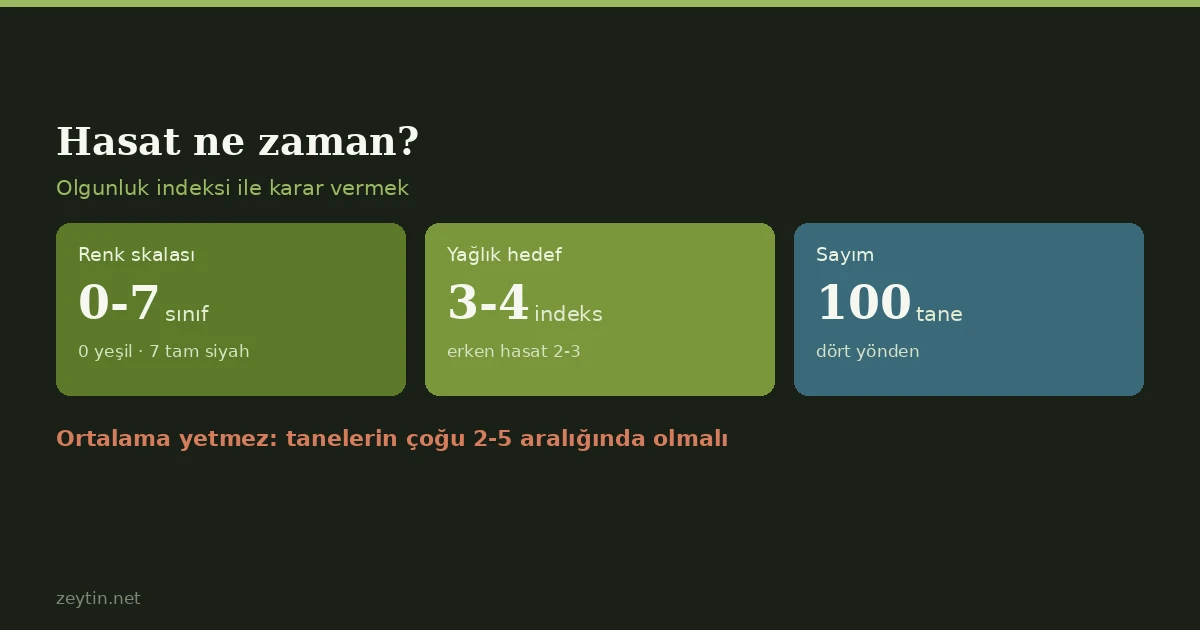
When to harvest olives: deciding with the maturity index
Harvest timing is set by the maturity index, not the calendar. The 0-7 colour scale, how to calculate it from 100 fruits, early versus late harvest compared, and ripening times by variety.
Article
When to harvest olives: deciding with the maturity index
Harvest timing is set by the maturity index, not the calendar. The 0-7 colour scale, how to calculate it from 100 fruits, early versus late harvest compared, and ripening times by variety.
 Article
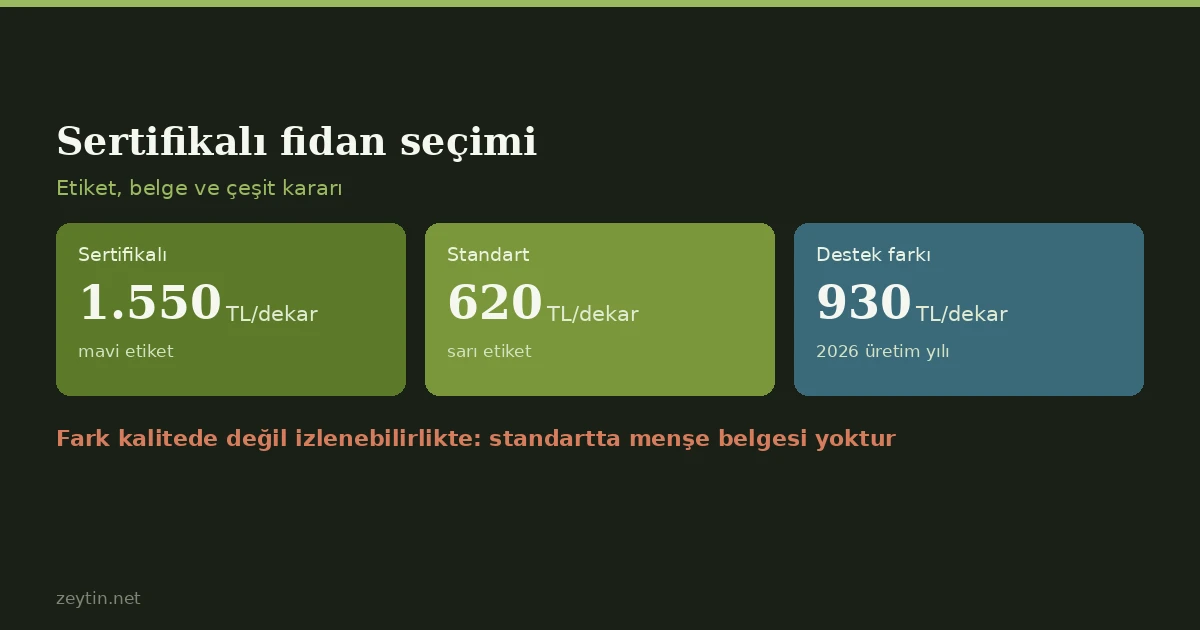
Choosing certified olive saplings: labels, documents and variety
Label colour shows the certificate class: blue certified, yellow standard. The difference is traceability, not quality. The support gap is 930 lira per decare. Four questions that settle variety choice.
Article
Choosing certified olive saplings: labels, documents and variety
Label colour shows the certificate class: blue certified, yellow standard. The difference is traceability, not quality. The support gap is 930 lira per decare. Four questions that settle variety choice.
 Article
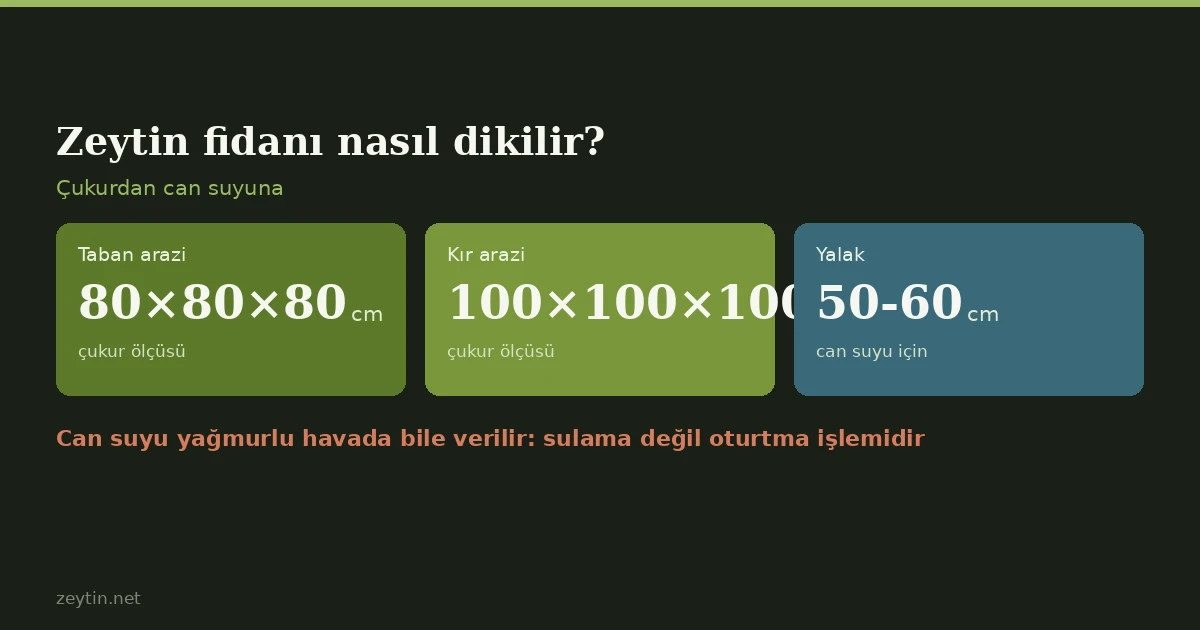
How to plant an olive sapling
Planting season, hole dimensions, removing a potted sapling, planting depth and the graft union, the basin and settling water — why settling water is given even in rain, first-year care and five common mistakes.
Article
How to plant an olive sapling
Planting season, hole dimensions, removing a potted sapling, planting depth and the graft union, the basin and settling water — why settling water is given even in rain, first-year care and five common mistakes.