How do you let an olive grove on shares? What the contract should say
In Türkiye, letting an olive grove on shares is a "share-cropping lease" under the Code of Obligations; if the share is not agreed, local custom applies. Whether the share is in olives or oil, who pays which costs, a term of at least two harvests, pruning consent, frost years, unharvested fruit, what happens if the grove is sold and the headman-approved lease needed for ÇKS: a ten-point checklist with the relevant articles.
Short answer: in Türkiye, letting an olive grove "on shares" (ortakçılık or yarıcılık) is not regulated under that name. The Turkish Code of Obligations treats it as a share-cropping lease — in Turkish law, ürüne katılmalı kira, a lease in which the rent is a share of the crop. The contract can be made orally, but there are two reasons to put it in writing. If the share is not written down, it is set by local custom. And to register the grove in the Farmer Registration System (ÇKS), a lease agreement approved by the village headman is required.
Below we go through what the law says, the clauses that belong in the contract, and the points where disputes most often arise.
How the law defines share-cropping
Article 357 of the Turkish Code of Obligations (Law No. 6098) defines a usufructuary lease (ürün kirası) as a contract in which the lessor lets the lessee use something that yields produce and harvest that produce in return for rent. The second paragraph of the same article gives share-cropping its legal name:
t; A share-cropping lease is a usufructuary lease in which the rent is agreed as a certain proportion of the produce to be harvested. If this proportion has not been agreed in the contract, it is determined according to local custom.
So letting a grove for a fixed sum and letting it for a share of the crop are both usufructuary leases. The only difference is the form of the rent. The popular name yarıcılık comes from splitting the crop in half, but the law sets no ratio. In practice the share varies by region, by the condition of the grove and by who carries the costs. If the share is not written down, any dispute turns on what local custom is — something both sides tend to remember differently.
Where there is no special rule for usufructuary leases, the general provisions on leases apply (art. 358).
How common is it?
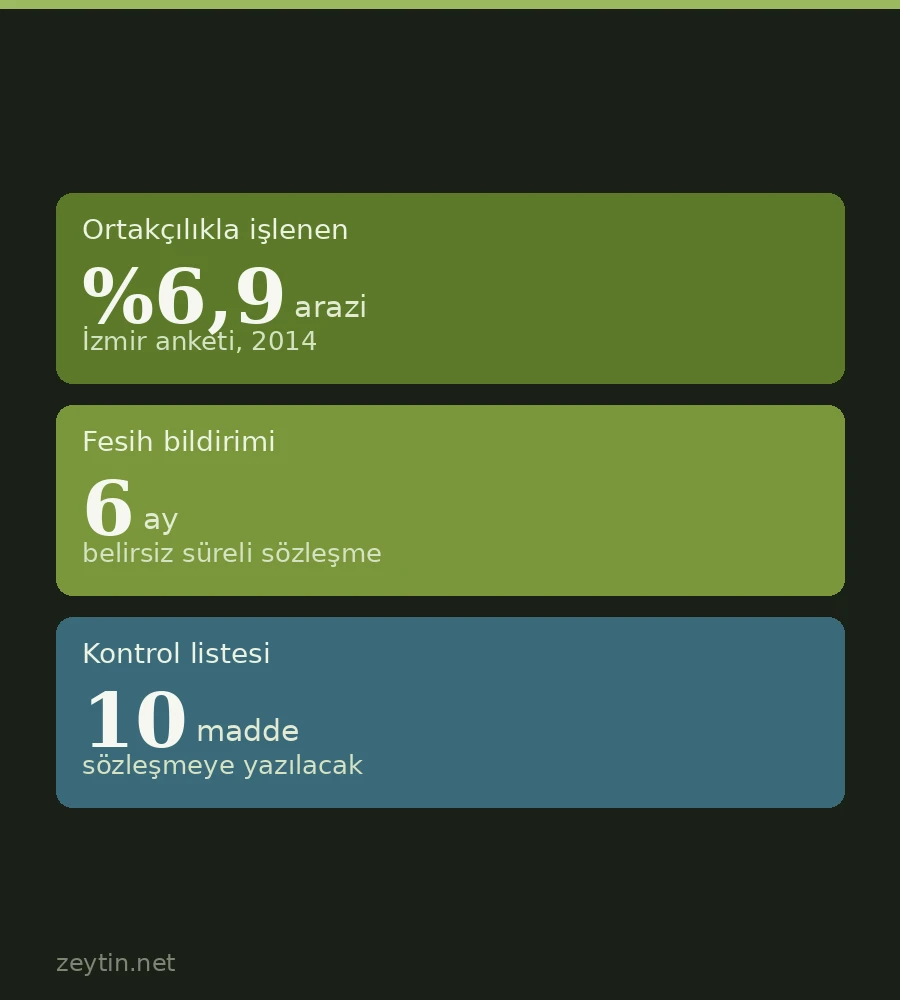
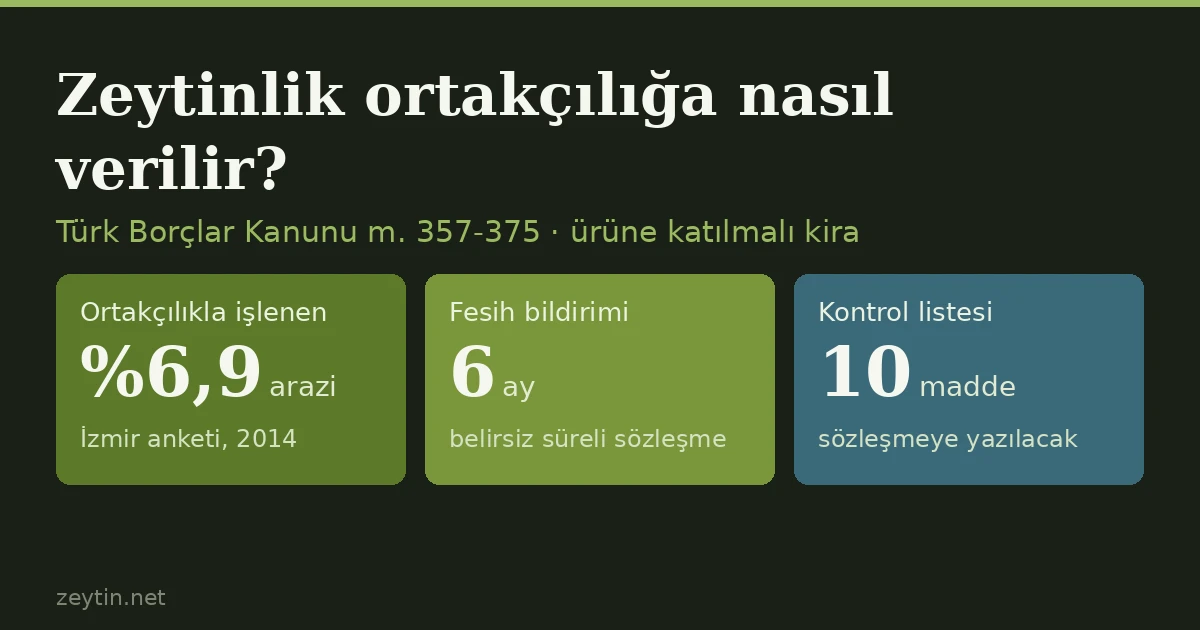
There is no measured national figure. In a survey of 64 olive growers in İzmir by researchers at Ege University, published in 2014, 92.7% of farm land was owner-operated, 6.9% was worked under share-cropping, and only 0.4% was rented for cash. Fixed-rent leases were almost absent; when olive land changed hands for working, it did so mostly on shares. We summarised the study's other findings in problems of olive growers.
There is a clear reason for this. Olive yields swing sharply between an on year and an off year. Under a fixed rent, the whole risk of the off year falls on the grower who works the land. Under a crop share, both parties lose together in a bad year and gain together in a good one.
Ten clauses the contract should contain
1. Identify the grove. The block and parcel number from the land registry, the area and the number of trees. The Code requires that, where the lease also covers tools, equipment or other items, the parties jointly value them and sign an inventory in two copies (art. 359). Recording the number and age of trees, and any ungrafted ones, in the same inventory prevents a "trees are missing" argument at the end.
2. Define what the share is a share of. This is where most disputes start. Is the share calculated on olives or on oil? With an olive share, the contract should say where the weighing takes place and where delivery is made. With an oil share, it should say who pays the milling fee and how the oil yield will be documented. We explained where kilos and litres get confused in how much oil one kilo of olives gives, and which documents to ask for at the mill in what to check when having olives pressed.
3. Split the costs. The Code places the duty of upkeep on the lessee — the share-cropper — including minor repairs (art. 365). Major repairs that become necessary during the lease are the lessor's responsibility (art. 361). There is no statutory rule for fertiliser, crop protection, pruning labour, irrigation water, harvest wages or transport. Each of these should be assigned in writing, and the share itself is usually negotiated against that split.
4. Set the term. A fixed-term lease ends automatically when the term expires. If the parties tacitly carry on, the lease is deemed renewed for one year at a time unless agreed otherwise (art. 367). With olives, a one-year contract lands the share-cropper on either an on year or an off year. A term covering at least two harvests is therefore more sensible.
5. Pruning and the way the grove is run. Without the lessor's consent, the lessee may not change the way the land is farmed in a manner whose effects will last beyond the end of the lease (art. 364). Heavy rejuvenation pruning, converting to irrigation or top-working trees to a new variety fall into this category and should require consent. Uprooting trees is a separate matter: in designated olive-growing areas it requires a permit from the agriculture ministry and cannot be delegated to the share-cropper by contract. We cover how and when to prune separately.
6. Frost and hail years. If the normal yield of agricultural land falls substantially because of an extraordinary disaster or natural event, the lessee may ask for a proportional reduction of the rent (art. 363). This matters mostly for fixed rents, since under a crop share the share falls automatically with the crop. Writing "no reduction may be claimed" into the contract does not always work: under the Code, waiving this right in advance is valid only if the possibility was taken into account when the rent was set, or if the loss is covered by insurance. We describe what frost damage looks like in the grove in another article.
7. The end date and unharvested fruit. When the lease of agricultural land ends, the lessee has no claim to produce not yet harvested. The lessee may, however, claim compensation for the costs incurred in growing it, in an amount set by the court (art. 374). Because the olive harvest can stretch from November into January, tying the end of the contract to completion of harvest and delivery rather than to a calendar date avoids conflict.
8. Passing the grove on. The share-cropper may not sublet the grove or transfer the right to farm it without the lessor's consent (art. 366). The common arrangement of "I'll take it on and get someone else to work it" needs written permission.
9. If the grove is sold. If the leased property changes hands for any reason after the contract is made, the new owner becomes a party to the lease (art. 310). Selling the grove does not end the share-cropping arrangement by itself.
10. Death and termination. In an open-ended lease, unless the contract or local custom sets another period, termination requires at least six months' notice. For agricultural land, notice is given for the spring or autumn date used by local custom (art. 368). If the share-cropper dies, the heirs and the lessor may terminate with six months' statutory notice (art. 371).
ÇKS registration and support payments
Applications for agricultural support rely on the ÇKS record, and the grove is registered in the name of the person who actually farms it. Under Article 7 of the Farmer Registration System Regulation, a lease agreement is required to register leased land. The agreement must be signed in the presence of the village headman and council members and approved by the headman. If the lease allows it, the lessee may in turn let the land to another farmer; in that case both agreements are required for registration.
Two further points matter. First, ÇKS records are not used to determine ownership: the share-cropper's registration gives no right over the land itself. Second, the contract should state clearly which party receives any support payment and whether it is shared. Like every clause left unwritten, this one tends to become an argument after the harvest.
Tax on sales
Whichever party sells its share, the buyer withholds tax on the sale: 4% if the sale is not registered at a commodity exchange, 2% if it is. Details are in withholding tax and the producer receipt. A party that prefers to sell through a cooperative can look at joining an olive cooperative.
Summary
- Share-cropping is a "share-cropping lease" under the Code of Obligations (art. 357). If the share is not agreed, local custom applies.
- The contract should say whether the share is in olives or oil, who pays the milling fee and where weighing takes place.
- Upkeep is the share-cropper's duty, major repairs the owner's. Input costs are split by agreement.
- The term should cover at least two harvests, and the end should be tied to harvest and delivery.
- Changes to the way the grove is farmed need consent. Uprooting trees also needs a ministry permit.
- If the grove is sold, the lease continues with the new owner (art. 310).
- ÇKS registration requires a lease approved by the village headman. Registration is not proof of ownership.
⚠ This article provides general information and is not legal advice. For a valuable or long-term contract, consult a lawyer or the local chamber of agriculture.
One rating per visitor; you can change yours at any time. Ratings are real reader votes — no seeded or default scores.
Related
 Article
Does a harvesting machine damage the olive tree?
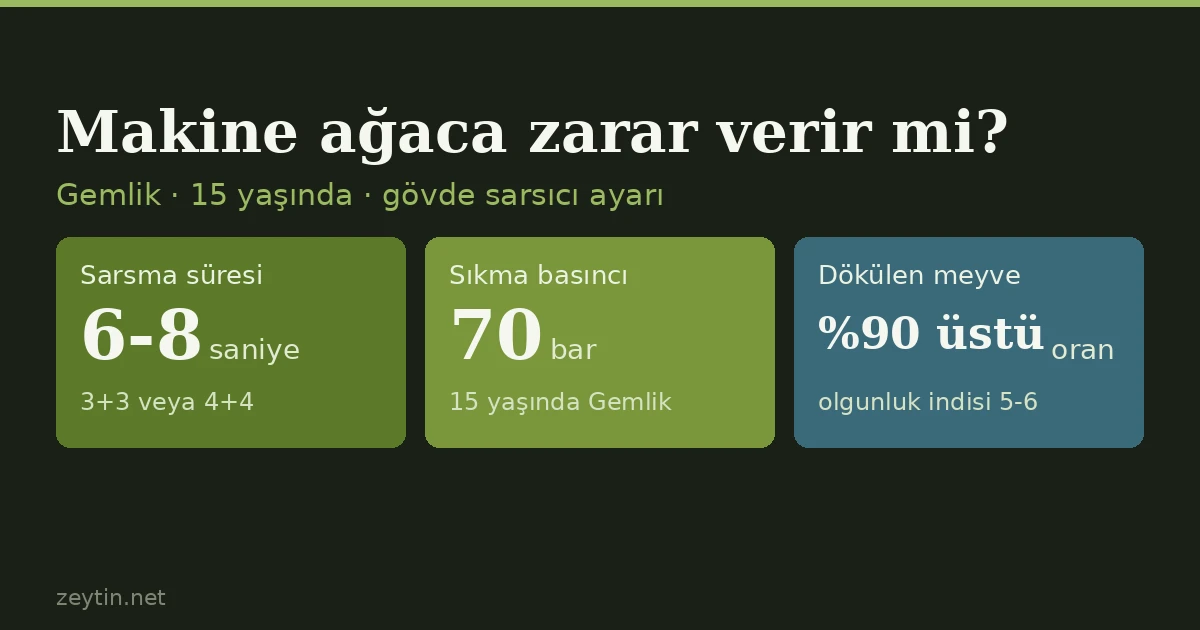
Trunk shakers, branch shakers and hand picking: the damage comes not from the machine itself but from its settings and duration. The figures the Turkish agriculture ministry's research institute gives for the Gemlik variety — 70 bar clamping pressure, 20 Hz, a 6-8 second shake — and what falls off the tree once that window is exceeded. Why grove spacing, slope limits and operator training are technical requirements.
 Article
Where does an olive sapling come from? From cutting to laboratory
Most table olive varieties will not root, and those that do are clones of one another — defenceless against disease. Tissue culture reports up to 85% success in vitro, but zeatin is expensive.
 Article
When to harvest olives: deciding with the maturity index
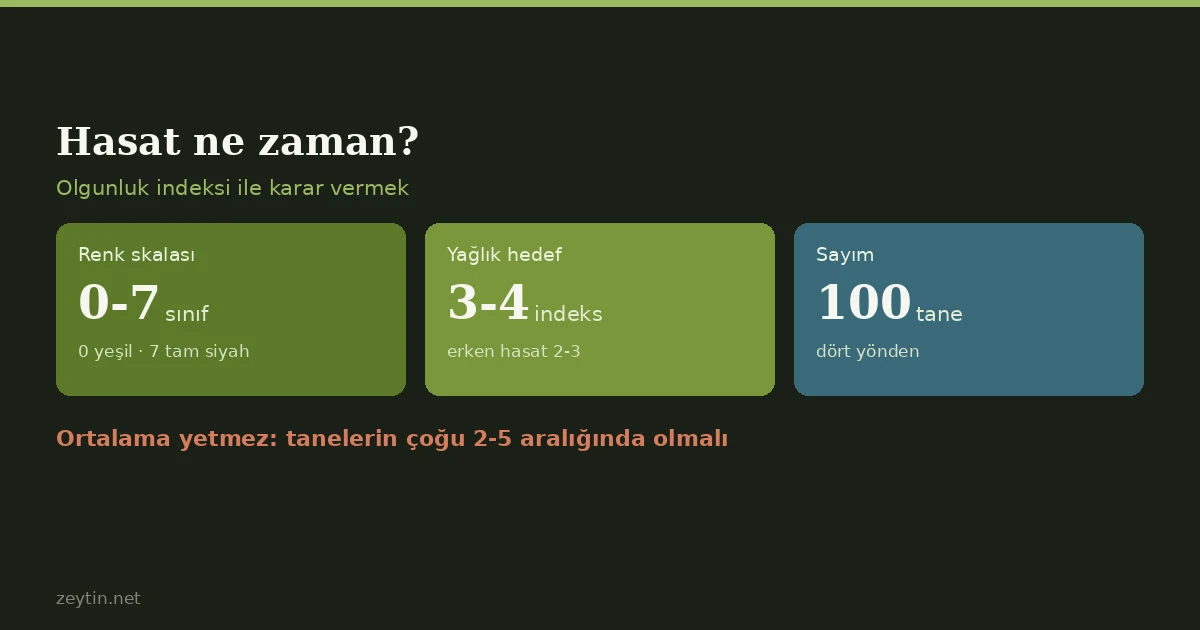
Harvest timing is set by the maturity index, not the calendar. The 0-7 colour scale, how to calculate it from 100 fruits, early versus late harvest compared, and ripening times by variety.
 Article
What is an olive harvest net, and how do you choose one?
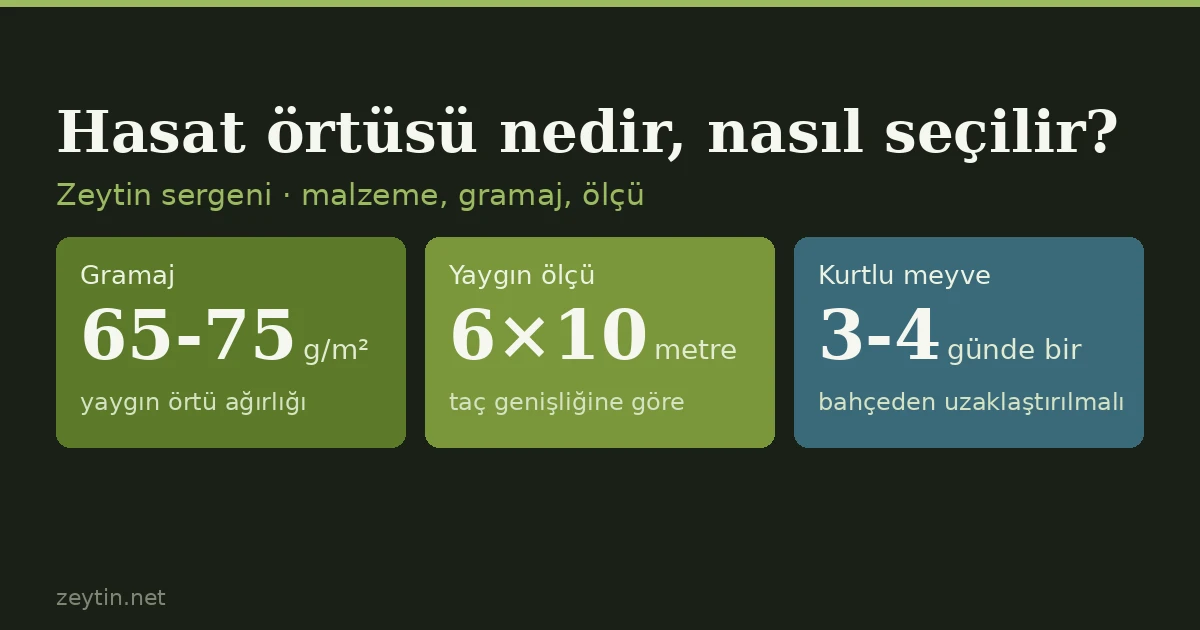
A net spread under the tree does two jobs at once: it keeps the fruit off the soil and it speeds up collection. Olives that touch the ground give higher-acidity oil, and fruit left on the ground feeds the next generation of olive fruit fly. Here is how to choose a net — material, weight, size — and how to lay it.