Why is my olive tree dropping its leaves?
An olive leaf lives two to three years and falls in spring along with the new growth; that is normal. The worrying drop is the one whose season, location or amount does not fit. Rings on the upper surface point to peacock spot, grey patches underneath to Cercospora leaf spot, dieback on one branch to Verticillium, one-sided yellowing to root rot. Water, nutrient deficiencies, scale insects, frost and lack of light also make olives shed leaves. How to tell them apart, and what to do.
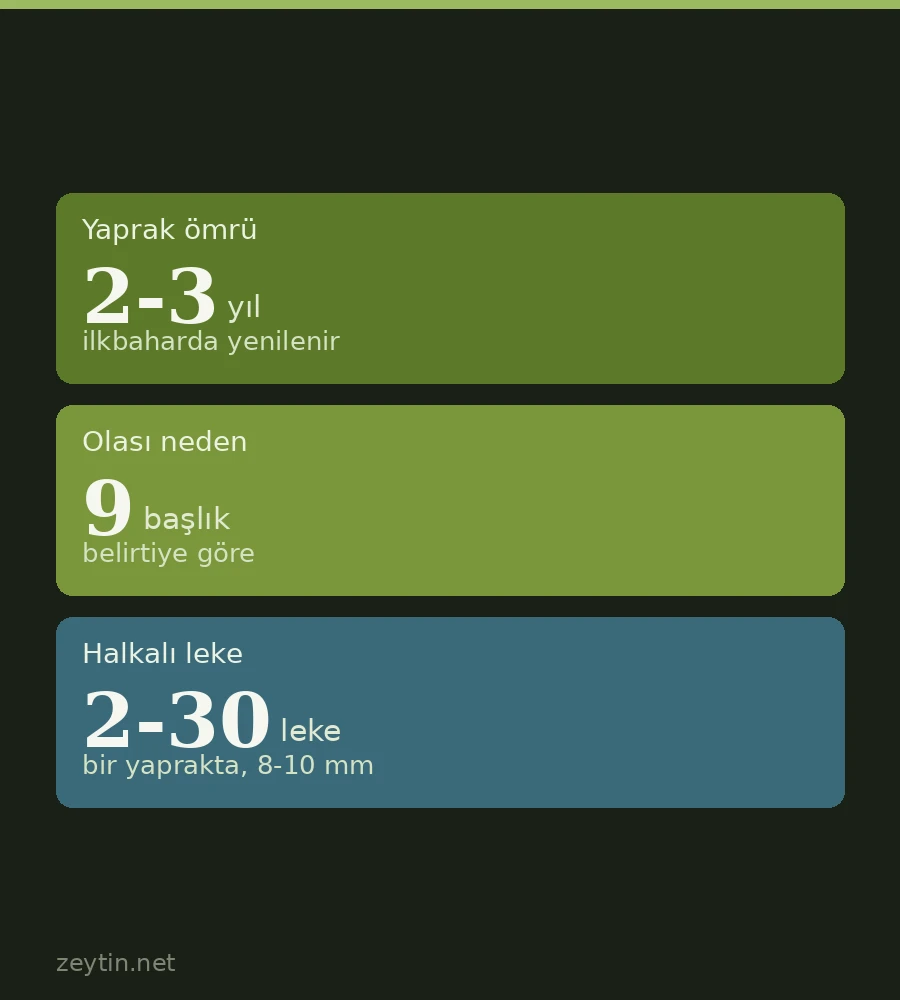
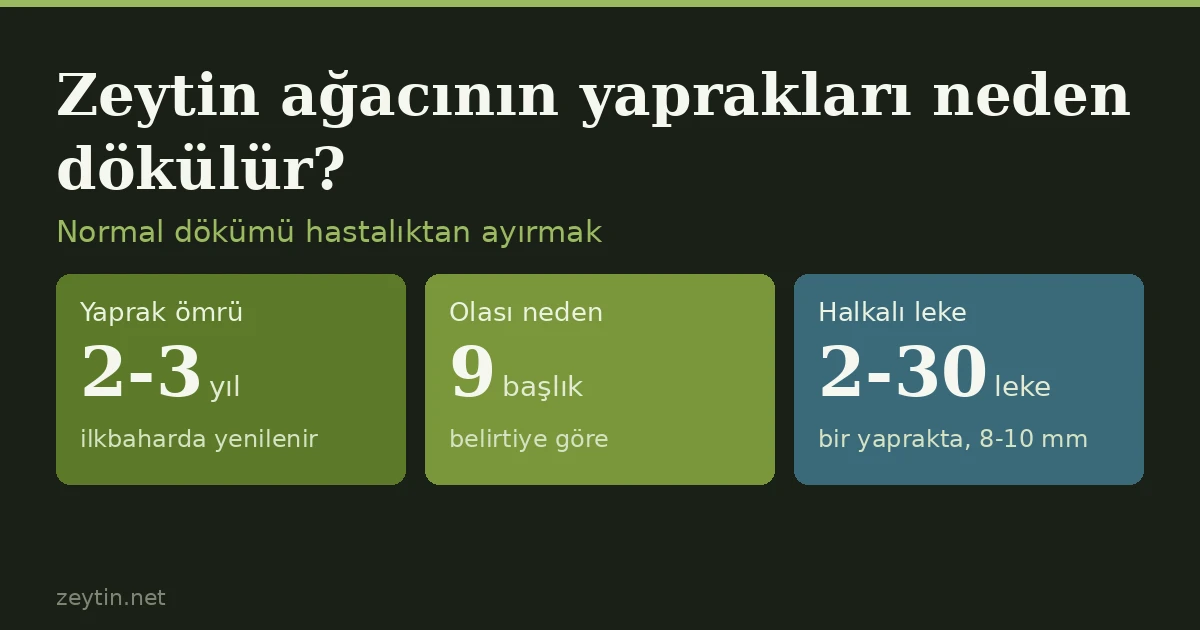
The short answer: the olive is an evergreen, but it does not keep its leaves for life. Each leaf lives two to three years, and the old leaves fall in spring, as new shoots emerge. That drop is normal. The leaf drop you should worry about is the one whose season, location or amount does not fit that pattern: spots on the leaves, a drop concentrated on one branch or one side of the tree, or a tree that is not putting out new growth.
This article sorts leaf drop by symptom and links each possible cause to the detailed article on it.
First, rule out the normal
An olive leaf lives two to three years. According to the University of California's garden advisory publications, leaves of that age usually fall in spring, at the same time as the new growth appears. Normal leaf drop has three signs:
- The leaves that fall are the old ones on the inside and lower part of the tree; the shoot tips are green and full.
- Each leaf yellows evenly before it drops; it carries no spots, rings or soot.
- The tree is putting out new shoots at the same time.
If all three are present, there is nothing to do. If one is missing, look at the table below.
| What you see | Likely cause |
|---|---|
| Dark spots in concentric rings on the upper leaf surface, heavy drop in spring | Peacock spot |
| Grey, leaden patches on the underside of the leaf; upper side yellowed | Cercospora leaf spot |
| Sudden dieback on a single branch, leaves brown and curled along the midrib | Verticillium wilt |
| Yellowing and small leaves on one side, tree weakening over the years | Root rot |
| Yellowing and drop in the lower and middle canopy, weak shoots | Nitrogen deficiency or overwatering |
| Leaves and branches covered in a black, soot-like layer | Black scale and sooty mould |
| Leaves drying and curling after a cold night | Frost damage |
| Smaller leaves, curling at midday, drop in summer | Drought stress |
| Potted tree indoors, leaves falling continuously | Too little light |
1. Peacock spot
This is the best-known disease cause of leaf drop in olives. It is caused by a fungus (Spilocaea oleagina). Blackish-grey dots appear first on the upper surface of the leaf, and rings then form around them; a single leaf may carry 2 to 30 spots, each 8-10 millimetres across. At an advanced stage the leaves yellow and fall; in epidemic years the tree loses much of its foliage in spring and takes on a bushy, stripped look.
The disease thrives on humidity: it is more common in densely planted, poorly ventilated groves on low-lying ground with heavy, water-holding soil, and near the sea. Because the fungus overwinters in fallen leaves, collecting the spotted leaves on the ground is part of controlling it. Symptoms and a regional spray calendar are in our peacock spot article.
2. Cercospora leaf spot
This is the disease most often confused with peacock spot. It is caused by Pseudocercospora cladosporioides. According to the scientific literature, the first symptom is grey patches on the underside of the leaf; the upper side yellows, the leaf turns yellow and then reddish-brown, and drops. In severe cases it causes heavy defoliation. It has been recorded in many olive-growing countries, including Greece, Italy, Spain, Portugal and Tunisia.
The way to tell them apart is simple: peacock spot marks the upper surface, in rings; Cercospora leaf spot marks the underside, without rings. For a firm diagnosis, take a leaf sample to the provincial or district agriculture directorate.
3. Verticillium wilt
A soil-borne fungus enters through the roots and blocks the water-conducting vessels, so water no longer reaches the leaves. The symptom usually appears on a single branch or one part of the tree: the leaves lose their green colour, turn light brown and curl back along the midrib. In spring, symptoms may show on the flowers before the leaves. It matters to prune out the dead branches before the leaves fall, because diseased leaves dropping to the ground add to the inoculum in the soil. Details in our Verticillium article.
4. Root rots
The leaves reveal a problem below ground, but late. With root-rot fungi such as Armillaria and Rosellinia, the first symptom is yellowing; it may affect the whole tree or, depending on where the roots are infected, only one side. The leaves become smaller and eventually drop, leaving the tree with fewer leaves than normal. Heavy, waterlogged soil, deep planting and flood irrigation all raise the risk. Our root rots article explains how to tell the two fungi apart.
5. Water: too little and too much
Drought. The olive tolerates drought, but it pays for it with its leaves: it makes them smaller, shortens its shoots and sheds fruit. A slight curling of the leaves at midday is the first warning, though by the time it shows the stress is already under way. Our irrigation article covers when and how much to water.
Too much water. Especially in pots and in heavy soil, lower leaves that yellow and drop, together with soil that stays wet, point to overwatering. If this goes on, it turns into root rot.
6. Nutrient deficiencies
According to the deficiency table in the Turkish ministry's technical sources, a nitrogen shortage shows as yellowing of the leaves, with drop starting in the lower and middle part of the tree. With boron deficiency, shoots break easily and dry out, and leaves fall. With potassium deficiency, the tips of older leaves turn brown while the base stays yellow. Because these symptoms resemble one another — and resemble diseases — diagnosis by eye is misleading; the right route is leaf and soil analysis. Sampling methods and standard values are in our nutrient deficiencies article.
7. Black scale and sooty mould
If leaves and branches are covered with a black, soot-like layer, the problem is not the blackness but the insect behind it. The olive black scale feeds on sap; fungi grow on the sweet honeydew it excretes, and the black layer coating the leaves blocks photosynthesis. As infestation grows, leaf and fruit drop begin. When to intervene is covered in our black scale article.
8. Frost
Leaves that dry, curl, lose colour and fall after a cold night are the typical picture of light to moderate frost damage. The tree usually sprouts again. Cracked bark and blackened shoot tips indicate more serious damage. Applying heavy nitrogen after a frost because "the tree is weak" can be a mistake. Details in our frost damage article.
9. Potted and newly planted trees
The most common complaint about olives kept indoors is leaf drop, and the main reason is light: the olive needs at least six hours of direct sun a day. A tree standing a few metres back from a window does not get it. Our article on caring for an olive tree in a pot has advice on position and watering.
On a newly planted or transplanted sapling, some leaf loss can be part of the root system adjusting to its new place. As long as the shoot tips stay alive, it is worth waiting; first-year care is covered in how to plant an olive sapling.
What to do
1. Check the season. Spring drop from the inner canopy, without spots and with new growth, is normal.
2. Look at both sides of the leaf. Rings on the upper side, grey patches underneath, or soot?
3. Look at the pattern. One branch, one side, the whole tree or only the lower canopy each point to different causes.
4. Do not leave spotted leaves on the ground. They are next spring's source of peacock spot.
5. Do not spray or fertilise on a guess. Take a sample of the spotted leaves to the provincial or district agriculture directorate, and have a leaf analysis done if you suspect a nutrient problem.
Read with care
⚠ This article is not a diagnostic tool; it points you in a direction. Symptoms resemble one another, and more than one cause can be at work in the same tree.
⚠ For spraying decisions, obtain the current list of licensed products and a calendar suited to your region from the provincial or district directorate.
One rating per visitor; you can change yours at any time. Ratings are real reader votes — no seeded or default scores.
Related
 Article
How to Grow an Olive Tree
Soil, climate, watering, pruning and patience. A basic care guide for anyone planting an olive tree.
 Article
When does the olive harvest begin?
The harvest starts in late September and runs into February. Erkence is earliest, Memecik hangs into mid-December, and Mission's table and oil harvests are two months apart.
 Article
Choosing certified olive saplings: labels, documents and variety
Label colour shows the certificate class: blue certified, yellow standard. The difference is traceability, not quality. The support gap is 930 lira per decare. Four questions that settle variety choice.
 Article
Grafting Olives: Changing Cultivar and Improving Wild Trees
When grafting is needed, taking scion wood, bud and cleft methods, topworking and aftercare.