What is an olive harvest net, and how do you choose one?
A net spread under the tree does two jobs at once: it keeps the fruit off the soil and it speeds up collection. Olives that touch the ground give higher-acidity oil, and fruit left on the ground feeds the next generation of olive fruit fly. Here is how to choose a net — material, weight, size — and how to lay it.
The cheapest piece of equipment in an olive harvest is often the one that earns its keep most reliably: the net spread under the tree. Depending on the region it is called a ground sheet, a harvest net or a collection net, but the job is the same.
That net does two things at once. First, it speeds up collection — the fruit that comes down lands on a single surface and can be swept toward one point. Second, and more importantly, it keeps the fruit from touching the soil.
Why contact with soil matters
An olive is vulnerable from the moment it leaves the branch. Fruit that touches soil, gets crushed or picks up mud sees microbial activity accelerate, and the free fatty acidity of the resulting oil rises.
According to the quality and harvest assessment published by the Osmaniye Provincial Directorate of Agriculture and Forestry, oil obtained from olives that have fallen to the ground or sat for a while shows high acidity, and such fruit cannot be used for food purposes. The issue is not cosmetic but categorical: a batch from the same grove, picked on the same day, can fall out of the extra virgin class purely because it touched the ground. We explained what acidity actually measures in what does acidity mean in olive oil.
In table olives the consequence is even more visible — bruised fruit returns as staining and softening in the brine. We collected those defects in quality problems in table olives.
Fruit left on the ground is next year's fly
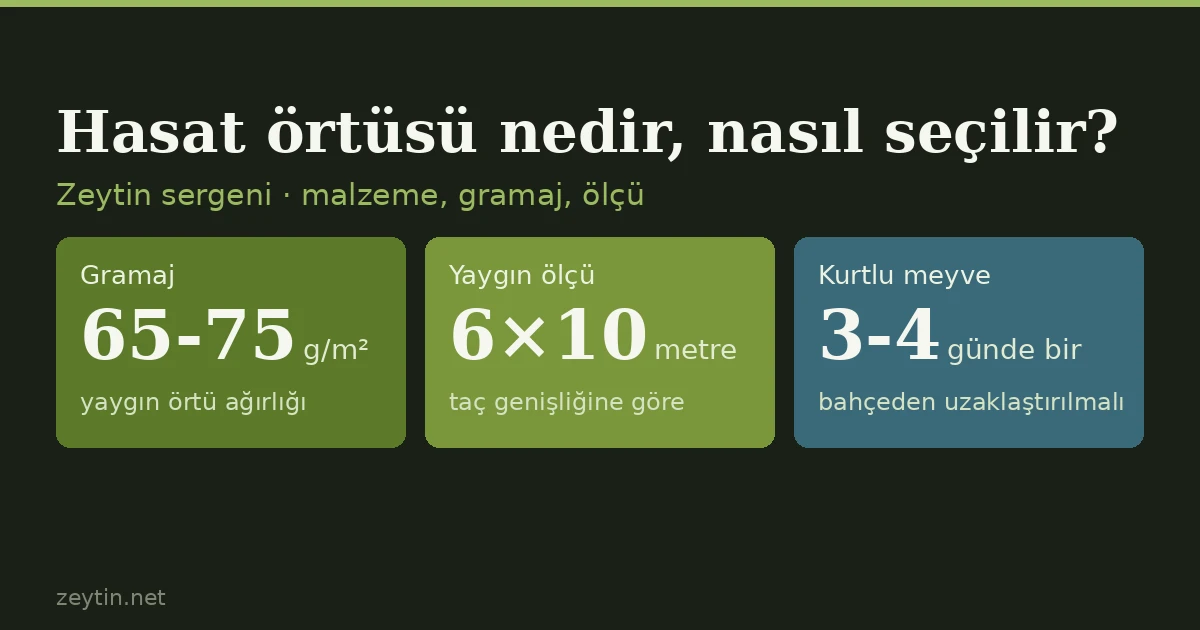
The net's second and most frequently overlooked benefit sits on the plant health side. Among the cultural measures listed for the olive fruit fly in the Ministry of Agriculture and Forestry's Integrated Pest Management Technical Instruction for Olives is this one: throughout the damage period, infested fruit should be collected every three to four days and removed from the grove. The same instruction also recommends working the soil in winter to destroy pupae.
The net's role here is simple. If the fruit that comes down stays on a single surface instead of mixing into the soil, it is possible to separate the infested fruit and take it out of the grove. Fruit scattered under the tree, in practice, never gets collected and stays where it fell. We covered the pre-harvest pressure from the olive fruit fly in the case of the warning issued in Aydın and Didim.
Material, weight, size
Harvest nets sold on the market share a common set of specifications:
| Specification | Common value | What it does |
|---|---|---|
| Material | Woven polypropylene / high-density polyethylene | Resistance to tearing and abrasion |
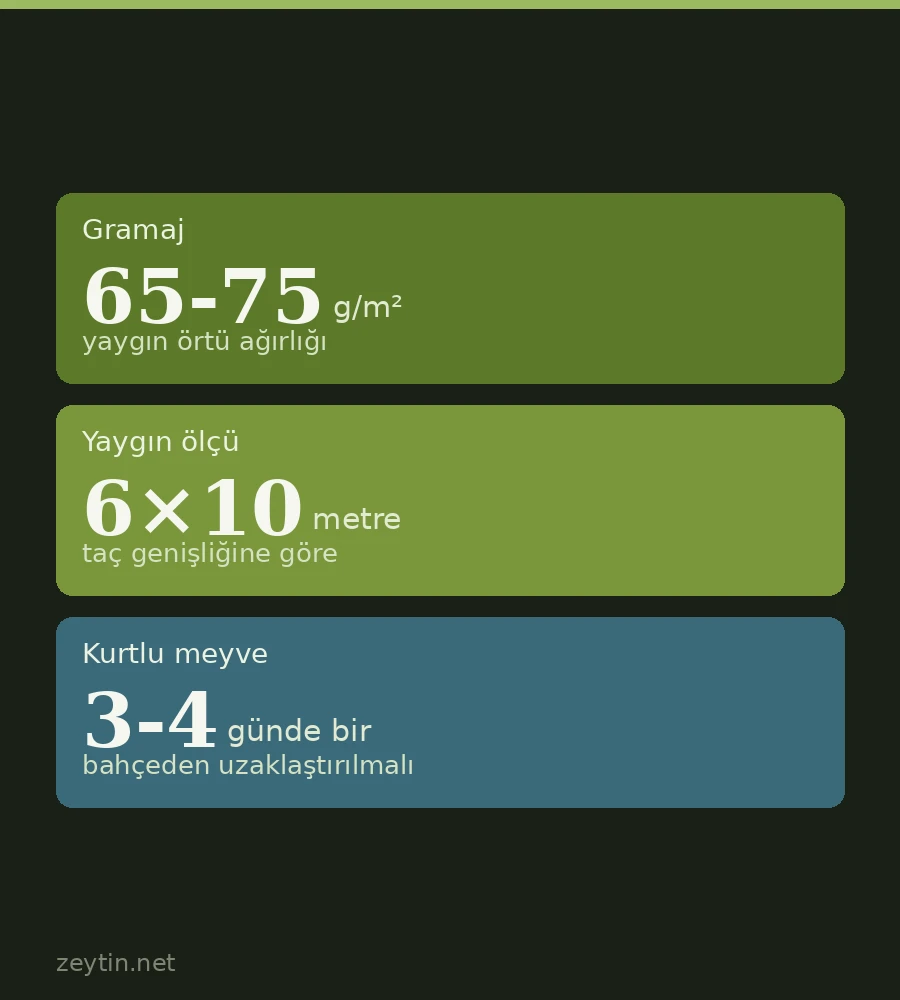
| Weight | 65-75 g/m² | Lighter is easier to move, heavier lasts longer |
| Density | around 75% | Porous weave lets water through, fruit stays on top |
| Size | 6×9, 6×10, 8×12 m | Chosen by canopy width |
| Edge | Overlocked seam | Stops the edge from unravelling |
| Additive | UV stabilised | Years of use in sunlight |
The porous weave has a practical payoff: when there is dew or overnight rain on the morning of the harvest, the water drains through and the fruit does not sit in it. A solid tarpaulin does the opposite.
When choosing a size, the measure to use is not the height of the tree but the width of the canopy's footprint. If the net does not cover the whole area the fruit falls into, it is not doing its job; in groves working with undersized nets, the losses are always at the edges.
Split or plain
Two types are common. The plain sheet is a single piece laid under one half of the tree, then moved across once that side is finished. It is cheap and fits any tree, but it means laying and lifting twice per tree.
The split net is cut from one edge in to the centre so it can be slipped around the trunk, covering the whole canopy floor in one go. Versions with straps and rings let the edges be fastened together. With a larger crew and a densely planted grove, it saves real time.
The choice depends on tree form: on multi-trunked traditional trees a split net is awkward to fit, and the plain sheet remains the more practical option.
How to lay it
A few details decide the outcome:
- Centre it on the trunk. The net's centre of gravity belongs at the base of the tree, with the edges extending past the canopy footprint.
- Leave more on the downhill side. Fruit always rolls downhill; whichever side is cut short is the side that loses fruit.
- Weight the edges. Stones, sandbags or pegs — a net lifting in the wind costs both working time and safety.
- Overlap two nets rather than butting them together. The gap between them is exactly where fruit escapes.
- Agree the laying and lifting order with the crew. Waiting for one person to come down from a tree is the single biggest time sink of a harvest day.
Umbrellas instead of nets in mechanical harvesting
In groves worked with a trunk shaker there is an alternative to the ground sheet. According to the mechanical harvesting work of the Atatürk Central Horticultural Research Institute, part of the Ministry of Agriculture and Forestry, the fruit can be dropped onto nets spread on the ground, or collected more safely and with less damage by fitting an umbrella system to the machine.
The umbrella comes with a condition: row and in-row spacing must be planned to allow the machine to manoeuvre. The same work gives a minimum of 7×7 m or 8×7 m for those distances. In a crowded traditional grove the umbrella will not work, and the ground sheet stays.
We compared which harvesting method suits which grove in the cost of five harvesting methods to the tree and to the oil.
After the net
The work does not end when the net has gathered the fruit. The sequence described in the same institute's work is this: what comes down is sorted free of leaves and shoots and then placed in crates for sale.
Two details matter here. The first is the sorting — leaves and twigs arriving from the net affect both yield and the taste of the oil at the mill. The second is the container: olives should travel in ventilated crates rather than sacks, because fruit piled on itself begins to spoil from its own heat.
The third is time. Picked fruit needs to reach the mill as quickly as possible; we went through how fast waiting shows up in the oil in how soon must harvested olives be pressed.
Common mistakes
- Leaving the net in the grove once the harvest ends. Even UV-stabilised fabric ages in a single season if left permanently exposed.
- Mixing fruit picked off the ground with fruit taken from the tree. Anything that touched soil should be kept and processed separately.
- Folding and storing the net while wet. It develops mould, and next season the fruit falls onto a tainted surface.
- Taking an undersized net to a large tree. You will not see the loss, because the loss happens around the edges.
What to do for the tree itself once the harvest is over is collected in olive tree care after harvest.
One rating per visitor; you can change yours at any time. Ratings are real reader votes — no seeded or default scores.
Related
 Article
Organic olive growing: what a four-year trial found
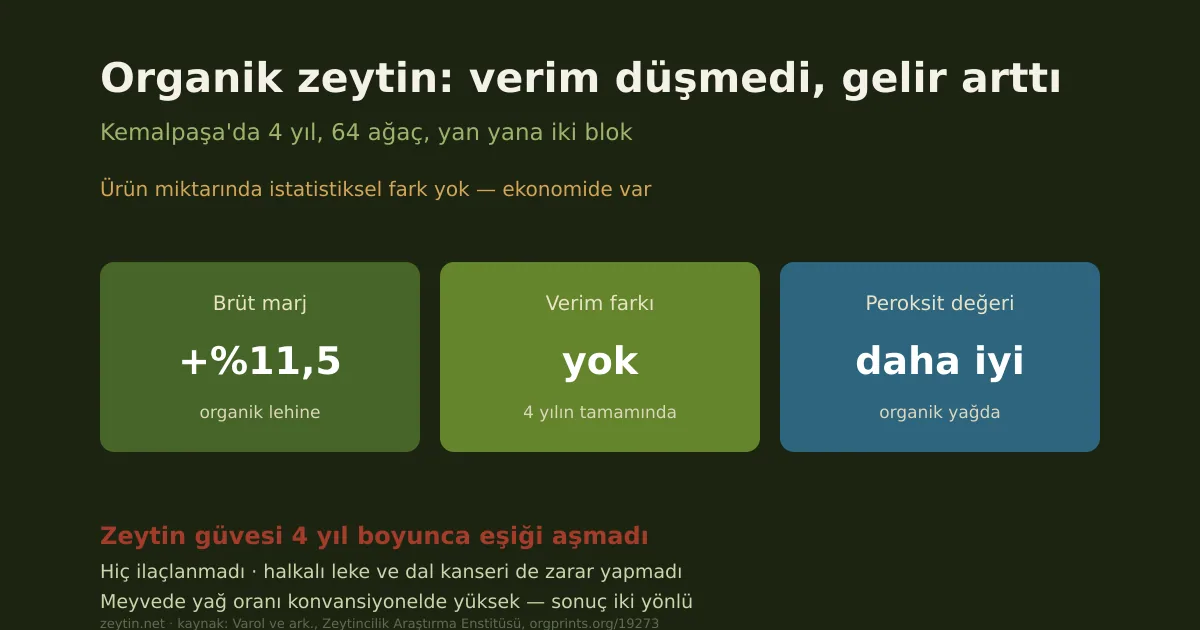
A four-year organic vs conventional trial at Kemalpaşa: no yield difference, 11.5% higher gross margin for organic, lower peroxide value, but higher fruit oil content under conventional management.
Article
Organic olive growing: what a four-year trial found
A four-year organic vs conventional trial at Kemalpaşa: no yield difference, 11.5% higher gross margin for organic, lower peroxide value, but higher fruit oil content under conventional management.
 Article
Can an olive tree be uprooted and moved?
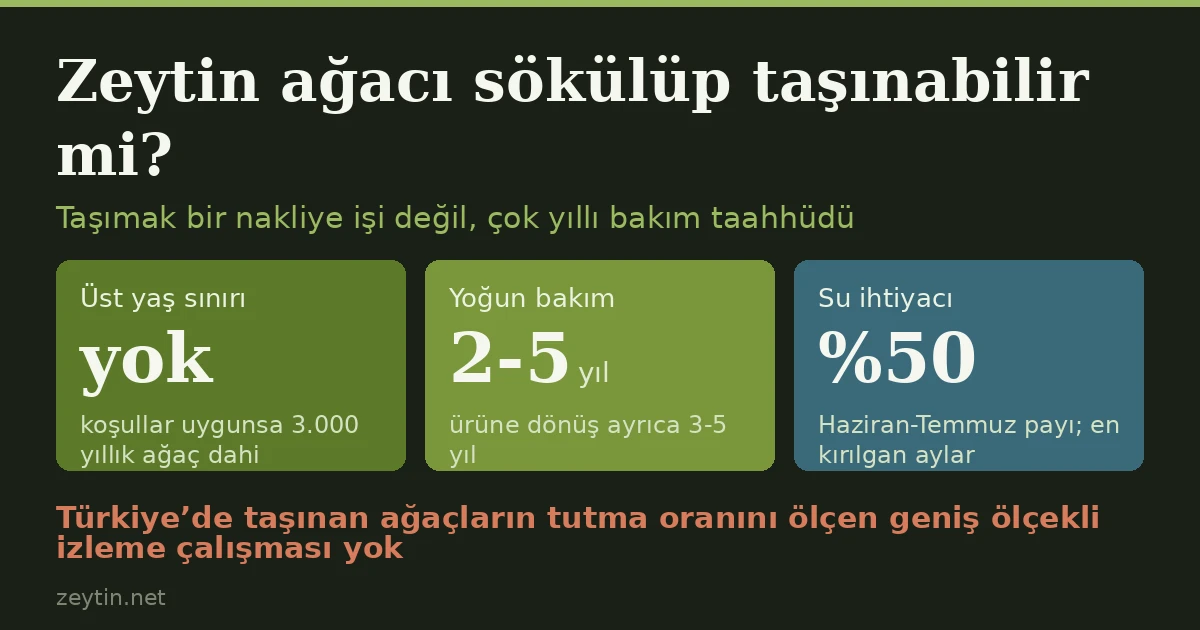
The technical answer is yes: olives can be moved at any age, with no upper limit. But "can be moved" and "is the same tree afterwards" are different questions. Winter timing, root-to-canopy balance, two to five years of care and three to five years without fruit are the real cost — and no large-scale Turkish study measures survival rates.
Article
Can an olive tree be uprooted and moved?
The technical answer is yes: olives can be moved at any age, with no upper limit. But "can be moved" and "is the same tree afterwards" are different questions. Winter timing, root-to-canopy balance, two to five years of care and three to five years without fruit are the real cost — and no large-scale Turkish study measures survival rates.
 Article
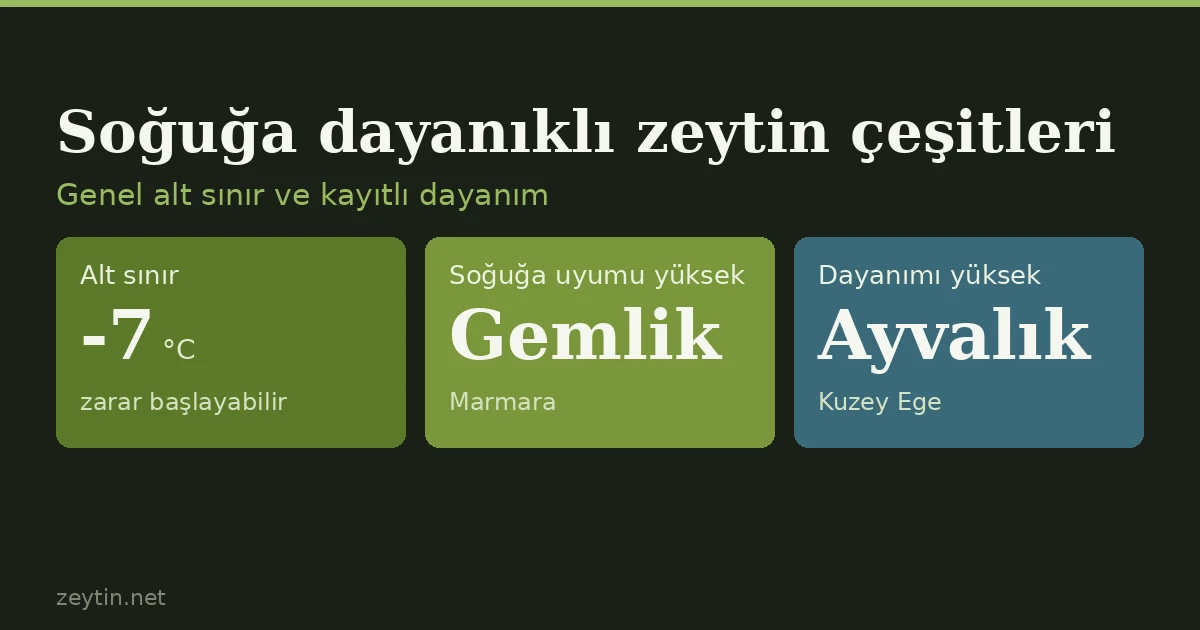
Cold-hardy olive varieties: Gemlik, Ayvalık and the other candidates in the data
In our variety data, Gemlik, Ayvalık, Coratina, Picual and Hojiblanca are recorded with high cold adaptation or hardiness; Kalamata, Leccino, Memecik and Domat are medium, Frantoio moderately sensitive and Saurani low. But variety alone is not enough: tree age, the duration of the cold and the site of the grove also decide.
Article
Cold-hardy olive varieties: Gemlik, Ayvalık and the other candidates in the data
In our variety data, Gemlik, Ayvalık, Coratina, Picual and Hojiblanca are recorded with high cold adaptation or hardiness; Kalamata, Leccino, Memecik and Domat are medium, Frantoio moderately sensitive and Saurani low. But variety alone is not enough: tree age, the duration of the cold and the site of the grove also decide.
 Article
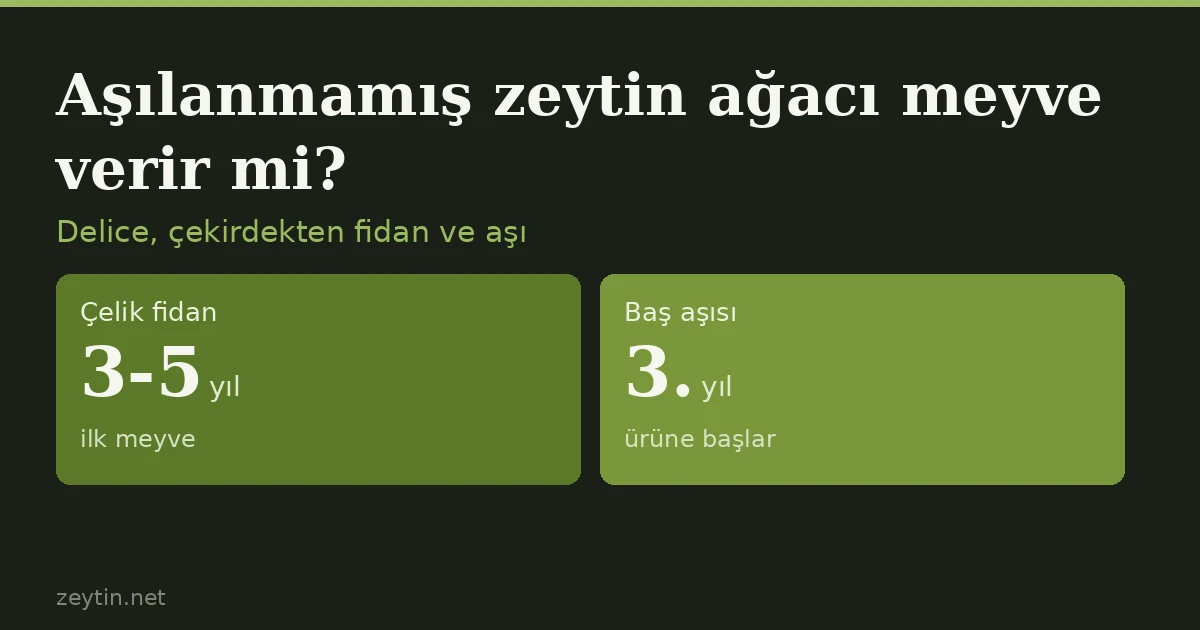
Does an ungrafted olive tree bear fruit? Wild olives, seedlings and grafting
An ungrafted olive tree does bear fruit, but usually small, thin-fleshed and low in oil. Neither the wild trees known in Turkey as delice nor seedlings grown from a stone carry the variety of the parent tree. How to tell, what grafting gains, and why wild olives are still valuable.
Article
Does an ungrafted olive tree bear fruit? Wild olives, seedlings and grafting
An ungrafted olive tree does bear fruit, but usually small, thin-fleshed and low in oil. Neither the wild trees known in Turkey as delice nor seedlings grown from a stone carry the variety of the parent tree. How to tell, what grafting gains, and why wild olives are still valuable.