Should harvested olives be carried in crates or in sacks?
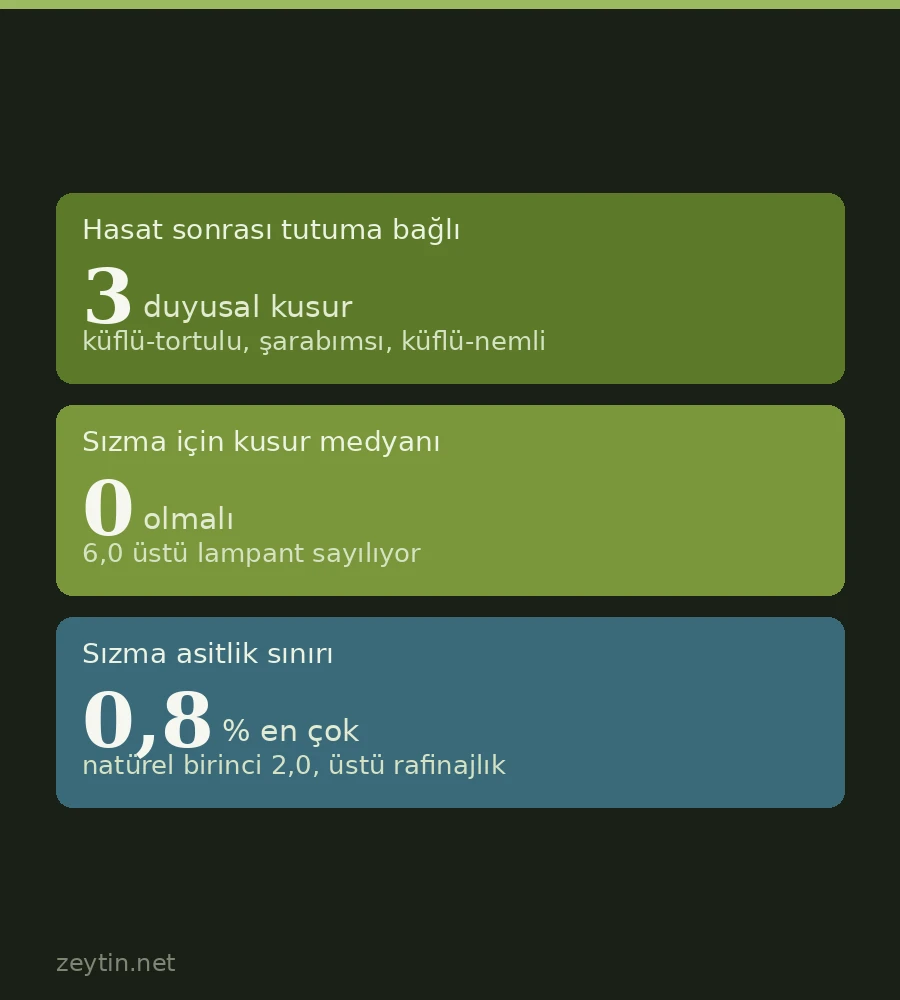
The cheapest decision of the harvest season is also one of the decisions that sets the grade of the oil. Three separate defects in the International Olive Council's vocabulary are defined directly by how the fruit was held after picking — and all three describe what a sack does.
When harvest begins, the first practical decision taken in the grove is what the picked olives go into. A sack is light, cheap, foldable and can be carried on a back. A crate takes up space, is awkward to move and costs money. Every extension source nonetheless says crate. The reason is not packaging but chemistry.
What happens inside a sack
An olive is not an inert object once it leaves the branch. It goes on respiring: consuming oxygen, producing carbon dioxide and heat. In open air that heat disperses. In a sack it cannot.
Three things stack up. First, airflow through the mass inside a woven sack effectively stops, and the centre of the pile turns into an oxygen-free environment within hours. Second, because the heat produced cannot escape, the temperature climbs — in the grove this is called kızışma, heating up. Third, the weight of the fruit above crushes the fruit below, and every crushed olive releases its own juice and sugars.
An oxygen-free environment, a rising temperature and exposed sugary juice. That trio is precisely the set of conditions fermentation requires.
The defect already has a name
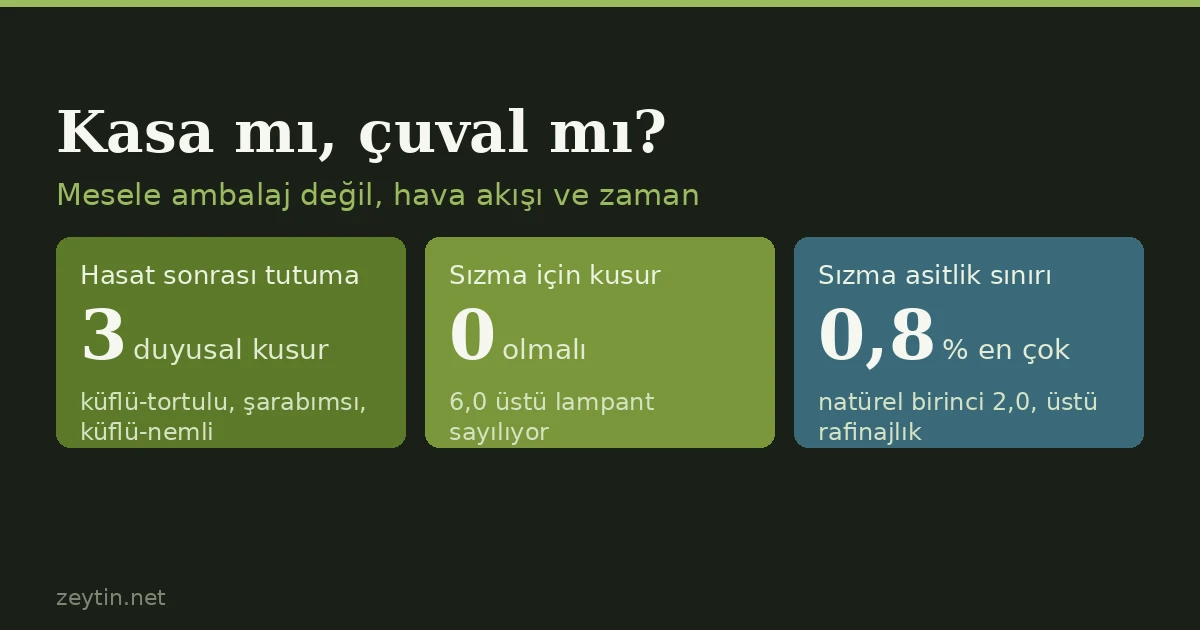
No guesswork is needed here, because the outcome is written into the international standard by name. The International Olive Council's sensory guide (COI/T.20/Doc. No 15/Rev. 7), setting out the negative attributes of virgin olive oil, ties three defects directly to how the fruit was held after picking.
Fusty/muddy sediment. The guide's definition: characteristic flavour of oil obtained from olives piled or stored in such conditions as to have undergone an advanced stage of anaerobic fermentation. The first half of that definition describes the pile inside a sack exactly — anaerobic, meaning without oxygen.
Winey-vinegary. Defined as a flavour reminiscent of wine or vinegar, attributed mainly to a process of aerobic fermentation in the olives or in the paste, leading to the formation of acetic acid, ethyl acetate and ethanol. The outer surface of the pile, in contact with air, takes this route.
Musty-humid-earthy. The definition names two situations: oil from fruit in which large numbers of fungi and yeasts have developed as a result of its being stored in humid conditions for several days, or oil obtained from olives that have been collected with earth or mud on them and which have not been washed. Olives gathered off the ground after rain and tipped into a sack satisfy both conditions at once.
Three defects, three separate mechanisms, one shared cause: how the fruit was held until milling.
The consequence shows up in the grade
The practical price of these defects is steep. Under the Council's classification, an oil can be extra virgin only if the median of the defects is 0 — the tasting panel perceiving no defect at all. If the median rises above 0 but stays within 3.5 the oil is virgin; between 3.5 and 6.0 it is ordinary virgin; above 6.0 it is lampante and not fit for direct consumption.
The chemistry points the same way. Fermentation and crushing drive up free acidity. Under Turkey's Olive Oil and Olive Pomace Oil Regulation of 17 September 2017 (No. 2017/26), the free acidity limit is 0.8% for extra virgin and 2.0% for virgin oil; above that the oil is lampante, destined for refining.
The gap is not just a label, it is a price. Fruit from the same grove, picked on the same day, can sell a grade lower purely because it spent one night in a sack. No mill setting recovers that loss: a mill cannot raise the quality of the fruit delivered to it, only preserve it.
What a crate does
What the perforated plastic crate solves is exactly the three mechanisms above.
Holes in the sides and base keep air moving, so the interior of the mass does not go anaerobic and respiration heat can leave. Because crates stack, the weight bears on the frame rather than on the fruit underneath, and crushing largely disappears. And because layer depth is capped by the depth of the crate, the heat build-up that comes with pile height never starts.
So the decision is not really "crate or sack". The crate is only the tool that solves airflow and crushing. The variable actually at stake is time: the interval between the moment the fruit leaves the branch and the moment it is milled. A crate lowers the cost of that interval; it does not zero it.
Time, and a few details
Best practice is not in dispute: mill the day's pick the same day. The longer the delay, the higher the risk on both acidity and sensory defects. A study by Türkoğlu and colleagues in the Journal of the Agricultural Faculty of Harran University (2012, 16(3):1-8) notes that pole-beating harvest together with transporting and holding the fruit in sacks adversely affects olive quality and therefore the quality of the final product; the same study stresses removing leaves, stems and impurities from fruit arriving at the plant as far as possible, and not allowing it to heat up.
Alongside that, a few details that matter in the grove:
- Keep ground-gathered olives separate. Fruit carrying soil or mud falls, unwashed, under the direct definition of the musty-humid-earthy defect. Holding it in its own crates and milling it separately saves the rest of the batch.
- Sort out leaves and stems. These are the material that holds moisture inside the mass and helps it heat.
- Do not leave crates in sun or rain. Shade is a condition for airflow to do its work, and wetted fruit opens the path to mould.
- Preserve air gaps when stacking. A crate pressed down so its holes are blocked has become a sack.
In short
A sack carries olives but holds the fruit: it cuts airflow, traps heat, crushes the fruit and clears the way for fermentation. Three separate defects in the international vocabulary describe that process by name, and each is enough on its own to push the oil out of the extra virgin class. A perforated crate breaks the first two links in that chain; only getting to the mill early breaks the third, which is time. By the point harvest quality becomes readable in the oil itself, the work is already done.
One rating per visitor; you can change yours at any time. Ratings are real reader votes — no seeded or default scores.
Related
 Article
Caring for an olive tree in a pot: container, soil, watering, light and winter
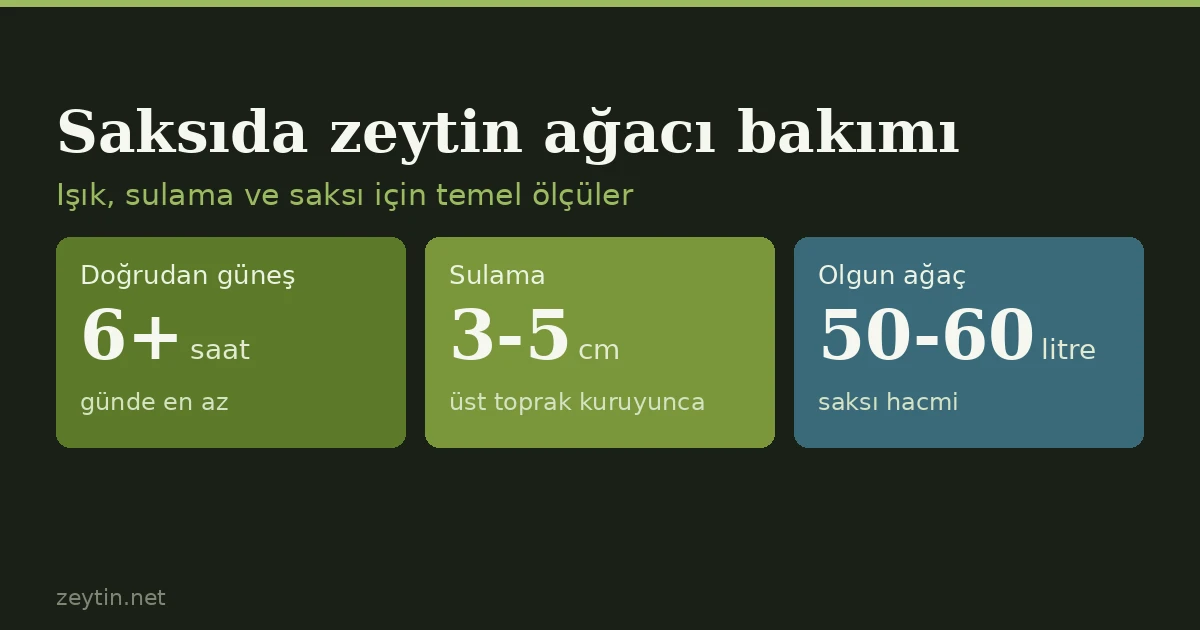
Olive trees can live in pots, but they do not forgive two things: too much water and too little light. A wide pot with drainage holes, a free-draining mix, watering once the top layer dries and at least six hours of direct sun are the basic rules. Expecting fruit indoors is usually pointless without a cool winter.
Article
Caring for an olive tree in a pot: container, soil, watering, light and winter
Olive trees can live in pots, but they do not forgive two things: too much water and too little light. A wide pot with drainage holes, a free-draining mix, watering once the top layer dries and at least six hours of direct sun are the basic rules. Expecting fruit indoors is usually pointless without a cool winter.
 Article
Organic olive growing: what a four-year trial found
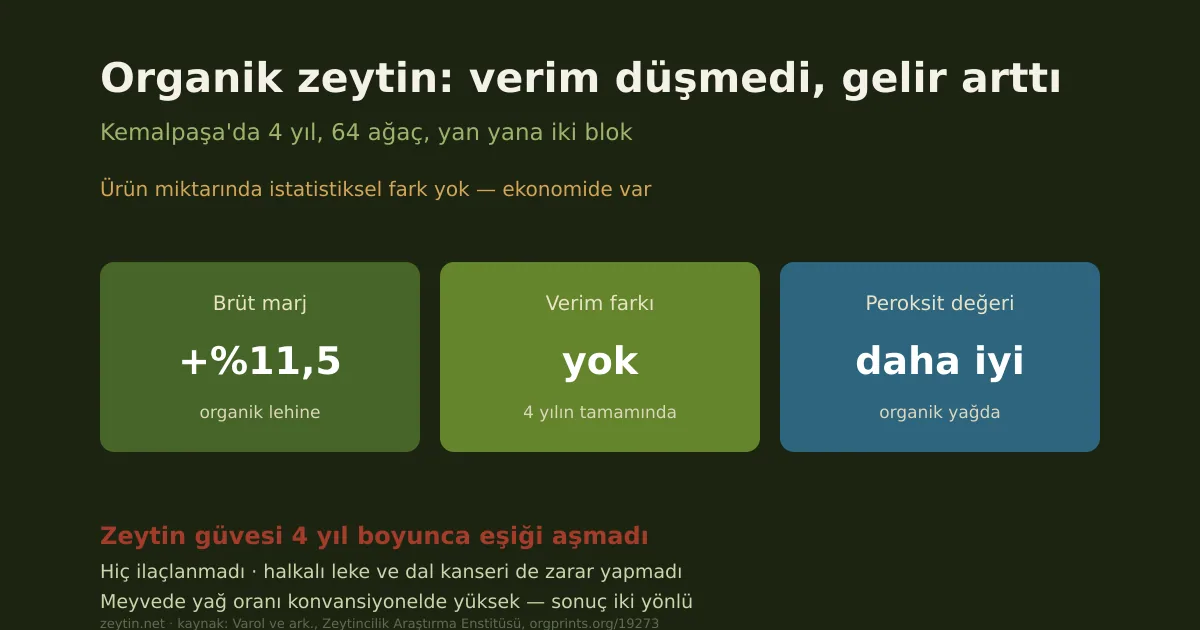
A four-year organic vs conventional trial at Kemalpaşa: no yield difference, 11.5% higher gross margin for organic, lower peroxide value, but higher fruit oil content under conventional management.
Article
Organic olive growing: what a four-year trial found
A four-year organic vs conventional trial at Kemalpaşa: no yield difference, 11.5% higher gross margin for organic, lower peroxide value, but higher fruit oil content under conventional management.
 Article
Do olives grow in cold regions?
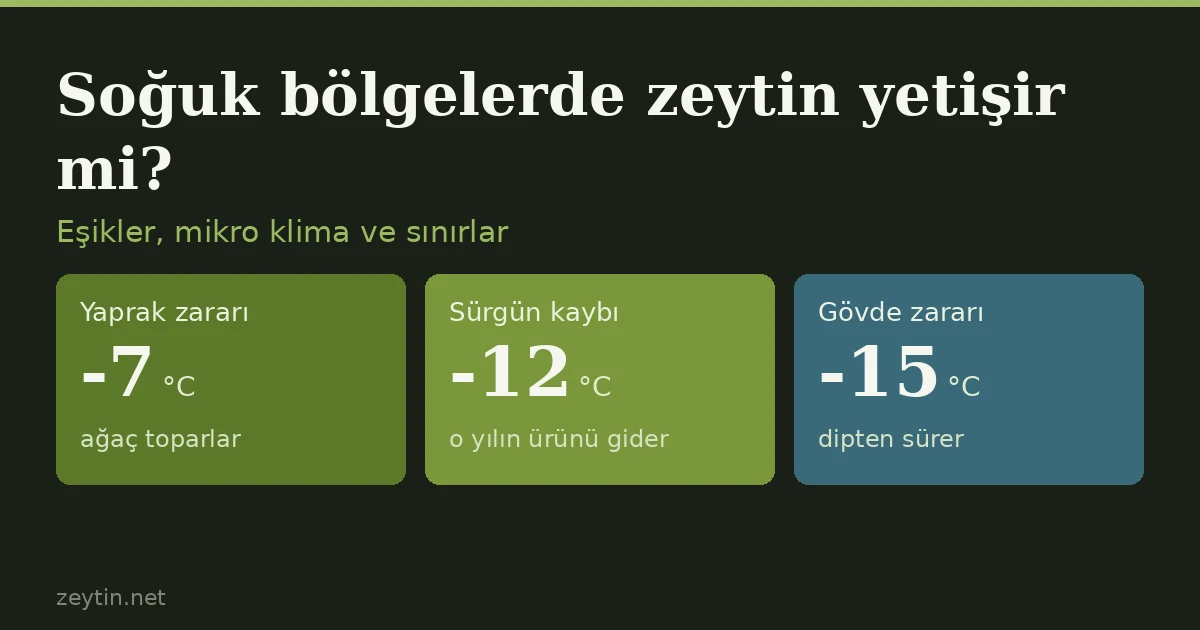
Olives survive -7 °C, lose shoots at -12 °C and the trunk below -15 °C. Yet Artvin delivers Turkey's highest yield per tree: microclimate beats the map.
Article
Do olives grow in cold regions?
Olives survive -7 °C, lose shoots at -12 °C and the trunk below -15 °C. Yet Artvin delivers Turkey's highest yield per tree: microclimate beats the map.
 Article
Should I switch to organic? A decision guide for olive groves
A four-year trial found no yield difference and put organic 11% ahead economically. But where does the real cost of switching lie, who does it suit, and how do you fight the fly without chemicals?
Article
Should I switch to organic? A decision guide for olive groves
A four-year trial found no yield difference and put organic 11% ahead economically. But where does the real cost of switching lie, who does it suit, and how do you fight the fly without chemicals?