How many kilos of olives does one tree yield?
Türkiye averaged 13.5 kilos per tree in the 2025/26 season. But the average describes nobody's grove: 20.3 kilos in İzmir, 3.5 kilos in Şanlıurfa. The same grove does not repeat its own number either — across six major provinces, per-tree yield went from 22.6 kilos one season to 8 kilos the next. Here is what the figure actually depends on, and how to place your own tree against it.
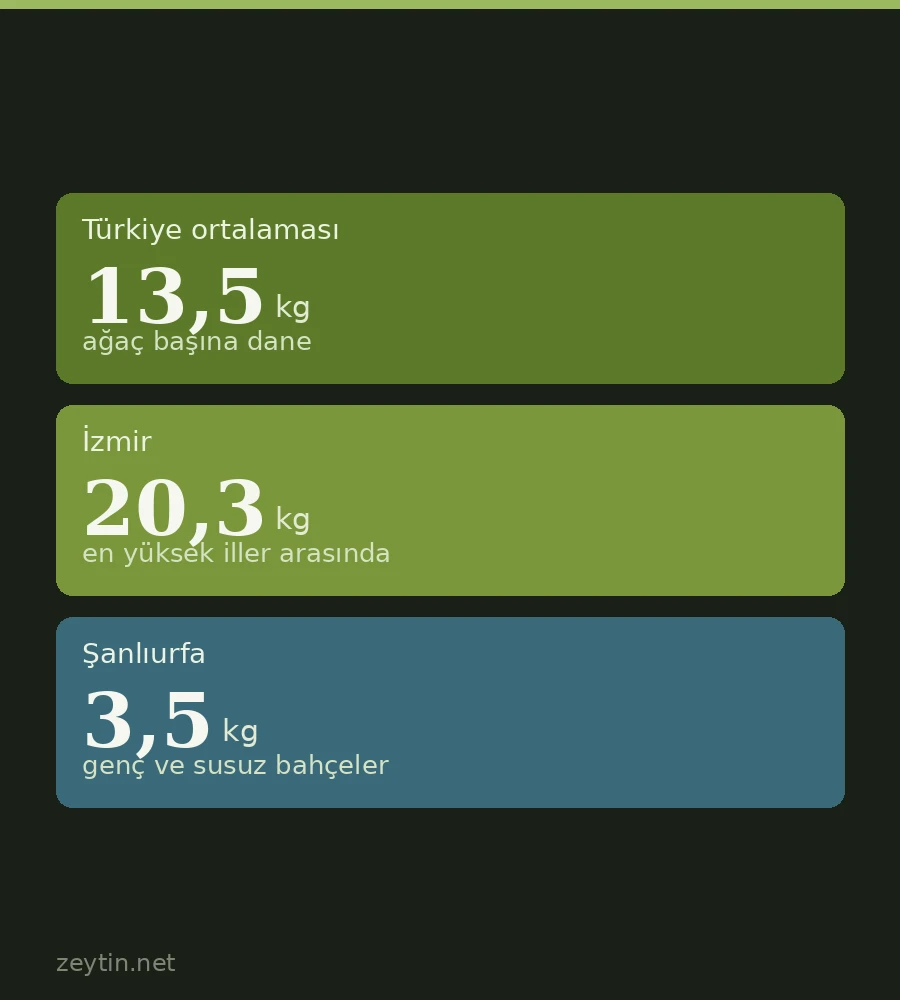
There is no single correct answer to this question, but there is a measured average. In the 2025/26 season, Türkiye averaged 13.5 kilos of olives per bearing tree. That figure comes from the data of 45 provinces: 2,370,297 tonnes of fruit from 175.7 million bearing trees. On top of that there are another 34 million trees not yet in production — meaning roughly one in every five olive trees in the country sits outside this calculation.
Learning the average is the easy part. The hard part is that the average describes almost no actual grove.
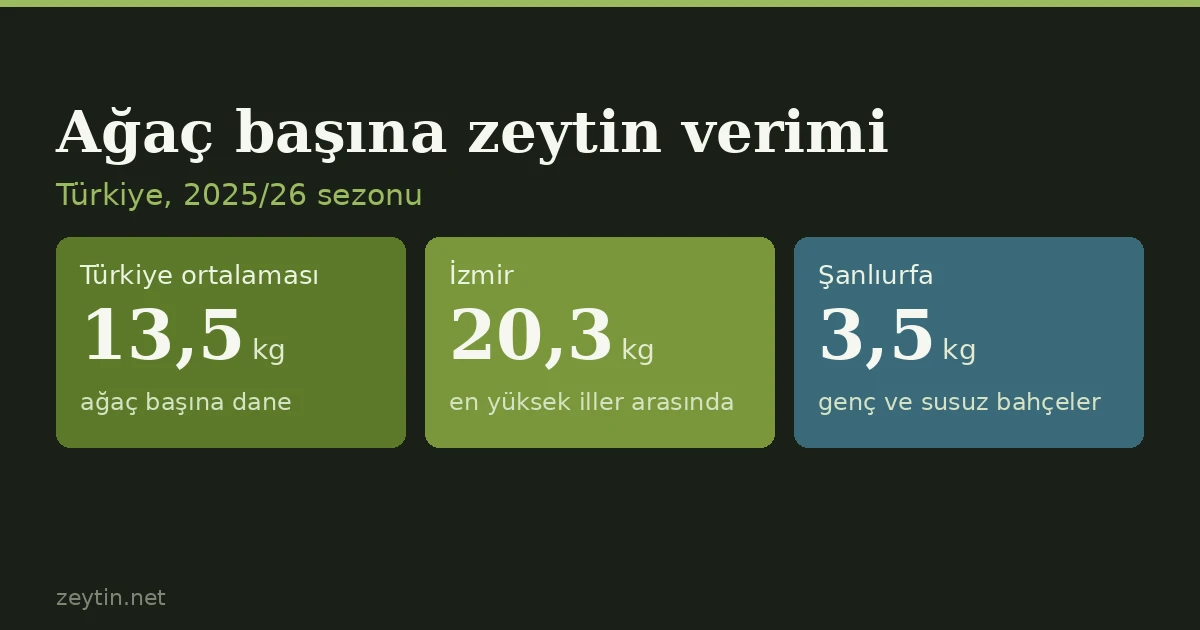
Same year, same country, a sixfold gap
Here is how per-tree yield broke down by province in 2025/26:
| Province | Per tree | Bearing trees |
|---|---|---|
| İzmir | 20.3 kg | 18.5 m |
| Aydın | 19.6 kg | 22.4 m |
| Mersin | 19.5 kg | 11.5 m |
| Çanakkale | 15.8 kg | 5.2 m |
| Balıkesir | 13.8 kg | 11.0 m |
| Muğla | 10.7 kg | 14.9 m |
| Kilis | 5.8 kg | 4.5 m |
| Gaziantep | 4.6 kg | 9.3 m |
| Şanlıurfa | 3.5 kg | 2.3 m |
A tree in İzmir yields roughly six times what a tree in Şanlıurfa yields. The reason is not that one variety is good and another bad; it is that irrigation, soil depth, age distribution and management intensity all shift together. The young and largely rainfed groves of the southeast have not yet reached full capacity — we examined soil quality in the Kilis groves separately. In the Aegean the trees are old, the roots deep, and most of the grove has settled into an established production routine.
Even the same grove does not repeat its own number
This is where the data gets genuinely unsettling. Across six major provinces of the Aegean and Marmara (İzmir, Aydın, Manisa, Muğla, Bursa, Çanakkale), per-tree yield moved like this over four seasons:
| Season | Per tree |
|---|---|
| 2022/23 | 21.5 kg |
| 2023/24 | 8.0 kg |
| 2024/25 | 22.6 kg |
| 2025/26 | 14.9 kg |
Same trees, same provinces, a gap of nearly three to one. This is alternate bearing: the olive loads one year and rests the next. Flower buds fail to form in sufficient number during a heavy crop year, because carbohydrates are pulled into the fruit and hormones produced in the seed suppress bud differentiation; the following season comes in low. We covered the mechanism of yield fluctuation in olives in its own article.
The practical consequence: "how many kilos will my tree give?" cannot be answered from a single year. Take the average of at least two seasons. One year's number is not the tree's capacity — it is that year's turn in the cycle.
How many kilos of olives, how many of oil?
An oil grove needs a second conversion. In 2025/26 the extraction yield on oil-type fruit was 18.9%: 1,631,201 tonnes of oil olives produced 308,580 tonnes of olive oil.
So a rough national calculation: 13.5 kilos of fruit per tree × 18.9% ≈ 2.5 kilos of olive oil. Treat that as an estimating tool, not a guarantee. Extraction yield swings between roughly 12% and 25% depending on variety, ripeness and the moment of milling; it falls with early harvest and rises with late harvest, at the cost of quality. We set out that trade-off with figures in when to harvest olives: the maturity index.
The same average also contains table olives: in that season 739,097 tonnes of fruit went to table processing. In a table-olive grove the question is not "how many kilos of oil" but "which calibre" — we handled the effect of fruit size on price in the economics of calibre.
The five things that set per-tree yield
Age. A sapling starts bearing in its third to fifth year and usually reaches its yield plateau after the tenth. The country's 34 million non-bearing trees are largely waiting in that queue. If your tree is five years old, comparing it to the average means nothing.
Planting distance. Ten trees per decare is not the same as a hundred. In high-density planting, yield per tree falls while yield per decare rises. When you compare numbers you need to know which unit you are speaking in, which is exactly why how many trees per decare matters, and why we put the arithmetic of both layouts side by side in building a high-density olive grove.
Water. In most places the gap between an irrigated and a rainfed grove is larger than the gap between varieties. The effect of drip irrigation becomes decisive in dry summers in particular.
Pruning and harvest method. Shoots broken by beating are next year's crop, which sharpens alternate bearing. We gathered how to prune and the harvesting methods in separate articles.
Variety. Productivity really does differ by cultivar; we compared measured data in which olive variety is the most productive. But variety comes after the four items above — a good variety badly managed does not beat an ordinary variety well managed.
If your tree yields nothing at all
Zero and low are different problems. If there is no crop at all, the issue is usually not capacity but pollination, grafting, frost or roots; why is my olive tree not bearing fruit works through that distinction step by step.
How to measure your own tree
Working out your own figure is more useful than comparing yourself to averages, and it needs no instrument beyond a scale.
The single-tree method. Mark the three most typical trees in the grove — not the best ones, the average ones. At harvest, crate and weigh the fruit from each separately and take the mean of the three. That number is your grove's per-tree yield for the year. Repeat on the same three trees the following season; alternate bearing only becomes measurable once you can see two years side by side.
The grove method. Divide the total harvest by the number of bearing trees. Two mistakes are common here: including young non-bearing trees in the divisor, which makes yield look worse than it is, and converting crate counts to kilos without weighing. The weight of a full olive crate varies noticeably with how it is filled; weigh one crate at the start of the season and derive your own coefficient.
Converting to the decare. To turn per-tree yield into yield per decare, multiply by the number of trees. Twenty trees per decare at 15 kilos each means 300 kilos per decare. That unit gives a fairer comparison with a neighbouring grove, because it removes the difference in planting distance.
When to worry. If an irrigated, well-tended Aegean grove over ten years old averages below 8 kilos across two seasons, the problem is not capacity but most likely a single item: nutrient deficiency, pest pressure or delayed pruning. Nutrient deficiencies and olive fruit fly control point to the first two places to look.
The short answer
The Türkiye average is 13.5 kilos; above 20 kilos in the better Aegean groves; below 5 kilos in the young, rainfed groves of the southeast. On average that converts to roughly 2.5 kilos of oil. For your own tree the only meaningful figure is the average of two seasons — and the way to raise it runs through water, pruning and harvest method, not through changing variety.
One rating per visitor; you can change yours at any time. Ratings are real reader votes — no seeded or default scores.
Related
 Article
Caring for an olive tree in a pot: container, soil, watering, light and winter
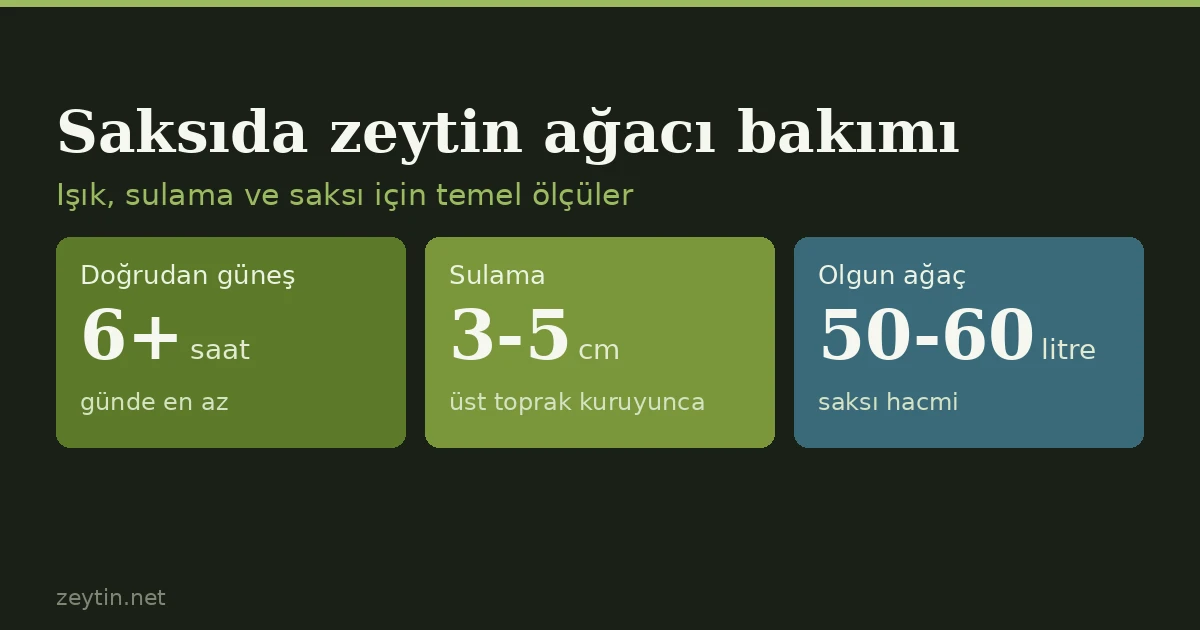
Olive trees can live in pots, but they do not forgive two things: too much water and too little light. A wide pot with drainage holes, a free-draining mix, watering once the top layer dries and at least six hours of direct sun are the basic rules. Expecting fruit indoors is usually pointless without a cool winter.
Article
Caring for an olive tree in a pot: container, soil, watering, light and winter
Olive trees can live in pots, but they do not forgive two things: too much water and too little light. A wide pot with drainage holes, a free-draining mix, watering once the top layer dries and at least six hours of direct sun are the basic rules. Expecting fruit indoors is usually pointless without a cool winter.
 Article
Which olive variety is the most productive? Regular crops, early bearing and alternate bearing
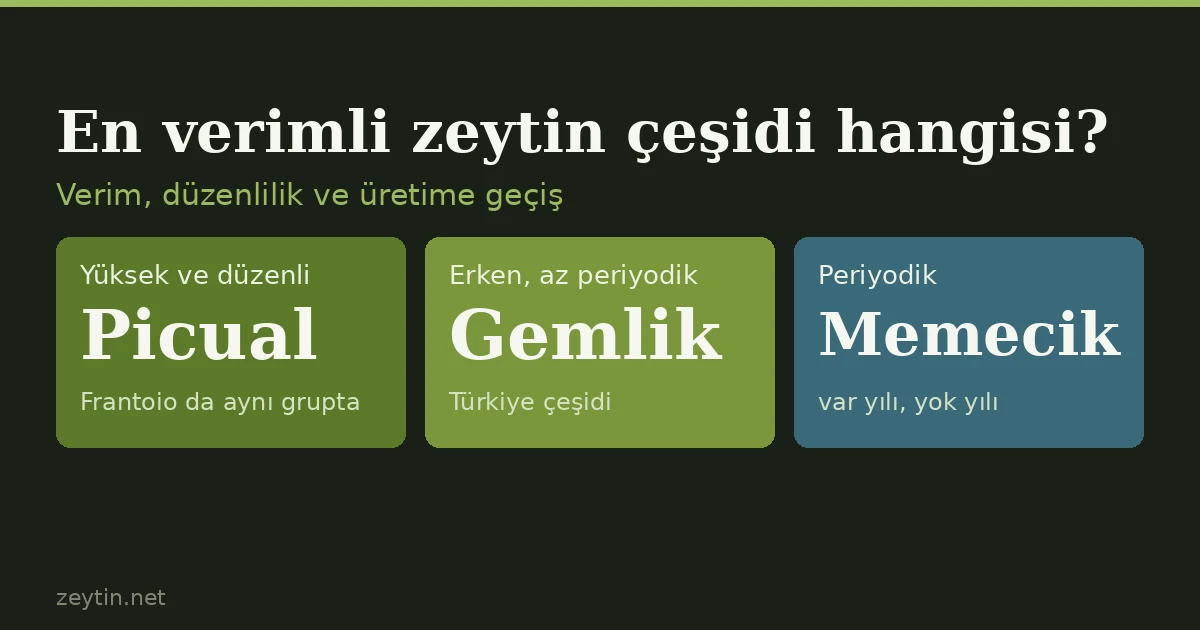
There is no single "most productive olive". Productivity depends on whether a tree bears regularly every year, how early it starts cropping and pollination. In our variety data, Picual and Frantoio are high and regular, Gemlik is early with low alternate bearing, while Kalamata, Hojiblanca and Memecik swing between on and off years.
Article
Which olive variety is the most productive? Regular crops, early bearing and alternate bearing
There is no single "most productive olive". Productivity depends on whether a tree bears regularly every year, how early it starts cropping and pollination. In our variety data, Picual and Frantoio are high and regular, Gemlik is early with low alternate bearing, while Kalamata, Hojiblanca and Memecik swing between on and off years.
 Article
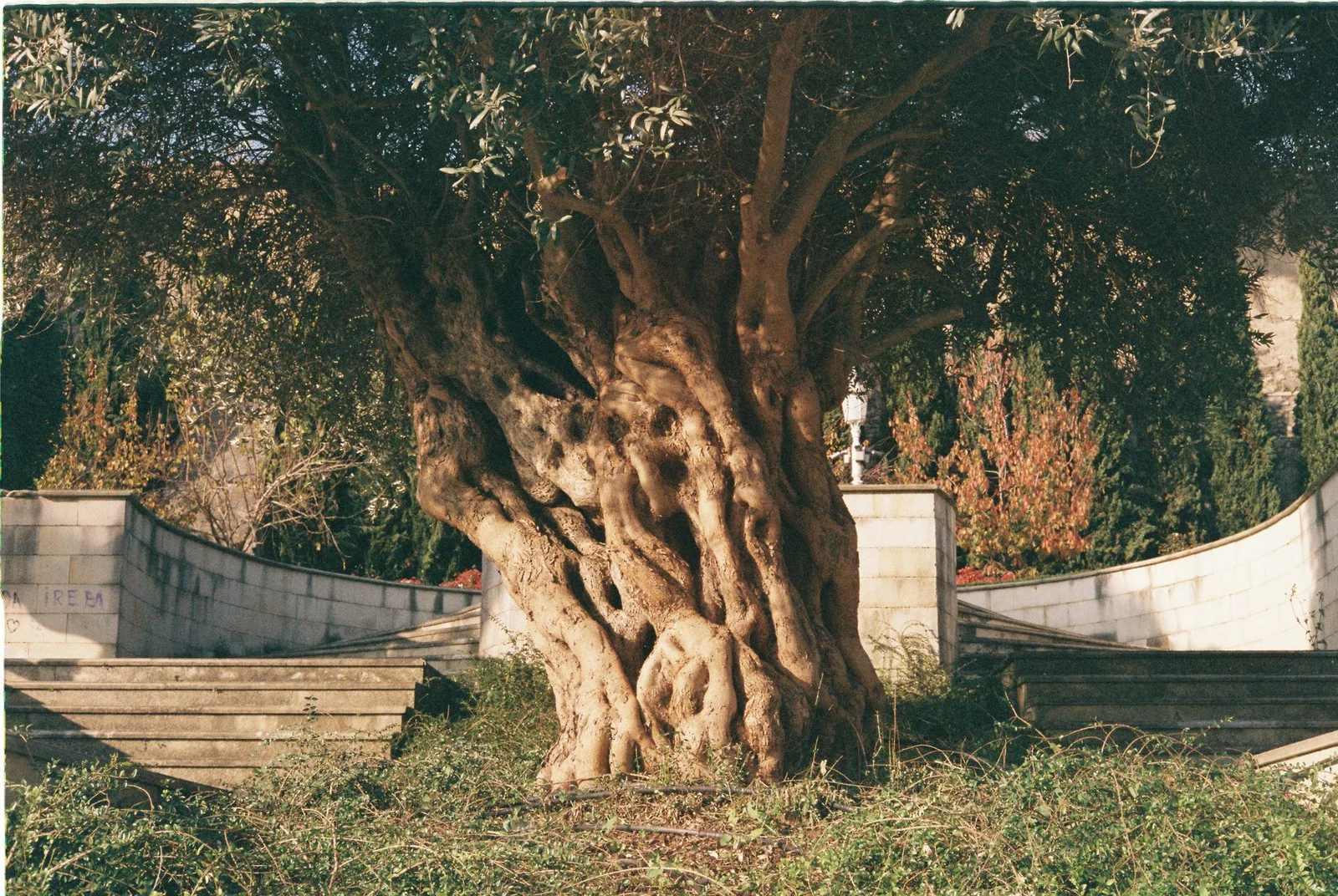
Grafting Olives: Changing Cultivar and Improving Wild Trees
When grafting is needed, taking scion wood, bud and cleft methods, topworking and aftercare.
Article
Grafting Olives: Changing Cultivar and Improving Wild Trees
When grafting is needed, taking scion wood, bud and cleft methods, topworking and aftercare.
 Article
Can an olive tree be uprooted and moved?
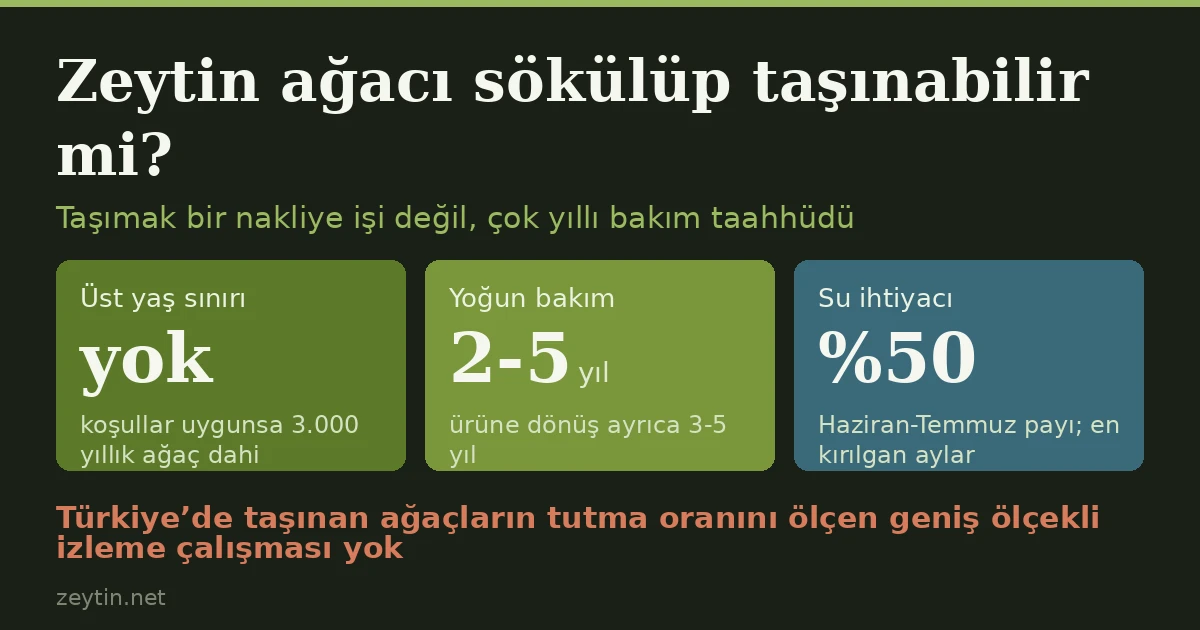
The technical answer is yes: olives can be moved at any age, with no upper limit. But "can be moved" and "is the same tree afterwards" are different questions. Winter timing, root-to-canopy balance, two to five years of care and three to five years without fruit are the real cost — and no large-scale Turkish study measures survival rates.
Article
Can an olive tree be uprooted and moved?
The technical answer is yes: olives can be moved at any age, with no upper limit. But "can be moved" and "is the same tree afterwards" are different questions. Winter timing, root-to-canopy balance, two to five years of care and three to five years without fruit are the real cost — and no large-scale Turkish study measures survival rates.