Can an olive cutting root in water? How to root olive cuttings at home
Standing an olive twig in water is not a tested method for olives. Nurseries root cuttings in perlite under high humidity with hormone; in Turkish trials rooting ranged from 2% to 86% depending on variety and hormone.
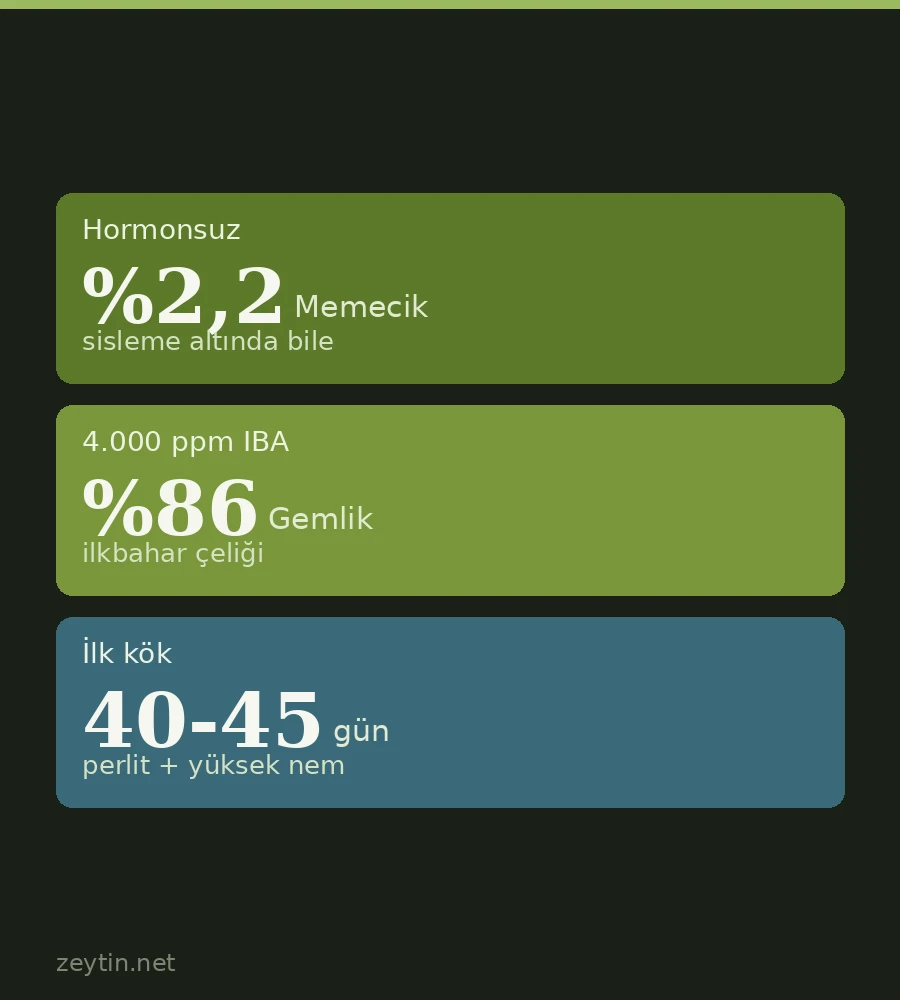
Short answer: standing an olive twig in a glass of water and waiting for roots is not a tested or recommended method for olives. We could not find any study that measures olive cuttings rooting in water. Nurseries and research institutes alike set cuttings not in water but in an airy, free-draining medium such as perlite, keep humidity high with misting, and usually use a rooting hormone. Even under those conditions olives do not always root easily: in the Memecik variety only 2.2% of untreated cuttings formed roots.
That does not make propagating an olive at home impossible. Below, step by step and with research results, is what works and what does not.
Why water does not work
There are two layers to the problem. The first is the olive itself. Unlike willow or ivy, the olive does not throw roots readily from a cut stem. A mass of tissue called callus forms first at the base of the cutting, and roots follow later. The process takes weeks, and throughout that time the base of the cutting has to stay both moist and aerated. Still water uses up its oxygen quickly, so an olive cutting left in water for weeks runs a high risk of its base blackening and rotting.
The second layer is what happens if it does root. Houseplant guides from US university extension services note that roots formed entirely in water are structurally different from those formed in a solid medium, and that when moved to soil the plant can wilt, drop leaves and suffer tip dieback, with higher losses. That observation comes from general horticulture rather than from an olive experiment, but there is good reason to expect the transition to be harder still for a slow-rooting species like the olive.
How nurseries do it
Today olives are propagated mostly by semi-hardwood leafy cuttings. A 1999 FAO manual on olive nursery production notes that Italy was then producing four to five million olive plants a year, 60% of them from cuttings. The method it describes is largely the same as the one used in Turkish trials:
- Cutting: pieces 10–15 cm long from a 6–12-month-old shoot 3–8 mm thick. Turkish trials also use 20–25 cm cuttings. The base is cut just below a node, and only 2–3 pairs of leaves are left at the top. Shoots with vegetative buds are chosen, not fruiting ones.
- Hormone: the bottom 2 cm is dipped for 2–5 seconds in an IBA (indole-3-butyric acid) solution. The FAO manual gives a range of 2,500–5,000 ppm.
- Medium: according to the manual, agricultural perlite works best. Turkish trials use perlite, peat-perlite or cocopeat-perlite mixes.
- Climate: air at 20 °C, the rooting medium at about 24 °C with bottom heat, and relative humidity above 80%. Nurseries achieve that humidity with an intermittent mist system.
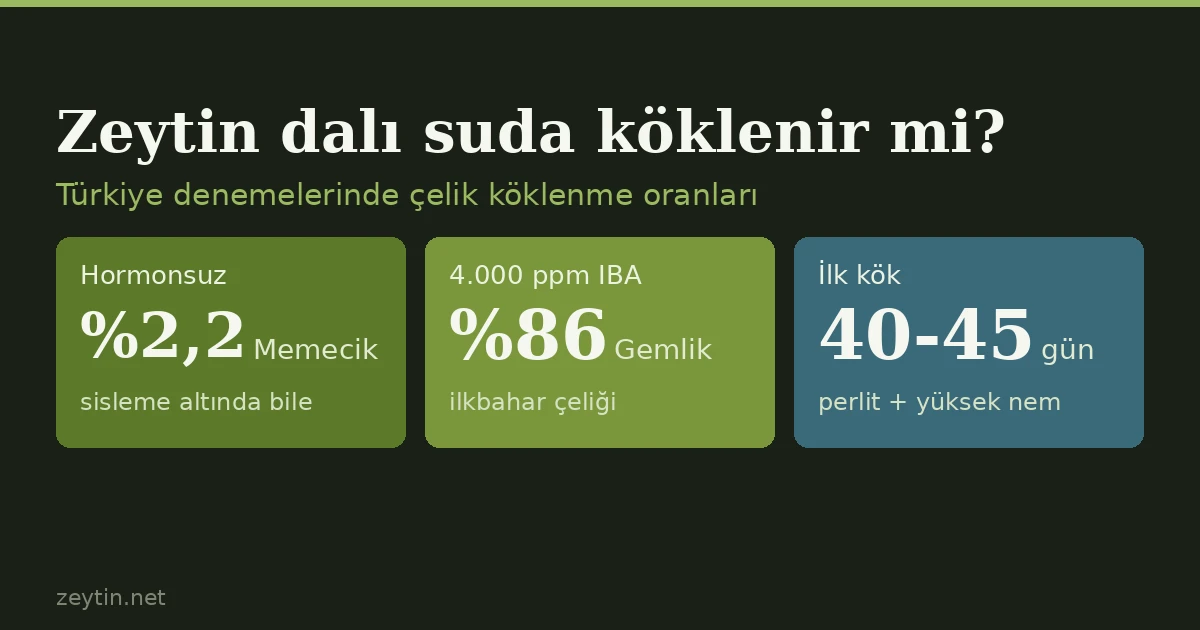
- Time: according to the manual, the base swells and forms callus in 20–25 days, the first root appears at 40–45 days, and most roots form within 60–65 days. Turkish trials read their results after 60 to 120 days.
How much difference hormone makes
In a five-variety trial in Hatay published in 2023, 33% of untreated cuttings rooted under mist. With 2,000 ppm IBA the rate rose to 46.5%, and with 4,000 ppm to 59.4%. The best result came from Gemlik cuttings taken in spring and treated with 4,000 ppm: 86.3%.
A Memecik study from Aydın published in 2020 shows the gap more sharply. Untreated cuttings rooted at just 2.2%; with 6,000 ppm IBA the rate climbed to 44.4%. In a hard-to-root variety, in other words, the hormone is the difference between "almost none" and "a reasonable share".
Which varieties root easily, and which do not
Variety is one of the biggest factors. In the same Hatay study the variety averages were:
| Variety | Rooting |
|---|---|
| Gemlik | 65.8% |
| Savrani | 46.7% |
| Sarı Haşebi | 44.4% |
| Kargaburnu | 38.1% |
| Halhalı | 37.0% |
Other studies point the same way. A classification published in 2020 puts Gemlik and Yamalak Sarısı among the high-rooting varieties (above 60%) and Domat among the low ones (below 20%). In a shaded-tunnel trial published in 2005, Ayvalık cuttings peaked at 40% while Domat cuttings formed only callus and no roots. A comprehensive book chapter on the varieties grown in Türkiye also notes that hard-to-root varieties such as Çelebi and Halhalı are propagated by grafting for exactly that reason.
If the tree in your garden is a Gemlik, your odds are relatively good. If it is a Domat or a Memecik, cuttings at home will usually end in disappointment.
If you want to try at home
Recreating nursery conditions at home is difficult, but the principles are the same:
1. The right shoot: from the middle or lower part of a healthy tree, without fruit, from this year's or last year's growth. A cut piece should not wait more than two days and should be kept in shade and moist.
2. Perlite, not water: fill the pot with perlite or a perlite-peat mix and push the base of the cutting a few centimetres in.
3. Humidity: to keep the leaves from drying out, humidity has to stay above 80%. At home people usually try to achieve this by covering the pot with a clear cover and keeping it in a bright spot out of direct sun.
4. Temperature: rooting happens between 20 and 25 °C, and the manual advises against taking cuttings in very hot or very cold seasons. In the Hatay trial, cuttings taken in mid-October (46.3%) did slightly better than those taken in mid-March (43.4%), so autumn is a suitable time too.
5. Patience: allow at least six weeks for the first root and two to three months for a solid root mass. Once roots appear, move the cutting into a bag or pot filled with equal parts soil, sand and manure.
We found no scientific basis in olives for home-made "rooting aids" such as honey, cinnamon or willow water. In a trial with the Nabali variety, willow extract used together with IBA gave 46.9% rooting against 46% with IBA alone — so willow did not prove a substitute for IBA. No trial with honey or cinnamon on olive cuttings exists.
Other routes besides cuttings
The FAO manual also lists older methods better suited to home and small-scale conditions. In autumn, two-year-old wood pieces 1–2 cm thick and 20–30 cm long can be planted in bags; branch pieces 5–7 cm thick and 30–40 cm long can be planted directly in place with two thirds buried. According to the manual, propagation from the knobby swellings at the base of the tree (ovules) gives the best results. Pulling off and planting suckers from the base, on the other hand, is not recommended because it weakens the parent tree.
Why not from a pit?
You can grow an olive from a pit, but the tree will not be a copy of its mother. The FAO manual states that seedlings never fully show the characteristics of the parent plant and stay unproductive for a long time, which is why olives are propagated only asexually, by cuttings and grafting. Pit-grown seedlings are used in nurseries as rootstocks. What an ungrafted tree yields is covered in does an ungrafted olive tree bear fruit, and how grafting is done in grafting olive trees.
Fine for your own garden, not for sale
Türkiye's Seed Law No. 5553 counts saplings and cuttings as "seed material". Selling saplings requires authorisation from the ministry, and the law penalises holding quantities beyond personal needs that amount to trade. Exchanges between farmers are exempt provided they are not commercial and stay within personal needs. In short, rooting a few cuttings for your own garden is not a problem; if you are planting an orchard, certified saplings are the safer route both for variety accuracy and for support payments. Once a cutting has rooted, the usual rules of planting an olive sapling apply.
We covered the results of a field study that tried producing rootstock from wild olive cuttings in a separate article.
One rating per visitor; you can change yours at any time. Ratings are real reader votes — no seeded or default scores.
Related
 Article
Building a high-density olive grove: five requirements
High-density planting is not a choice of variety but a five-component system — miss one and it performs worse than a traditional grove. Spacing, yields, the overlooked oil-content trade-off, and who it does not suit.
 Article
When to harvest olives: deciding with the maturity index
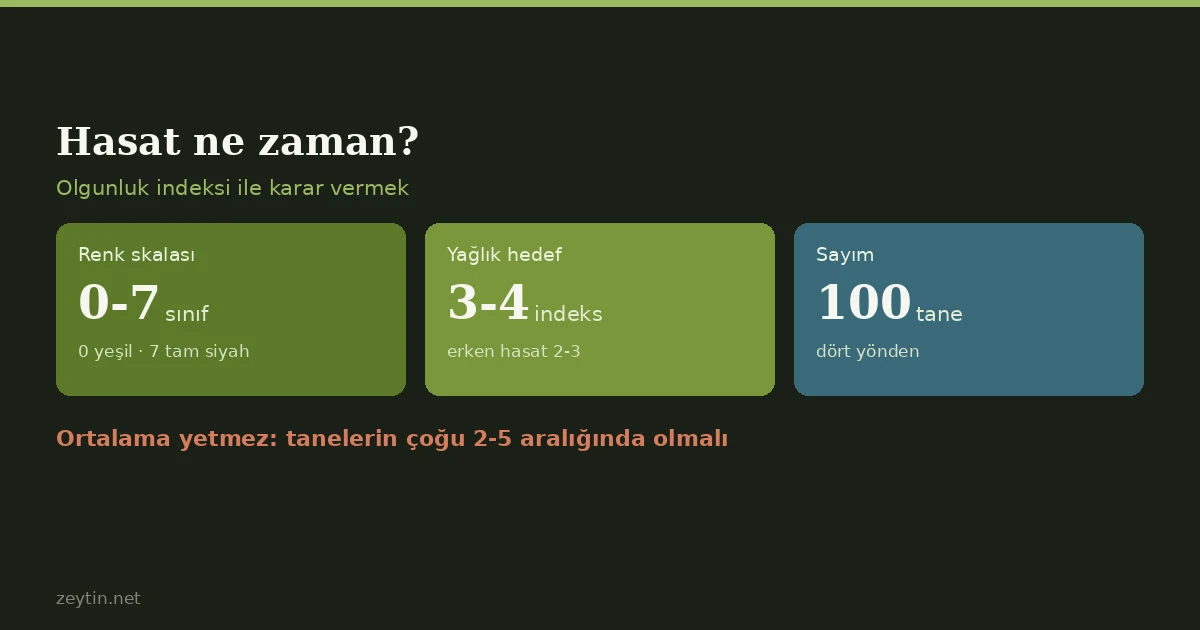
Harvest timing is set by the maturity index, not the calendar. The 0-7 colour scale, how to calculate it from 100 fruits, early versus late harvest compared, and ripening times by variety.
 Article
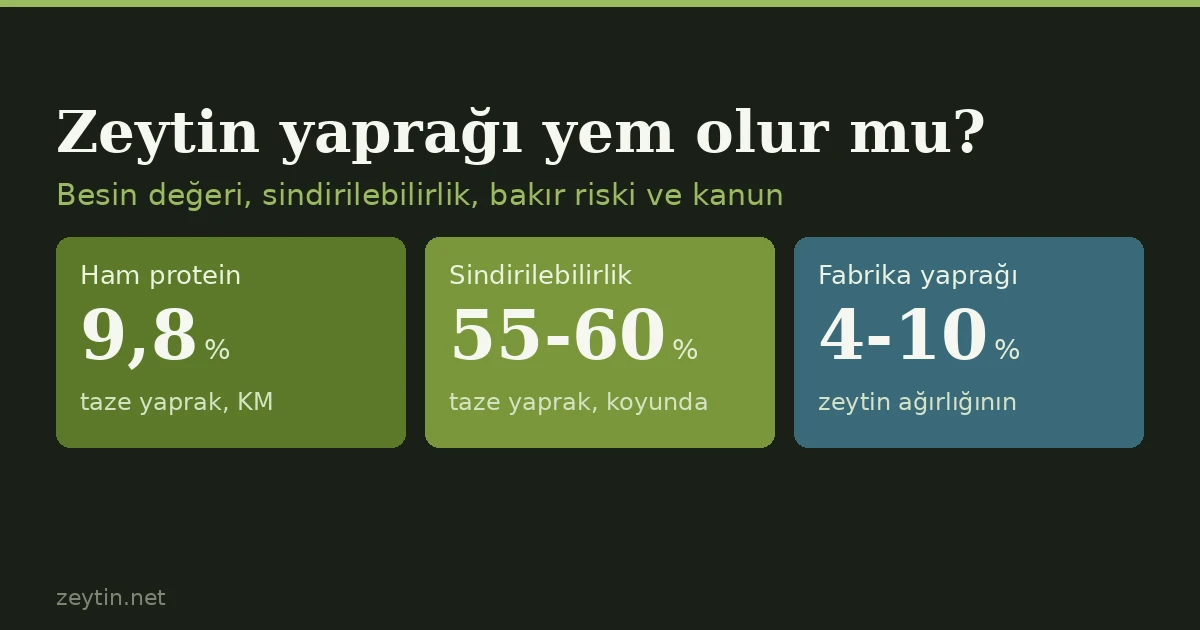
Can olive leaves be used as animal feed? Do sheep and goats eat them, and are they harmful?
Olive leaves are a fibrous roughage eaten by sheep, goats and cattle: crude protein 8-12% of dry matter, NDF 46-53%. In sheep, fresh leaves are 55-60% digestible, leaves from chopped branches only 15-40%. Leaves sprayed with copper fungicides pose a poisoning risk to sheep.
 Article
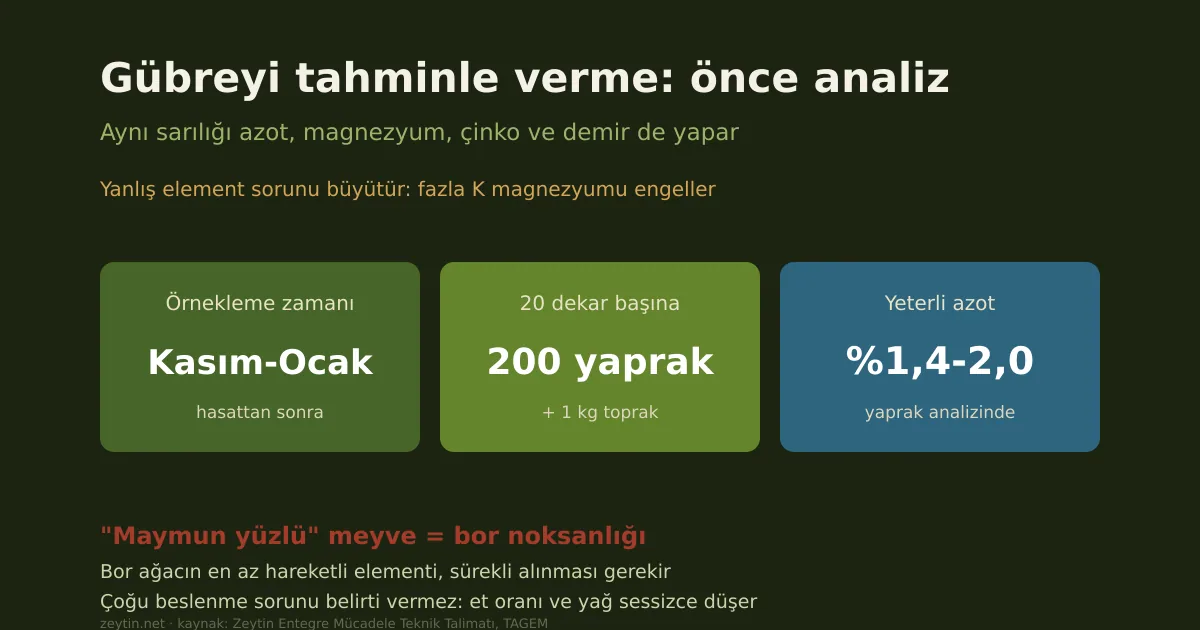
Nutrient deficiencies in olive: from symptom to element
The same yellowing can mean nitrogen, magnesium, zinc or iron, and the wrong element makes it worse. Standard leaf analysis values, symptom-to-element matching and the boron schedule.