Does an ungrafted olive tree bear fruit? Wild olives, seedlings and grafting
An ungrafted olive tree does bear fruit, but usually small, thin-fleshed and low in oil. Neither the wild trees known in Turkey as delice nor seedlings grown from a stone carry the variety of the parent tree. How to tell, what grafting gains, and why wild olives are still valuable.
A tree that has stood on its own on a plot for years, a seedling that sprang up from a stone at the edge of a garden, or a small-fruited olive with thorny-looking branches in the scrub. The owner's question is usually the same: will this tree bear fruit without grafting, and if it does, is the fruit any good?
The short answer
Yes, it bears fruit. An olive tree flowers and sets fruit without being grafted. But the fruit of an ungrafted tree is most likely:

- Small. It does not come close to the size of cultivated varieties.
- Thin-fleshed. The share of flesh relative to the stone is low.
- Low and irregular in oil. Oil content varies from tree to tree.
- Light cropping. It lags behind selected varieties in yield and regularity.
So the answer to "does it bear fruit?" is yes; the answer to "does it give an economic crop?" is mostly no.
Two different kinds of ungrafted tree
Wild olives (delice)
The trees called delice in Turkey are the wild or feral form of the olive. Growing on their own and never grafted, they are found in the Mediterranean and Aegean scrubland, along field edges and in old groves. As we described in rooting olive cuttings and wild rootstock, hundreds of thousands of wild olives are known in the Hassa district of Hatay alone.
The young shoots of wild olives are often dense, with short internodes and hard tips; their leaves can be smaller than those of cultivated varieties. The fruit is small and the stone relatively large.
Seedlings grown from a stone
If you plant the stone of a cultivated olive, or a fallen stone sprouts on its own, the resulting tree will not be the parent's variety. The olive is largely cross-pollinated; each stone carries a new genotype mixing the parent tree with another tree that supplied the pollen. A stone from a Gemlik olive does not produce a Gemlik tree but a new tree whose traits cannot be predicted.
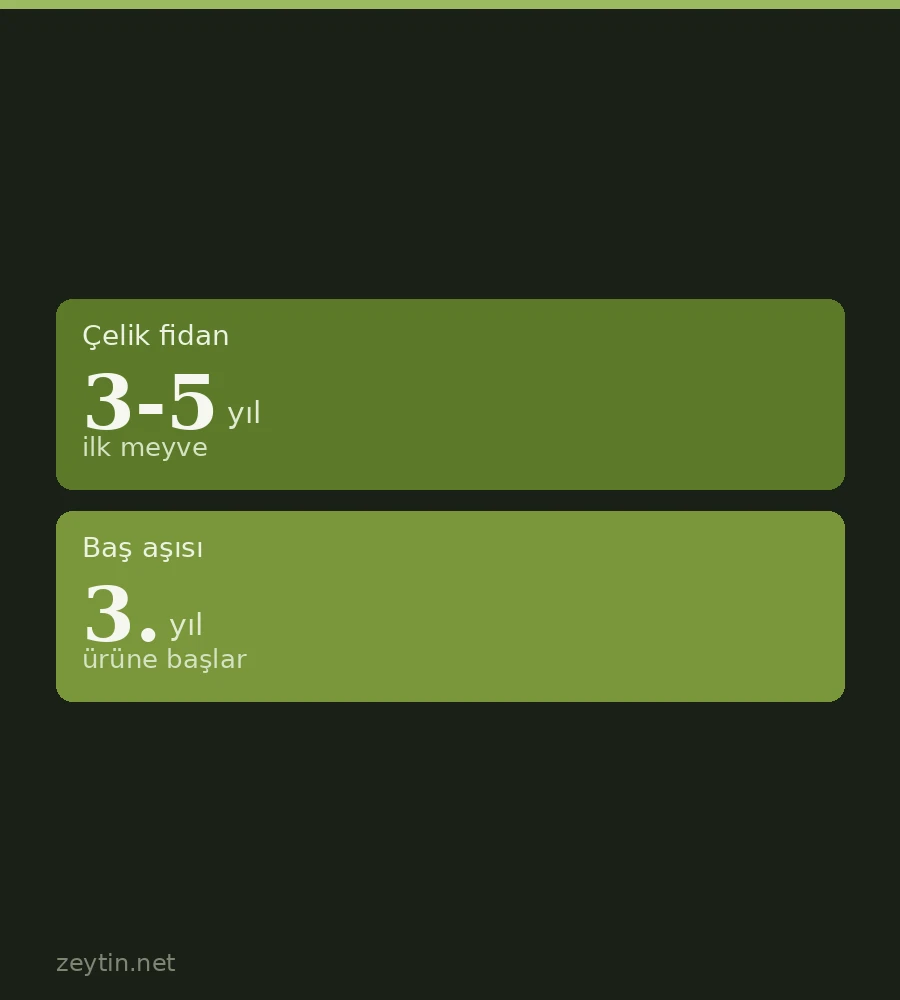
Another disadvantage of seedling olives is a long juvenile period. A cultivated sapling propagated from a cutting usually gives its first fruit in 3-5 years, while a tree grown from seed comes into flower and fruit much later.
That is why nurseries propagate cultivated varieties not from stones but from cuttings or by grafting: the way to preserve a variety's traits exactly is to root a piece of the same tree.
What is the fruit good for?
The fruit of an ungrafted tree is still an olive: it can be cured for the table or pressed for oil. The problem is quantity and yield. Small fruit with large stones gives little flesh when cured and little oil when pressed. In some areas, small amounts of oil are pressed from wild olives and sold as a local product. Making a few jars of olives for the household from a single tree is perfectly possible; basing a grove's income on ungrafted trees is not realistic.
How to tell a tree is ungrafted
Genetic analysis gives a definite answer, but in the field these clues help:
- A graft union. Grafted trees may show a ring or swelling on the trunk or main branches where the bark texture changes. On old trees this mark may have disappeared.
- Fruit. Fruit clearly smaller and thinner-fleshed than known varieties nearby.
- Branch structure. Dense young shoots with short internodes and hard tips.
- Suckers. Shoots coming from the base of a grafted tree come from the rootstock; if they look different from the rest of the tree, the tree is grafted and the basal shoots are ungrafted.
What does grafting gain?
Grafting a cultivated variety onto an ungrafted tree instead of uprooting it means making use of a root system decades old. According to the figures in grafting olive trees, a top-worked tree usually starts cropping in its third year, while getting the same variety from a new sapling takes six or seven years.
For grafting to succeed:
- Scions should come from a tree that has already cropped and whose variety has been verified.
- Main branches should not all be cut in one year, but spread over two.
- Choose a variety suited to the region, with a pollinator nearby. See pollination and pollinator varieties.
Why wild olives are still valuable
An ungrafted tree may be unproductive, but it is not worthless.
- It is a strong rootstock. A wild olive that has survived for centuries without irrigation or care carries a root system adapted to drought and local soil.
- It is a genetic resource. Wild olives and local genotypes are important raw material for breeding hardiness. The study on nameless genotypes in southeast Anatolia shows that unregistered trees may include some with valuable traits.
- Not every ungrafted tree is wild. The "unnamed" tree in an old grove may be an unregistered local variety. Assessing its fruit before uprooting it, and consulting a specialist if needed, is a good habit.
When buying saplings
The way to avoid ungrafted or unidentified trees from the start is to buy certified saplings. Certification documents which variety and which mother tree a sapling was propagated from.
Reading notes
The clues here are general observations. To identify a tree's variety, or whether it is ungrafted, with certainty, you can consult the olive research institute in your region or your provincial or district agriculture directorate.
One rating per visitor; you can change yours at any time. Ratings are real reader votes — no seeded or default scores.
Related
 Article
Organic olive growing: what a four-year trial found
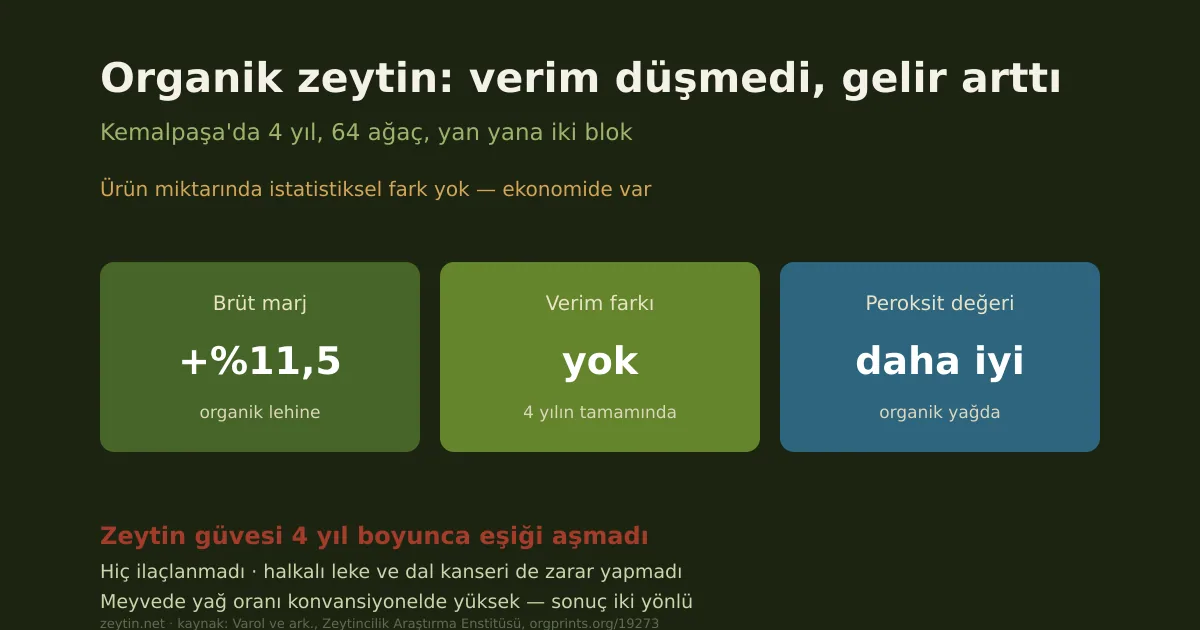
A four-year organic vs conventional trial at Kemalpaşa: no yield difference, 11.5% higher gross margin for organic, lower peroxide value, but higher fruit oil content under conventional management.
Article
Organic olive growing: what a four-year trial found
A four-year organic vs conventional trial at Kemalpaşa: no yield difference, 11.5% higher gross margin for organic, lower peroxide value, but higher fruit oil content under conventional management.
 Article
Arbequina IRTA-i18: the clone behind super-high-density olive groves
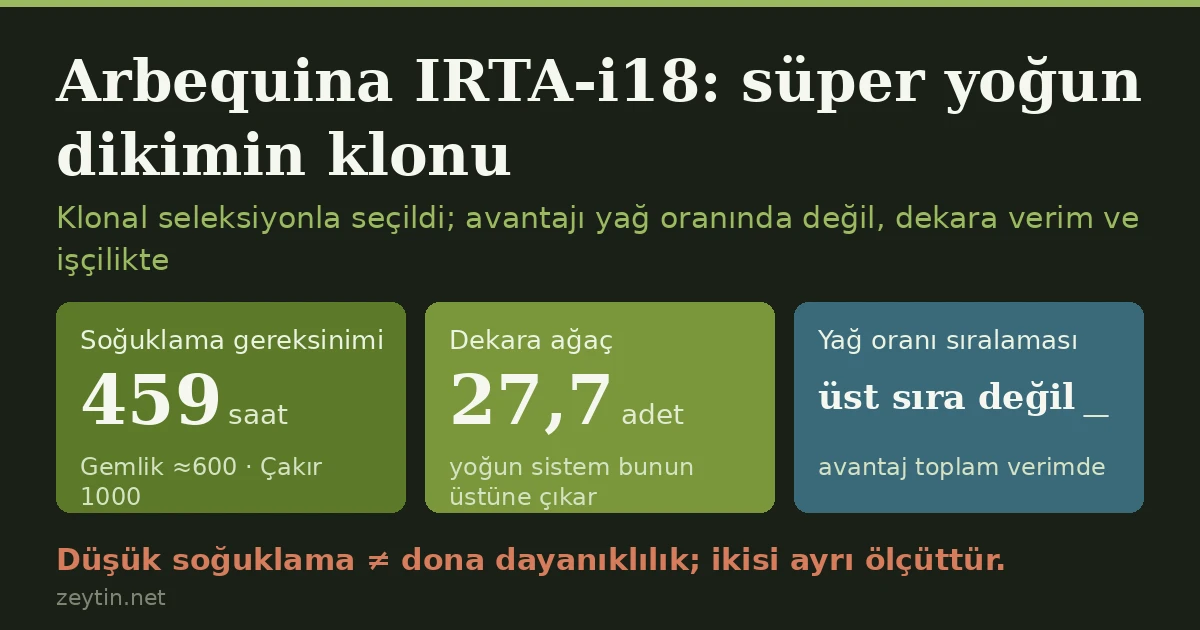
IRTA-i18, developed from Arbequina by clonal selection, was chosen for super-high-density groves. What early bearing, mechanical harvest and a low 459-hour chilling requirement actually mean.
Article
Arbequina IRTA-i18: the clone behind super-high-density olive groves
IRTA-i18, developed from Arbequina by clonal selection, was chosen for super-high-density groves. What early bearing, mechanical harvest and a low 459-hour chilling requirement actually mean.
 Article
When to harvest olives: deciding with the maturity index
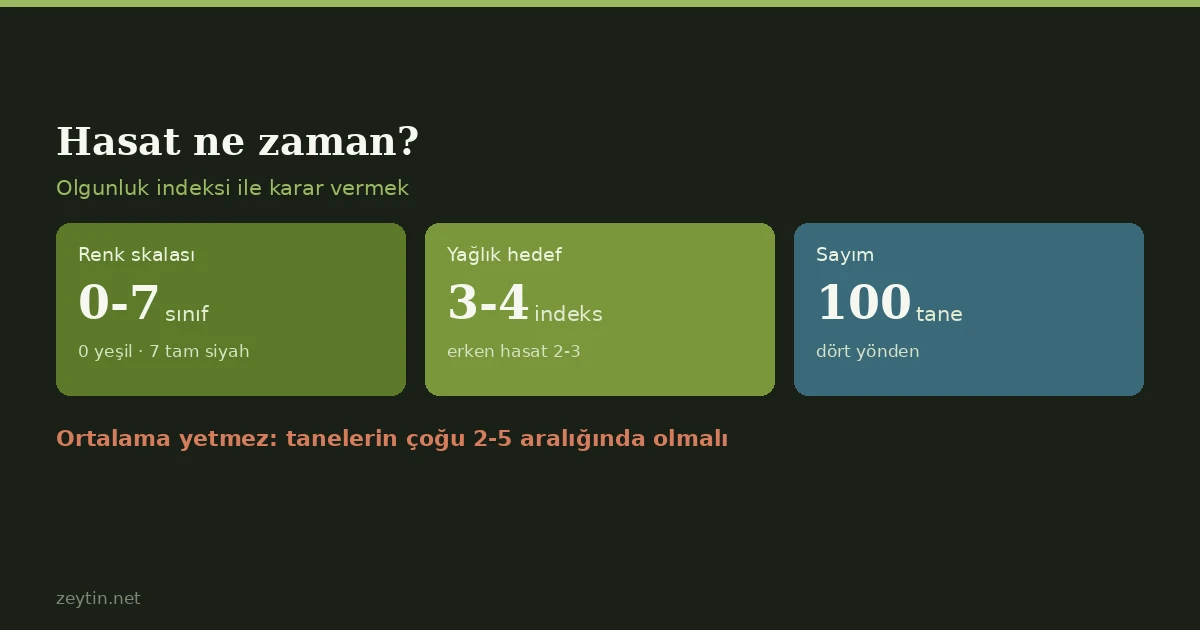
Harvest timing is set by the maturity index, not the calendar. The 0-7 colour scale, how to calculate it from 100 fruits, early versus late harvest compared, and ripening times by variety.
Article
When to harvest olives: deciding with the maturity index
Harvest timing is set by the maturity index, not the calendar. The 0-7 colour scale, how to calculate it from 100 fruits, early versus late harvest compared, and ripening times by variety.
 Article
Building a high-density olive grove: five requirements
High-density planting is not a choice of variety but a five-component system — miss one and it performs worse than a traditional grove. Spacing, yields, the overlooked oil-content trade-off, and who it does not suit.
Article
Building a high-density olive grove: five requirements
High-density planting is not a choice of variety but a five-component system — miss one and it performs worse than a traditional grove. Spacing, yields, the overlooked oil-content trade-off, and who it does not suit.