Which olive variety is the most productive? Regular crops, early bearing and alternate bearing
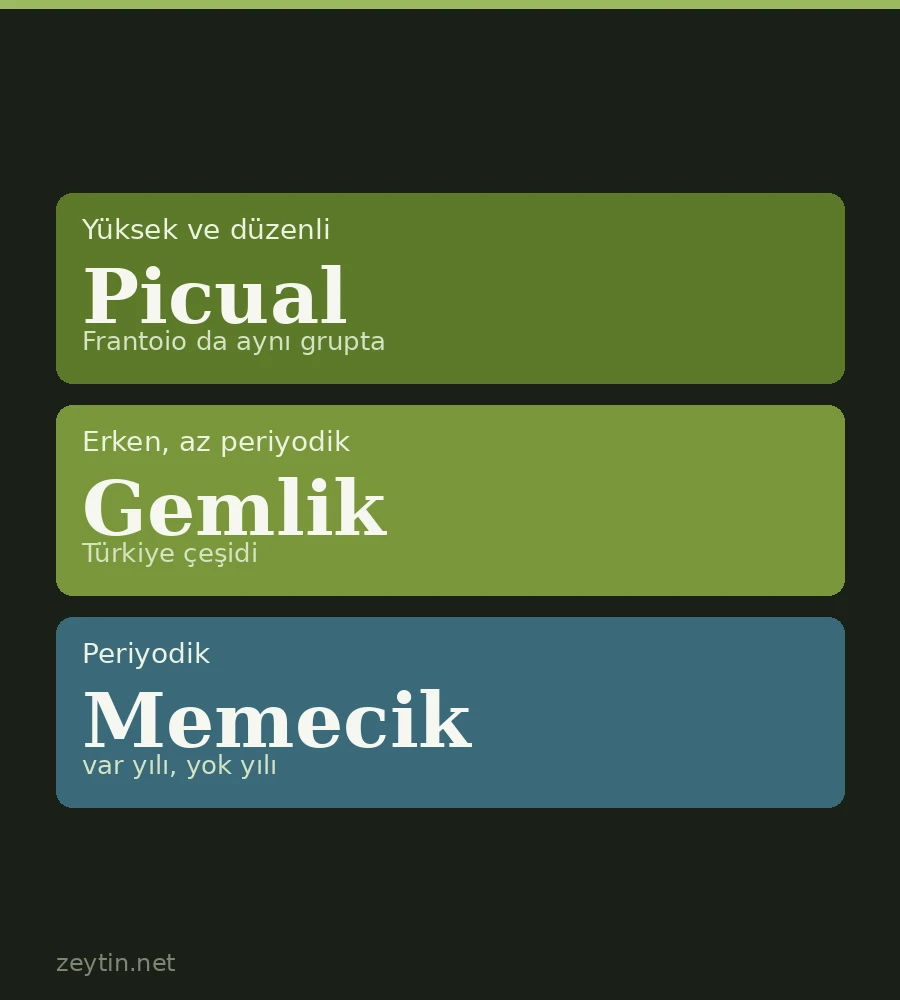
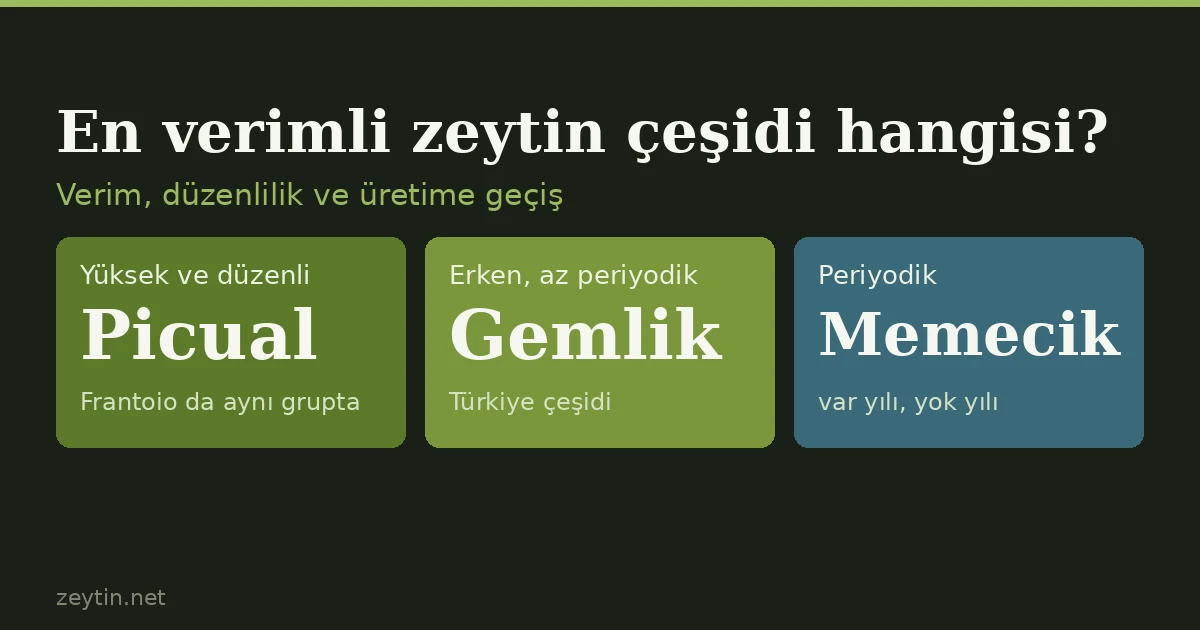
There is no single "most productive olive". Productivity depends on whether a tree bears regularly every year, how early it starts cropping and pollination. In our variety data, Picual and Frantoio are high and regular, Gemlik is early with low alternate bearing, while Kalamata, Hojiblanca and Memecik swing between on and off years.
"Which olive is the most productive?" is the first question almost everyone asks before buying saplings. The short answer: there is no single most productive variety. A variety's yield on paper only shows up in your grove when climate, soil, irrigation and pollination are right. But there are real, measurable differences between varieties, and this article brings them together using the data published on our variety pages.
Productivity is not a single number
When people talk about "yield" in olives, they may mean three different things:
1. Fruit per tree or per decare. How many kilos of olives the grove produces.
2. Oil content. How much of the fruit is oil. We covered this separately in olive varieties with the highest oil content.
3. Regularity. Whether the tree produces a similar crop every year.
What shapes a grower's income most is often the third. A variety that crops heavily one year and almost nothing the next can fall behind one that yields less on average but steadily every year.
Alternate bearing: on years and off years
An olive tree tends to rest after a heavy crop. This is called alternate bearing. The tendency varies greatly between varieties, and it can be softened with care, pruning and irrigation, but never eliminated entirely.
Varieties that stand out in the data
The table below brings together the yield, regularity and onset of production information recorded on our variety pages.
| Variety | Yield | Regularity | Onset of production |
|---|---|---|---|
| Picual | High | Regular, no alternate bearing | Early |
| Frantoio | High | Regular | Medium |
| Gemlik | — | Low tendency to alternate | Early |
| Ayvalık | — | Little alternate bearing | — |
| Domat | High with good care | Regular | — |
| Uslu | Good | Regular with good care | — |
| Samanlı | Good | — | — |
| Coratina | — | — | Medium-early |
| Kalamata | High | Alternate | — |
| Hojiblanca | High | Alternate: on and off years | — |
| Memecik | Satisfactory | Shows alternate bearing | — |
A dash means the information is not in our variety record; it does not mean "none".
The picture that emerges: globally, Picual and Frantoio stand out for crops that are both high and regular. Among Turkish varieties, Gemlik looks the most balanced, thanks to early bearing and low alternate bearing. Kalamata and Hojiblanca are productive but uneven, and Memecik, although it is one of the most widespread varieties in the Aegean, shows clear alternate bearing.
Why early bearing matters
After planting, the first fruit usually appears within 3-5 years, while economic yields take 7-10 years. Those are the years in which a grove produces only costs. Varieties that start cropping early, such as Picual and Gemlik, shorten that wait and bring the return on investment forward. In a long-lived grove the early difference fades over time, but in a grove established with a loan or on rented land, cash flow in the first decade is often the real criterion behind the choice of variety. Our calculation on cutting down or renewing a grove shows the same period matters.
Pollination: the factor that quietly cuts yield
Whether a variety sets enough fruit when planted on its own can matter more than any yield table. According to our data, Picual, Uslu and Nizip Yağlık are self-fertile. Gemlik, Domat and Memecik are partly self-fertile; Ayvalık, Edincik Su and Samanlı are recorded as pollinators for Gemlik, and Ayvalık, Memeli and Gemlik for Domat. Coratina has low self-fertility, and Halhalı is recorded as not self-fertile, so it always needs a pollinator nearby.
This is one of the most common reasons a single-variety grove fails to deliver the expected crop. Details are in pollination and pollinator varieties in olive.
High-density planting and yield per decare
Yield per tree and yield per decare are not the same. Varieties with a compact canopy that start cropping early can be planted more densely, and such groves can give more fruit per decare within a few years. That is why Arbequina, Arbequina IRTA-i18 and Koroneiki are the main varieties in high-density and super-high-density systems. Our articles on how many trees per decare and building a high-density grove go through the calculation in detail.
Factors as decisive as the variety
Whichever variety you choose, yield is closely linked to four things:
- Water. Water shortage, especially during flowering and fruit growth, cuts the crop directly. See olive irrigation.
- Nutrition. Fertilising without a soil analysis ends up either too little or too much. See fertilisation and soil analysis.
- Pruning. The shaded inner canopy does not bear fruit. See olive pruning.
- Chilling. A tree that does not get a cool enough winter does not flower properly. See chilling requirement.
Reading notes
The descriptions in the table come from the sources on our variety pages and reflect observations made by different studies under different conditions. The same variety may behave differently in another region. To estimate how much oil your grove might give, you can use the yield calculator.
One rating per visitor; you can change yours at any time. Ratings are real reader votes — no seeded or default scores.
Related
 Article
Organic olive growing: what a four-year trial found
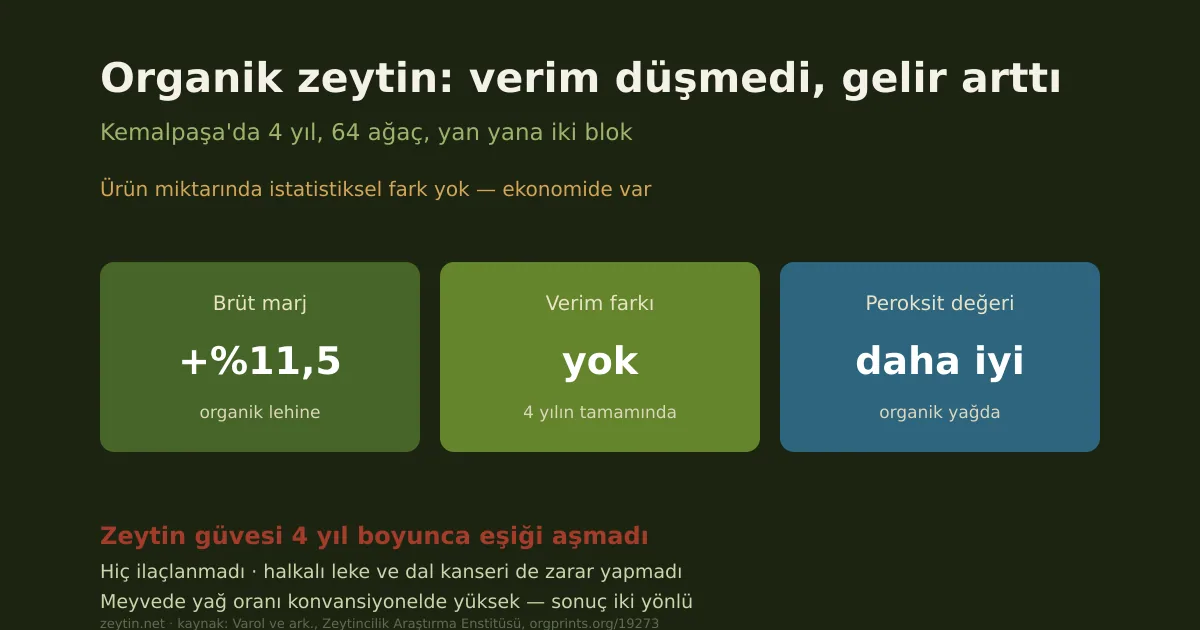
A four-year organic vs conventional trial at Kemalpaşa: no yield difference, 11.5% higher gross margin for organic, lower peroxide value, but higher fruit oil content under conventional management.
Article
Organic olive growing: what a four-year trial found
A four-year organic vs conventional trial at Kemalpaşa: no yield difference, 11.5% higher gross margin for organic, lower peroxide value, but higher fruit oil content under conventional management.
 Article
Olive Pruning: Why, When and How
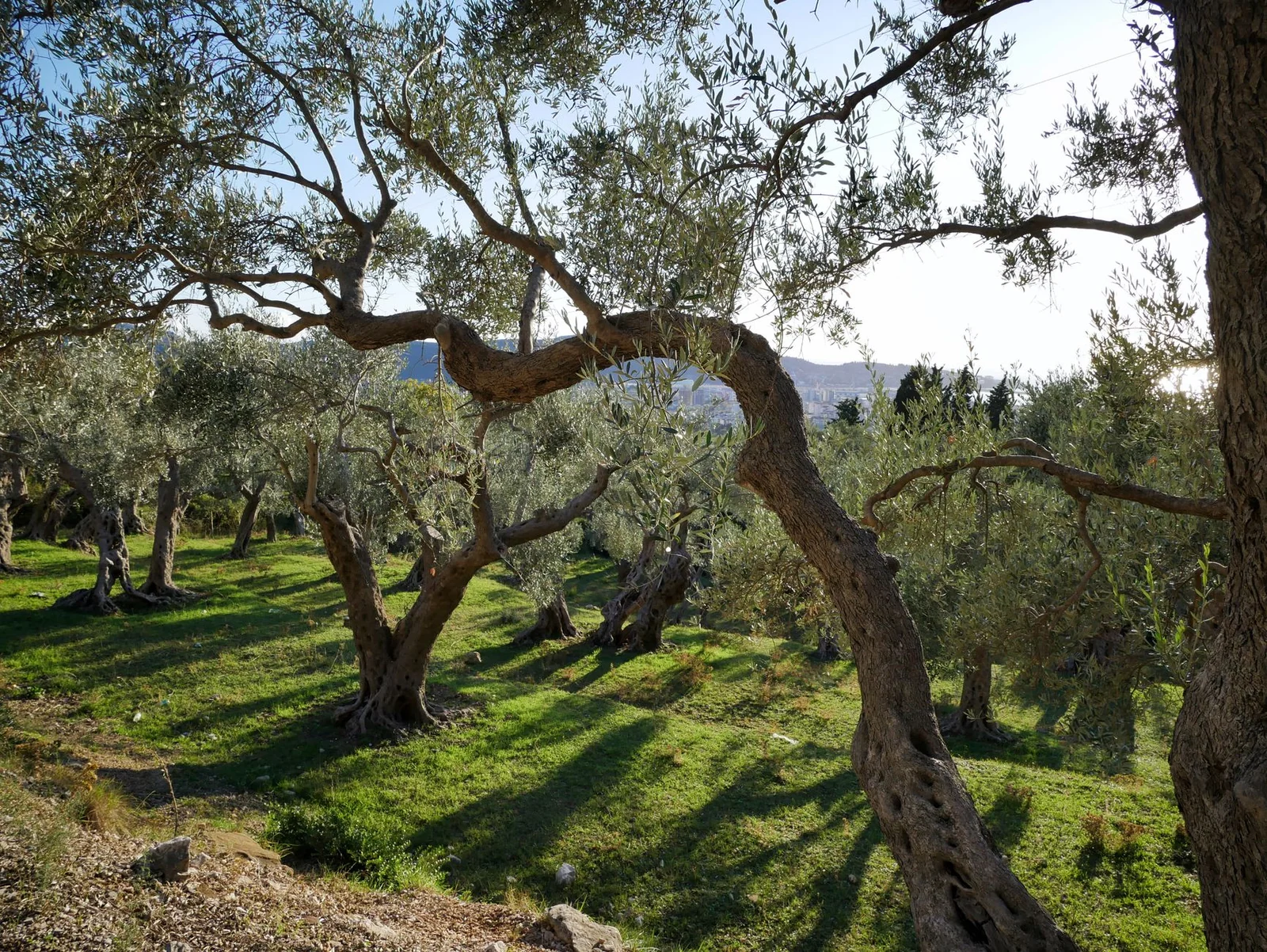
Why olives are pruned, when to do it, formative and production pruning, rejuvenation and high-density systems.
Article
Olive Pruning: Why, When and How
Why olives are pruned, when to do it, formative and production pruning, rejuvenation and high-density systems.
 Article
Grafting Olives: Changing Cultivar and Improving Wild Trees
When grafting is needed, taking scion wood, bud and cleft methods, topworking and aftercare.
Article
Grafting Olives: Changing Cultivar and Improving Wild Trees
When grafting is needed, taking scion wood, bud and cleft methods, topworking and aftercare.
 Article
Should I switch to organic? A decision guide for olive groves
A four-year trial found no yield difference and put organic 11% ahead economically. But where does the real cost of switching lie, who does it suit, and how do you fight the fly without chemicals?
Article
Should I switch to organic? A decision guide for olive groves
A four-year trial found no yield difference and put organic 11% ahead economically. But where does the real cost of switching lie, who does it suit, and how do you fight the fly without chemicals?