Which olive varieties have the highest oil content?
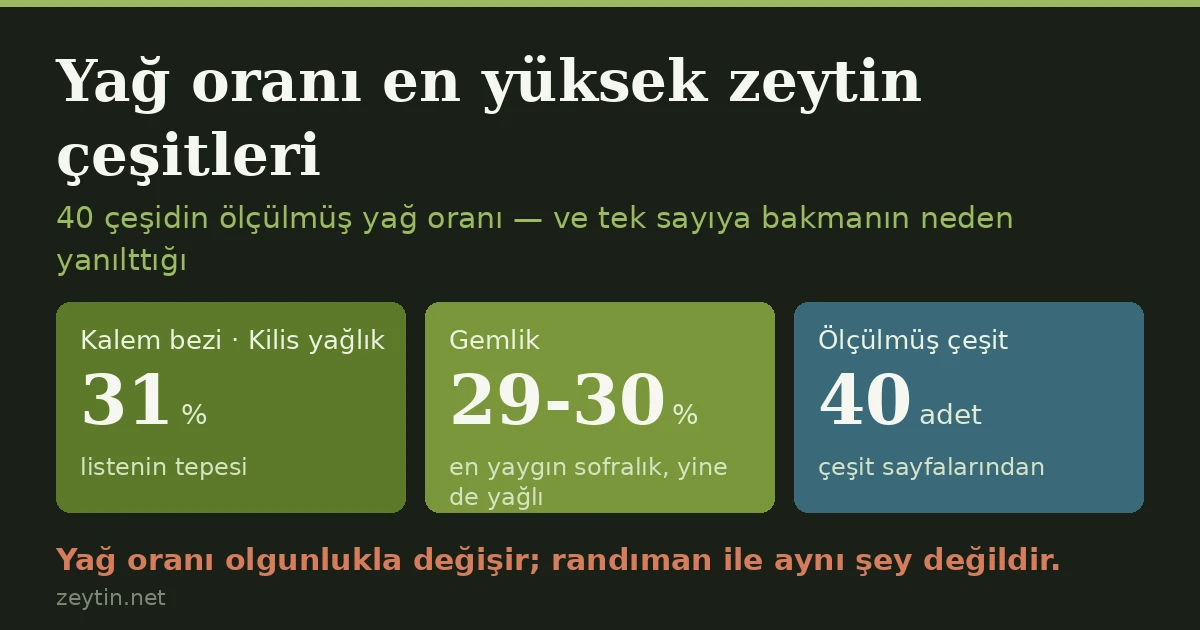
Kalem bezi and Kilis yağlık lead at 31 percent, with Gemlik just behind at 29-30. Measured oil content for 40 varieties — and what the figure does and does not tell you.
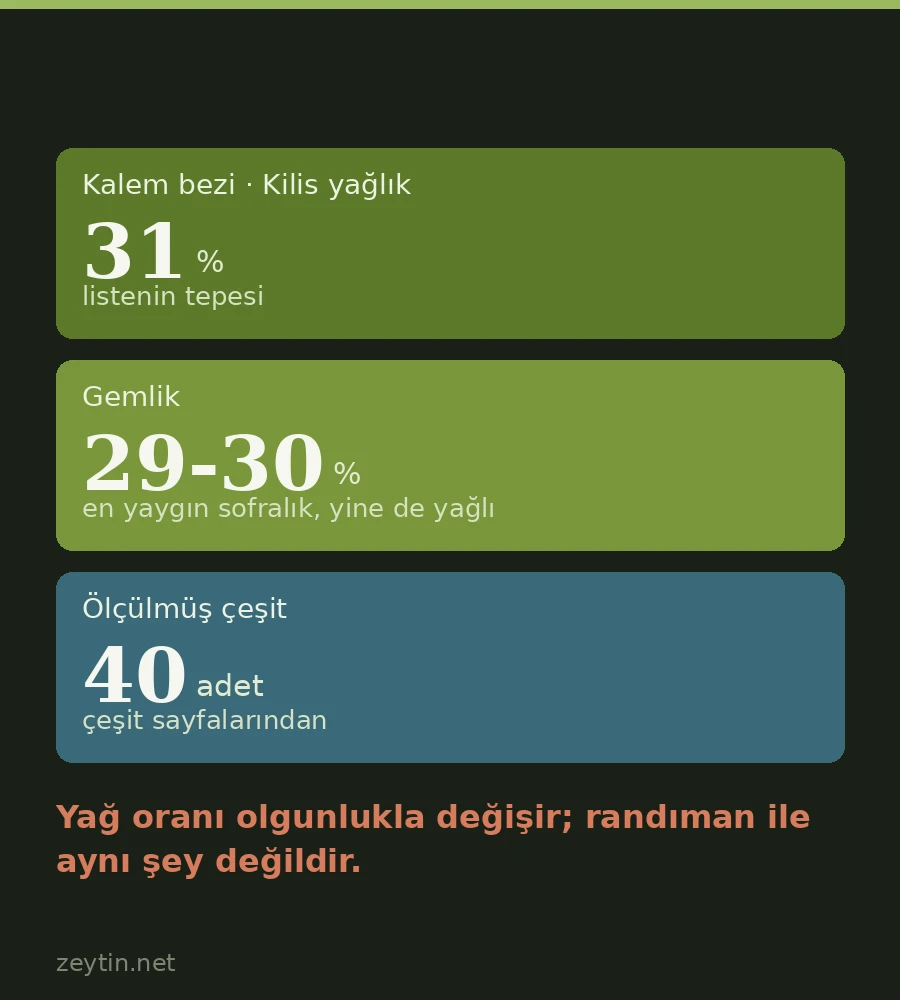
"Which olive variety gives the most oil?" does not have a single-name answer. Across the measurements compiled on our variety pages, oil content is recorded for 40 varieties, and the spread is wide: roughly nine percentage points separate top from bottom.
Measured oil content
| Variety | Oil content |
|---|---|
| Kalem bezi | 31% |
| Kilis yağlık | 31% |
| Gemlik | 29-30% |
| Saurani | 29% |
| Çekişte | 27% |
| Nizip yağlık | 27% |
| Patos | 26.8% |
| Memecik | 25-28% |
| Koroneiki | 24-28% |
| Erkence | 25-26% |
| Picual | 24-27% |
| Ayvalık (Edremit) | 23-26% |
| Leccino | 22-27% |
Why a single number misleads
Oil content states what share of the fruit's weight is oil. But it is not a fixed varietal trait; it rises with ripeness. The registration document for Antalya Tavşan Yüreği states this plainly: oil content runs between 9 and 20.2 percent at the green stage and reaches 25 percent at black maturity. Same tree, same year, close to a twofold difference.
A second confusion: high oil content does not mean a lot of oil per tree. A variety can carry much oil in its fruit and still set little fruit. Yield per hectare is the product of oil content and tree productivity — and productivity swings year to year because of alternate bearing.
So which one is "best"?
It depends on what you are growing for. In oil production, a high share is income; in table olive production it can be unwanted, because oily fruit softens faster in brine. For table varieties the measures that matter are flesh ratio and flesh-to-pit ratio.
Shares of Türkiye's tree stock separate "oiliest" from "most common": Erkence 3.5 percent, Kilis yağlık 3, Halhalı 2.2, Nizip yağlık 2, Çekişte 1.5. Kalem bezi, at the top of the oil list, is not a widespread variety; mid-to-upper varieties such as Gemlik and Memecik form the body of national production.
Do not confuse it with extraction yield
Oil content is the oil in the fruit; extraction yield is how much of it the mill can actually recover. The national crop report gave an extraction yield of 5.5 percent for the 2025-26 season, meaning not all the oil inside the fruit is captured. Pressing temperature, malaxation time and how long the fruit waits before milling widen or narrow that gap.
So planting a "31 percent variety" does not put 31 percent oil in your tank. Processing quality decides the distance; variety choice only raises the ceiling.
Same variety, different grove: why the figure shifts
Most values in the table are ranges rather than single numbers: Memecik 25-28%, Koroneiki 24-28%, Leccino 22-27%. Those ranges are not measurement error; they are the reality. Four things move a variety's oil content.
Water. In an irrigated grove the fruit grows larger but its water share rises too, so oil content as a percentage falls. Under dry conditions the fruit stays small and the share rises. The same variety therefore gives two different numbers in irrigated and rain-fed groves — and total oil per hectare may still be higher in the irrigated one.
Harvest timing. Oil accumulates as the fruit turns colour. Early harvest means a lower share, late harvest a higher one. But late harvest weakens the oil's sensory attributes and shelf life. The grower makes a deliberate trade between yield and quality here.
The year. An olive tree bears heavily one year and lightly the next. In a heavy year, resources per fruit fall and oil content slips a point or two. That is why the year of a measurement matters when reading the table.
Region. Heat sum and sunshine hours act directly on oil accumulation. A variety grown in the northern Aegean and the same variety in the southeast will not match; Kilis yağlık's high figure cannot be separated from its region.
Table or oil: same table, read in reverse
High-oil varieties are treated as oil types and low-oil ones as table types — but that is a crude split. In Türkiye a number of varieties are dual purpose. Gemlik is the best-known case: despite sitting high on the list at 29-30 percent, it is the country's most widespread table variety. Memecik goes to both oil and table.
That dual use gives the farmer flexibility. In years when prices favour table olives the fruit goes to brine; when they favour oil it goes to the mill. The gap between the two prices formed for the same olive reaches sixfold in some years.
For those planting a new grove
Oil content is not the first criterion on its own. First filter for varieties that meet your region's chilling requirement and frost risk; chilling requirement is recorded for nine varieties in our measurements. Then decide your market: are you selling oil or brine? Only after those two filters does oil content become a meaningful ranking.
There is also self-fertility: some varieties do not set enough fruit alone and need a pollinator. We hold this information for 12 varieties. A grove planted with a high-oil variety but no pollinator never reaches the figure on paper. At the sapling selection stage, those two questions come before oil content.
In short
Kalem bezi and Kilis yağlık top the oil-content ranking. But three things must be read together when choosing: the variety's oil content, the tree's productivity and your region's conditions. You can compare the measured data on our variety pages.
One rating per visitor; you can change yours at any time. Ratings are real reader votes — no seeded or default scores.
Related
 Article
The Olive: Tree, History, Production and Future
The botany, history and uses of the olive tree; current production figures worldwide and in Turkey, provinces, varieties and the sector's future — with tables.
Article
The Olive: Tree, History, Production and Future
The botany, history and uses of the olive tree; current production figures worldwide and in Turkey, provinces, varieties and the sector's future — with tables.
 Article
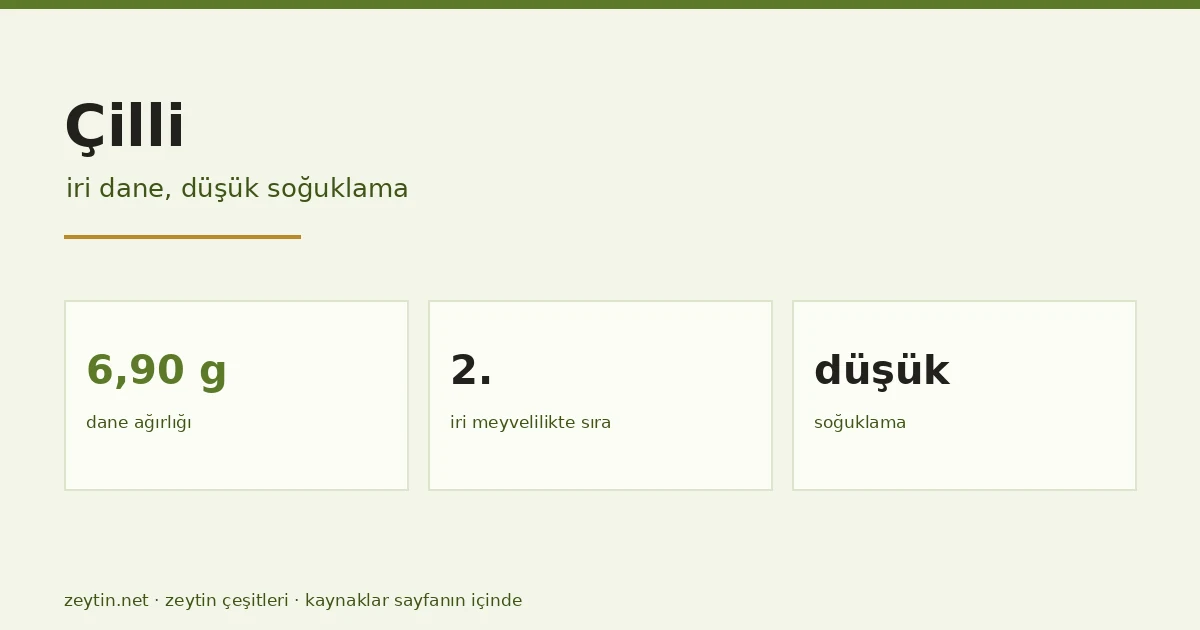
The Çilli olive: large fruit, low chilling requirement
At 6.90 g it ranks among the large-fruited cultivars, and sits in the low chilling-requirement group — second only to Adana Topağı.
Article
The Çilli olive: large fruit, low chilling requirement
At 6.90 g it ranks among the large-fruited cultivars, and sits in the low chilling-requirement group — second only to Adana Topağı.
 Article
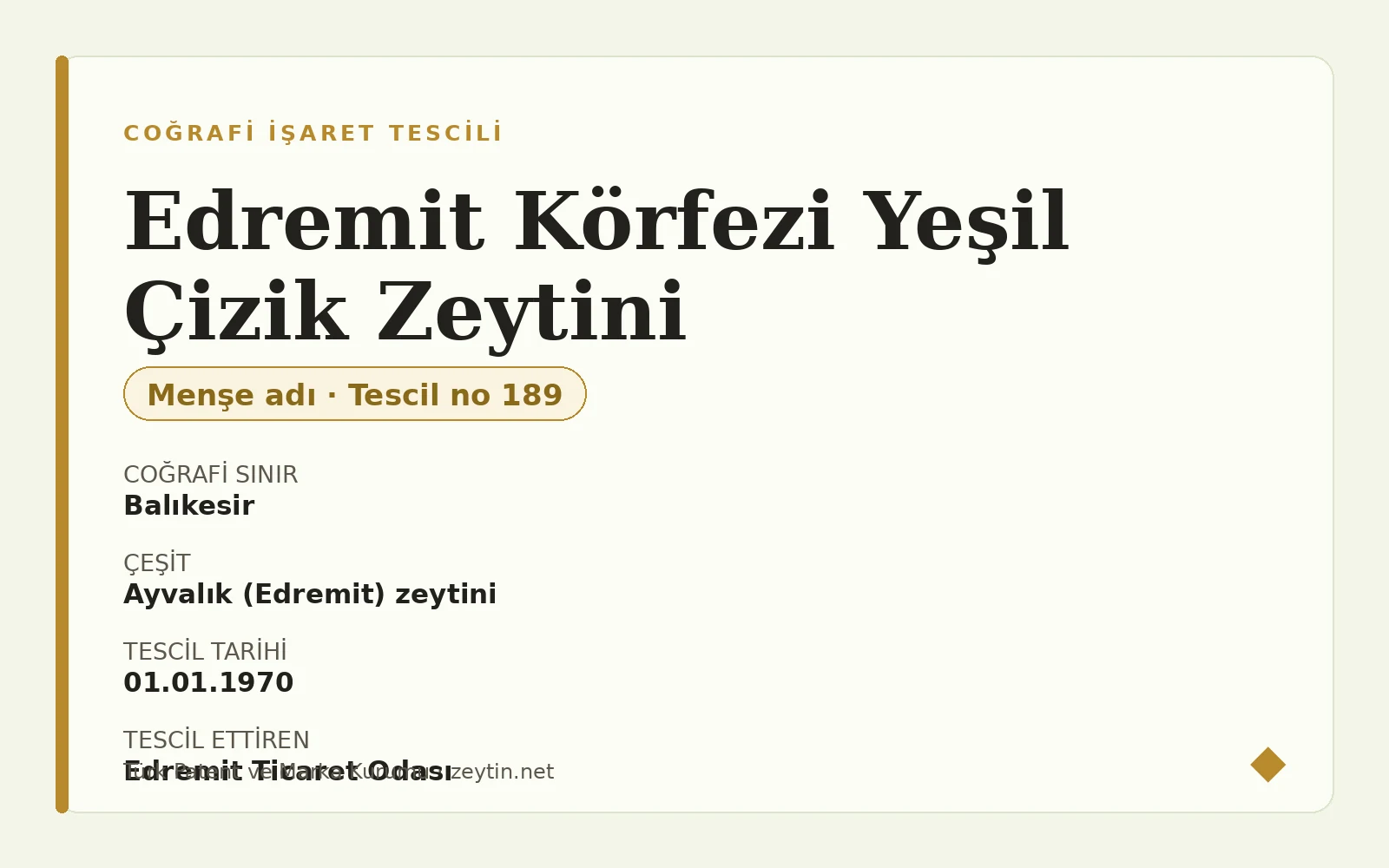
Edremit Gulf Green Scored Olive: a registration that defines altitude and slope
Registered in 2014. The certificate draws the boundary topographically as well as administratively: 50-250 m altitude, 5-6% slope. Debittering is entirely natural.
Article
Edremit Gulf Green Scored Olive: a registration that defines altitude and slope
Registered in 2014. The certificate draws the boundary topographically as well as administratively: 50-250 m altitude, 5-6% slope. Debittering is entirely natural.
 Article
Sat olive
Sat is a recorded variety of the Black Sea. No measured pomological data published.
Article
Sat olive
Sat is a recorded variety of the Black Sea. No measured pomological data published.