Milas Olive Oil: a press bed dated to 2000 BC
Registered in the European Union as well. The certificate's archaeological anchor is a press bed cut into rock at Pilavtepe — four thousand years old.
Very few of Türkiye's geographical indications are also registered in the European Union. Milas Olive Oil is one of them — and the historical evidence it rests on comes not from a text but from rock.
The record
| Registration no | 201 |
| Registration date | 13.10.2015 |
| Type | Designation of origin |
| Area | The Milas district of Muğla |
| Cultivar | Memecik |
| EU registration | 23.12.2020 |
The evidence in the rock
Milas and its surroundings were the heart of the Carian civilisation. The certificate lists the olive oil production remains documented in the area: press beds, press weights, lever sockets, vat remains, treading vats and vessel emplacements.

Two of them are dated:
Pilavtepe. A press bed shaped into the bedrock in the Sarıçay bed on the Milas–Bodrum road, dated to 2000 BC. Olives were being pressed here four thousand years ago.
Herakleia. A press weight found on the shore of Lake Bafa belongs to a late Roman farmhouse.
We covered the wider Mediterranean picture in the history of the olive; Milas sits at one of its oldest edges.
An unbroken chain
The certificate's strength is a record showing that production never stopped:
| Period | Record |
|---|---|
| 2000 BC | Pilavtepe press bed |
| Late Roman | Herakleia press weight |
| 16th–17th c. | Olive mills and oil houses of the Menteşe Sanjak |
| 16th–19th c. | Oil shipped from Milas to meet Istanbul's demand |
| Mid-19th c. | High-capacity factories |
| Late 19th c. | Iron screw press system |
| Mid-20th c. | Hydraulic presses (steam, then electric) |
| Today | Hydraulic press and continuous systems |
From before the Ottoman period Milas supplied olive oil to a wide region reaching as far as İzmir. The port of Güllük was the principal outlet for exports in every era.
The Istanbul detail is especially telling: between the 16th and 19th centuries the capital was a major consumption centre for oils of Milas origin. The name has circulated as a mark of quality for centuries.
The geography
Milas lies in the Menteşe region of north-western Muğla. It is mountainous country, bounded to the west by Lake Bafa and Mount İlbir, with the Akçay depression running to the east and narrow, deep, partly calcareous valleys defining the terrain.
The groves run in a crescent from the district centre, north-east to south-west: from Yusufça through Kırcağız, Selimiye, Bafa, Danişment, Hisarcık and Kazıklı to Güllük. The certificate simplifies the boundary — the area lying north and west of a straight line drawn between Güllük and Yusufça.
The densest planting is around Lake Bafa. We looked at the whole province in olive growing in Muğla.
In short
Milas Olive Oil is a geographical indication for oil from the Memecik cultivar, registered both in Türkiye and in the European Union. What sets its certificate apart is not a table of chemistry but a production record running four thousand years back without a break.
The criteria the document binds
The registration does not only protect a name; it defines the product numerically:
| Criterion | Value in the document |
|---|---|
| Peroxide value | 4.5 meq O₂/kg (max) |
| Total phenolic content | 100 mg/kg min |
That the document sets a floor for total phenolic content is notable — most registrations never define phenol levels, although bitterness, pungency and shelf-life behaviour largely depend on them.
Inspection. Members: Milas Ticaret ve Sanayi Odası.
The cultivar behind it, measured
The registration is granted to a place, but the cultivar the definition rests on has measurable values:
| Property | Value |
|---|---|
| 1 kg’daki tane sayısı | 210 |
| Et oranı | %88 |
| Et / çekirdek oranı | 5,86 |
| Et/çekirdek oranı | 6,7 |
| Yağ oranı | %25-28 |
| Toplam fenol | 296-407 mg CAE/kg |
| α-tokoferol | 219-324 mg/kg |
| Olgunlaşma | Kasım ortası - aralık ortası |
| Kendine verimlilik | Kısmi |
| Soğuğa dayanım | Orta |
| Kullanım | Yağlık; yeşil ve siyah sofralık olarak da tüketilir |
| Ağaç | yarı dik, kuvvetli |
Oil content reaches 28% at the top of its range — on its own enough to justify pressing. The cultivar is partially self-fertile; pollinators are used to secure yield. A flesh-to-stone ratio of 5.86 is the basic measure of how much of a table olive is actually eaten.
Its place in Muğla's olive production
| Item | Value |
|---|---|
| Fruit production | 174,376 t |
| — for oil | 162,632 t |
| — for the table | 11,744 t |
| Olive oil production | 32,142 t |
| Trees | 14,844 thousand |
| Yield per tree | 11.7 kg |
93% of the province's fruit goes to oil. An oil-based registration matches how the province actually produces.
One rating per visitor; you can change yours at any time. Ratings are real reader votes — no seeded or default scores.
Related
 Article
What are zeytinyağlılar? The logic of Turkish dishes cooked in olive oil
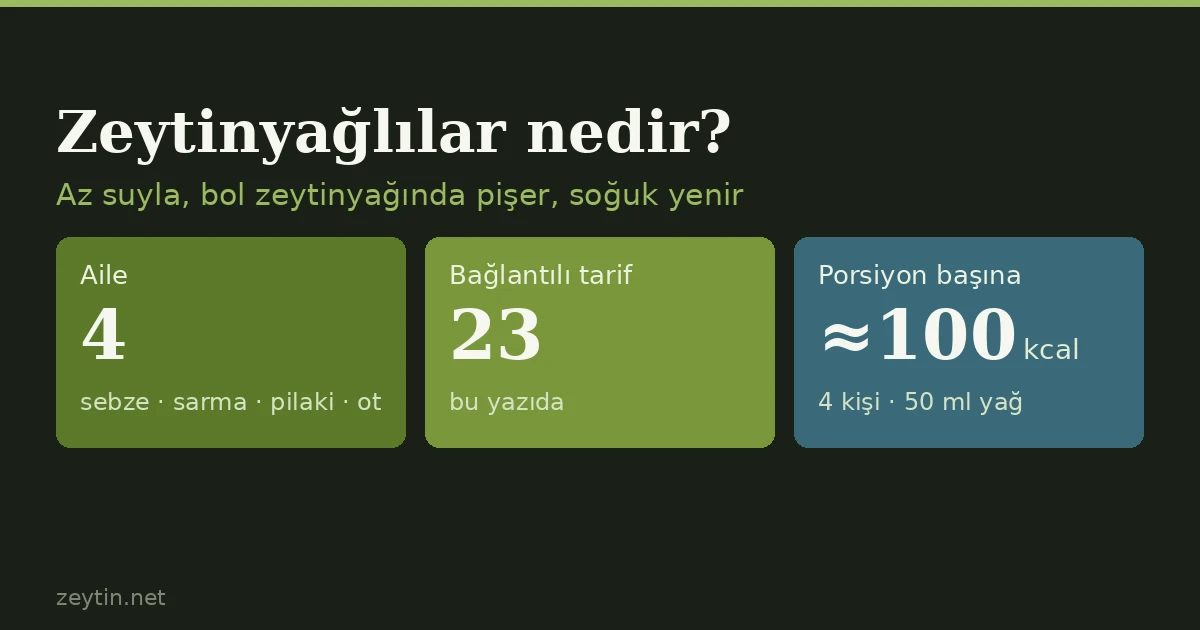
Zeytinyağlılar are Turkish dishes in which vegetables or pulses are cooked with little water in plenty of olive oil until they absorb their own juices, then eaten cold at room temperature. They contain no meat, can be made a day ahead and taste better the next day. Vegetable dishes, stuffed leaves and vegetables, pilaki beans and Aegean wild greens are the four main families.
Article
What are zeytinyağlılar? The logic of Turkish dishes cooked in olive oil
Zeytinyağlılar are Turkish dishes in which vegetables or pulses are cooked with little water in plenty of olive oil until they absorb their own juices, then eaten cold at room temperature. They contain no meat, can be made a day ahead and taste better the next day. Vegetable dishes, stuffed leaves and vegetables, pilaki beans and Aegean wild greens are the four main families.
 Article
Where does olive mill wastewater go? Lagoon rules and the two-phase option
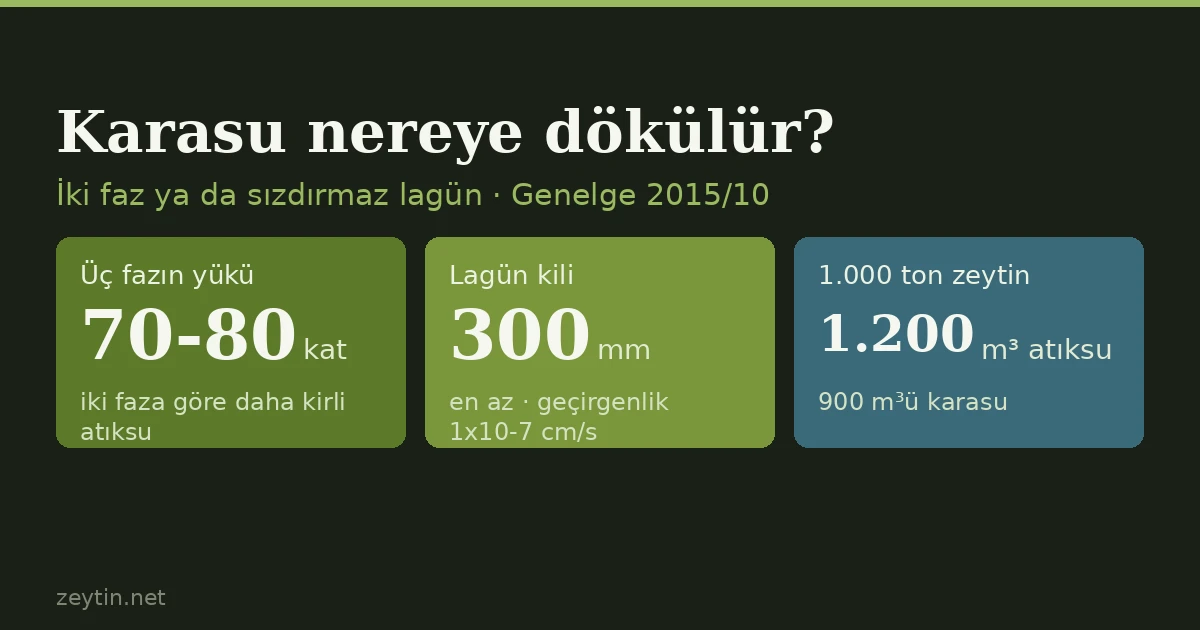
When pressing starts, the dark liquid piling up behind the mill has one legal destination, and it is not the stream. Türkiye offers two lawful routes: switch to a two-phase system, or build a sealed evaporation lagoon. The lagoon's clay thickness, permeability, depth and area are all fixed by numbers in a ministry circular — worked example included.
Article
Where does olive mill wastewater go? Lagoon rules and the two-phase option
When pressing starts, the dark liquid piling up behind the mill has one legal destination, and it is not the stream. Türkiye offers two lawful routes: switch to a two-phase system, or build a sealed evaporation lagoon. The lagoon's clay thickness, permeability, depth and area are all fixed by numbers in a ministry circular — worked example included.
 Article
What is riviera olive oil? Extra virgin, virgin and riviera compared
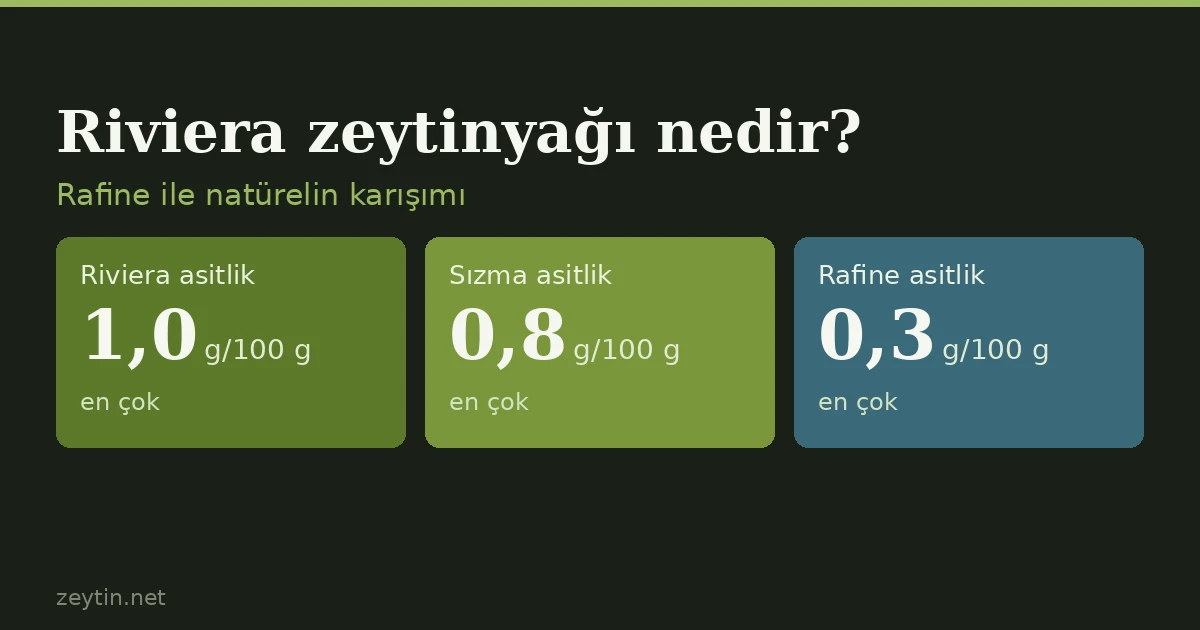
Riviera is a blend of refined and virgin olive oil: acidity at most 1%, peroxide 15. How it differs from extra virgin, virgin and pomace oil, in one table.
Article
What is riviera olive oil? Extra virgin, virgin and riviera compared
Riviera is a blend of refined and virgin olive oil: acidity at most 1%, peroxide 15. How it differs from extra virgin, virgin and pomace oil, in one table.
 Article
What does the colour of olive oil mean?
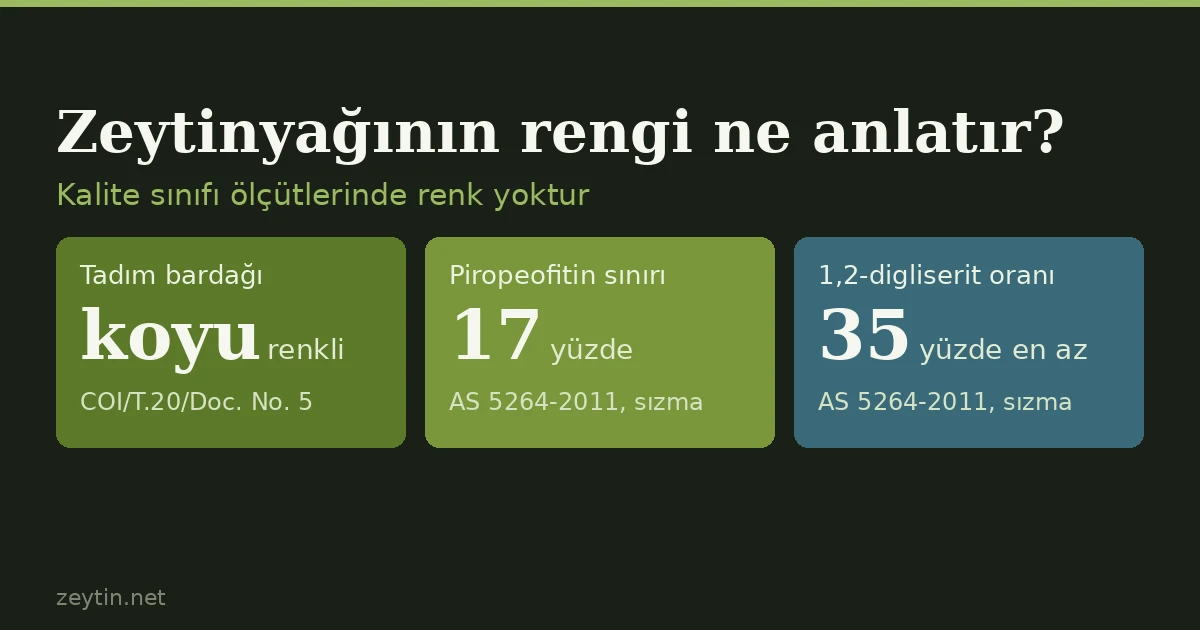
Dark green olive oil is widely assumed to be better, yet colour is not a criterion in any quality grade. The International Olive Council's official tasting glass must be dark enough that the colour of its contents cannot be seen — precisely so that the taster is not influenced by it. The chlorophylls and carotenoids that make the colour vary with cultivar, ripeness, leaf ratio and settling. Pigments do carry information in the laboratory as markers of freshness and heat treatment, but they cannot be read by looking at the bottle.
Article
What does the colour of olive oil mean?
Dark green olive oil is widely assumed to be better, yet colour is not a criterion in any quality grade. The International Olive Council's official tasting glass must be dark enough that the colour of its contents cannot be seen — precisely so that the taster is not influenced by it. The chlorophylls and carotenoids that make the colour vary with cultivar, ripeness, leaf ratio and settling. Pigments do carry information in the laboratory as markers of freshness and heat treatment, but they cannot be read by looking at the bottle.