Manavgat olive oil falls from 250-300 to 200 lira: the queue at the Chamber of Agriculture's mill spills onto the D-400 highway
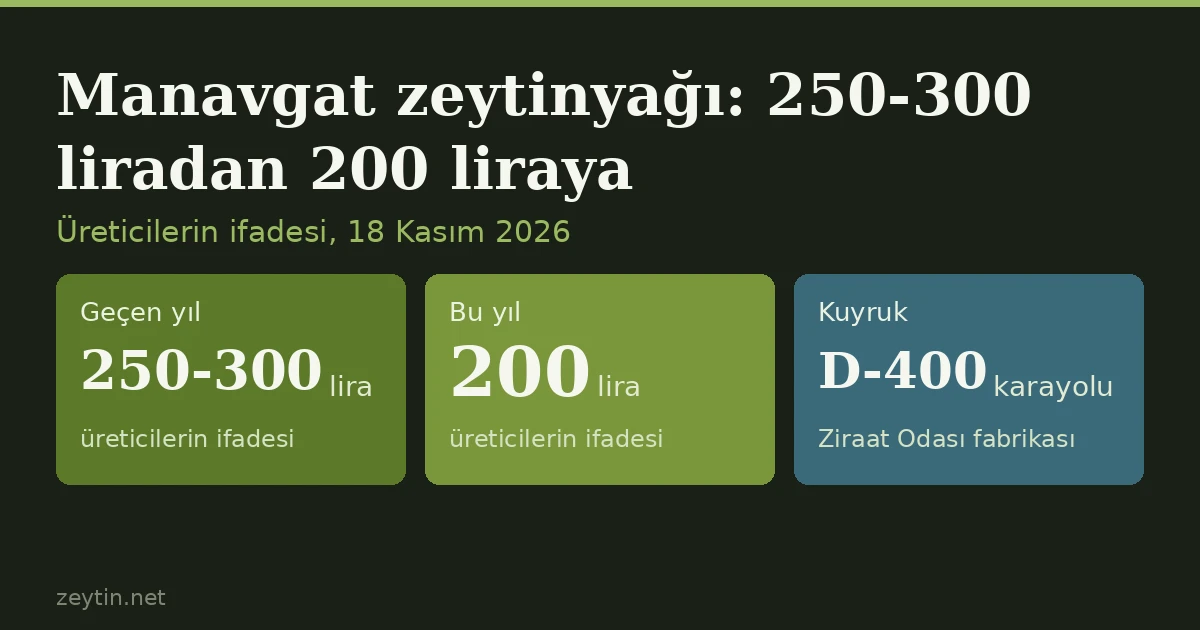
In Manavgat, Antalya, growers wait for hours at the olive oil mill after a larger harvest; the queue at the Manavgat Chamber of Agriculture's plant reached the D-400 highway. Growers say oil that sold for 250-300 lira last year has fallen to 200 lira. The reports do not say whether the price is per litre or per kilogram.
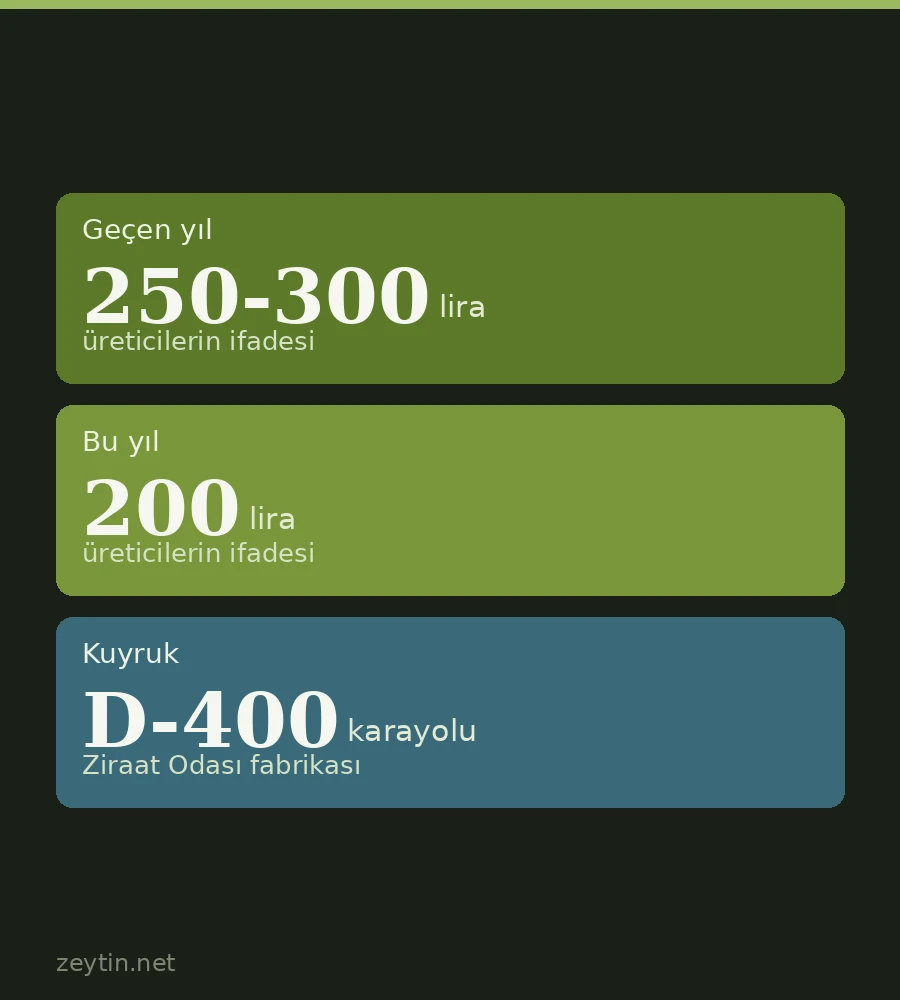
In Manavgat, in Turkey's Antalya province, growers queued in front of olive oil mills to press their larger harvest. According to reports dated 18 November 2026, the line of vehicles waiting at the Manavgat Chamber of Agriculture's plant, in the Tekandız area of Doğançam neighbourhood, spilled onto the D-400 highway. Growers say they sold their oil for 250-300 lira last year and that the price has fallen to 200 lira this year. Rasim Metin, president of the Manavgat Chamber of Agriculture, said the fall is not specific to Manavgat and that something similar is happening in Spain and other producing countries.
Figures in the reports
| Item | As stated in the reports |
|---|---|
| Last year's selling price (growers' statement) | 250-300 lira |
| This year's selling price (growers' statement) | 200 lira |
| Where the queue reached | D-400 highway |
| Waiting time | hours |
The reports are not consistent about the unit: one source gives the price simply as "lira", while other reports say per litre or per kilogram. We therefore do not tie the figure to a unit.
How big is the fall?
Reading the growers' ranges together gives the following (our own calculation): going from 250 to 200 lira is a fall of 20 per cent, and going from 300 to 200 lira is a fall of 33.3 per cent. A grower at the low end of the range has lost 20 per cent, one at the high end 33 per cent. The reports do not say which kind of oil (extra virgin or high-acidity) or which sales channel (at the mill, on the exchange) these figures refer to.
What did the Chamber say?
Rasim Metin said that prices continuing to fall while the harvest grows puts growers in a difficult position. He said the fall is not limited to the region and that similar developments are taking place in Spain and other olive-producing countries. Metin also called on hoteliers and tradespeople in Manavgat to use local growers' olive oil, watermelons, melons and tomatoes; in other words the Chamber's suggested way out is to raise local demand.
The harvest picture in the area
The reports give no separate harvest figure for Manavgat. At provincial level, Ali Çandır, president of the Antalya Commodity Exchange, said in September that the city's olive harvest would rise from about 55,000 tonnes last year to about 70,000 tonnes, an increase of 30 per cent; details are in our article on Antalya's on-year. The queue may be the reflection of that increase in pressing capacity, but the reports do not link the queue to capacity; that is our own interpretation.
Comparison with the national picture
According to Dr. Mustafa Tan, president of the National Olive and Olive Oil Council (UZZK), the average production cost of 1 kilogram of olive oil is 240-280 lira, against a market buying price of 170-200 lira; the figures are set out in our article on the UZZK's 2026/27 statement. Manavgat's 200 lira is at the top of that buying-price range, yet still below the cost range given by the same council. In Söke, in Aydın province, the head of the commodity exchange had said 5-acidity oil traded at 120 and 0.5-acidity oil at 170 lira: Söke Commodity Exchange statement. These figures come from different regions, different oil grades and unclear units, so they cannot be compared one to one; we put them side by side only to show the general level.
What the reports do not say
- How many vehicles or how many hours the queue involved.
- Whether the price is per litre or per kilogram, and which oil grade it refers to.
- The number of mills in Manavgat, their daily capacity and the pressing fee.
- A separate harvest estimate for Manavgat.
What to watch
As the season goes on, whether the queue shortens and whether the price in Manavgat falls below 200 lira will be the main indicators for growers in the district. How a pressing fee is calculated is explained in our pressing fee guide.
One rating per visitor; you can change yours at any time. Ratings are real reader votes — no seeded or default scores.
Related
 Article
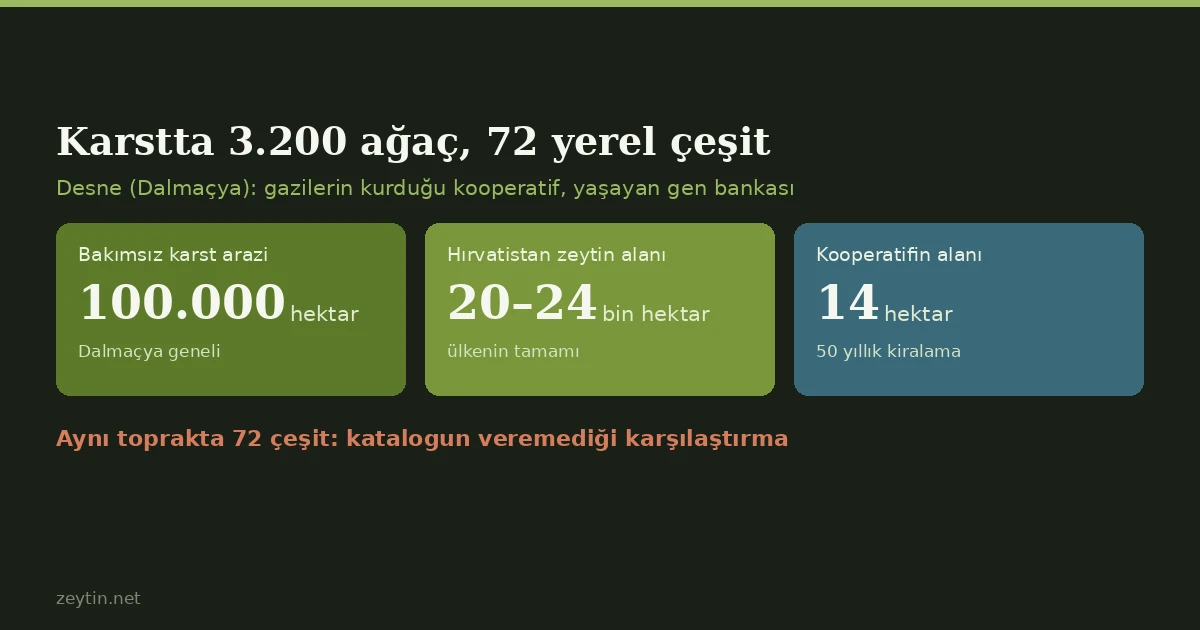
3,200 trees and 72 varieties on 14 hectares of stone: the cooperative turning Dalmatian karst into groves
Some 100,000 hectares of karst lie neglected in Dalmatia while all of Croatia has 20,000–24,000 hectares under olives. In Desne a veterans' cooperative has grown 3,200 trees of 72 native varieties on 14 hectares of rock — a grove that doubles as a natural laboratory for climate resilience.
 Article
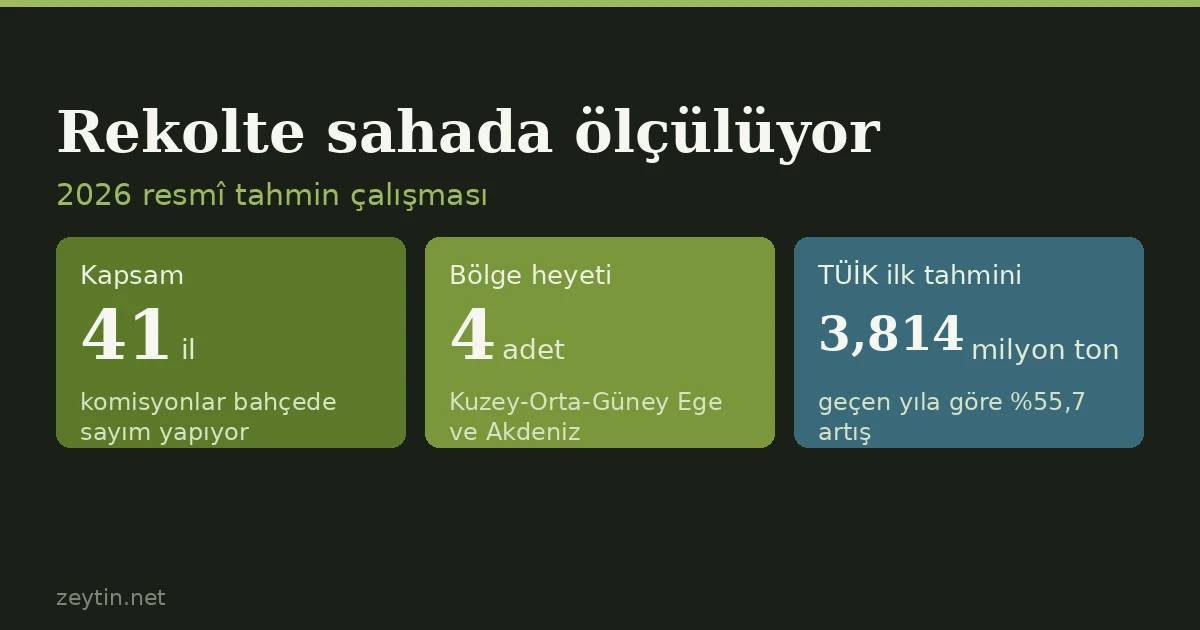
The official olive figure is measured in the grove: Türkiye's 2026 crop survey is under way
Türkiye's official olive crop figure is not produced at a desk. It comes from agricultural engineers counting fruit load tree by tree. A provincial crop estimation commission met in Denizli this week while field inspections continue in the districts. The national figure is assembled by an official delegation coordinated by the National Olive and Olive Oil Council across 41 provinces, and last season it was announced on 24 October.
 Article
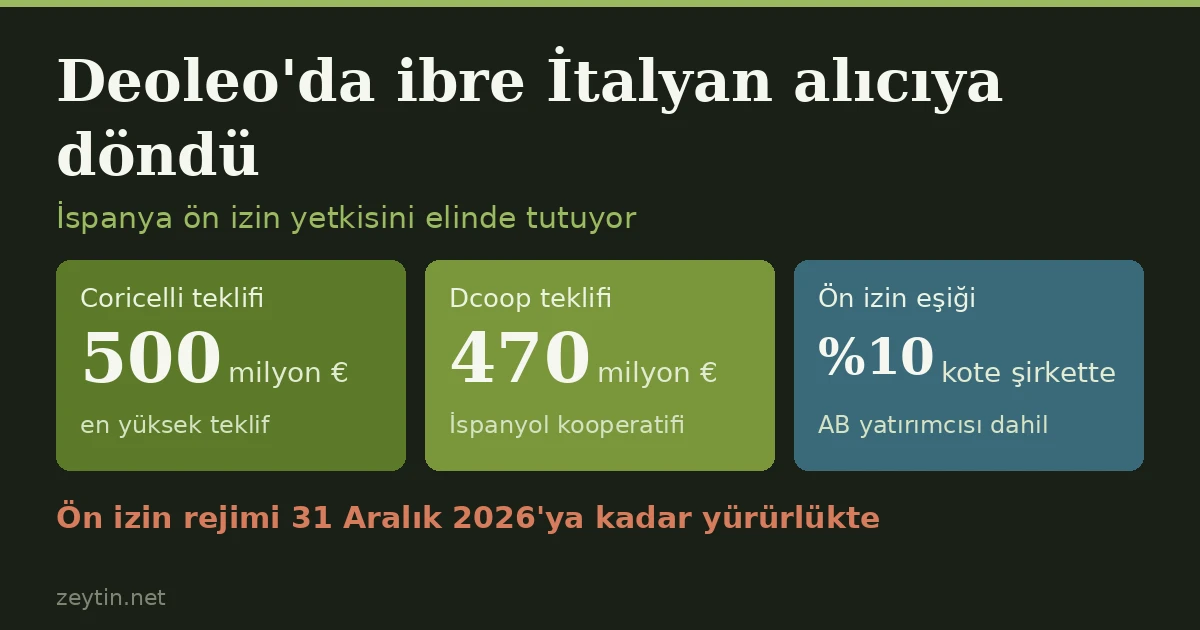
Spain steps back from vetoing Deoleo's sale: the door opens for Italy's Coricelli
Madrid's position on the sale of the world's largest olive oil bottler has shifted: in early September a Spanish buyer was preferred, and on 18 September Italy's Coricelli was reported to be seen as the best-positioned candidate. The government's lever is a foreign investment screening regime that covers EU investors too and runs to 31 December 2026. Because Deoleo is a major bulk buyer, the outcome matters to Turkish exporters.
 Article
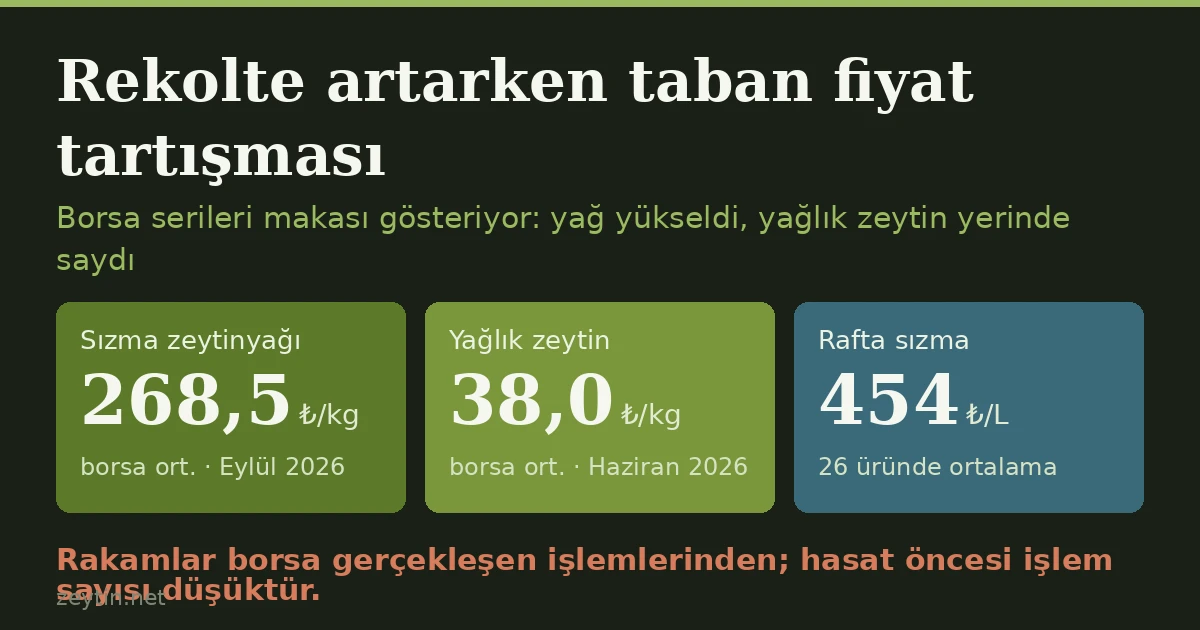
Crop forecast climbs as the minimum-price debate returns: what the exchange numbers say
With the 2026 harvest approaching, crop forecasts are up 40 percent in some provinces and growers want a floor price. Our exchange series shows why the dispute is really about olives, not oil.