Season-long inspection of olive oil businesses in Çanakkale: production, hygiene and raw-material acceptance checked in Central, Ezine and Eceabat
Food-control officers of the Çanakkale Provincial Directorate of Agriculture and Forestry inspected olive oil businesses in Central, Ezine and Eceabat; inspections will run province-wide all season. Checks covered production, hygiene and storage, raw-material acceptance and legal compliance. Business numbers, findings and penalties are not in the report.
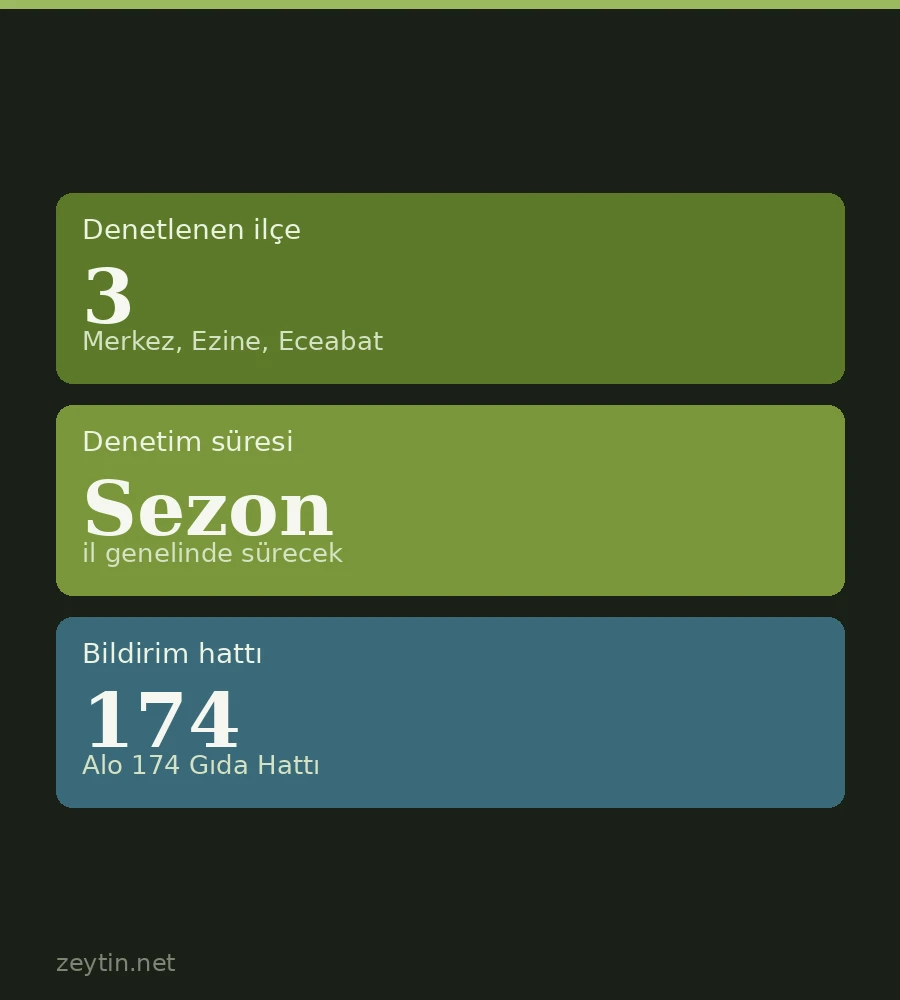
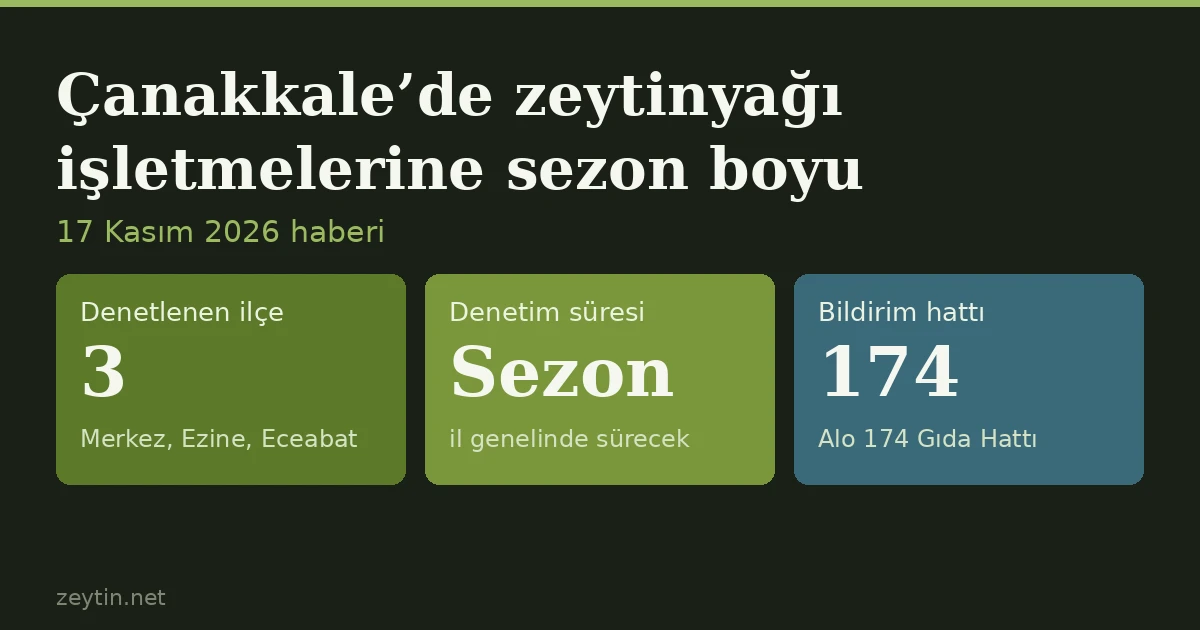
Food-control officers of the Çanakkale Provincial Directorate of Agriculture and Forestry inspected olive oil businesses in the Central, Ezine and Eceabat districts as the olive oil production season opened. According to a report dated 17 November 2026, the directorate announced in a social media post that inspections will continue across the province throughout the season. The report gives no number of businesses, no findings and no penalties; what was announced is the scope and the duration of the inspections.
What is being checked?
| Item | As stated in the report |
|---|---|
| Inspector | Food-control officers of the Çanakkale Provincial Directorate of Agriculture and Forestry |
| Districts | Central, Ezine, Eceabat |
| Production processes | Examined |
| Hygiene and storage conditions | Examined |
| Raw-material acceptance criteria | Examined |
| Compliance with legislation | Examined |
| Duration | All season, across the province |
| Reporting line | Alo 174 Food Hotline |
The directorate's stated aim is to guarantee consumers access to safe, good-quality olive oil, to protect food safety and to prevent possible breaches of the rules. Citizens can report any food-safety problem they come across to the Alo 174 Food Hotline.
What does "raw-material acceptance criteria" mean?
The report does not fill in this heading, so this is our interpretation: it could cover the conditions under which a mill accepts olives, such as how sound the fruit is, how long it has waited and how it was transported. In an inspection that runs all season this item matters, because the quality of the oil starts to be decided before milling, at the moment the olives enter the plant. But which criteria the directorate applies is not stated in the report.
How do inspections look elsewhere?
As the season opened, different kinds of inspection came to the fore in different provinces. The comparison below is our own compilation; the reports do not refer to one another.
- In the Mut district of Mersin, buying centres and sieving plants were inspected jointly on 13 November 2026; the subjects were sieve standards, scale accuracy and price labels. Details are in our article on the inspection in Mut.
- In Şarköy, Tekirdağ, growers were picked at random for a pre-harvest pesticide inspection.
- In Aydın, the police operations in early September focused on adulteration; 5 operations in 15 days gives the figures.
Unlike these three, the Çanakkale inspection looks at the business itself rather than at production in the field: hygiene, storage and acceptance conditions. The scale at a buying centre, the pesticide in the grove or adulteration on the market are not the subject of this report.
What changes for consumers and producers?
The report announces no new sanction or rule; it says compliance with existing legislation will be monitored all season. For consumers the only concrete element is the reporting line: the directorate reminds citizens that they can contact Alo 174 if they run into a food-safety problem. What to look for on a label and how adulteration is recognised is covered in our article on olive oil fraud and adulteration. For mills, the takeaway is that the inspection need not be a one-off and may be repeated through the season; neither the frequency nor the schedule has been announced.
What the report does not say
- How many businesses were inspected.
- Whether any breach or deficiency was found.
- Whether any administrative fine was imposed or any sample taken.
- The names or type of the inspected businesses, whether pressing plants or bottling plants.
- In what order districts beyond these three will be inspected.
What to watch
If the directorate announces the number of inspected businesses and the findings at the end of the season, the "inspections all season" message of this report will turn into numbers. Until then what we have is method and scope; there is no outcome.
One rating per visitor; you can change yours at any time. Ratings are real reader votes — no seeded or default scores.
Related
 Article
The world's largest bottler is for sale: a €500 million race for Deoleo
Deoleo, owner of Bertolli and Carbonell, holds 22% of global bottled olive oil sales. Italy's Coricelli leads at €500 million, Spain's Dcoop cooperative at €470 million. The Spanish government regards the company as nationally strategic. Because Deoleo is a major bulk buyer, the outcome matters to Turkish exporters too.
 Article
Spain decides in November: will part of a 1.6 million tonne crop be withdrawn from the market?
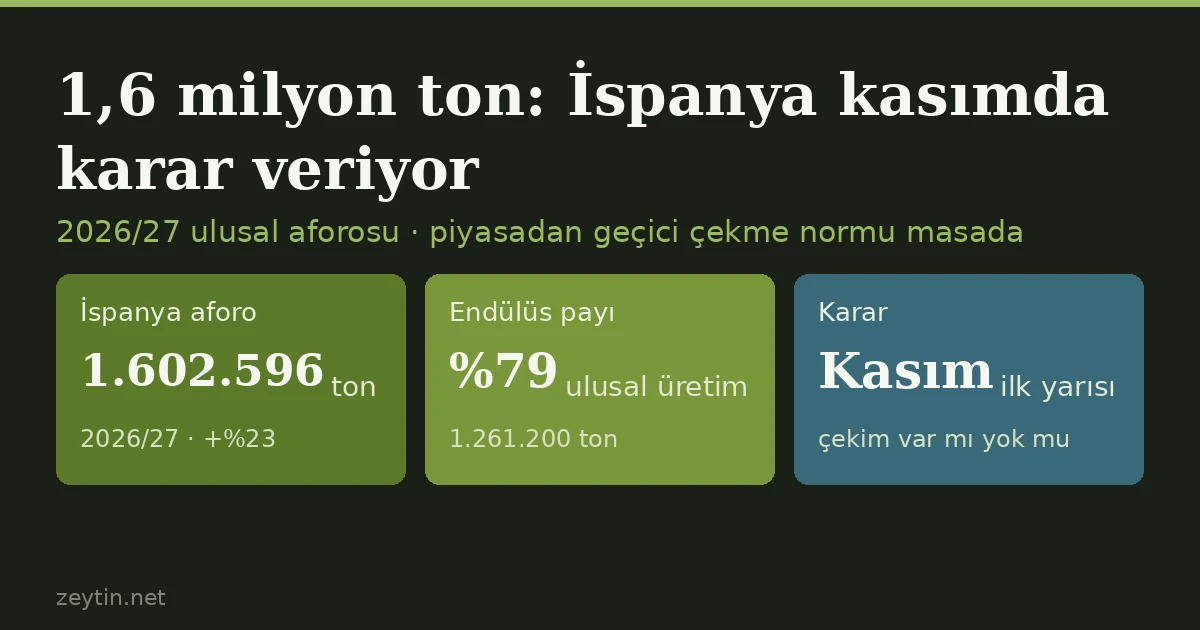
Spain's first national aforo for 2026/27 was presented in Jaén on 1 October: 1,602,596 tonnes of olive oil, 23% above last harvest. With carry-over stock, total availability approaches two million tonnes, and the Ministry of Agriculture will decide in the first half of November whether to activate a temporary withdrawal mechanism that has never been used. The ceiling on the world price Turkish exporters will face is being set here.
 Article
"Not definitive until November": Andalusian growers push back on the crop estimate
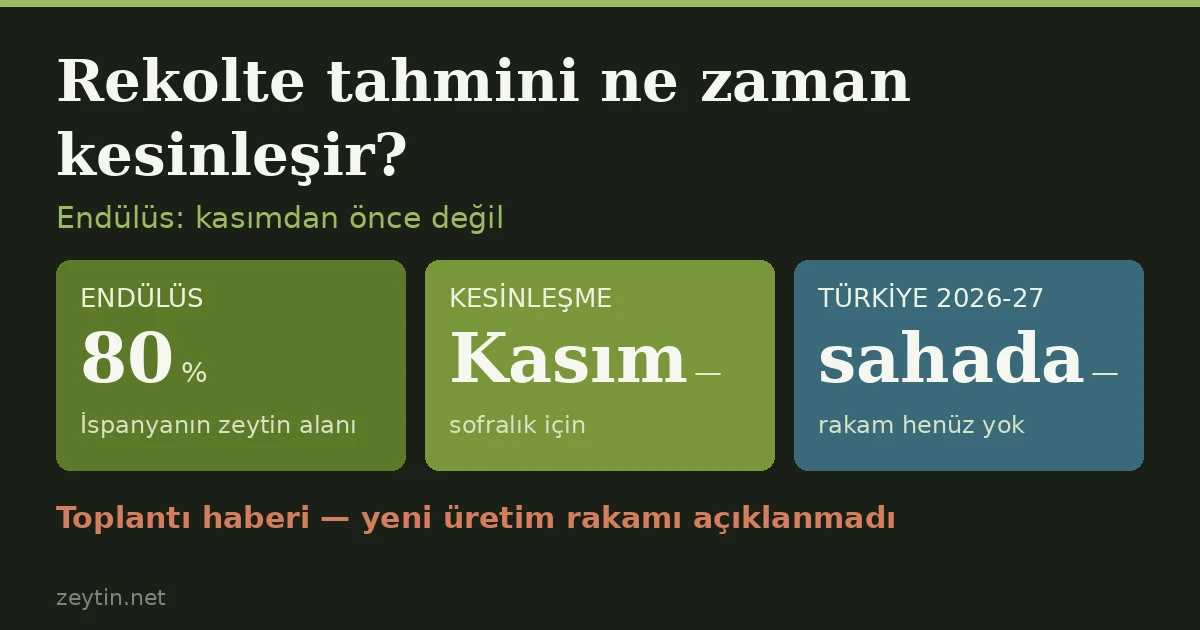
Andalusia's agriculture ministry called its first crop estimate "high production"; cooperatives and COAG in Seville objected: recent heat will affect the crop and the estimate is not definitive until November. Türkiye is making its 2026-27 estimate in the field the same week — the same caution applies here.
 Article
Two pressures before the harvest: costs and 100,000 tonnes carried over
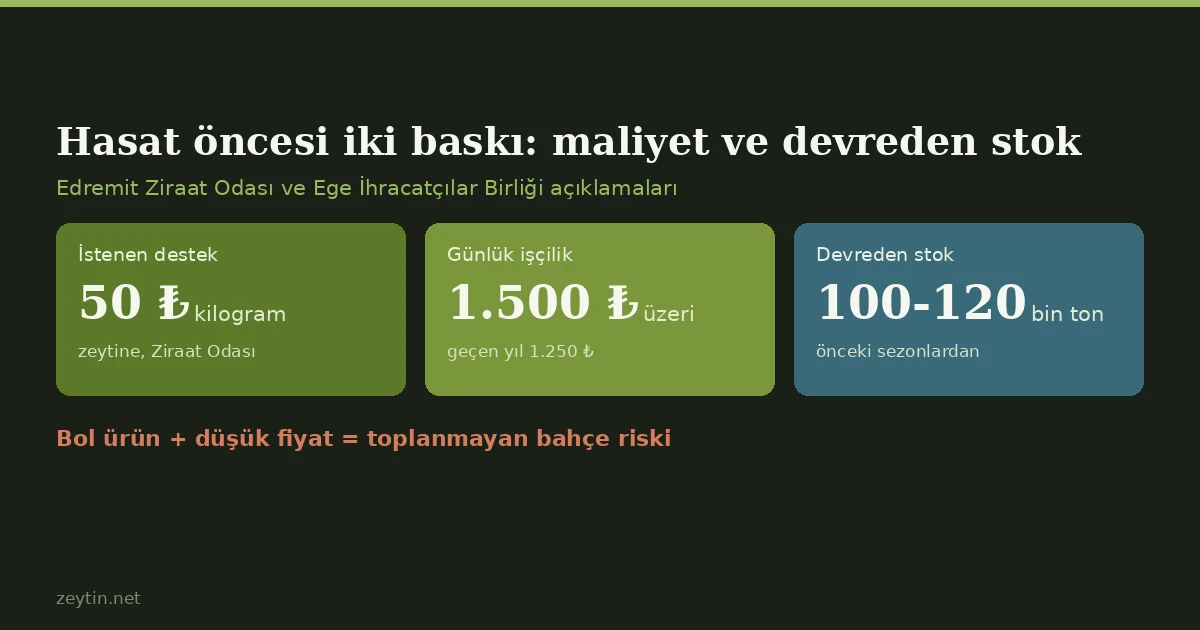
The chamber of agriculture wants 50 lira per kilo; daily labour has passed 1,500 lira. Exporters report 100,000-120,000 tonnes carried over from previous seasons.