Can an olive tree be uprooted and moved?
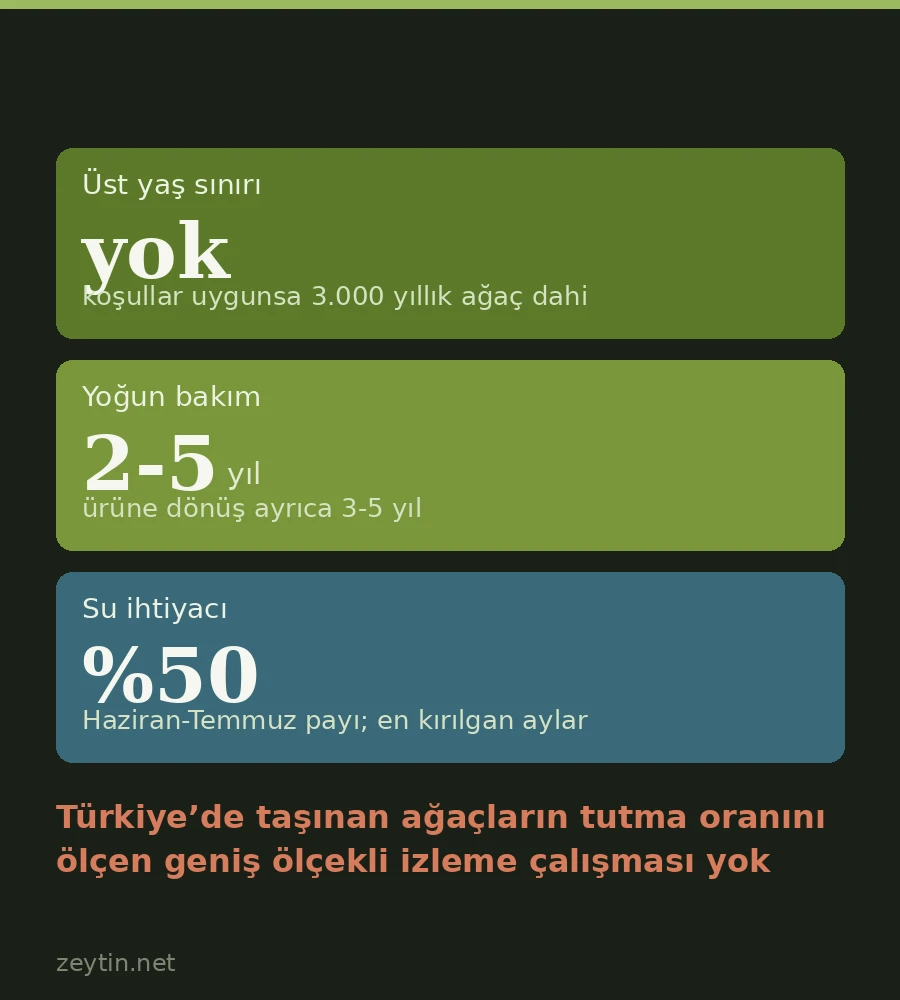
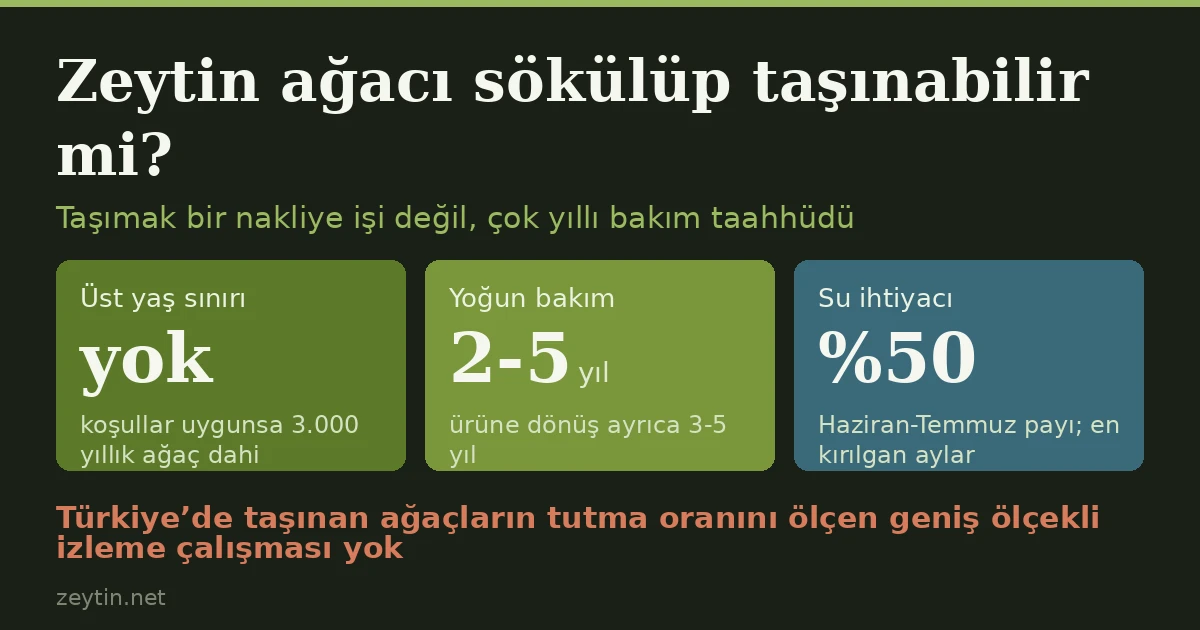
The technical answer is yes: olives can be moved at any age, with no upper limit. But "can be moved" and "is the same tree afterwards" are different questions. Winter timing, root-to-canopy balance, two to five years of care and three to five years without fruit are the real cost — and no large-scale Turkish study measures survival rates.
The question comes from two very different places. One is someone who planted a tree in the wrong corner of the garden; the other is a grower whose grove has to move because of mining or construction. The technical answer is the same for both. The consequences are not.
The short answer: yes, an olive tree can be uprooted and moved, and there is no upper age limit. According to Prof. Dr. Mücahit Taha Özkaya of Ankara University's Faculty of Agriculture, even a three-thousand-year-old specimen can be relocated when the conditions are right. But "can be moved" and "is the same tree afterwards" are not the same claim, and the gap between them is the subject of this article.
Why it works in olives
The olive has an unusually strong capacity to renew itself. It can go on living after its trunk has hollowed out, throw new shoots from the root collar, and rebuild a canopy after hard pruning. The burl the tree forms at its root collar over the years gives a structure to lift against during extraction. This is what makes an operation that would be risky in many other fruit species practicable in olives. The species' general behaviour is described in olive tree.
The practice spread with machinery: once cranes and dozers could reach the site, moving large trees became routine from the 1980s onwards.
Timing: winter
The best window is winter. As temperatures fall the tree enters dormancy; its demand for water and nutrients drops and losses through the leaf surface fall with it. A dormant tree's chances of tolerating root loss are far better than those of a tree in active growth.
The practical consequence is that the transplanting calendar falls in the same window as harvest and pruning. Lifting a tree in summer, in active growth and high evaporation, is the riskiest option.
Method: the balance between root and canopy
The whole operation comes down to one balance. Extraction leaves a significant part of the root system behind, and what remains can no longer support the old canopy. The canopy is therefore reduced in proportion to the roots.
In the practice Özkaya describes, the tree is lifted progressively by crane while the roots are cut with hydraulic shears; the canopy is pruned hard, down to three or four main stems, leaving only the structural limbs. The more root has been lost, the more the canopy is reduced. That ratio has to be judged by someone looking at the tree — it is not a figure that can be set from a desk.
The destination has to be ready too: the planting pit must match the width and depth of the root system, and the soil conditions should be compatible with those the tree came from. The logic of pruning is covered in olive pruning: how and when, and the planting side in how to plant an olive sapling.
Afterwards: two to five years
The real cost of transplanting is not in the lifting but in what follows. A relocated tree needs two to five years of intensive care: regular, uninterrupted irrigation, controlled feeding, attention to new growth. Until the root system is re-established the tree is defenceless against drought; a lapse in watering through a hot, dry summer is enough on its own to lose it. Irrigation practice is covered in olive irrigation and drip systems.
Expectations of a crop should be set accordingly: a transplanted tree generally returns to fruiting after three to five years. Even when the move succeeds, it writes off several years of production for the grower.
The known causes of failure fit the same picture: care abandoned halfway, mismatched soil — particularly a shift from dry conditions to irrigated ones or the reverse — and a canopy that was not cut back enough. All three arise from managing the aftermath, not from the extraction itself.
"Will be moved" is a commitment, not a measured outcome
This is the public side of the question. The regulations resting on Article 20 of Turkey's Law 3573 permit mining activity in olive grove areas on condition that the trees are relocated and the area later rehabilitated. The regulation of 1 March 2022 was annulled by the Council of State; Law 7554, in force from 24 July 2025, opened the same door at the level of primary legislation. The dates and figures are set out in olive groves and mining: the legislative record.
Between the technical answer and that commitment lies an unmeasured gap. There is no published large-scale Turkish study following how many mature olive trees survive relocation, or how many return to production and after how long. "The trees will be moved" is therefore a commitment, not evidence of what became of the trees that were moved.
This does not mean transplanting fails. The point is narrower: a technique that works on individual trees, where someone has taken on their care, cannot be assumed to produce the same result when thousands of trees are moved at once. In one case there is attention per tree; in the other there is not.
The destination: the decision that really settles it
Success usually turns not on the technique of extraction but on where the tree is taken. The soil and climate conditions set out for olives in the Turkish Ministry of Agriculture and Forestry's grower education booklet apply just as much when choosing a destination:
- Soil depth should be at least 1.2 metres, enough for the root system to develop. Since an uprooted tree has to rebuild its roots, the condition binds more tightly here.
- Drainage is needed before planting if the water table is within a metre, or if roots sit under water for more than three to four weeks in winter. Heavy clay soils are avoided.
- Soil pH should be in the 6-8 range.
- Cold: the lowest temperature olives tolerate is -7 °C; below that, young trees and the limbs of old ones are damaged. For a transplanted tree whose roots have not yet settled, that limit is less forgiving.
- The planting season is given as October to March, and the winter window suitable for relocation falls inside it.
The match between the water regime of the old site and the new one belongs under this heading too. Olives need some 750-800 mm of rainfall over the growing season, and that need is unevenly distributed: about 24% is used in March-April, 6% in May, 50% in June-July and 20% in August-September. The months in which a transplanted tree is most fragile therefore coincide with the months of highest water demand. Uninterrupted irrigation through the first summers is not a detail; it is the job itself.
Managing new growth also calls for patience. The ministry booklet advises no pruning at all in the first two years after a sapling is planted, with shape pruning beginning only after that. The same logic holds for a hard-pruned tree rebuilding its root system: it is allowed to regain leaf area, and the shoots coming from the trunk serve the tree's survival in those first years.
The decision for a garden owner
For someone with a few trees the arithmetic is simpler:
- For a young sapling, buying a new one is usually cheaper and safer than moving it. Sapling selection is covered in choosing certified olive saplings.
- For an old, established tree, relocation means serious machinery, an expert and a multi-year commitment to care. Most of the cost is not the crane and the haulage but the irrigation of the following years.
- For a tree with sentimental value, transplanting is sometimes the only option; in that case the work should be scheduled for winter and the pruning ratio set with an expert.
- If the tree is of monumental character, its registration status should be checked separately. A considerable share of Turkey's monumental olives are not registered, and an unregistered tree has no legal protection; measured examples are given in monumental olive trees of Edremit.
In summary
An olive tree can be moved; the species lends itself to it and there is no age limit. But relocation is not a haulage job — it is a multi-year commitment to care: lifting in winter, hard pruning proportioned to the roots, two to five years of uninterrupted aftercare and three to five years without a crop. Meet those conditions and the tree lives. Fail to meet them, and the fact that a tree was uprooted does not mean it was moved.
One rating per visitor; you can change yours at any time. Ratings are real reader votes — no seeded or default scores.
Related
 Article
How are olives harvested? What five picking methods cost the tree and the oil
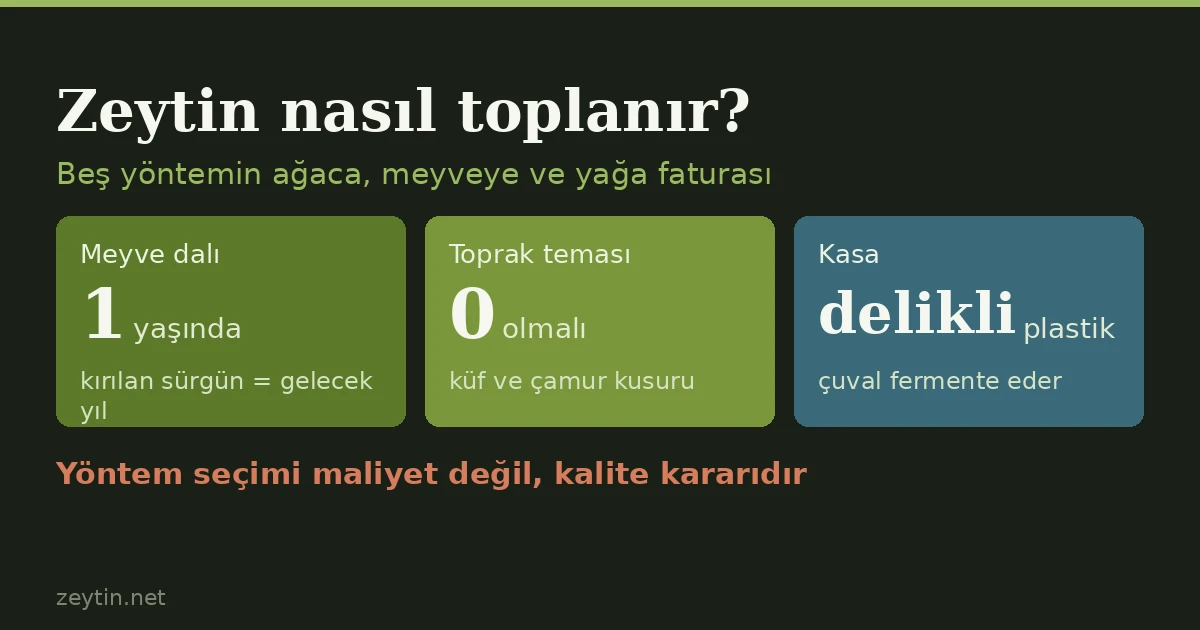
Hand picking, poles, combs, trunk shakers and straddle harvesters each charge a different bill — to the fruit, to the tree and to the acidity of the oil. Which method suits which grove, and what goes wrong on harvest day.
Article
How are olives harvested? What five picking methods cost the tree and the oil
Hand picking, poles, combs, trunk shakers and straddle harvesters each charge a different bill — to the fruit, to the tree and to the acidity of the oil. Which method suits which grove, and what goes wrong on harvest day.
 Article
Why is my olive tree not bearing fruit? 9 causes and what to do
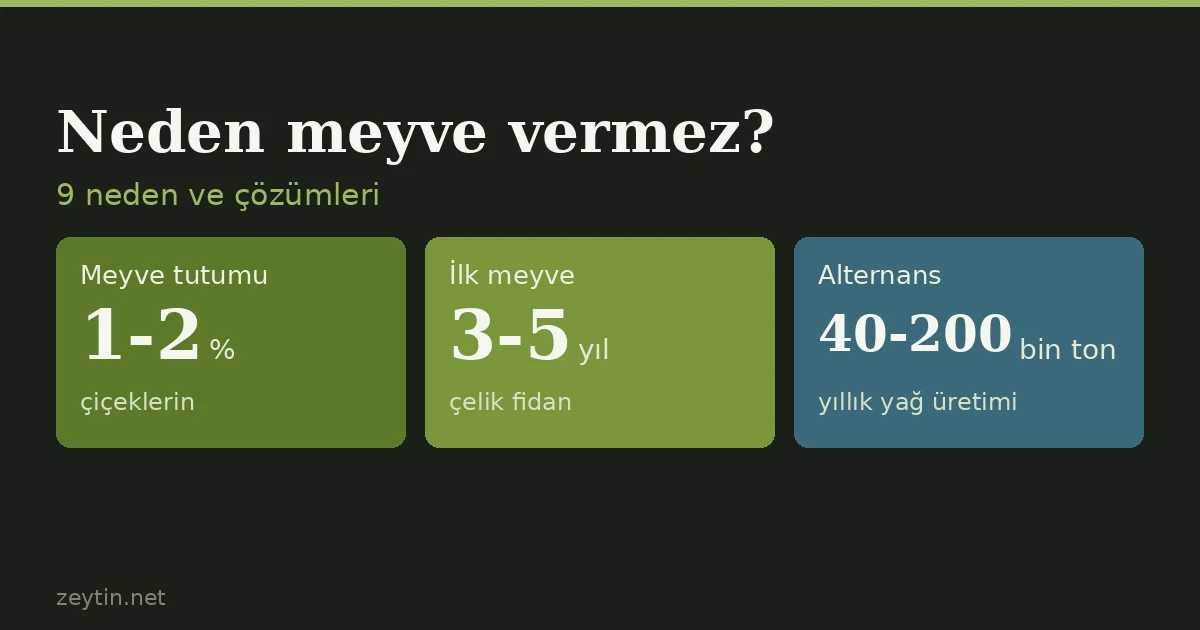
Behind an olive tree that flowers but sets no fruit, fills one year and stays empty the next, or has never cropped at all, there is usually more than one cause. From the tree's age and lack of grafting to missing pollinators, insufficient chilling, drought and the wrong fertiliser or pruning, here is how to diagnose by symptom and what to do.
Article
Why is my olive tree not bearing fruit? 9 causes and what to do
Behind an olive tree that flowers but sets no fruit, fills one year and stays empty the next, or has never cropped at all, there is usually more than one cause. From the tree's age and lack of grafting to missing pollinators, insufficient chilling, drought and the wrong fertiliser or pruning, here is how to diagnose by symptom and what to do.
 Article
Fertilising Olives: From Soil Analysis to an Annual Programme
How to read a soil test, which nutrients olives need and when, fertigation and organic matter management.
Article
Fertilising Olives: From Soil Analysis to an Annual Programme
How to read a soil test, which nutrients olives need and when, fertigation and organic matter management.
 Article
Olive Pruning: Why, When and How
Why olives are pruned, when to do it, formative and production pruning, rejuvenation and high-density systems.
Article
Olive Pruning: Why, When and How
Why olives are pruned, when to do it, formative and production pruning, rejuvenation and high-density systems.