Kahramanmaraş opens Doğukent olive oil plant with 90-tonne daily capacity, half of it grant-funded
The Doğukent Olive Oil Production Facility, able to process 90 tonnes of olives a day, has opened in Dulkadiroğlu, Kahramanmaraş. The investment exceeds 20 million TL, about half covered by a rural development grant. Set against the province's recorded 2025-2026 output, the capacity shows its scale; the tree count given in the speech does not match the recorded series.
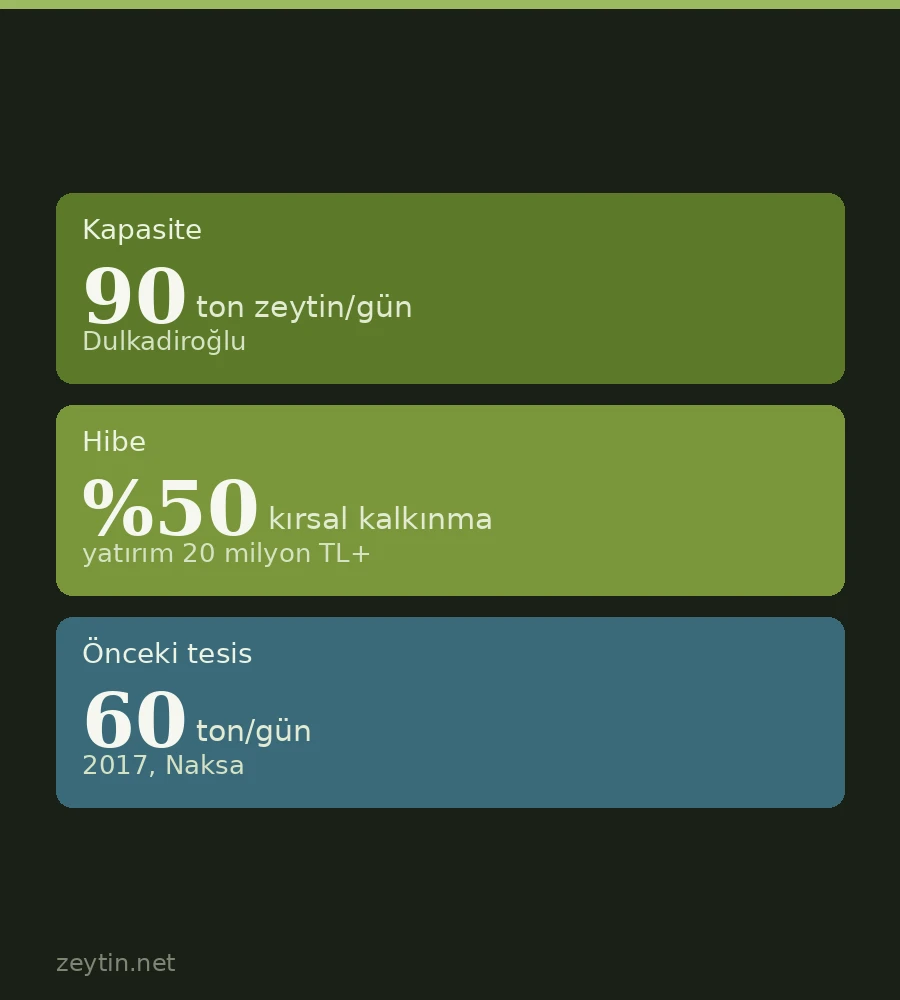
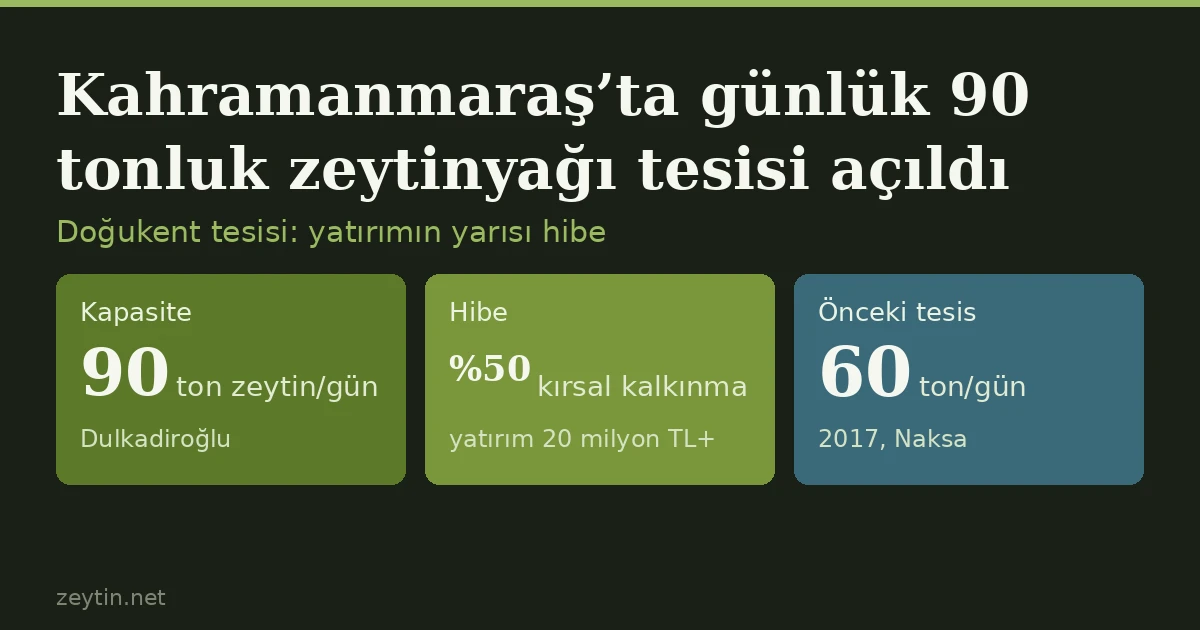
The Doğukent Olive Oil Production Facility has opened with a ceremony in Dulkadiroğlu, a district of Kahramanmaraş in southern Türkiye. According to local press reports, the plant can process 90 tonnes of olives per day, and the investor is businessman Abdurrahim Kırkgeçit. The plant is in the Ulutaş neighbourhood, and some reports describe it as a production and bottling facility. It was built with a 50 percent grant under the Ministry of Agriculture and Forestry's rural development investment programme, and the investment was put at more than 20 million TL at the opening.
| Item | Value |
|---|---|
| Location | Dulkadiroğlu, Kahramanmaraş |
| Daily olive processing capacity | 90 tonnes |
| Grant share (rural development) | 50% |
| Investment cost | over 20 million TL |
| Investor's 2017 plant (Naksa) | 60 tonnes/day |
| Upper limit mentioned for later expansion | 470 tonnes |
From sixty to ninety
At the opening, Kırkgeçit said he had built a plant under the name Naksa in 2017 with a daily processing capacity of 60 tonnes, and that he has now made a new 90-tonne investment after a gap of nine years. The new plant is 50 percent larger than his earlier capacity (our calculation). The reports do not say whether Naksa is still operating, so we rely only on the 90-tonne figure for the new plant.
A provincial official who spoke at the ceremony said that further investment could raise capacity to as much as 470 tonnes, roughly 5.2 times the current 90 tonnes. The reports do not say which investments are planned or on what timetable, so 470 tonnes is best read as a stated ceiling rather than a plan.
How large is that capacity against the province's recorded output?
One distinction matters: 90 tonnes is the amount of olives the plant can process in a day, not the amount of oil it will produce. Setting the capacity next to the province's officially based recorded output helps show the scale. The record on our Kahramanmaraş olive-growing page for the 2025-2026 season is as follows:
| Item | Value |
|---|---|
| Olives (fruit) | 8,029 t |
| — sent to milling | 6,022 t |
| — sent to table use | 2,007 t |
| Olive oil | 1,204 t |
| Trees of bearing age | 1.93 million |
| Trees not yet bearing | 1.30 million |
| Yield per tree | 4.2 kg |
A plant processing 90 tonnes a day could handle the province's entire olive crop for that season (8,029 tonnes) in about 89 days, and the part sent to milling alone (6,022 tonnes) in about 67 days (our calculation). This is a comparison of scale, not a forecast: how many days the plant will actually run, and at what load, is not known. The recorded oil share for the province is about 20 percent of the olives sent to milling (1,204 / 6,022). That is last season's province-wide outcome, not a measured yield for the new plant.
A further caution is needed. The 2025-2026 season was an off year for Türkiye as a whole, and a yield of 4.2 kilograms per tree reflects that. The olive is an alternate-bearing tree, and in an on year the province's output could rise above this table. Our data has no on-year breakdown for Kahramanmaraş, so it would be wrong to answer the question of how many times the capacity exceeds the crop using this one season's figures.
Two different tree counts
Kırkgeçit said the city has about 6 million olive trees, of which 4 million have started to bear fruit. In the recorded series, bearing and non-bearing trees together come to about 3.23 million (1.93 plus 1.30), with 1.93 million of bearing age. The figures given in the speech are roughly 1.9 times the recorded total, and about 2.1 times the recorded bearing trees. The reports do not explain the gap: it could be a different count date, a different scope, or planting in recent years. We cannot say which figure is current; we only note that the two do not match.
If the figure in the speech is right, the volume of olives available for processing in the province could grow as non-bearing trees come into production, whereas on the recorded series the increase would be more limited. How full the plant eventually runs therefore depends on which tree count reflects reality.
What the reports leave out
- The plant's annual processing target, the number of days it will run, and the jobs it will create.
- The pressing method and the capacity of the bottling line.
- A list of the regions it will serve: it is said that the plant is meant to serve not only Kahramanmaraş but also other parts of Türkiye.
- Where the plant will source the olives it processes, and at what price and terms.
Why it matters
Kahramanmaraş sits where the Mediterranean and south-eastern olive basins meet, and it is one of the few provinces whose varieties come from three separate basins. Growing processing capacity inside the province may reduce the need for producers to haul their olives to a distant mill. According to the ceremony reports, provincial officials presented the plant as part of the investment made in the city since the earthquakes of 6 February. A 50 percent grant also shows how large a share public support can take in a processing investment of this kind: roughly half of the 20 million TL was covered by the grant.
Two things are worth watching: how many olives the plant processes in its first season, and the official provincial figures for the 2026-2027 season. Together they will show what 90 tonnes a day really means at the scale of the province.
One rating per visitor; you can change yours at any time. Ratings are real reader votes — no seeded or default scores.
Related
 Article
Spain's competition authority opposes the withdrawal rule: "very negative for competition and consumers"
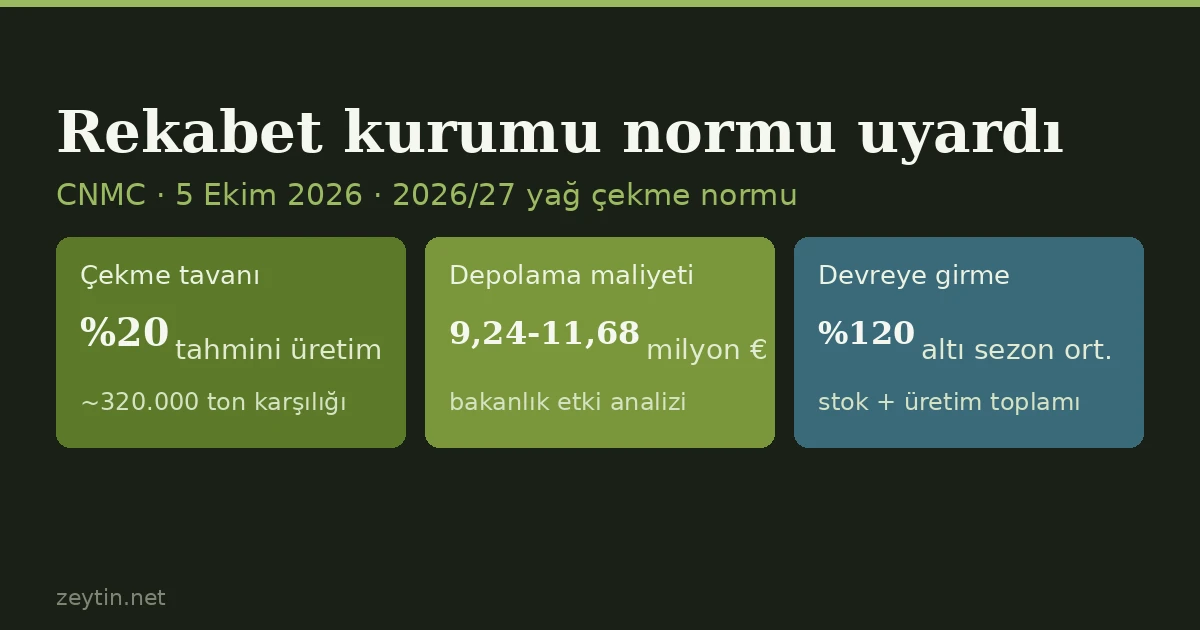
On 5 October the CNMC published its report on the draft rule that would withdraw part of Spain's olive oil from the market in the event of oversupply in 2026/27. The authority says the measure would raise prices and narrow quality and variety. The ministry's own impact assessment puts storage costs at €9.24-11.68 million. The withdrawal cap is 20 percent of estimated production — up to 320,000 tons.
 Article
Tunisian banks lent 3.3 billion dinars to the olive oil season; the 2027 draft budget earmarks bulk export duties for a sector fund
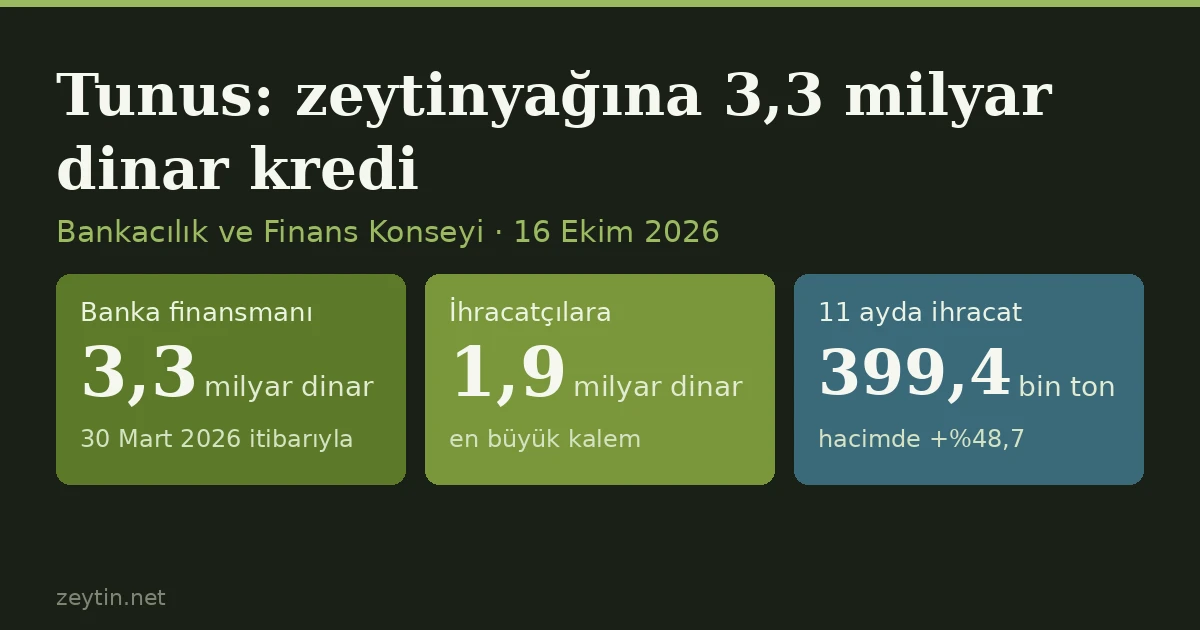
According to Néji Ghandri, president of the Tunisian Banking and Financial Council, banks extended 3.2-3.3 billion dinars to the 2025/26 olive oil season by 30 March, up from 2.2 billion the season before; 1.9 billion went to exporters. Tunisia exported 399,400 tonnes in eleven months. The 2027 draft budget opens a 100-million-dinar credit line for small growers and earmarks 10 per cent of bulk export duty revenue for a sector fund; it is not a new tax.
 Article
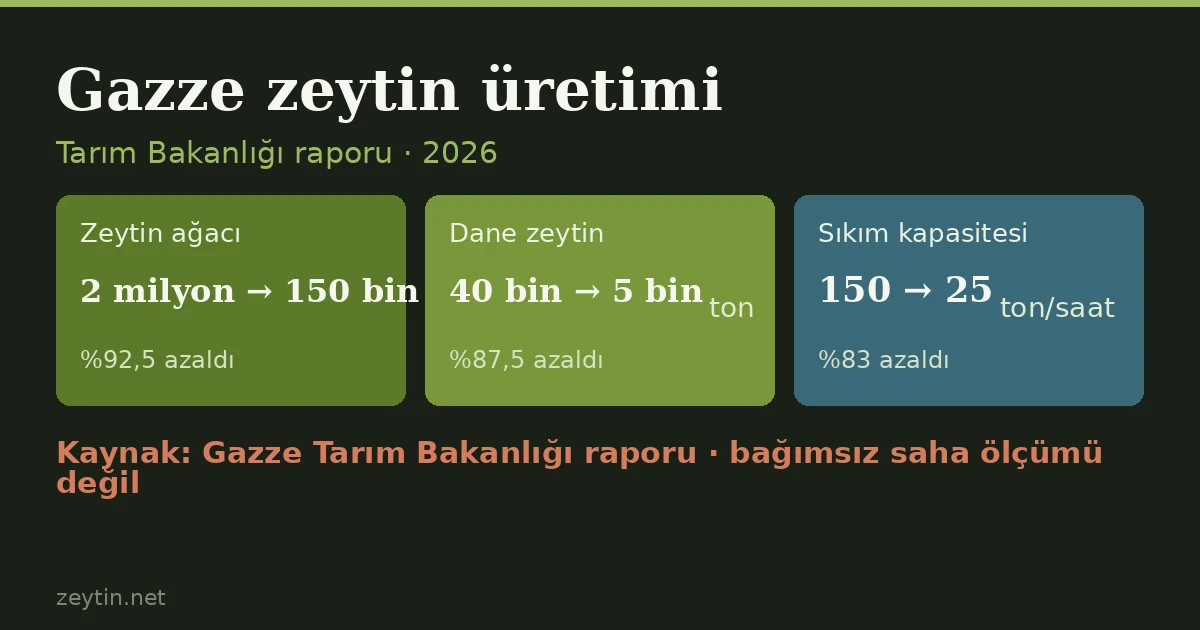
Gaza's olive report: 150,000 trees left of two million, production down 87.5%
According to a report from Gaza's Ministry of Agriculture, olive groves have shrunk from 50,000 dunums to 5,000 and the olive crop from 40,000 tonnes to 5,000. The loss is not confined to the grove: milling capacity has fallen from 150 tonnes an hour to 25, and the number of growers from 20,000 to 1,000.
 Article
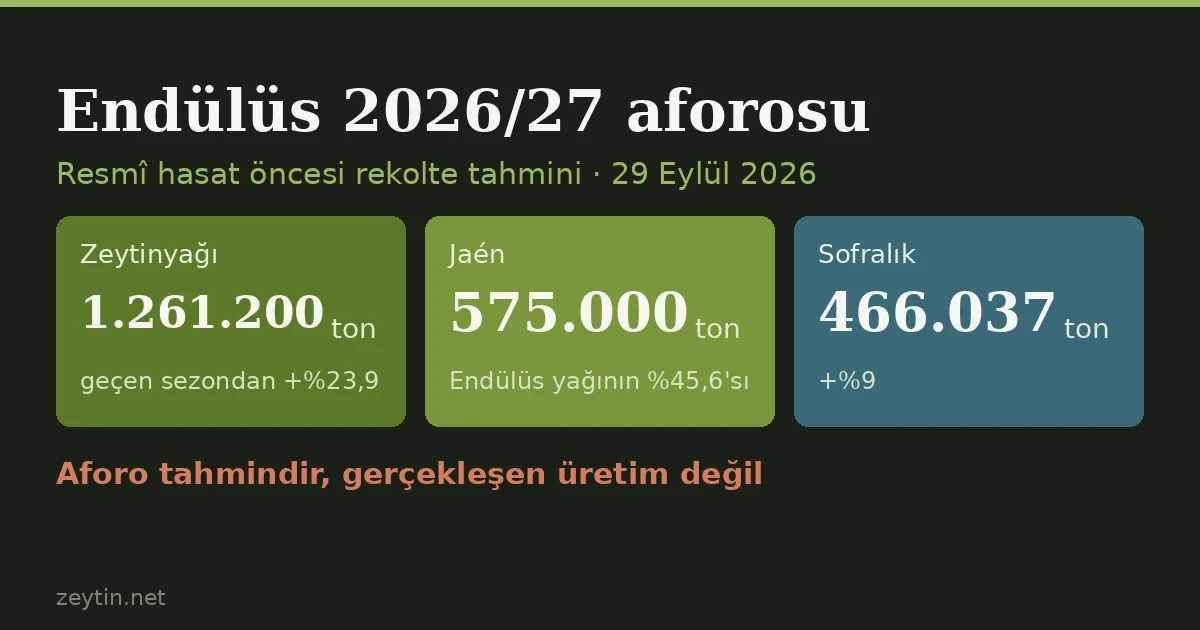
Andalusia finally puts a number on it: 1.26 million tonnes of olive oil, up 24%
Andalusia's agriculture ministry published its 2026/27 aforo on 29 September in Mengíbar: 1,261,200 tonnes of olive oil, 23.9% above last season and 44% above the five-year average. The heat warning growers raised in early September made it into the forecast's own reasoning. Four times Turkey's entire season output is entering an already soft price environment.