Marmarabirlik opens its purchase campaign: record 105,000-tonne declaration, 64,000-tonne target, olives bought down to size 41
Marmarabirlik opened its purchase campaign on 4 November 2026: members declared a record 105,000 tonnes and the buying target is 64,000 tonnes. Small olives will be bought down to size 41, and Erdek members hit by hail get a loan deferral and a price-difference payment.
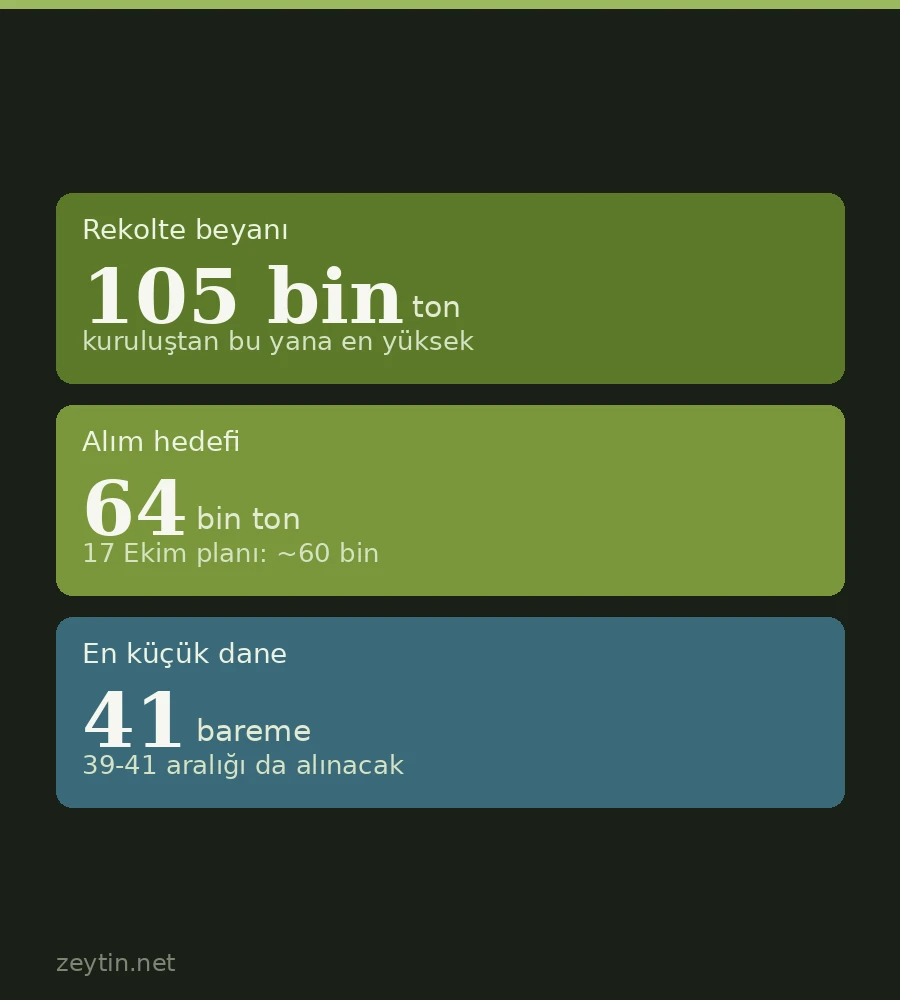
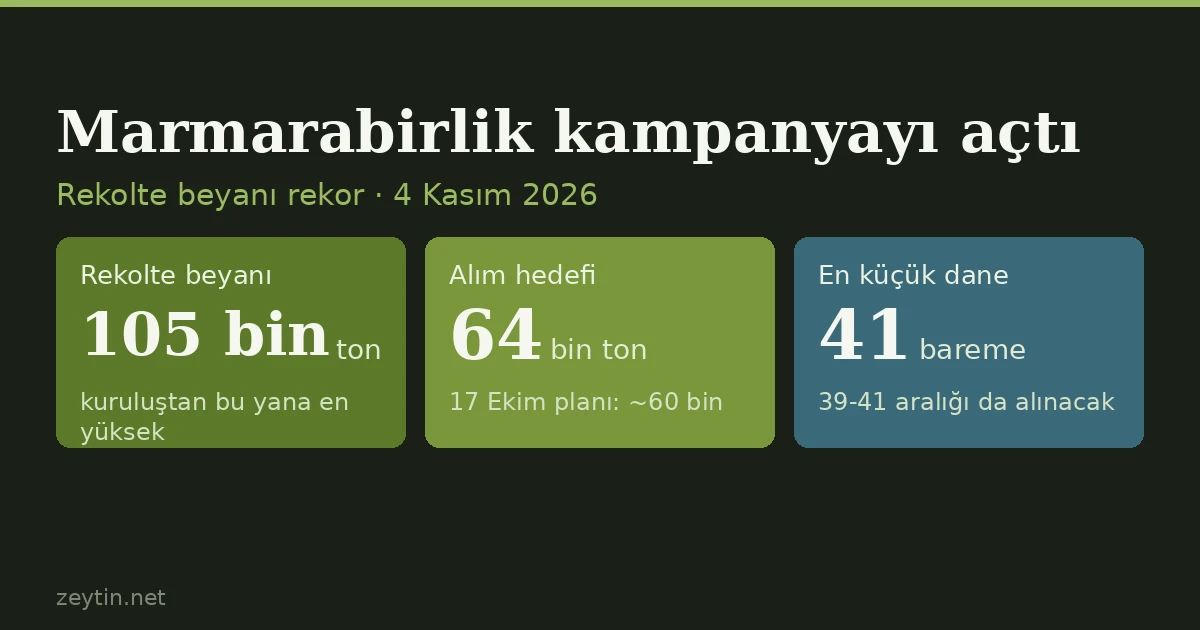
Marmarabirlik, the union of olive cooperatives in the Marmara region, opened its 2026/27 purchasing campaign on 4 November 2026. According to the union's statement, its members declared 105,000 tonnes of expected crop this season, the highest declaration since the union was founded. The purchasing target is 64,000 tonnes, and the production expected in the union's region is 430,000 tonnes. Two decisions were announced with the campaign: buying small-calibre olives down to size 41, and giving members in Erdek who were hit by hail a loan deferral and a price-difference payment.
Marmarabirlik brings together eight cooperatives in Gemlik, Mudanya, Erdek, Orhangazi, İznik, Edincik, Mürefte and Marmara Island, and is one of the biggest buyers of black table olives in the Marmara region. The opening of its campaign is therefore a reference point not only for members but for all producers in the area.
How the numbers moved in under three weeks
On 17 October the union said it planned to buy about 60,000 tonnes and expected 400,000 tonnes of olives in its region. When the campaign opened, both figures had gone up: the target is now 64,000 tonnes and the regional expectation 430,000 tonnes. That is an increase of about 6.7 per cent in the target and 7.5 per cent in the expectation.
| Item | 17 October | 4 November |
|---|---|---|
| Expected regional production | 400,000 t | 430,000 t |
| Purchasing target | ~60,000 t | 64,000 t |
| Crop declaration | not yet announced | 105,000 t |
The declaration is about 5.7 per cent above the previous record, the 99,300 tonnes declared in 2024/25. The 64,000-tonne target therefore equals roughly 61 per cent of the declaration. In the last record season the union bought 57,500 tonnes, or about 58 per cent of what was declared (both ratios are our own arithmetic). The union is raising its volume, but because the declaration grew as well, the share it will buy hardly changes. The declared 105,000 tonnes amount to roughly 24 per cent of the regional expectation. We explained how the process works in our piece on the crop declaration: a member who does not declare has the crop left out of the purchase.
The statement also gives a figure for the whole country: total table and oil olive production in 2026/27 is forecast at about 4.3 million tonnes. The report does not attribute that number to a particular source, so we cannot say whether it is the union's own estimate or a sector forecast.
Purchase dates will be set by the cooperatives
Purchases began on 4 November, but delivery dates are not the same in every cooperative. Each cooperative's board will set its own calendar, taking into account the climate of the area, the weather and the speed at which the olives darken. Union chairman Ali Yıldız said that care would be taken so that producers are not left worse off and that the value of the olives is protected. He also stressed that, with a large crop expected, it matters to use purchasing, storage and processing capacity efficiently.
First decision: buying down to size 41
The headline decision of the campaign is bringing small olives into the purchase. Yıldız said the amount of small fruit is high this year, announced that olives in the 39 to 41 count range will also be bought, and said the union will buy down to size 41 to support its members.
What this means for prices is not yet clear, because the announcement contains no purchase price. The latest record we hold is from last season: in the union's 2025/26 price announcement, oil olives were 53 TL/kg, the floor for table olives (41 count) was 55 TL/kg and the ceiling (18 count) was 160 TL/kg. That table sits on our purchase prices page, and a comparison will be possible once the new season's list is published. Last season's list also had 41 count as its smallest table class; this year's announcement says that class is being kept in scope specifically because of the abundance of small fruit.
Second decision: hail support in Erdek
For members hurt by hail in the Erdek cooperative region, the union foresees two kinds of support:
- Deferral of loan debts. The debts owed to the union by members who suffered losses will be postponed.
- A price difference. Olives that, because of hail damage, will be directed to oil but still have table-olive quality will be paid the difference between the two prices.
The statement does not say how long the deferral lasts, how many members are affected, how large the price difference is or when it will be paid. Until these details are published, the scale of the support cannot be judged. One Bursa outlet reports that the decision was "put on the agenda", while the union's statement says the support "will be given"; we have followed the union's wording.
What to watch
Three things are still open: the price list, the details of the Erdek support and the cooperatives' delivery calendars. If the union issues separate announcements on these, this story will need to be completed with that data. For now, what is certain is that the crop declaration is at a record level and that the union has raised its target.
What changes for readers
For a member who produces table olives, the opening of the campaign means finding out the calendar from the cooperative and delivering the declared quantity. For a producer who is not a member, the number to watch is the price list the union will announce, because there is no state floor price for table olives in Marmara and the union's price works as the reference for the region. How the record and the expectation of a large crop will show up in prices will become visible once the list is published.
One rating per visitor; you can change yours at any time. Ratings are real reader votes — no seeded or default scores.
Related
 Article
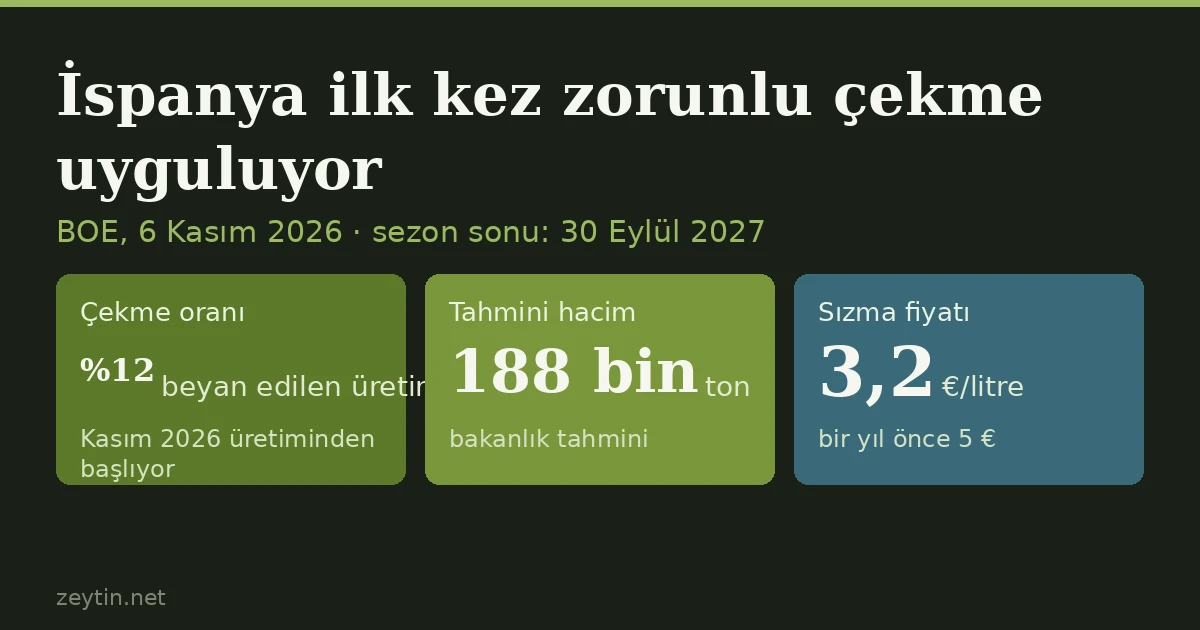
Spain activates mandatory olive oil withdrawal for the first time: 12% of output, about 188,000 tonnes held until September 2027
Spain's agriculture ministry published its decision in the BOE on 6 November: from November, mills must keep 12% of declared output in storage until 30 September 2027. The ministry estimates about 188,000 tonnes will be withdrawn; October early-harvest oils are exempt and mills receive no compensation.
 Article
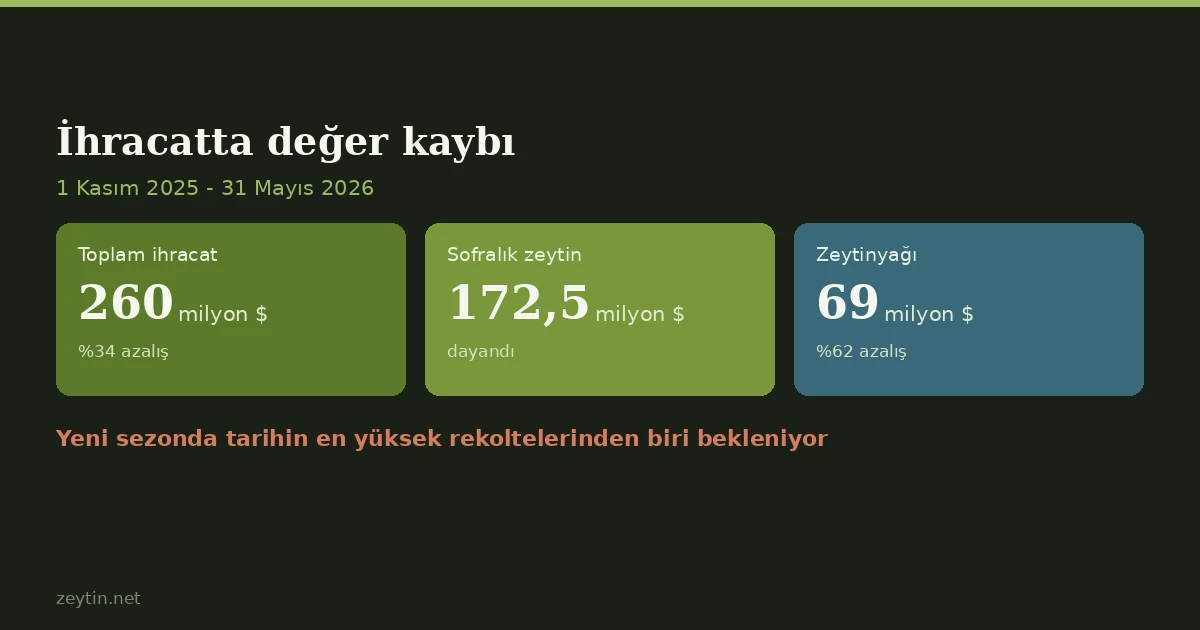
Olive oil exports down 62% by value as a record harvest is expected
Olive and olive oil exports fell 34% to $260 million between 1 November 2025 and 31 May 2026. Table olives held at $172.5 million while olive oil dropped to $69 million. The target is a return to $1 billion.
 Article
Crop forecast climbs as the minimum-price debate returns: what the exchange numbers say
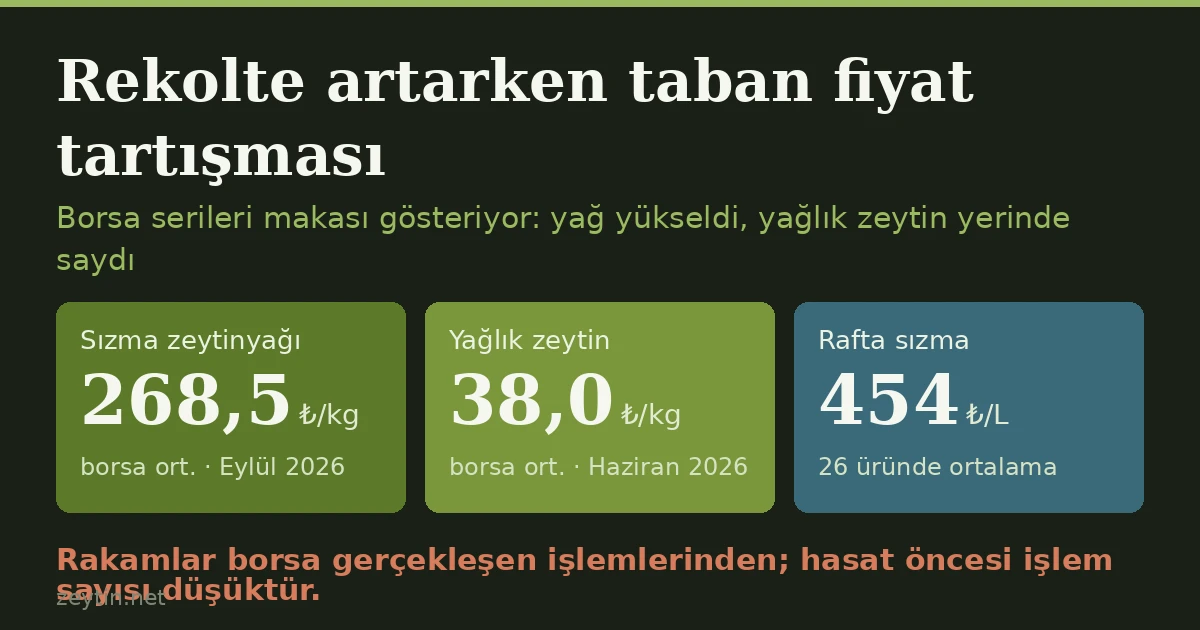
With the 2026 harvest approaching, crop forecasts are up 40 percent in some provinces and growers want a floor price. Our exchange series shows why the dispute is really about olives, not oil.
 Article
Turkey's 23 September fraud list: 21 olive oils, 11 from a single seller
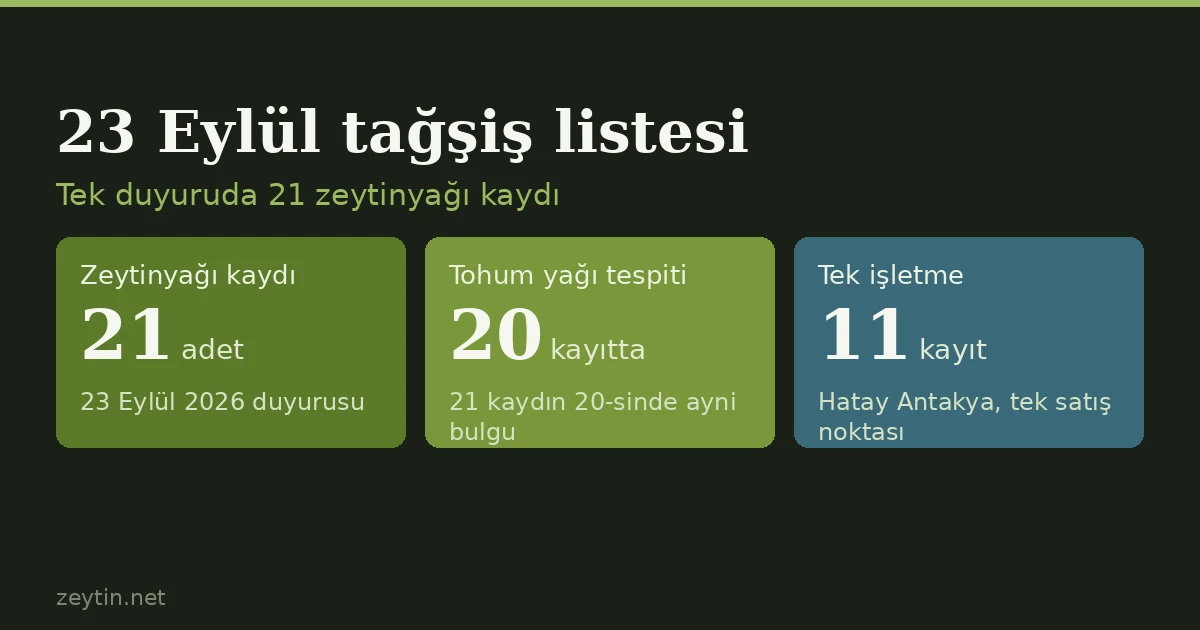
Twenty-one olive oil entries joined Turkey's public food-fraud register on 23 September 2026 — two-thirds of what the other eleven announcements since April produced combined. In twenty of them the finding is identical: seed oil adulteration.