258 growers, €1.77 million: in Spain the fraud was not in the oil, it was in the payment
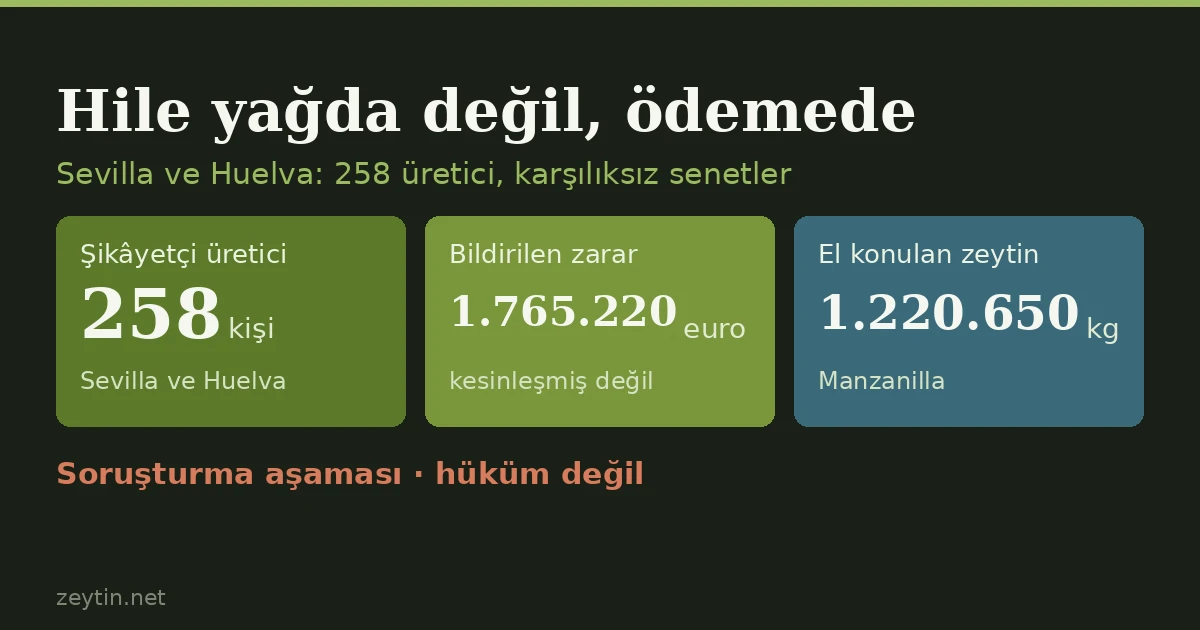
Spain's Guardia Civil has detained a table olive trader accused of defrauding 258 growers in Seville and Huelva of €1,765,220. The olives were real and the sales were real; the money never reached the producers. Investigators seized 1,220,650 kilos of Manzanilla olives.
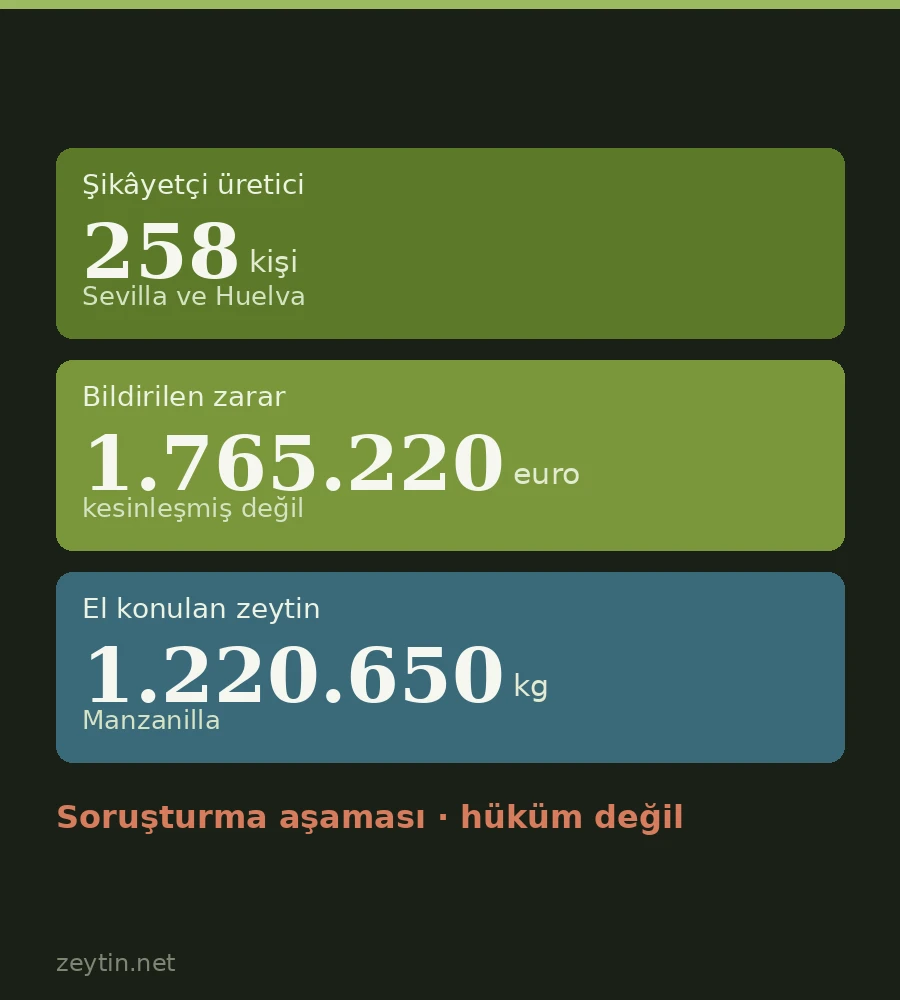
Spain's Guardia Civil has detained a man accused of defrauding 258 olive growers in the provinces of Seville and Huelva. The losses reported in the complaints total €1,765,220. The operation is named Alxaraf Proditio Olea, and the investigation was run by the ROCA team based in Sanlúcar la Mayor.
This story differs in one important way from the adulteration and fraud cases we write about often: nothing was added to the product. The olives were real, the quality was real, the sales were real. The only thing missing was the money owed to the growers.
How it worked
According to the Guardia Civil, the suspect took delivery of growers' harvests while presenting the appearance of a solvent buyer. The arrangement itself was the ordinary one in the sector: product now, payment after the sale.
The olives were then sold on to distribution companies and paid for. The investigators' own sentence is the clearest summary: "The olives were sold and the money was collected, but it never reached their producers."
The method of keeping growers waiting was equally conventional: repeated promises of payment, announcements that financing was on its way, written acknowledgements of debt, and promissory notes that bounced for insufficient funds. Those four together manufacture just enough hope to keep a creditor from filing a complaint. The investigation was in fact opened during the 2025 season, after cooperatives and agricultural companies came forward — meaning the problem ran for at least a full campaign before it surfaced.
What was seized
Investigators carried out two searches, in Olivares and Albaida del Aljarafe, both in Seville province.
| Seized | Quantity |
|---|---|
| Table olives (Manzanilla) | 1,220,650 kg |
| High-end vehicles | 2 |
| Luxury watches | 13 |
Gold and silver bars and pieces, mobile phones, computers and commercial, accounting and banking documentation were also taken. That last item is where the case will actually be built: in a fraud of this kind, the proof is the paper trail showing where the product went and into whose account the payment landed.
Manzanilla is Seville's classic table variety, and the setting is no accident — the Aljarafe district is the heart of Spanish table olive growing.
Two kinds of fraud, two different defences
When people in the olive sector say "fraud", they usually mean the product: oil cut with another oil, or colour and ripeness tricks in table olives. That kind of fraud is caught in a laboratory. Türkiye's own adulterated oil operations in September were driven by analysis results in exactly that way.
The Seville case is the second kind: commercial fraud. Sample the product and it comes back clean; the label is accurate, the lot is traceable. There is nothing a laboratory can do about it. The only route to detection runs through payment records and through pulling a large number of separate complaints together into one pattern.
The practical consequence of the distinction matters: food safety inspection does not see this risk at all. What protects the grower here is not inspection but contract and record.
Why it matters beyond Spain
Because the mechanism is not Spanish. In table olives, the product leaving the grower before the money arrives is the normal structure worldwide: the harvest is delivered to a trader or a processor, and payment is booked for after processing and sale. The arrangement works perfectly as long as the buyer stays solvent, and the moment it does not, the entire risk sits with the grower. For a producer already entering a season where costs press against prices, a single unpaid harvest is enough to end the business.
Two structures reduce that exposure in Türkiye:
1. Cooperative and union purchasing. The purchase prices announced by Marmarabirlik, together with a published instalment calendar, tie payment to a rule the member knows in advance. The price may be argued over; whether payment happens is not.
2. Registration on the commodity exchange. A sale registered at a commodity exchange puts the price and the parties on record, so no one can later claim the delivery never took place.
What stays outside those records stays unprotected. We have written separately about unregistered workshops in the table olive sector; undocumented delivery is the precondition for exactly the situation described in this case.
Practical lessons for growers
⚠ A promissory note is not a payment. In this file the bounced note appears not as an instrument of payment but as an instrument of delay.
⚠ "Financing is coming" is not a receivable. Repetition of the promise does not strengthen the claim; it signals that the delay has become the arrangement.
⚠ The written record of delivery — weighbridge tickets, delivery notes, contracts — is the only basis for a later complaint. The case built by those 258 growers rests on exactly those documents.
⚠ Growers delivering to the same buyer knowing about one another makes a delay visible far earlier than it is to any of them alone. In Spain the complaints were started not by individual farmers but by cooperatives and agricultural companies, which is precisely why the pattern became legible.
Reading it carefully
⚠ The detained man is accused of fraud and offences against property and the socioeconomic order. The case is at the investigation stage; this is not a court judgment.
⚠ €1,765,220 is the amount reported in complaints, not an established loss. The Guardia Civil says "to date" — the number of complainants and the total may both rise.
⚠ The 1.2 million kilos of olives seized are not necessarily the same consignment as the unpaid growers' product; they were taken into custody as evidence.
⚠ The figures and the account of the operation come from the Guardia Civil's own statement. No response from the defence has been made public.
One rating per visitor; you can change yours at any time. Ratings are real reader votes — no seeded or default scores.
Related
 Article
3,200 trees and 72 varieties on 14 hectares of stone: the cooperative turning Dalmatian karst into groves
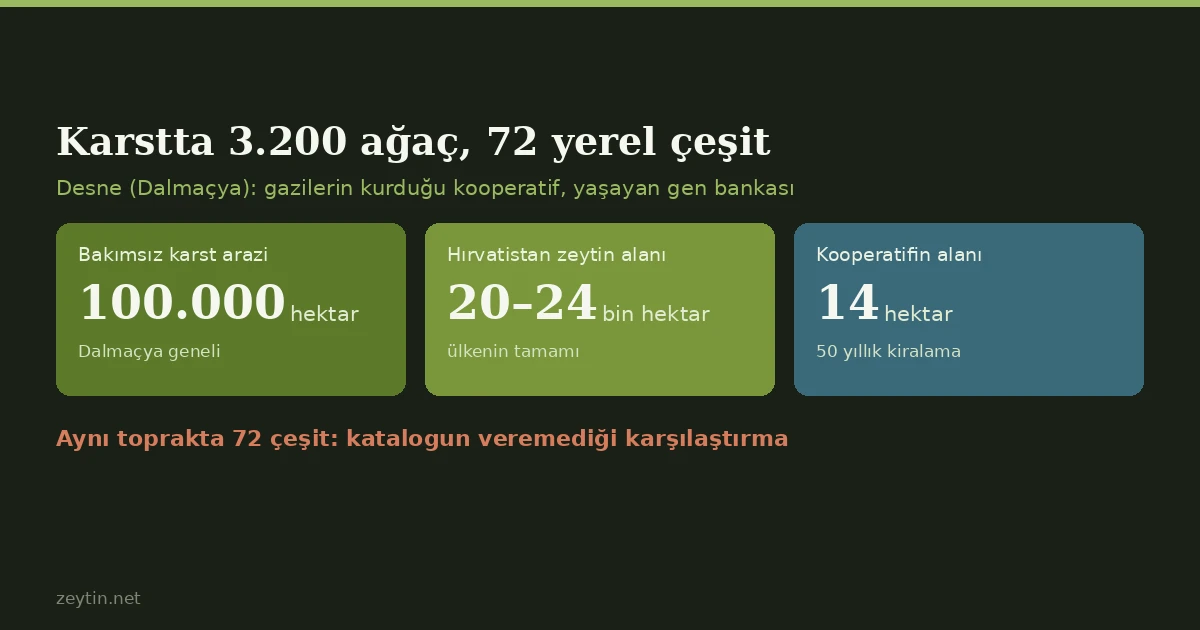
Some 100,000 hectares of karst lie neglected in Dalmatia while all of Croatia has 20,000–24,000 hectares under olives. In Desne a veterans' cooperative has grown 3,200 trees of 72 native varieties on 14 hectares of rock — a grove that doubles as a natural laboratory for climate resilience.
Article
3,200 trees and 72 varieties on 14 hectares of stone: the cooperative turning Dalmatian karst into groves
Some 100,000 hectares of karst lie neglected in Dalmatia while all of Croatia has 20,000–24,000 hectares under olives. In Desne a veterans' cooperative has grown 3,200 trees of 72 native varieties on 14 hectares of rock — a grove that doubles as a natural laboratory for climate resilience.
 Article
Adulterated olive oil costs more than the real thing: price is no longer a sign of authenticity
Diker, president of the Edremit Chamber of Agriculture, says adulterated oils sold online now exceed the wholesale price of genuine oil: wholesale starts at 240 lira, the fake sells above 300. Our exchange data complicates the picture — genuine extra virgin in Aydın is already 307.60 lira.
Article
Adulterated olive oil costs more than the real thing: price is no longer a sign of authenticity
Diker, president of the Edremit Chamber of Agriculture, says adulterated oils sold online now exceed the wholesale price of genuine oil: wholesale starts at 240 lira, the fake sells above 300. Our exchange data complicates the picture — genuine extra virgin in Aydın is already 307.60 lira.
 Article
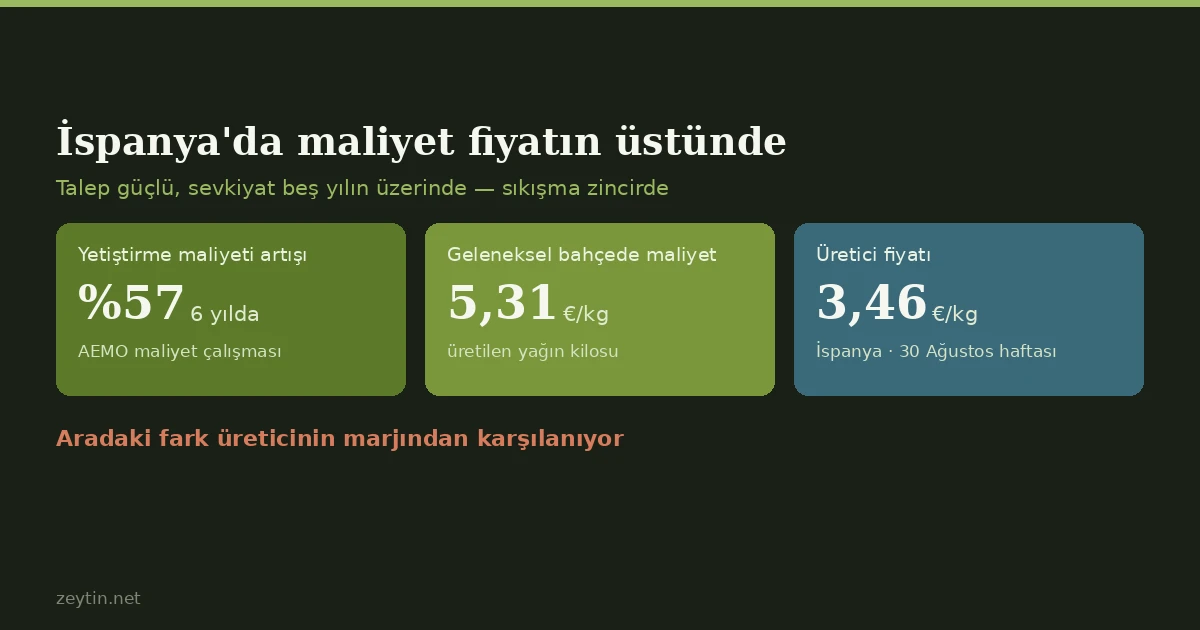
In Spain the cost sits above the price: €5.31 in a traditional grove, €3.46 at the gate
Olive cultivation costs have risen 57% in six years and reach €5.31 per kilogram in the most traditional groves, according to an AEMO study. The same week, Spain's producer price was €3.46. The Andalusian cooperative federation, with 342,000 members, is asking not for aid but for a change to the Food Chain Law.
Article
In Spain the cost sits above the price: €5.31 in a traditional grove, €3.46 at the gate
Olive cultivation costs have risen 57% in six years and reach €5.31 per kilogram in the most traditional groves, according to an AEMO study. The same week, Spain's producer price was €3.46. The Andalusian cooperative federation, with 342,000 members, is asking not for aid but for a change to the Food Chain Law.
 Article
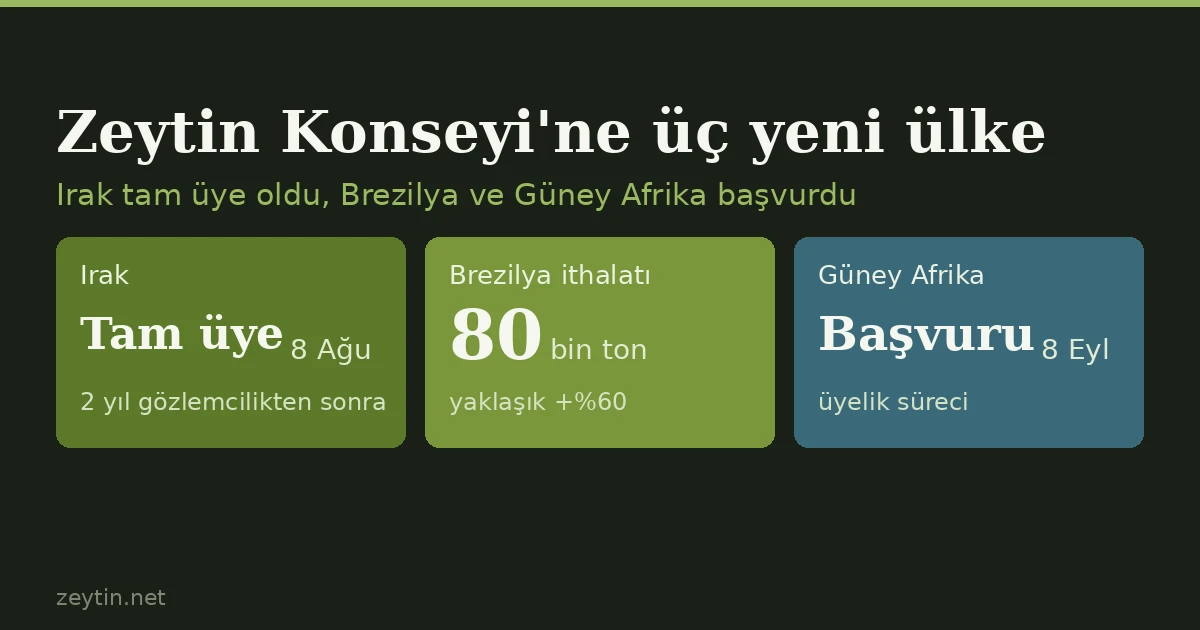
The International Olive Council grows: Iraq joins, Brazil and South Africa apply
The International Olive Council (IOC) saw three developments in a month: Iraq became a full member on 8 August, South Africa submitted its membership request on 8 September and Brazil on 9 September. The expansion reflects olive oil's shift towards production and consumption areas beyond the Mediterranean.
Article
The International Olive Council grows: Iraq joins, Brazil and South Africa apply
The International Olive Council (IOC) saw three developments in a month: Iraq became a full member on 8 August, South Africa submitted its membership request on 8 September and Brazil on 9 September. The expansion reflects olive oil's shift towards production and consumption areas beyond the Mediterranean.