Cem Zeytin loses 486 million lira in nine months: it sold 9% more olives but earned 19% less per kilo
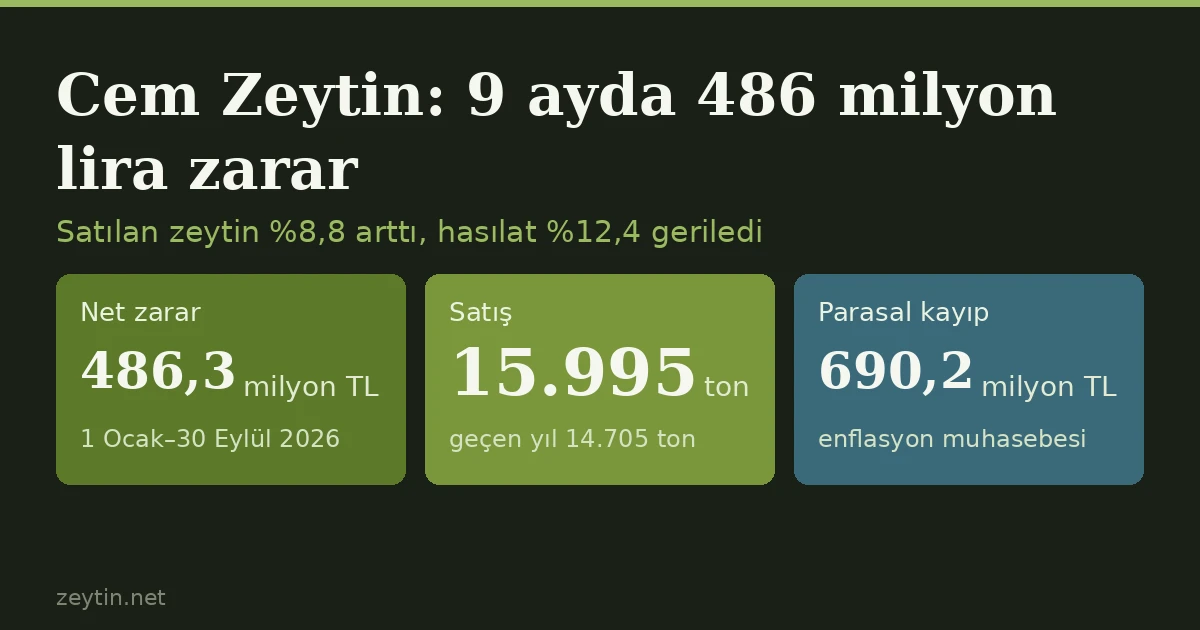
Table olive processor Cem Zeytin, listed in Istanbul, reported a nine-month net loss of 486.3 million lira in its filing to KAP. Sales rose from 14,705 to 15,995 tonnes while revenue fell 12.4%. The loss came not from operations but from a 690 million lira inflation-accounting monetary loss and a swing in tax.
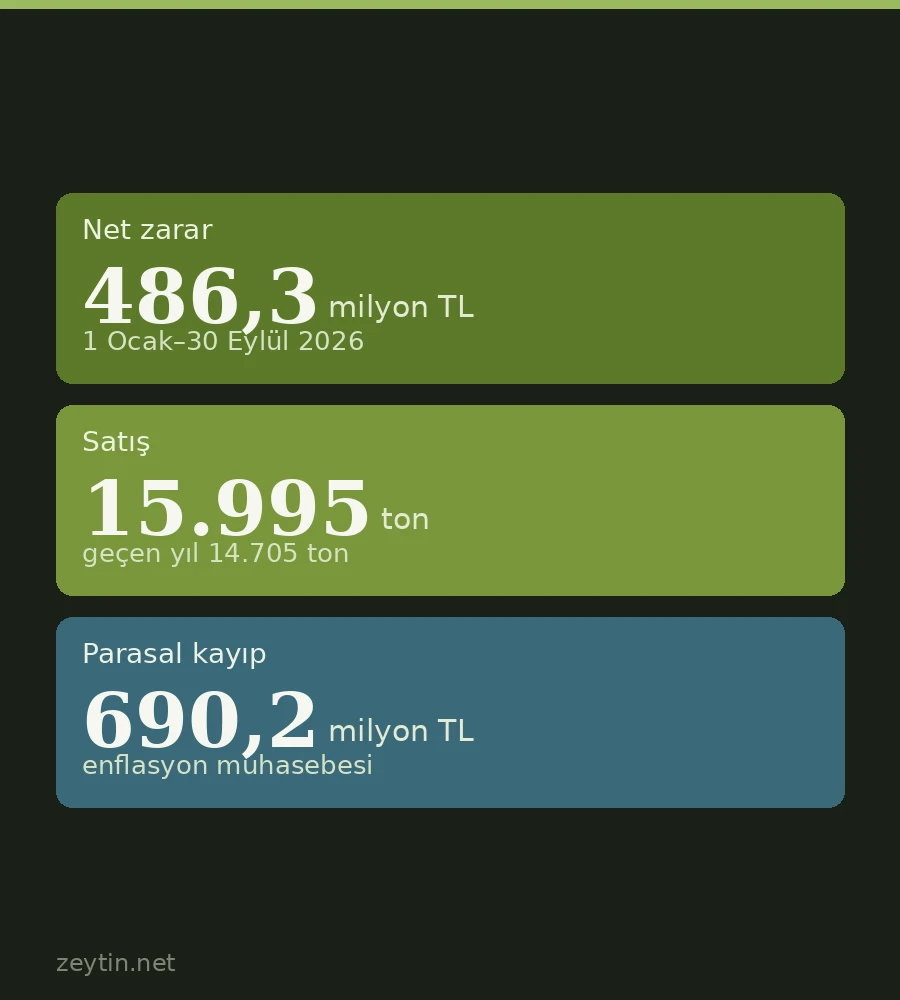
Cem Zeytin A.Ş., a table olive processor listed on Borsa İstanbul under the ticker CEMZY, closed the first nine months of 2026 with a net loss of 486.3 million lira. According to the financial report the company filed with Turkey's Public Disclosure Platform (KAP) on the evening of 30 October, the loss was 7.7 per cent larger than the 451.5 million lira it lost in the same period of 2025.
The headline figure is less interesting than what sits underneath it. The company sold more olives than a year earlier, made a profit from its core operations and cut its financial debt to about a third. What pushed the bottom line deeper into the red was the monetary loss produced by inflation accounting, together with a swing in the tax line.
The figures
| Item | 2025 | 2026 | Change |
|---|---|---|---|
| Revenue | 2,541.4 | 2,226.6 | -12.4% |
| Gross profit | 581.9 | 471.5 | -19.0% |
| Operating profit | 538.5 | 393.0 | -27.0% |
| Finance costs | -295.6 | -295.6 | flat |
| Loss on net monetary position | -802.9 | -690.2 | -14.0% |
| Loss before tax | -582.7 | -417.8 | -28.3% |
| Net loss for the period | -451.5 | -486.3 | +7.7% |
| Sales volume (tonnes) | 14,705 | 15,995 | +8.8% |
Turkish listed companies have reported under hyperinflation accounting (TMS 29, the local equivalent of IAS 29) since 2023, so last year's figures are restated in September 2026 lira. The percentages are our own calculations from the company's statements.
More olives, less money
Over nine months the company sold 15,995 tonnes of olives, against 14,705 tonnes a year earlier. Volume rose by 8.8 per cent while revenue fell by 12.4 per cent. Dividing olive sales revenue by the tonnage sold, income per kilo fell in real terms from roughly 174 lira to 141 lira, a drop of about 19 per cent. That is a crude average, because the product mix changed: sales of semi-finished product, olives sent on for oil, doubled from 1,168 to 2,322 tonnes, and those sell for far less than packed table olives, which drags the average down.
The company explained the shortfall in its own words in a separate report filed the same day, the one listed companies must publish on whether the assumptions behind their flotation price have held. It said that although volumes were similar to the previous year, "revenue and profit margins could not reach the targeted level in this period because of both cost increases and the difficulties encountered in pricing." Gross margin slipped from 22.9 to 21.2 per cent, and the operating margin from 21.2 to 17.6 per cent.
The third quarter on its own shows a sharper turn. July-to-September revenue fell from 764.5 million to 639.3 million lira, down 16.4 per cent, and a company that made a 28.5 million lira profit in that quarter last year booked a loss of 187 million lira this time.
What made the loss bigger
Operating profit was 393 million lira. Two items turned it into a loss. The first is a 690.2 million lira loss on the net monetary position. Under inflation accounting, a company whose monetary assets, such as cash and receivables, exceed its monetary liabilities records a loss as money loses value. Cem Zeytin now holds more cash than financial debt, so it sits on the losing side of that calculation; the same item was 802.9 million a year ago.
The second is tax. The pre-tax loss actually narrowed, from 582.7 million to 417.8 million lira. But last year the company booked a tax income of about 131 million lira, while this year it booked a tax expense of about 68.5 million. A result that improved before tax therefore looks worse after it.
Finance costs were identical in both years at 295.6 million lira, while income from investment activities rose from 16.3 million to 273.8 million lira.
Exports up fivefold, still small
According to the company's interim activity report, foreign sales rose from 165 to 797 tonnes, of which 638 tonnes were whole black olives in brine or dry-cured, against just 7 tonnes a year earlier. Export revenue rose from 29.9 million to 105.5 million lira. Even so, exports are only about 4.5 per cent of gross sales. Cem Zeytin is essentially a domestic business, selling to corporate customers on order, under its own brands and as a private-label packer. For the wider picture of Turkey's olive trade this year, see our report on nine-month exports.
Total output barely moved, from 13,540 to 13,454 tonnes, but its make-up shifted. Production of whole, cracked and slit green olives fell by 37 per cent, while stuffed green olives rose from 1,174 to 2,129 tonnes, well above the line's rated capacity of 660 tonnes. Black olives in brine rose from 6,145 to 6,992 tonnes. Overall the plants ran at 112.8 per cent of stated capacity.
Balance sheet: debt down, stocks seasonal
Financial debt fell from 1.43 billion lira at the end of December 2025 to 512 million lira at the end of September, and cash of 1.02 billion lira now exceeds not just that but the company's total liabilities of 930 million lira. Inventories fell from 2.80 billion to 1.10 billion lira. Much of that drop is seasonal: olives are bought at harvest, so the December balance sheet closes with full tanks and the September one just before the new crop arrives. The workforce shrank from 267 to 250.
Where the olives come from
The company does not grow olives. It buys all its fruit within Turkey, through traders, from Edremit, Akhisar and Mut, three of the country's main table olive basins, and processes it at its plant in Havran, in Balıkesir province, and at a second plant in Mut, Mersin, that began production in June 2024. Its raw material cost is therefore tied directly to orchard-gate prices in those areas. This season's opening prices in Akhisar, and the growers' harvest stoppage that followed, are covered in Akhisar harvest halt.
How far from the flotation forecast?
The valuation report prepared for the company's flotation projected 5.99 billion lira of revenue and 27,645 tonnes of sales for 2026. Nine-month revenue is 37.2 per cent of that figure; sales volume is 57.9 per cent. Because the forecast was drawn up in 2024 prices and the actual figures are inflation-adjusted, the ratio is only an approximate yardstick. The final quarter coincides with the new harvest, but the company is clearly a long way from the target. The year-end accounts will also show what this season's olive purchases have cost.
For the structure of the sector the company works in, see the table olive sector: 461 registered firms, 8,000 unregistered.
One rating per visitor; you can change yours at any time. Ratings are real reader votes — no seeded or default scores.
Related
 Article
The UN names 2026 the Year of the Woman Farmer: in olives the labour is women's, the records are not
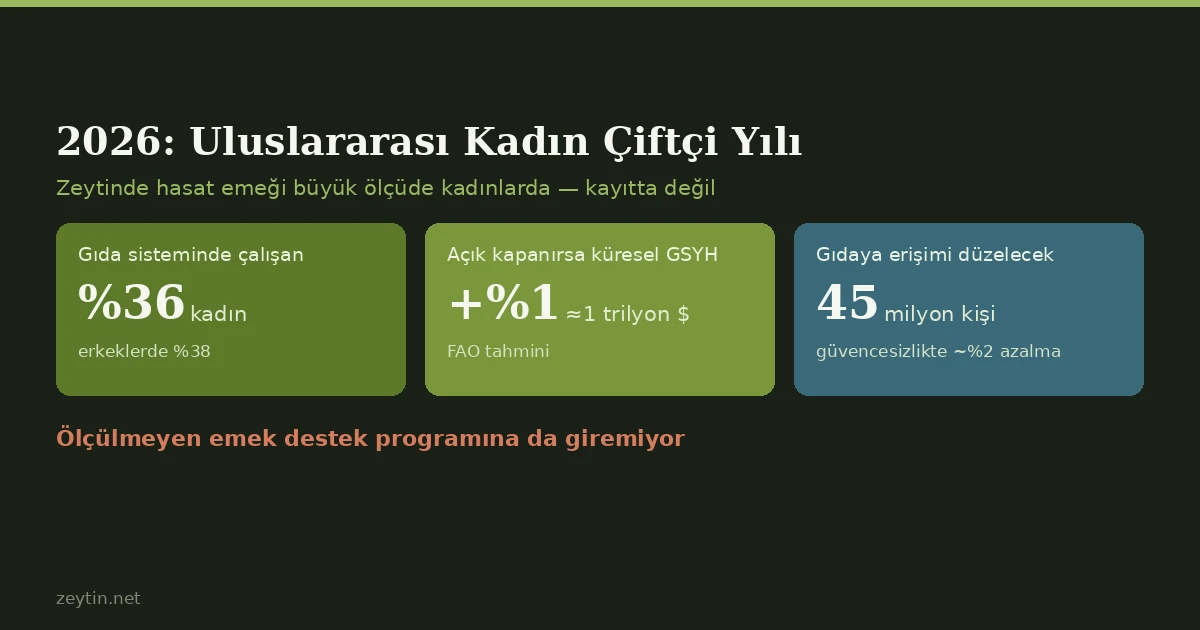
FAO reports that agrifood systems employ 36% of working women and 38% of working men; closing the gender gap would add 1% to global GDP (about $1 trillion) and improve food access for 45 million people. In olives, most harvest labour is women's — title deeds and decisions are not.
 Article
Orhangazi's crop is doubling: the oil olive share climbs from 10% to 40%
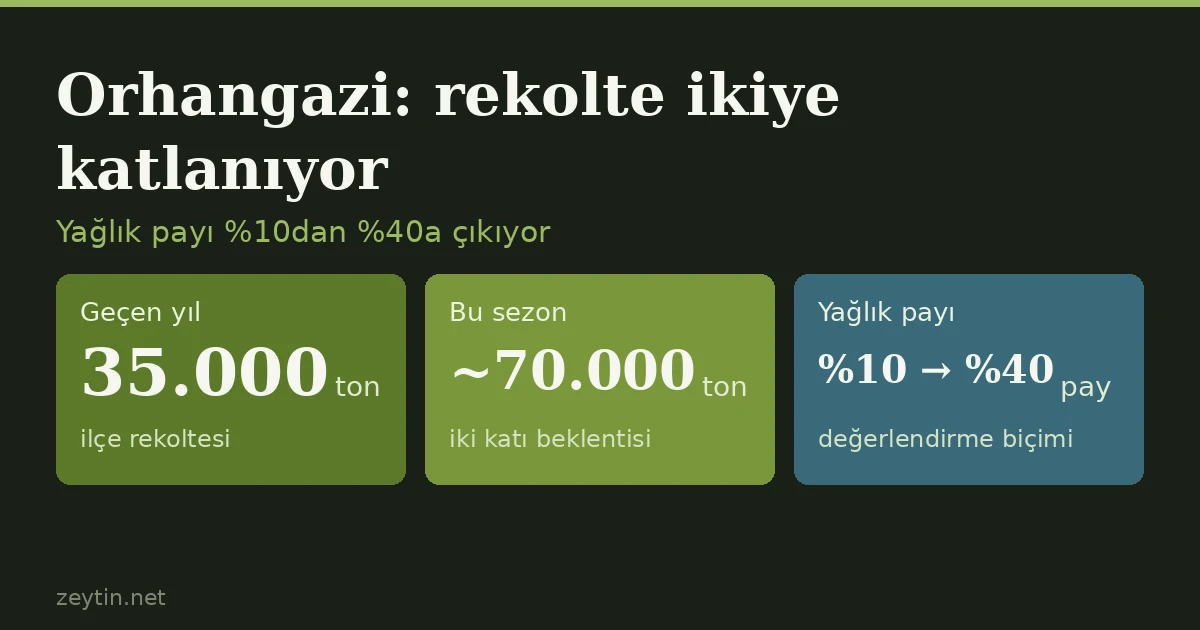
According to figures from the Orhangazi District Directorate of Agriculture and Forestry, last season's crop of roughly 35,000 tonnes could double this year. But in Türkiye's table olive heartland the real shift is in the split: the share pressed for oil is expected to rise from 10% to 40%. Mills are already in maintenance, and the grower's income now depends on fruit size.
 Article
Andalusia moves against North African imports: 76% of what arrives is extra virgin
Andalusia's farm sector objects that more than 76% of the olive oil imported into the region in early 2026 was extra virgin. The regional minister has requested exceptional measures under Article 195 of the EU regulation. Türkiye could meet the same door.
 Article
The EU's newest olive oil registration is in northern Italy: Olio dei Colli di Bologna gets PGI status
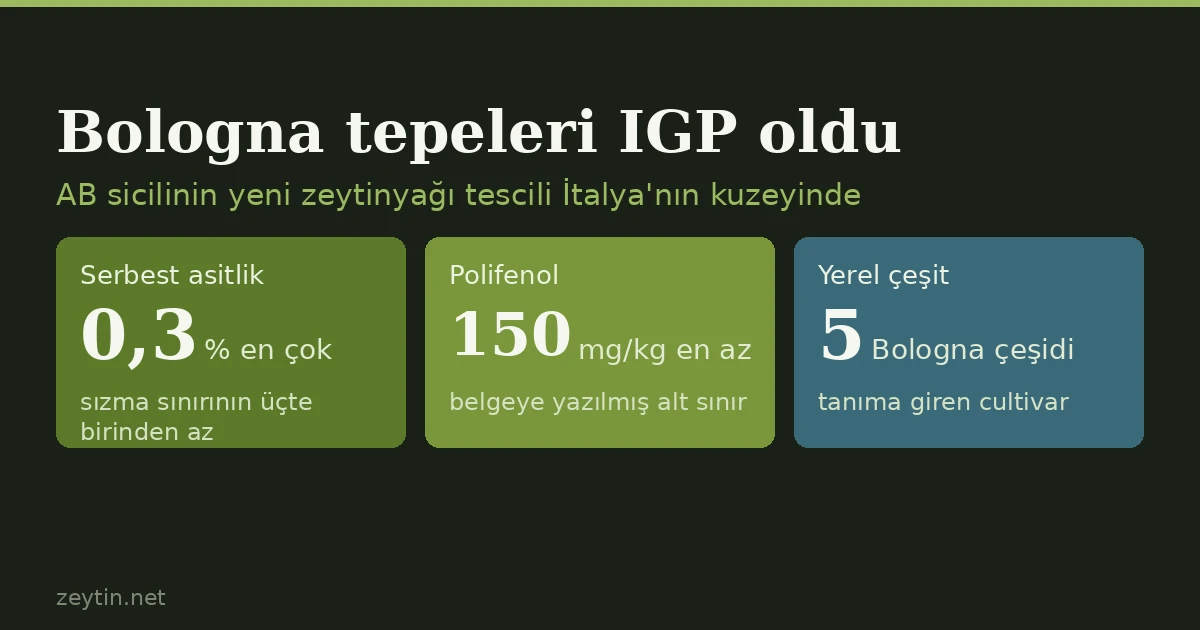
The European Commission has entered olive oil from the hills of Bologna into the Union register of geographical indications. The specification caps free acidity at 0.3 percent, well under a third of the legal limit for extra virgin, and writes five local Bolognese cultivars into the definition.