Agriculture in the EU budget bargain: allocations kept, the four big olive oil producers still object
Ireland, holding the Council presidency, circulated a revised compromise text for the 2028-2034 budget on 10 October: 1.62 trillion euros in current prices, savings of 141 billion euros (8%) against the Commission proposal, with agricultural and cohesion allocations retained. The objections have not stopped, because under the Commission proposal the income support of the Common Agricultural Policy is ring-fenced at 295.7 billion euros inside a single 865 billion euro fund, against 387.8 billion euros allocated to that policy for 2021-2027. All four of the Union's big olive oil producers sit in the group of 17 states resisting the cut.
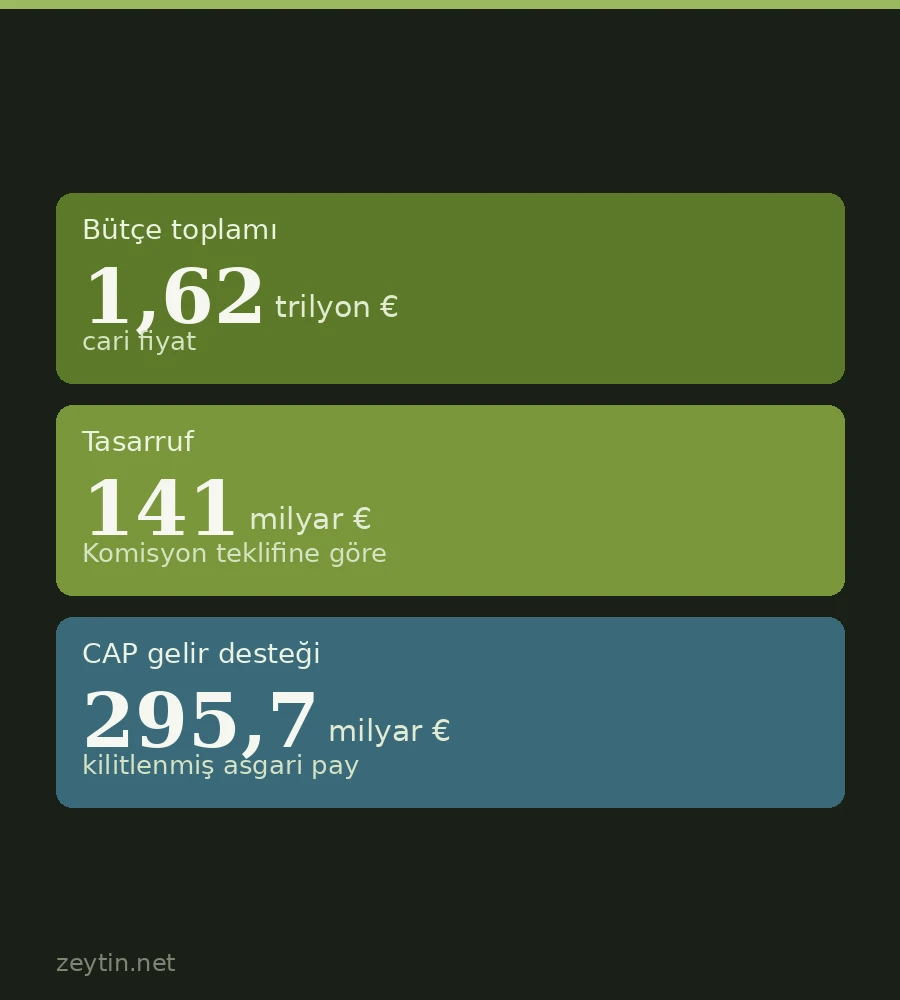
The negotiation over the European Union's long-term budget for 2028-2034 has reached a stage that bears directly on the countries that grow most of the world's olives. Ireland, which holds the rotating presidency of the Council, circulated a revised compromise text to member states on 10 October 2026. The text goes to heads of government this week, at the October European Council.
The headline volume
According to the presidency's own announcement, the proposal is worth 1.62 trillion euros in current prices: a 30% increase on the current budget, equal to 1.16% of EU gross national income — or 1.05% if the repayment of Next Generation EU common debt is excluded. Measured against the European Commission's July 2025 proposal, the presidency text finds savings of 8%, or 141 billion euros, and those savings are spread across every heading rather than concentrated in one.
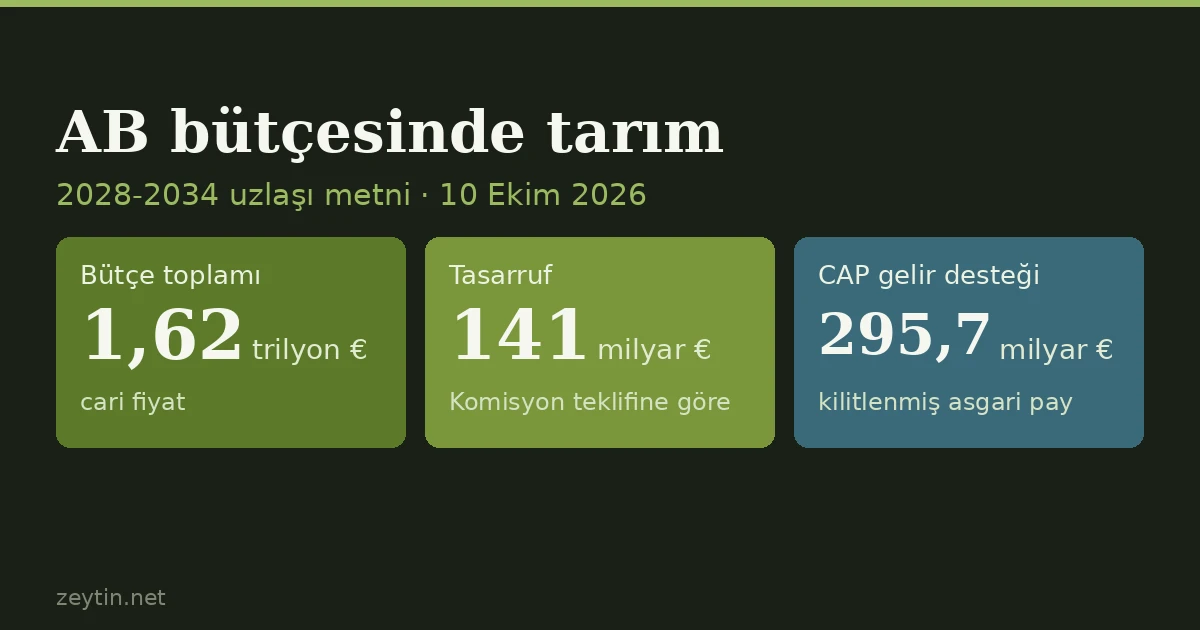
For agriculture, the decisive sentence sits in Heading 1. The presidency writes that, following the position taken by a majority of member states, it retains the national allocations for cohesion, agricultural and fisheries policies under the National and Regional Partnership Plans. The savings in that heading therefore do not come out of the allocations themselves; they come from moderating the increases that had been planned for the EU Facility and for decentralised agencies.
| Item | Amount |
|---|---|
| Total budget (current prices) | €1.62 trillion |
| Savings against the Commission proposal | €141 billion (8%) |
| Competitiveness funds package | more than €400 billion |
| Administration heading | €95 billion (8.8% saving) |
| Humanitarian assistance | €25 billion (maintained) |
| New own resources target | about €55 billion a year |
"Protected" — but measured against what?
This is where the objection begins. The Commission's July 2025 proposal folds cohesion and agricultural funds into a single instrument, the National and Regional Partnership Fund, worth 865 billion euros. Inside that envelope, a minimum share is ring-fenced for the income support interventions of the Common Agricultural Policy together with fisheries interventions: 295.7 billion euros.
The comparison that matters is this. For 2021-2027, the Common Agricultural Policy was allocated 387.8 billion euros in current prices, and that figure covered direct payments, market interventions and rural development together. The new floor of 295.7 billion euros covers only a defined set of interventions: degressive area-based income support, coupled income support, payments for natural constraints, investment support and similar measures. In nominal terms the gap is roughly 24%; on a like-for-like comparison the decline works out at around 15%.
The proposal also carries a separate stabiliser against market shocks: a unity safety net worth 900 million euros a year, or 6.3 billion euros over seven years, in 2025 constant prices.
Seventeen against six
Two blocs have been facing each other for months. The group that publishes joint declarations as the Friends of Cohesion now numbers 17 member states — Bulgaria, Croatia, Cyprus, Czechia, Estonia, Greece, Hungary, Italy, Latvia, Lithuania, Malta, Poland, Portugal, Romania, Slovakia, Slovenia and Spain. Their argument is narrow and specific: cohesion policy, the Common Agricultural Policy and the Common Fisheries Policy are the only policies that lose money in real terms under the Commission's proposal, even though the overall budget grows.
On the other side stand six net contributors pressing for restraint: Austria, Denmark, Finland, Germany, the Netherlands and Sweden. Their stated priorities are competitiveness, security and defence — the policies they describe as belonging to the future rather than the past.
The detail worth noticing is the overlap. The Union's four big olive oil producers — Spain, Italy, Greece and Portugal — are all inside the group of seventeen.
Why the olive sector is exposed
First, because olive groves are among the crop groups that draw most widely on area-based income support. In those four countries olive growing is divided among hundreds of thousands of small holdings, and the direct payment is a fixed line in their accounts rather than a marginal one.
Second, because the bargaining is happening in a season when prices have collapsed. In the European Commission's weekly producer price series, which we track, extra virgin olive oil in the week of 11 October stood at €3.32/kg in Spain and €3.31 in Jaén, against €4.37 in Italy and €4.30 in Bari — all four down on the week before. Growers in Italy are still protesting, and Spain is debating a withdrawal of oil from the market in November. The storage and withdrawal instruments that growers are asking for are themselves financed out of the Common Agricultural Policy.
Seen from Türkiye
Turkish olive growers take nothing from this budget. What the budget does determine is the cost floor of their competitors. A Spanish grower who receives a direct payment can survive at 3.32 euros a kilo; the same price pushes the competitive limit of a Turkish exporter downwards.
In a season when Turkish olive oil export revenue was running 62% behind the previous year by the end of August, that is not an abstract problem.
The effect, however, is not immediate. The new framework enters into force in 2028. This is not a decision that changes the price of the current crop; it is the decision that sets the terms of competition after 2028.
Reading the numbers carefully
The presidency text is not binding. It is a negotiating basis, and its purpose is to narrow differences rather than settle them. Council President Costa wants agreement before the end of 2026; whether that timetable holds was not known as of 15 October.
The figures also rest on different bases. The 1.62 trillion euro total is in current prices, while the 141 billion euro saving is measured against the Commission proposal. Other totals for the same file, calculated in 2025 constant prices, are also in circulation; the two bases should not be added together or compared directly.
Finally, 295.7 billion euros is a minimum floor, not an allocation. The final distribution will be shaped by each member state's own partnership plan, and how much of it reaches olive growing is not knowable today.
One rating per visitor; you can change yours at any time. Ratings are real reader votes — no seeded or default scores.
Related
 Article
Andalusia finally puts a number on it: 1.26 million tonnes of olive oil, up 24%
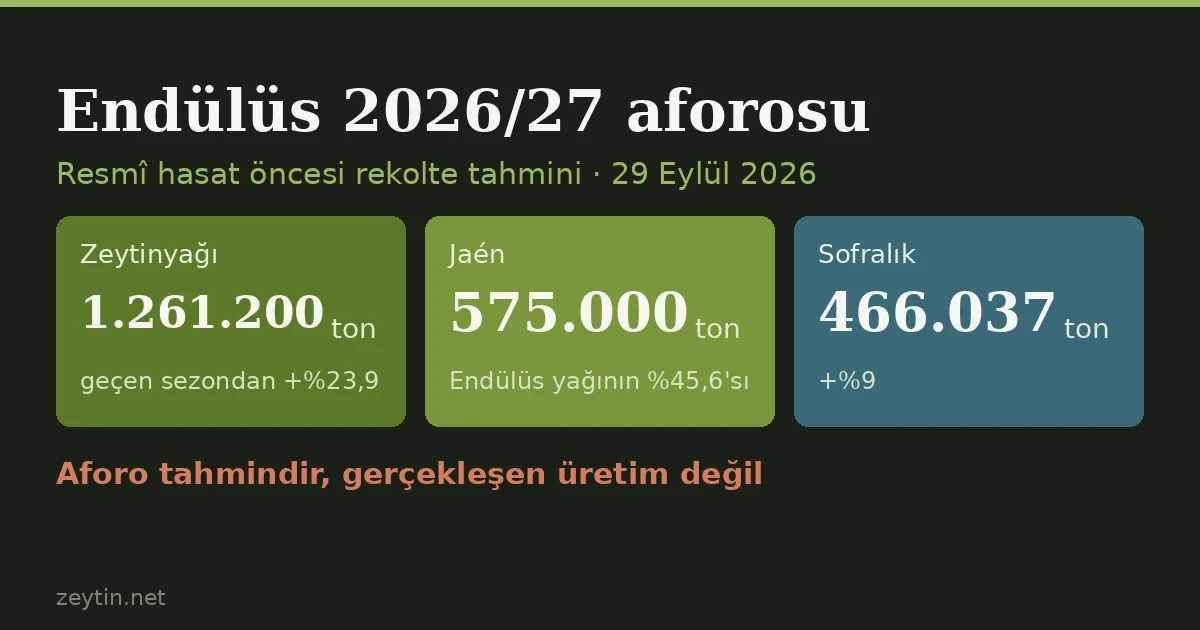
Andalusia's agriculture ministry published its 2026/27 aforo on 29 September in Mengíbar: 1,261,200 tonnes of olive oil, 23.9% above last season and 44% above the five-year average. The heat warning growers raised in early September made it into the forecast's own reasoning. Four times Turkey's entire season output is entering an already soft price environment.
 Article
In Spain the cost sits above the price: €5.31 in a traditional grove, €3.46 at the gate
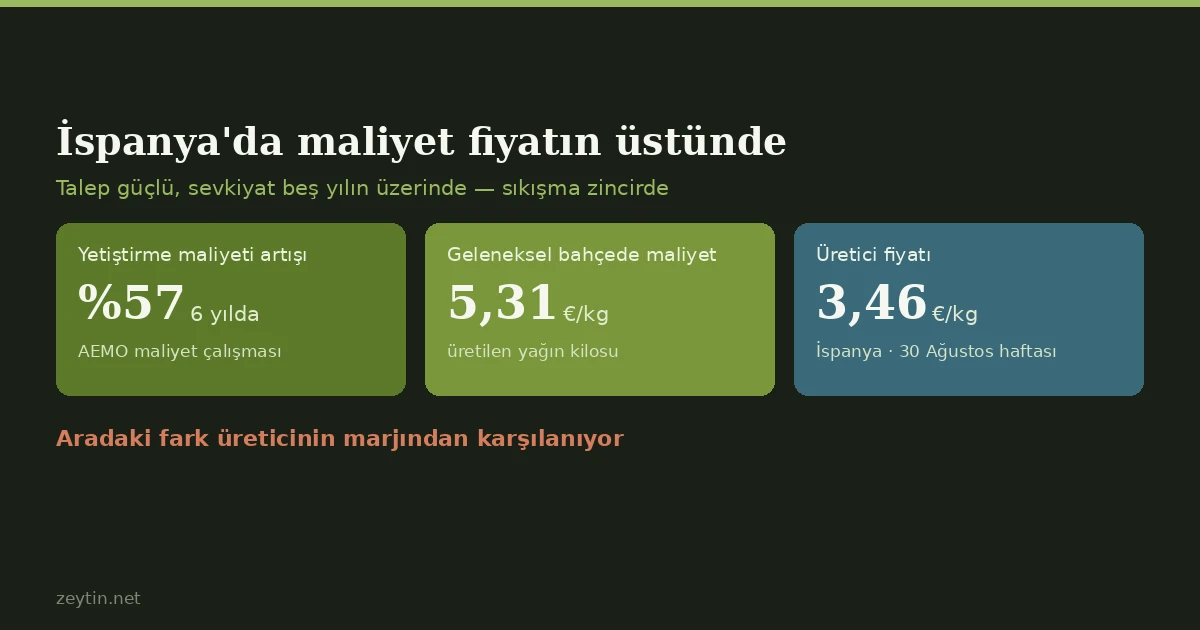
Olive cultivation costs have risen 57% in six years and reach €5.31 per kilogram in the most traditional groves, according to an AEMO study. The same week, Spain's producer price was €3.46. The Andalusian cooperative federation, with 342,000 members, is asking not for aid but for a change to the Food Chain Law.
 Article
Harvest halted amid a record forecast: 50 lira for table olives in Akhisar, 10 for oil
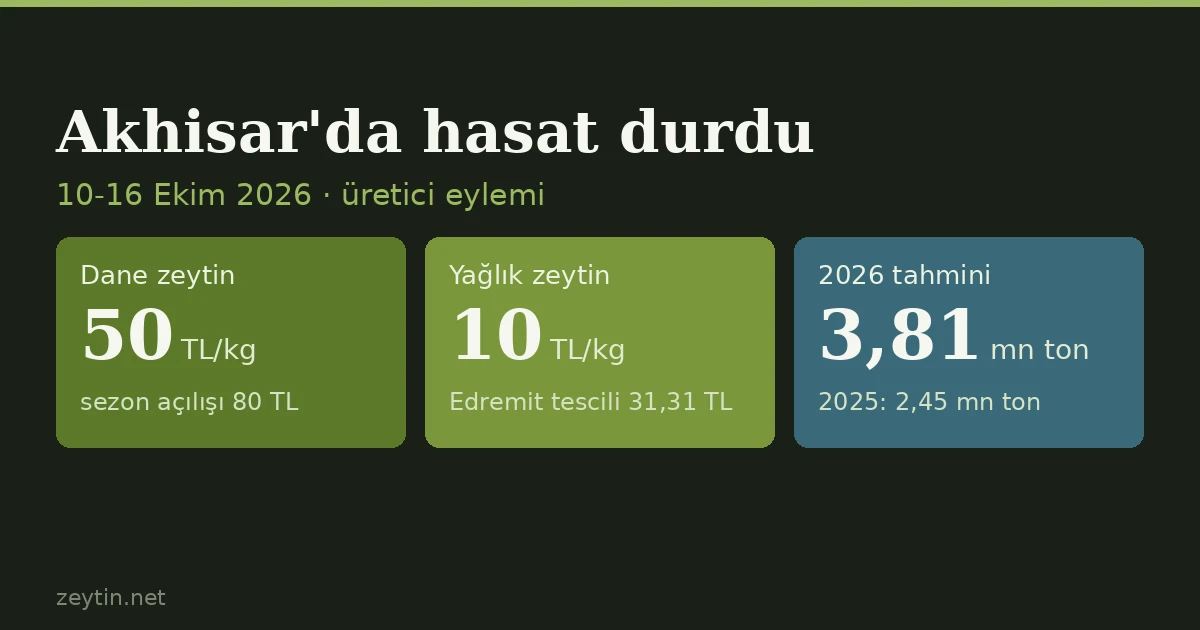
Growers in Akhisar halted the harvest for a week on 10 October. Table olive prices that opened the season at 80 lira fell to 50, and oil olives to 10 — below last season's table olive floor. In the same days the official first estimate puts production at 3.8 million tonnes.
 Article
Antalya's crop is up 30%: of 70,000 tonnes of olives, 55,000-60,000 head for the mill
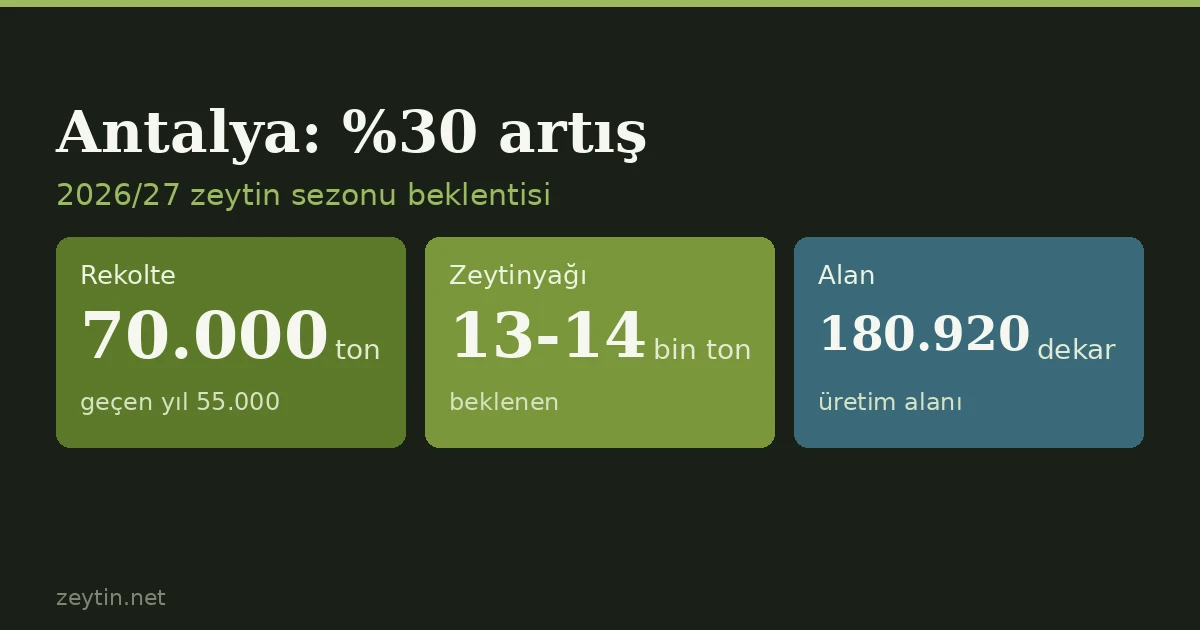
According to the Antalya Commodity Exchange, the province's olive crop is rising about 30% from some 55,000 tonnes last season to around 70,000 tonnes, with 13,000-14,000 tonnes of olive oil and 10,000-15,000 tonnes of brined fruit expected. Harvest opened on 15 September. There is movement on the registration front too: an EU application has been filed for the Tavşan Yüreği olive, and a geographical indication file is under way for the Beylik variety.