Pakistan to plant 2 million olive trees in three years to cut edible oil imports
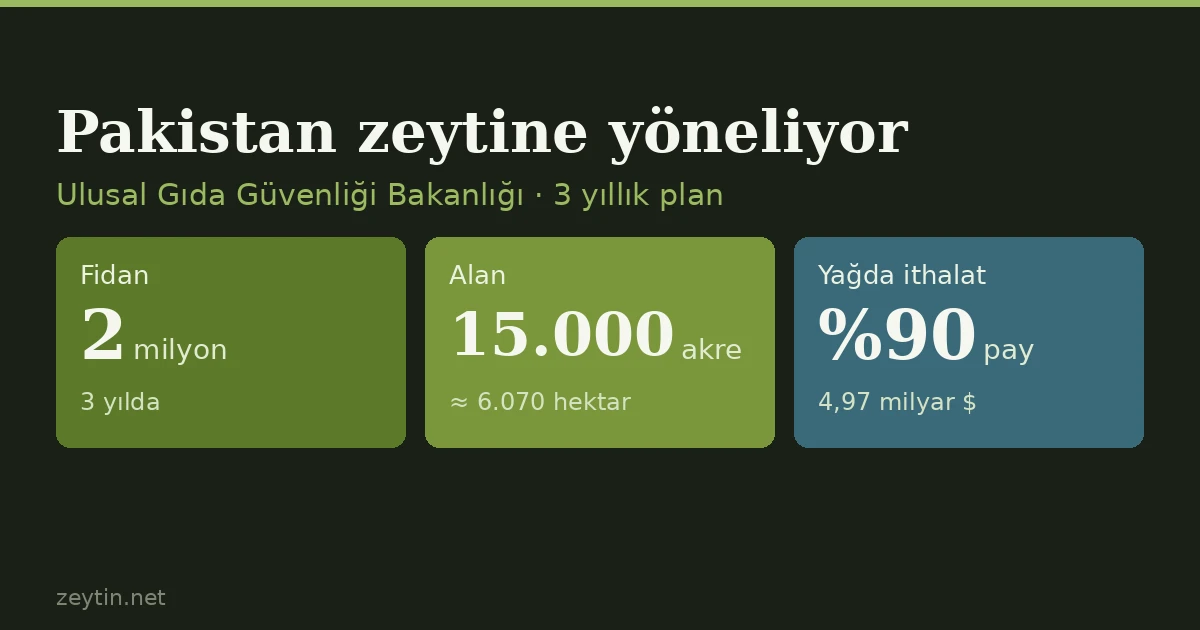
Pakistan's Ministry of National Food Security and Research plans to establish olive groves on 15,000 acres (about 6,070 hectares) over three years and supply 2 million plants in that period. The country imports roughly 90 per cent of its edible oil; the import bill reached 4.97 billion dollars in 2024-25.
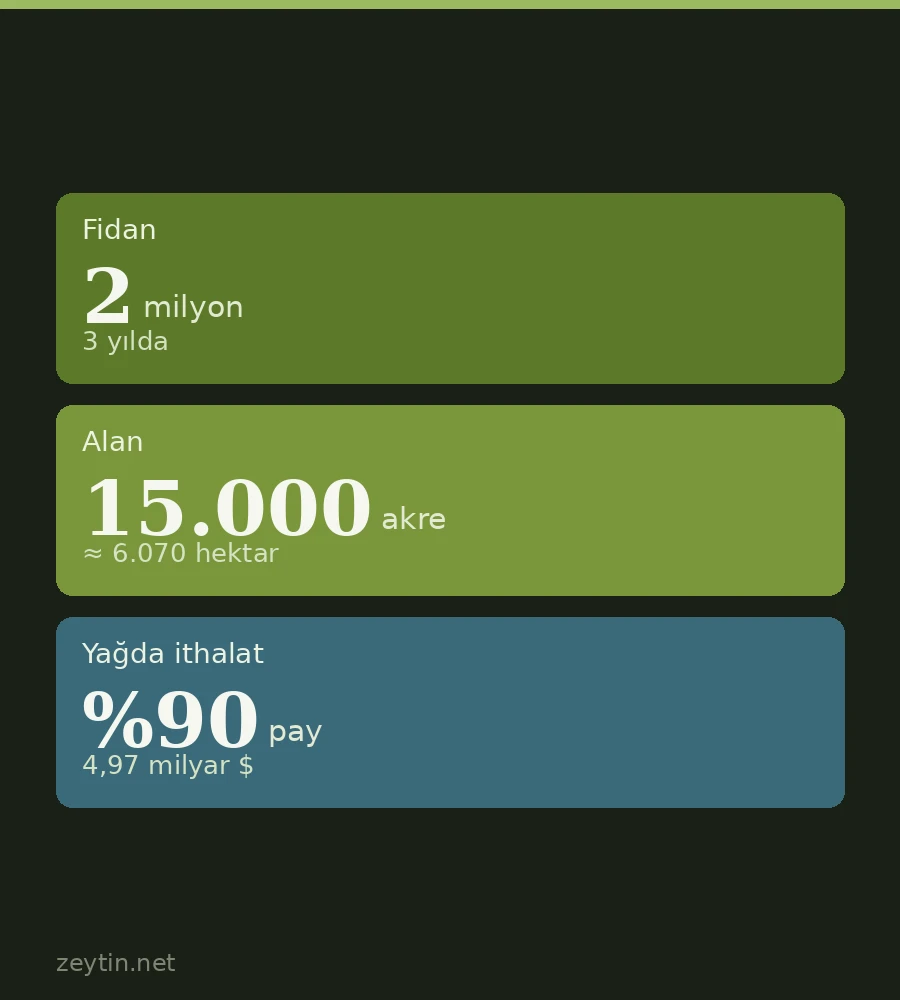
The olive map is not only growing around the Mediterranean. Pakistan is turning to olives to reduce its dependence on imported edible oil, and it has now put concrete numbers on the plan. The country's Ministry of National Food Security and Research intends to establish olive plantations on 15,000 acres over the next three years and to supply growers with 2 million olive plants in the same period. That is roughly 6,070 hectares.
The plan was discussed at a meeting chaired by Minister Rana Tanveer Hussain, where project team leader Dr Muhammad Tariq briefed officials, and was made public on 15 September.
Why olives?
Pakistan's real problem is not olive oil but edible oil in general. According to the ministry's 2024-25 year book, the picture looks like this:
| Item | Amount |
|---|---|
| Imports | 4.169 million tonnes |
| Import value | 4.971 billion dollars |
| Domestic production | 0.474 million tonnes |
| Total availability | 4.643 million tonnes |
| Import dependency | about 90% |
In May the country also announced a wider roadmap: 70% self-sufficiency in edible oil by 2035. It foresees expanding the oilseed area from 1.24 million to 4.6 million hectares, lifting annual domestic output to 4.578 million tonnes, and installing 1,000 mini oil expellers and 1,500 farm machines. If the targets are met, about 7 billion dollars of imports a year could be replaced by domestic production. Olives are the tree crop pillar of that programme.
What does the plan cover?
What stands out in the ministry's statement is that the effort is not limited to handing out plants. For olives to bring farmers a real income, production is meant to be built together with processing, storage, testing and marketing. The main points:
- An oil extraction facility in every olive cluster. Mills are to be set up close to growing areas so that fruit can be processed without long waits after picking.
- Post-harvest infrastructure. Stronger storage, testing and quality analysis systems.
- Use of by-products. The minister instructed that olive by-products should not go to waste but be turned into value-added products.
- The Potohar region. This plateau in northern Punjab was highlighted as a large, still untapped potential for olives.
- A realistic look at machinery. Officials were asked to reassess the number of machines foreseen in the project and their costs.
- The private sector. Private investment and participation in processing and operations will be encouraged.
What has been done so far?
Pakistan is not starting from scratch. The second phase of the programme to promote commercial-scale olive cultivation is under way. In 2024-25 alone:
- 822,452 olive cuttings were planted,
- 108,859 plants went into the ground in Balochistan,
- drip irrigation was installed on 737 acres across several Balochistan districts,
- 45 training sessions were held, attended by 2,684 people, including young people and women.
The new plan ties these scattered beginnings to a three-year schedule with a defined area and number of plants.
What this scale means
Two million plants and 6,070 hectares are not a large figure for Mediterranean countries, but they are a serious step for a country without an olive tradition. A new grove takes several years to bear fruit; as we explain on our olive tree page, a grafted sapling usually gives its first fruit in year three to five, with full yields later. The olive oil outcome of the plan will therefore not be seen immediately, but in the early 2030s.
The real test will be building milling and quality, more than planting trees. The sooner olives are processed after picking, the lower the acidity of the oil; oil whose acidity rises drops out of the extra virgin category. That is why Pakistan's goal of a mill for every cluster matters. You can follow the stages oil goes through in a mill in our article on how cold-pressed olive oil is made and our explainer on what a malaxer is.
Quality infrastructure: laboratories and standards
It is significant that the ministry singles out "testing". Olive oil grades are not set by taste alone: the International Olive Council standard used in international trade requires free acidity of no more than 0.8% for extra virgin olive oil and 2% for virgin olive oil, with no defects found by a trained tasting panel. Without laboratories and panels to verify these criteria, oil cannot be sold under the right label even on the domestic market.
The second critical point is planting material. Which varieties the planned 2 million plants are and where they come from will shape the plantations' first decade. If disease-free, variety-verified plants are not used, replacing a grove that shows yield or adaptation problems years later means starting almost from scratch. We explain what to look for in our guide to choosing certified olive saplings.
The third point is climate. Olives need a period of winter cold to set fruit; in very hot plains flowering can be weak. Pakistan's emphasis on cooler uplands such as Potohar is a consistent choice from that point of view.
What it means for Türkiye
New olive countries matter in two ways: on the one hand as a possible future olive oil producer, on the other as a market that needs plants, machinery, milling technology and know-how today. The machinery, mill and training needs Pakistan has set out point to room for cooperation for companies and universities with experience in these areas. We will follow the commercial side in the coming months as Pakistan announces project tenders and sourcing choices.
We also look at how olives are spreading to new regions, the varieties that suit different climates and the balance between producing countries on our world olive varieties page.
One rating per visitor; you can change yours at any time. Ratings are real reader votes — no seeded or default scores.
Related
 Article
Crop forecast climbs as the minimum-price debate returns: what the exchange numbers say
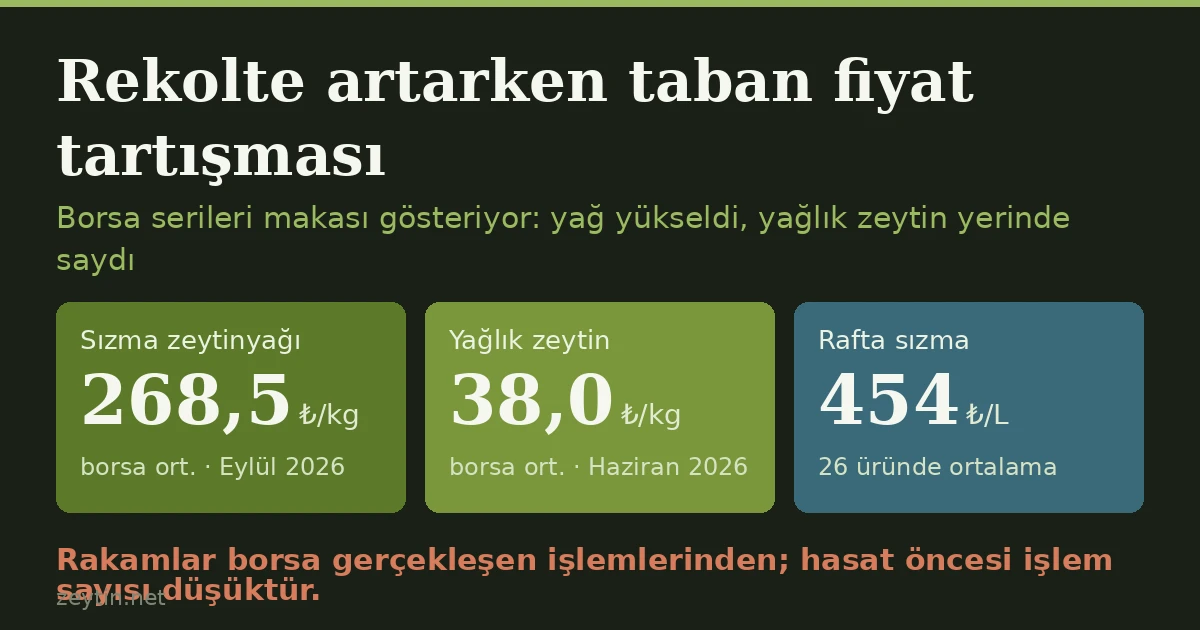
With the 2026 harvest approaching, crop forecasts are up 40 percent in some provinces and growers want a floor price. Our exchange series shows why the dispute is really about olives, not oil.
Article
Crop forecast climbs as the minimum-price debate returns: what the exchange numbers say
With the 2026 harvest approaching, crop forecasts are up 40 percent in some provinces and growers want a floor price. Our exchange series shows why the dispute is really about olives, not oil.
 Article
The UN names 2026 the Year of the Woman Farmer: in olives the labour is women's, the records are not
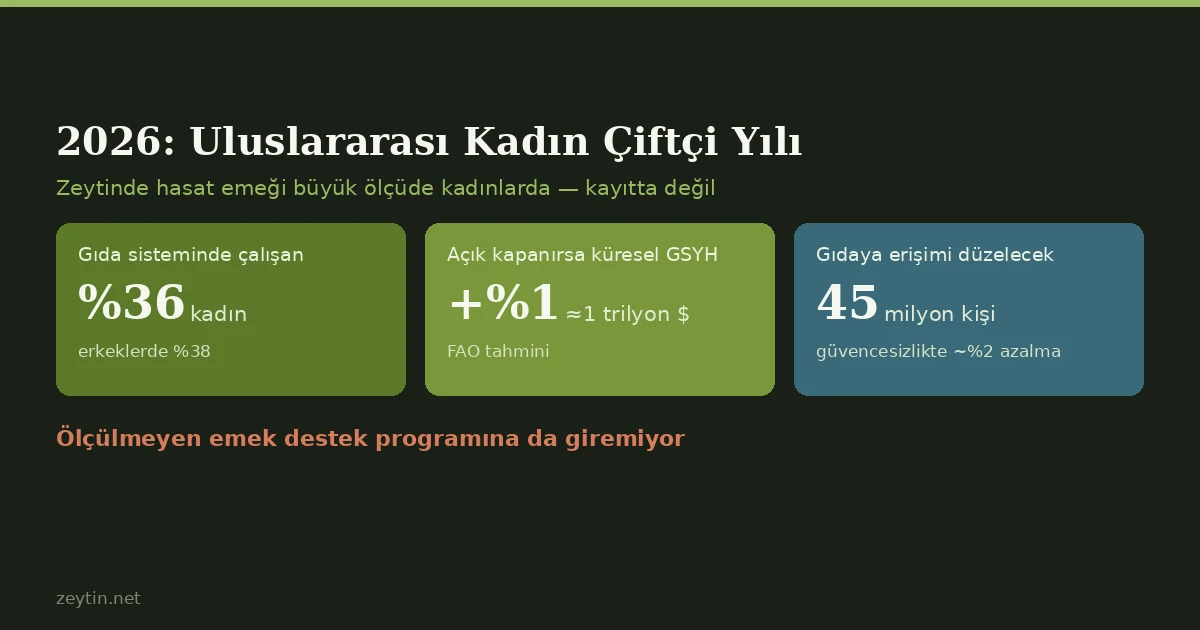
FAO reports that agrifood systems employ 36% of working women and 38% of working men; closing the gender gap would add 1% to global GDP (about $1 trillion) and improve food access for 45 million people. In olives, most harvest labour is women's — title deeds and decisions are not.
Article
The UN names 2026 the Year of the Woman Farmer: in olives the labour is women's, the records are not
FAO reports that agrifood systems employ 36% of working women and 38% of working men; closing the gender gap would add 1% to global GDP (about $1 trillion) and improve food access for 45 million people. In olives, most harvest labour is women's — title deeds and decisions are not.
 Article
Tunisia's output falls from 500,000 to 300,000 tonnes — revenue may hold
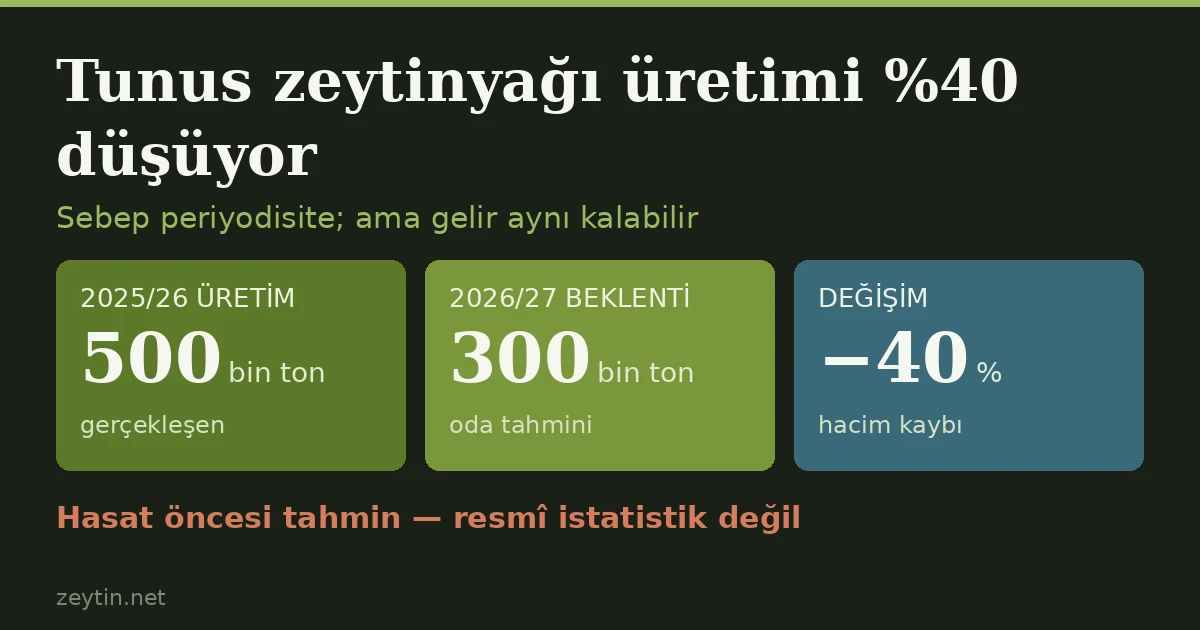
Tunisia's National Chamber of Olive Producers expects olive oil output to fall from 500,000 to 300,000 tonnes in 2026/27, citing alternate bearing. Revenue is still expected to match last season because prices are higher. Türkiye's most direct bulk competitor is shrinking.
Article
Tunisia's output falls from 500,000 to 300,000 tonnes — revenue may hold
Tunisia's National Chamber of Olive Producers expects olive oil output to fall from 500,000 to 300,000 tonnes in 2026/27, citing alternate bearing. Revenue is still expected to match last season because prices are higher. Türkiye's most direct bulk competitor is shrinking.
 Article
Olive fruit fly warning before harvest in Aydın: check groves, spray only above the threshold
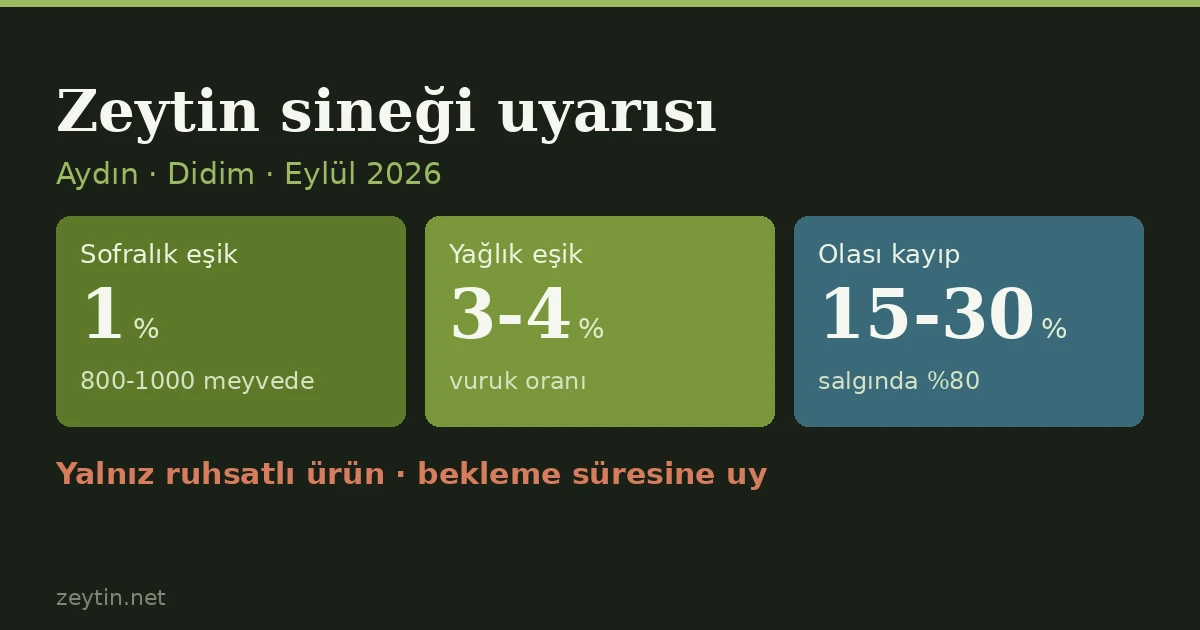
The Didim District Directorate of Agriculture and Forestry, together with the Aydın Provincial Directorate, has warned growers about the olive fruit fly ahead of the harvest. Growers were asked to check groves regularly, monitor pest density and, if needed, act only with products licensed for olives and at the right time. Fly pressure rising in autumn cuts both yield and oil quality.
Article
Olive fruit fly warning before harvest in Aydın: check groves, spray only above the threshold
The Didim District Directorate of Agriculture and Forestry, together with the Aydın Provincial Directorate, has warned growers about the olive fruit fly ahead of the harvest. Growers were asked to check groves regularly, monitor pest density and, if needed, act only with products licensed for olives and at the right time. Fly pressure rising in autumn cuts both yield and oil quality.