Greece heads for 300,000 tons: first lot sold at €5.95 after last year's €7.85
Greece expects its largest olive oil harvest since 2022/23 in 2026/27, with industry estimates near 300,000 tons. The season's first lot — 55 tons of extra virgin in Laconia — changed hands at €5.95 per kilo, down from €7.85 a year earlier. Carryover oil sells near €3.40 and new-crop producer prices are expected around €4. A simultaneous rebound across the three largest producers pushes down the world price Turkish exporters will meet.
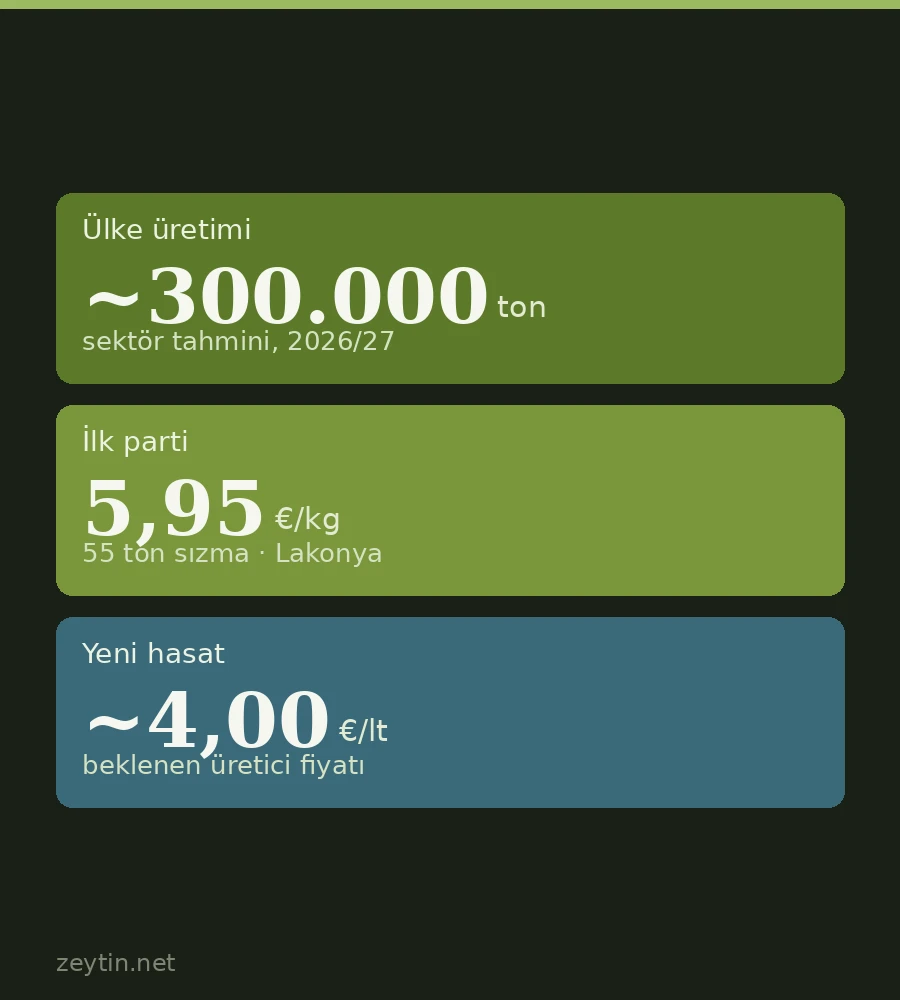
Greece is entering the new season with two opposing signals: the trees are visibly fuller than last year, while prices sit well below last year's levels. Industry estimates put national output at around 300,000 tons. If the forecast holds, this would be the largest Greek harvest since 2022/23, when the country produced more than 330,000 tons.
Two separate trade bodies give closely aligned numbers: Kostas Koutsioumpis, president of the Association of Greek Olive Oil Standardization Industries (SEVITEL), and Manolis Giannoulis, president of the National Interprofessional Olive Oil Organization. The range being discussed is 280,000-330,000 tons, with 300,000 the most widely cited scenario. The rebound follows a weak season in which pest outbreaks damaged the fruit and forced some growers to end the harvest earlier than usual.
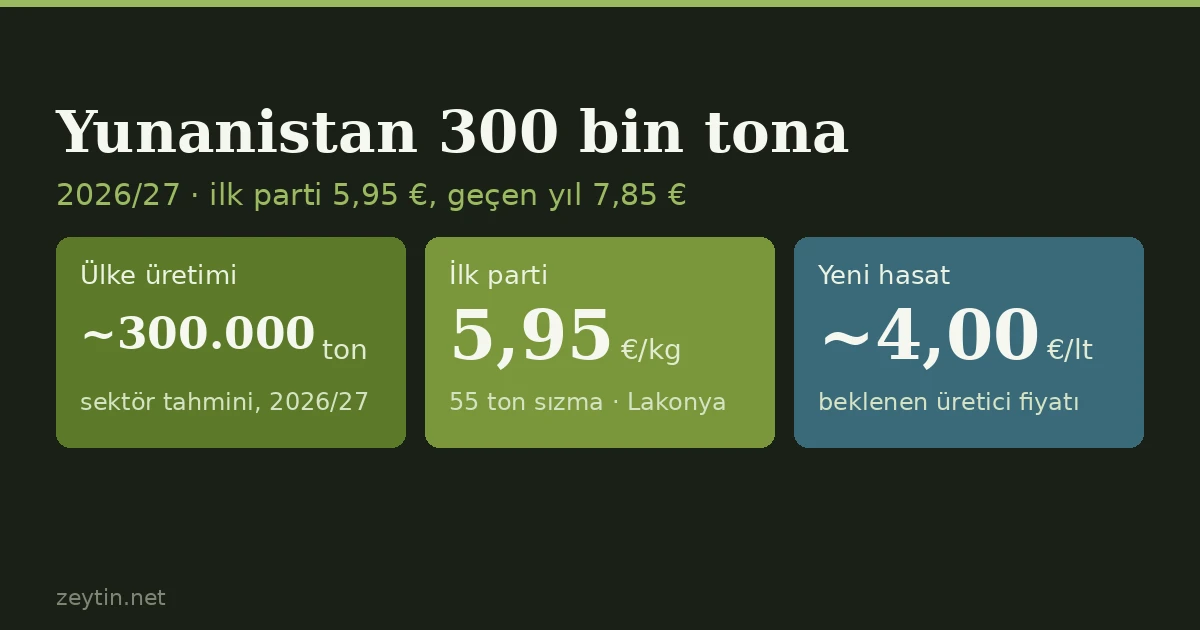
| Greece · 2026/27 | Figure |
|---|---|
| National output (industry estimate) | ~300,000 t |
| Messenia | could exceed 60,000 t |
| Laconia capacity | ~30,000 t |
| Crete (last season) | ~40,000 t |
| Season's first lot | €5.95/kg |
| Last season's first lot | €7.85/kg |
| Carryover oil (today) | ~€3.40/l |
| New-crop expectation | ~€4.00/l |
The first lot changed hands at €5.95
The season's opening deal was struck in Laconia, in the far south of the country. The Agioi Apostoloi Agricultural Olive Oil Cooperative sold 55 tons of extra virgin olive oil at auction for €5.95 per kilo. Two companies took part, one Greek and one Italian; the Italian firm secured the batch.
That figure alone does not mean prices are high. Last season's first lot sold at €7.85, so the opening price has fallen roughly 24 percent in a year. The first lot is early-harvest oil every year and carries a premium — it marks the ceiling of the season, not the average. Producers read it the same way: the price covers the cost of early harvesting, but is not considered high once total expenses are counted.
The average sits lower. According to Giorgos Kokkinos, head of the Nileas association of olive oil producers in Messenia, oil carried over from last season is currently selling at around €3.40 per litre, while producer prices for new-crop extra virgin are expected to hover near €4. On Lesbos, the band being quoted is the same.
Region by region
Messenia alone could exceed 60,000 tons this crop year. Harvesting has already begun in pockets of the region with the early-ripening indigenous Mavroelia variety; the harvest of Koroneiki, the dominant cultivar, is expected to begin in late October.
In Laconia, overall capacity is around 30,000 tons, and last season delivered only about half of that. A significantly larger yield is expected this year. Demand from traders and large bottlers, however, is thin, and storage tanks remain full of oil carried over from last season.
In Crete, preliminary estimates suggest output could reach up to twice last year's meagre 40,000 tons. Kostis Kekerides of the Zakros agricultural cooperative near Lasithi says production in his area could exceed 1,000 tons, against an average of about 300 tons in recent years. His explanation is direct: three crop years of drought, followed by substantial rainfall this year. Harvesting opens in early October and may run until February. Part of the cooperative's oil is marketed under the Sitia PDO label, mostly for export, though traders buy most of its annual output in bulk.
It is not good everywhere. On Lesbos, trees suffered heat stress from hotter-than-usual weather and lost a significant part of their foliage; growers there now speak of half the initially expected yield. In Stylida in central Greece, producers have joined to protest both low producer prices and the spread of the olive fruit fly, calling for a guaranteed minimum price that covers production costs.
The forecast is not locked in yet
Kokkinos's own warning sits on top of the number: if rainfall and humidity increase over the next couple of months, olive pests such as gloeosporium would find fertile ground to multiply. The 300,000-ton figure therefore reflects the fruit load on the trees today, and because pressing continues until February, it will only settle over the coming months.
Lesbos shows how quickly that can change. On the island, the initial projection halved on heat-driven defoliation alone. A mid-season revision is the rule rather than the exception in this crop.
Madrid, not Athens, sets the direction
The point Kokkinos makes applies to Turkey as well: prices at origin are set not by the Greek harvest but by the harvest of the world's largest producer. The 1,602,596-ton national forecast Madrid announced on 1 October is more than five times the Greek estimate. Abundant Spanish production lowers foreign demand for fresh oils and drags Greek prices down with it.
That is exactly why the warning from Laconia matters. Panagiotis Batzakis, who heads the same cooperative, says that if prices stay below €5 per litre, half of the local groves planted with Athinolia — a variety that demands more attention than most — could soon be abandoned. The cooperative's first lot went at €5.95: just above that threshold, and for the most premium oil of the season. In Crete the same sentence comes from different mouths: harvest, fertilizer, irrigation and energy costs have all risen, and if the price does not cover them, the business is not viable.
What it means for Turkey
On current site data, extra virgin olive oil was registered at ₺298.23 per kilo on the Edremit exchange on 25 September. At the European Central Bank's 5 October rate (€1 = ₺55.0755) that is roughly €5.42 — above Spain's €3.45 and Italy's €4.75, and just below the price of the Greek opening lot at €5.95.
The picture is clear: Turkish oil is not on the cheap side of the world price this season. The 500,000-600,000 ton harvest expectation being discussed in İzmir is double the Greek estimate, yet the price Turkish exporters meet abroad depends on Madrid's number, not Athens'. A simultaneous rebound across the three largest producers reinforces the fact that there is no scarcity in the Mediterranean this year — and Greece's 300,000 tons becomes the third large item added to the supply side.
One rating per visitor; you can change yours at any time. Ratings are real reader votes — no seeded or default scores.
Related
 Article
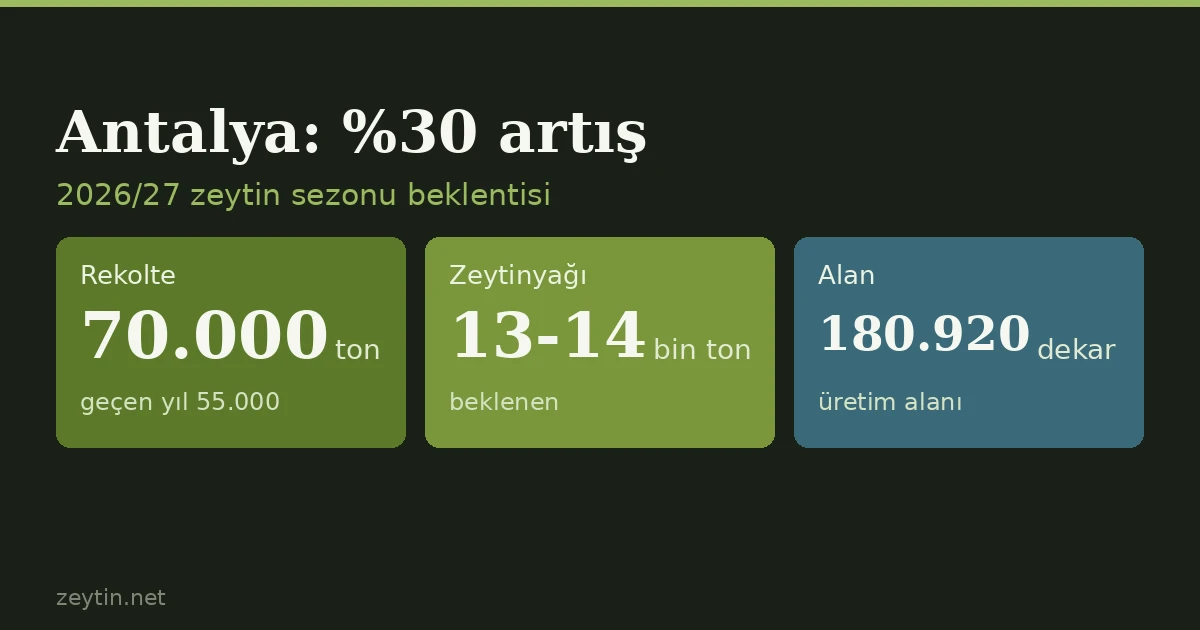
Antalya's crop is up 30%: of 70,000 tonnes of olives, 55,000-60,000 head for the mill
According to the Antalya Commodity Exchange, the province's olive crop is rising about 30% from some 55,000 tonnes last season to around 70,000 tonnes, with 13,000-14,000 tonnes of olive oil and 10,000-15,000 tonnes of brined fruit expected. Harvest opened on 15 September. There is movement on the registration front too: an EU application has been filed for the Tavşan Yüreği olive, and a geographical indication file is under way for the Beylik variety.
Article
Antalya's crop is up 30%: of 70,000 tonnes of olives, 55,000-60,000 head for the mill
According to the Antalya Commodity Exchange, the province's olive crop is rising about 30% from some 55,000 tonnes last season to around 70,000 tonnes, with 13,000-14,000 tonnes of olive oil and 10,000-15,000 tonnes of brined fruit expected. Harvest opened on 15 September. There is movement on the registration front too: an EU application has been filed for the Tavşan Yüreği olive, and a geographical indication file is under way for the Beylik variety.
 Article
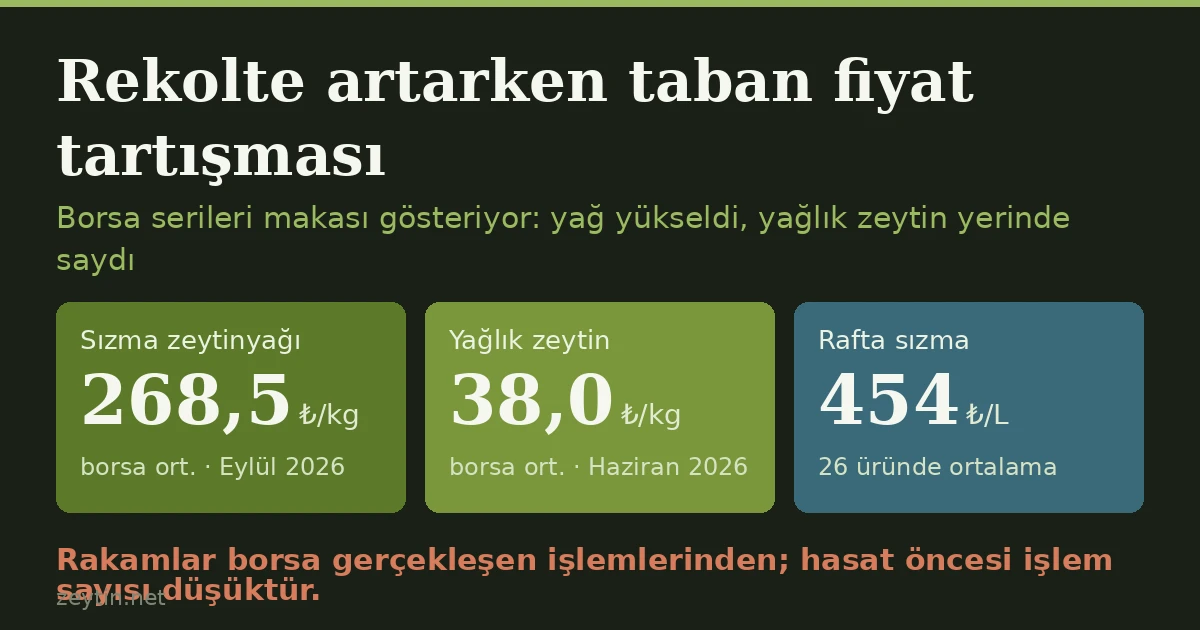
Crop forecast climbs as the minimum-price debate returns: what the exchange numbers say
With the 2026 harvest approaching, crop forecasts are up 40 percent in some provinces and growers want a floor price. Our exchange series shows why the dispute is really about olives, not oil.
Article
Crop forecast climbs as the minimum-price debate returns: what the exchange numbers say
With the 2026 harvest approaching, crop forecasts are up 40 percent in some provinces and growers want a floor price. Our exchange series shows why the dispute is really about olives, not oil.
 Article
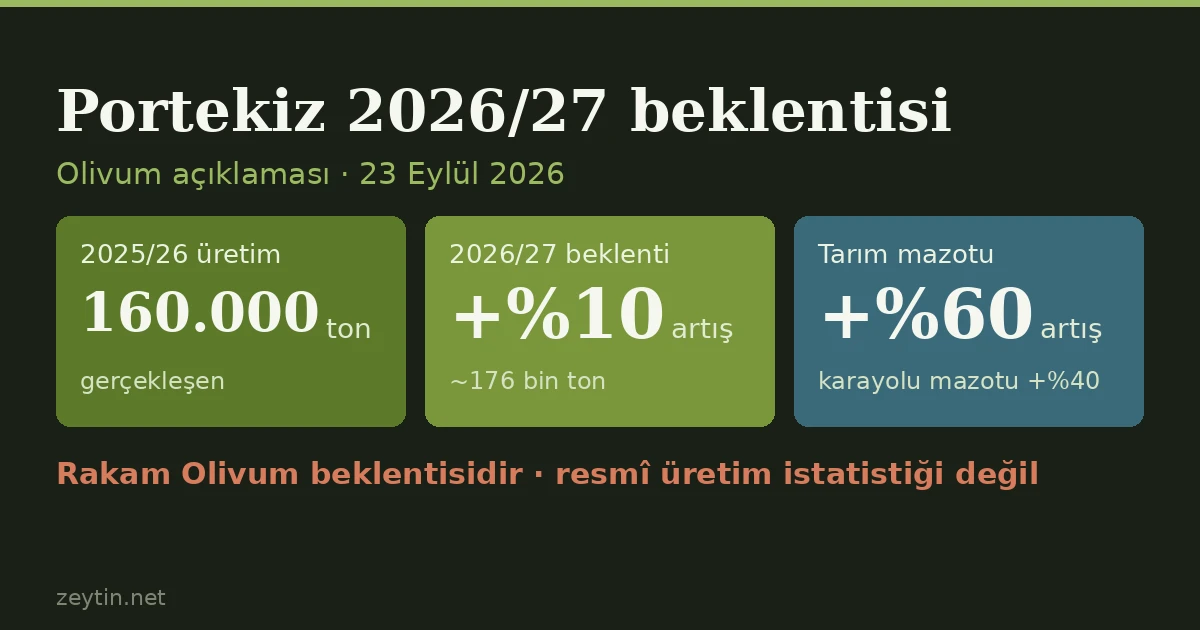
Portugal heads back to 177,000 tonnes: output up 10%, farm diesel up 60%
Portugal's olive association Olivum expects production to rise by about 10% in 2026/27 — a return from 160,000 tonnes to the 177,000 of two years ago. The same statement records a 60% rise in the price of agricultural diesel.
Article
Portugal heads back to 177,000 tonnes: output up 10%, farm diesel up 60%
Portugal's olive association Olivum expects production to rise by about 10% in 2026/27 — a return from 160,000 tonnes to the 177,000 of two years ago. The same statement records a 60% rise in the price of agricultural diesel.
 Article
Skilled operators for olive mills: training ends in Milas, Muğla trains women operators
Ahead of the harvest, two training programmes in Muğla focus on operators, the most critical link in olive mills. A three-day operator course run by MİTSO, Milas Tariş and HAUS Makine has ended in Milas, and the Muğla Chamber of Commerce and Industry is launching a 50-place "Women's Hands in Industry" programme to train women as mill operators.
Article
Skilled operators for olive mills: training ends in Milas, Muğla trains women operators
Ahead of the harvest, two training programmes in Muğla focus on operators, the most critical link in olive mills. A three-day operator course run by MİTSO, Milas Tariş and HAUS Makine has ended in Milas, and the Muğla Chamber of Commerce and Industry is launching a 50-place "Women's Hands in Industry" programme to train women as mill operators.