🫙 Olive Oil
Olive Oil: A Guide to Extra Virgin, Virgin and Riviera
What is extra virgin olive oil, what does acidity mean, how is cold pressing done, and how do you recognise a good oil? Olive oil grades and storage conditions.
The price gap between bottles on the shelf comes not from the brand but from the grade. Two things determine that grade: how the oil was extracted, and its free acidity.
This section explains the difference between extra virgin, virgin, refined and riviera oil, what the acidity figure on the label actually tells you, how cold pressing works, and what to look for when buying. It also covers how to store an opened bottle — because a good oil turns ordinary within months if kept badly.
 Article
Olive Oil Fraud and Adulteration: How It Is Done and How It Is Caught
Seed oil blending, refined oil sold as extra virgin, soft deodorisation… The economics of fraud, the laboratory methods, and the home tests that do not work.
Article
Olive Oil Fraud and Adulteration: How It Is Done and How It Is Caught
Seed oil blending, refined oil sold as extra virgin, soft deodorisation… The economics of fraud, the laboratory methods, and the home tests that do not work.
 Article
How to Read an Olive Oil Label
Grade, harvest year, acidity, origin and bottling place: which statements on a label are binding and which are just marketing — with a quick checklist.
Article
How to Read an Olive Oil Label
Grade, harvest year, acidity, origin and bottling place: which statements on a label are binding and which are just marketing — with a quick checklist.
 Article
Why is freshly pressed olive oil cloudy, and should you wait for it to settle?
Oil straight from the mill is cloudy for a simple reason: droplets of water and fragments of fruit stay suspended in it. Cloudiness on its own is neither a mark of quality nor a defect. What matters is how long the sediment stays in contact with the oil, because that is where the actual defect is born.
Article
Why is freshly pressed olive oil cloudy, and should you wait for it to settle?
Oil straight from the mill is cloudy for a simple reason: droplets of water and fragments of fruit stay suspended in it. Cloudiness on its own is neither a mark of quality nor a defect. What matters is how long the sediment stays in contact with the oil, because that is where the actual defect is born.
 Article
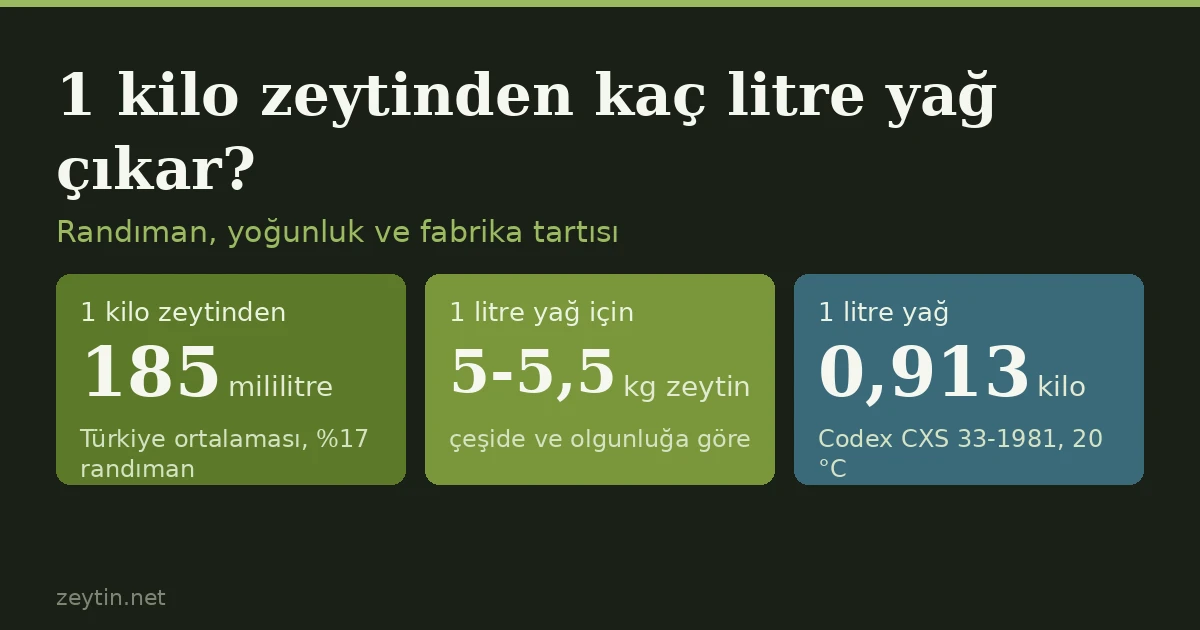
How much olive oil comes from one kilo of olives?
On the Turkish average, one kilo of olives gives around 170 grams of oil — about 185 millilitres. Put the other way round: a litre of oil needs 5 to 5.5 kilos of olives. Almost all the confusion in the calculation comes from treating kilos and litres as the same thing.
Article
How much olive oil comes from one kilo of olives?
On the Turkish average, one kilo of olives gives around 170 grams of oil — about 185 millilitres. Put the other way round: a litre of oil needs 5 to 5.5 kilos of olives. Almost all the confusion in the calculation comes from treating kilos and litres as the same thing.
 Article
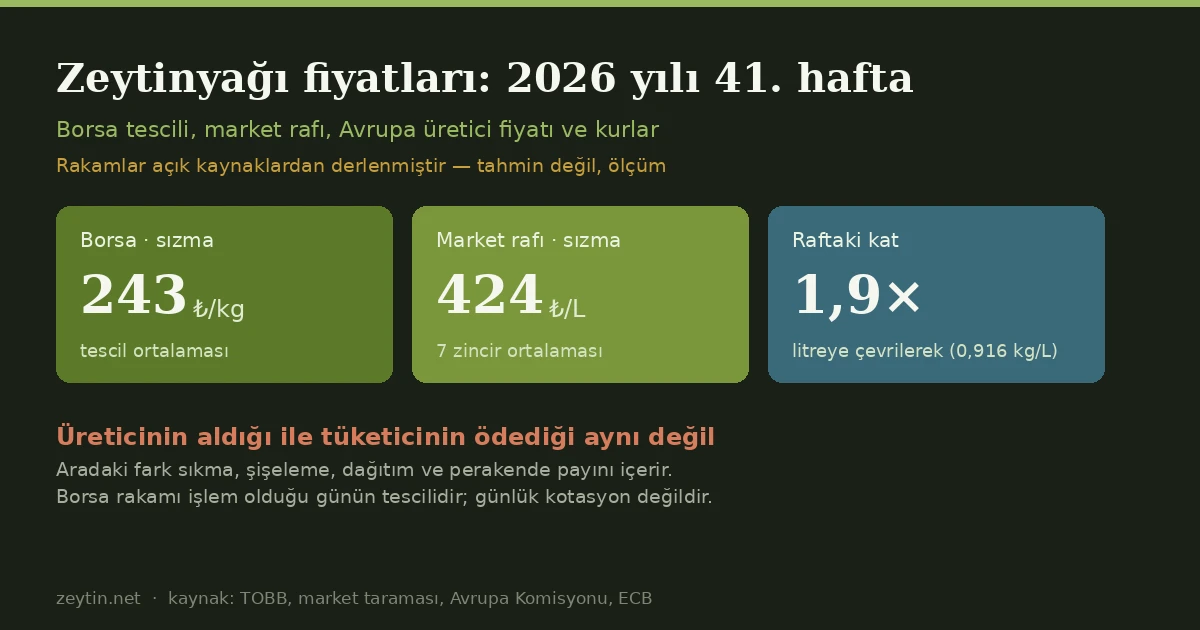
Olive Oil Prices: Week 41 of 2026
Week 41 of 2026: Turkish exchange prices, European producer prices and exchange rates side by side.
Article
Olive Oil Prices: Week 41 of 2026
Week 41 of 2026: Turkish exchange prices, European producer prices and exchange rates side by side.
 Article
Does olive oil have a use-by date? Best-before dates, shelf life and oil past its date
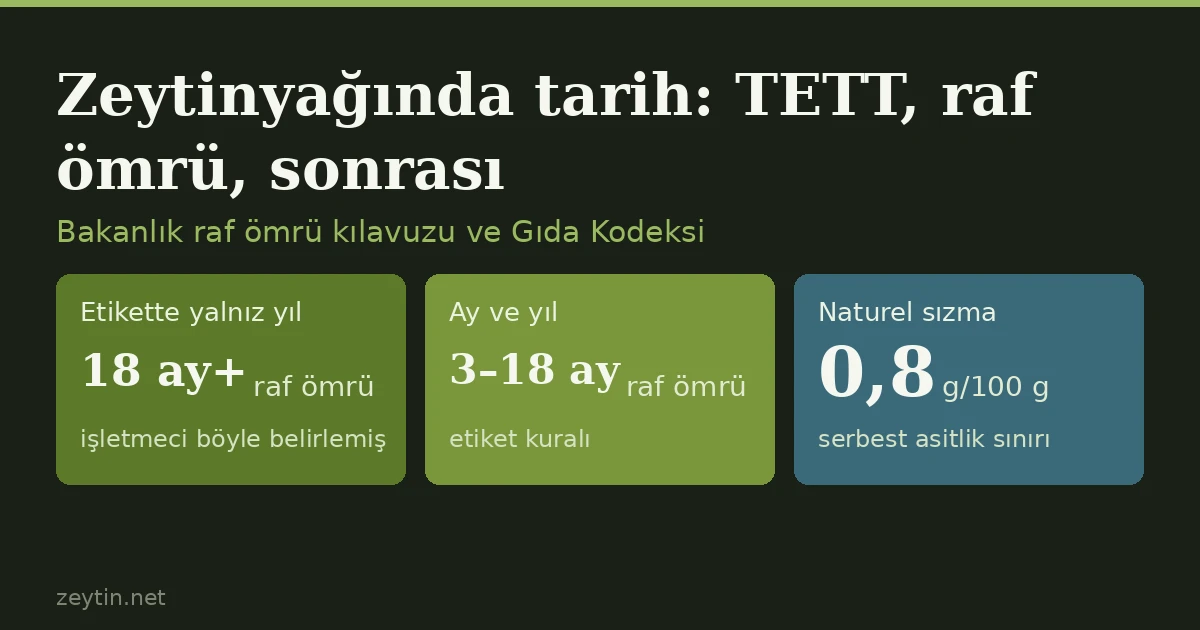
Olive oil carries a best-before date, not a use-by date. Under the Turkish ministry's shelf-life guideline, oil past that date may be consumed, sold or donated if it was stored properly and its appearance, smell and taste are normal. Shelf life is set by the operator rather than by legislation — and even the format of the date reveals how long it is.
Article
Does olive oil have a use-by date? Best-before dates, shelf life and oil past its date
Olive oil carries a best-before date, not a use-by date. Under the Turkish ministry's shelf-life guideline, oil past that date may be consumed, sold or donated if it was stored properly and its appearance, smell and taste are normal. Shelf life is set by the operator rather than by legislation — and even the format of the date reveals how long it is.
 Article
Does olive oil solidify in the fridge?
Olive oil solidifies in the fridge, but this is not a purity test: sunflower and canola oil do the same. The rate depends on variety and fatty acid composition.
Article
Does olive oil solidify in the fridge?
Olive oil solidifies in the fridge, but this is not a purity test: sunflower and canola oil do the same. The rate depends on variety and fatty acid composition.
 Article
Why is olive oil bitter and pungent? Is it spoiled, or is it good?
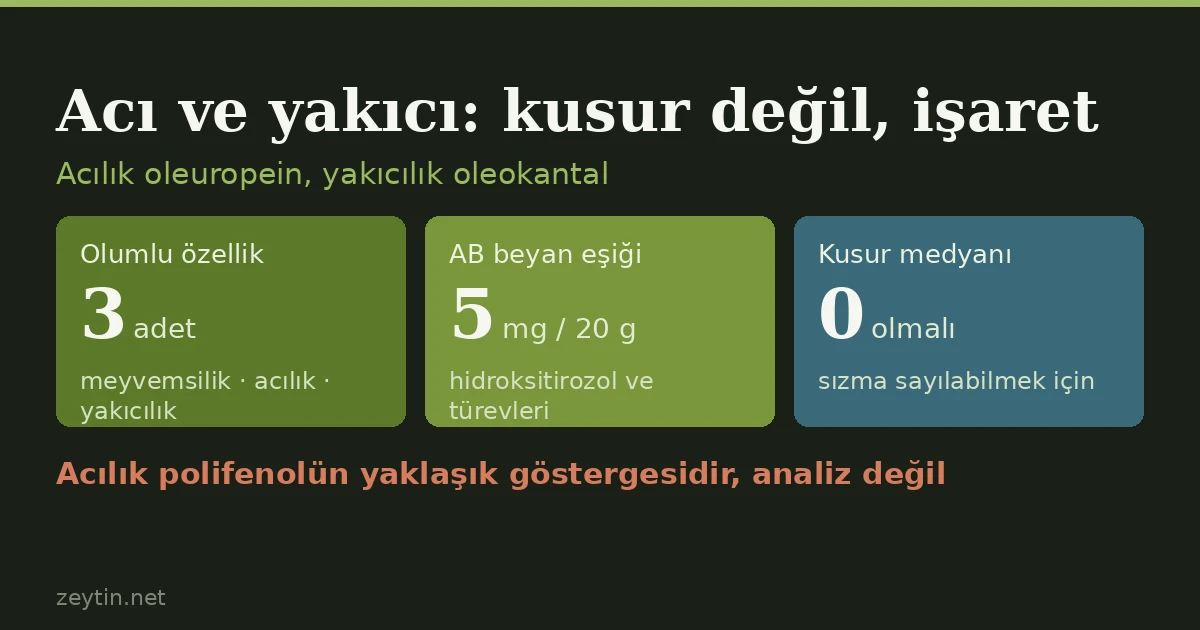
The bitterness and throat-catching pungency of freshly pressed olive oil is not a fault but a signal of polyphenols. Bitterness comes from oleuropein, pungency from oleocanthal, and both count as positive attributes in the international tasting standard. We also separate them from the defects they get confused with.
Article
Why is olive oil bitter and pungent? Is it spoiled, or is it good?
The bitterness and throat-catching pungency of freshly pressed olive oil is not a fault but a signal of polyphenols. Bitterness comes from oleuropein, pungency from oleocanthal, and both count as positive attributes in the international tasting standard. We also separate them from the defects they get confused with.
 Article
Olive Oil Prices: Week 40 of 2026
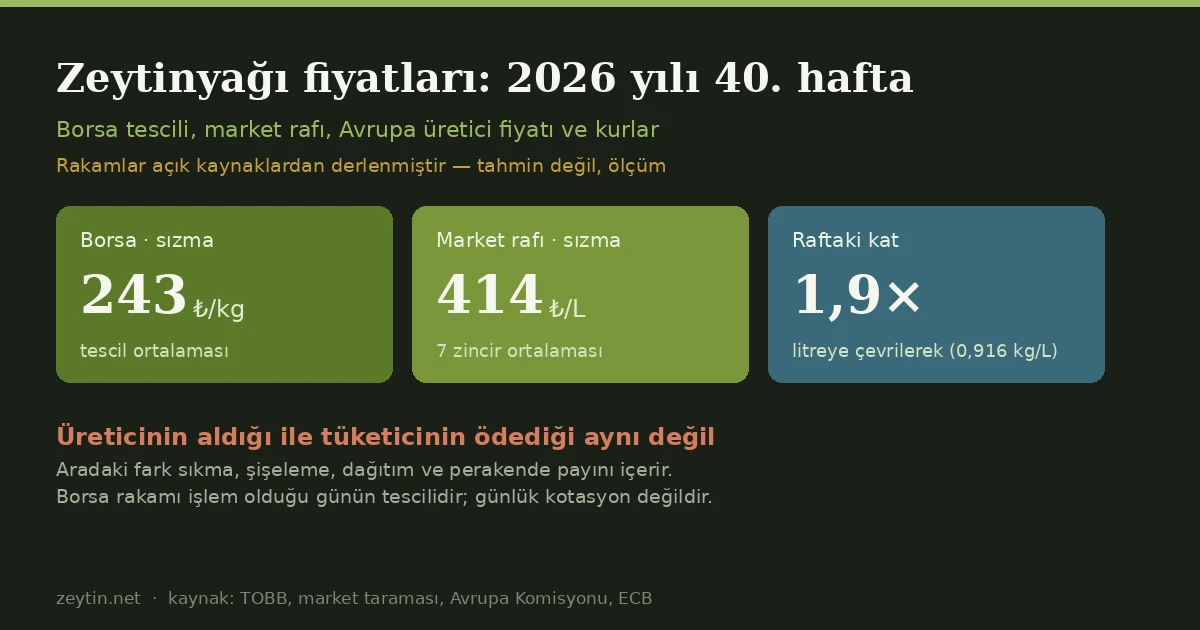
Week 40 of 2026: Turkish exchange prices, European producer prices and exchange rates side by side.
Article
Olive Oil Prices: Week 40 of 2026
Week 40 of 2026: Turkish exchange prices, European producer prices and exchange rates side by side.
 Article
How soon must harvested olives be pressed? What waiting writes into the oil
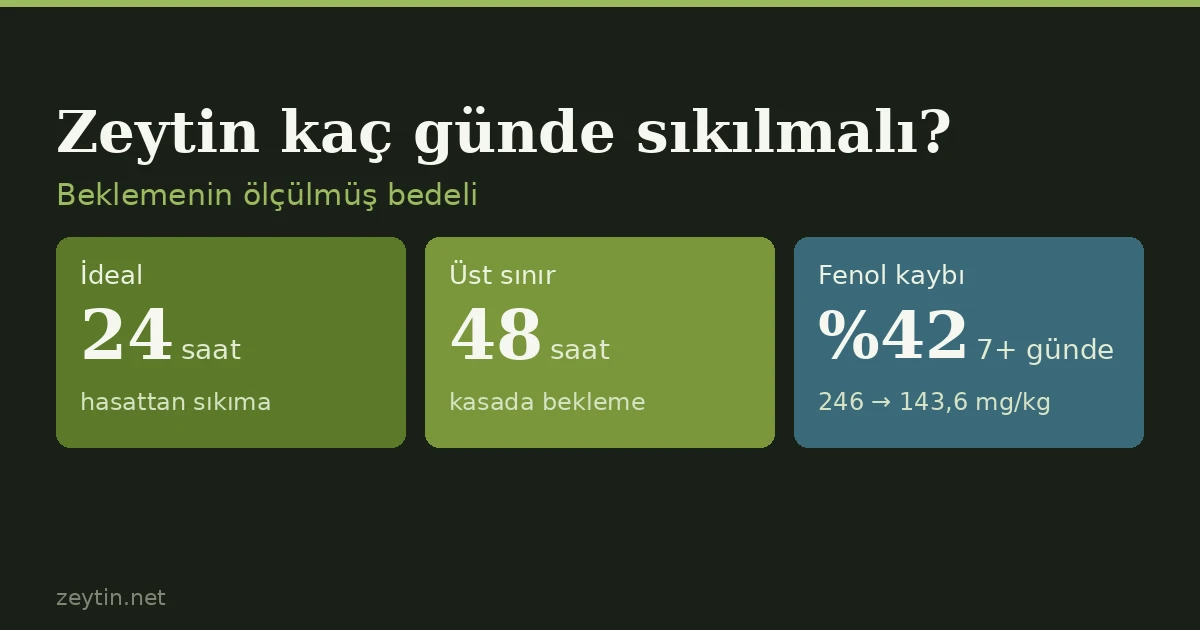
The right answer is 24 hours, with 48 as the outer limit. Measurements on 228 batches across seven mills show that olives left waiting lose 42% of their polyphenols, more than half of their green aroma and a third of their oxidative stability — even while staying inside the legal acidity limit. In an 'on' year, with mill queues lengthening, this is the grower's most critical call.
Article
How soon must harvested olives be pressed? What waiting writes into the oil
The right answer is 24 hours, with 48 as the outer limit. Measurements on 228 batches across seven mills show that olives left waiting lose 42% of their polyphenols, more than half of their green aroma and a third of their oxidative stability — even while staying inside the legal acidity limit. In an 'on' year, with mill queues lengthening, this is the grower's most critical call.
 Article
What is riviera olive oil? How it differs from extra virgin, and what the label means
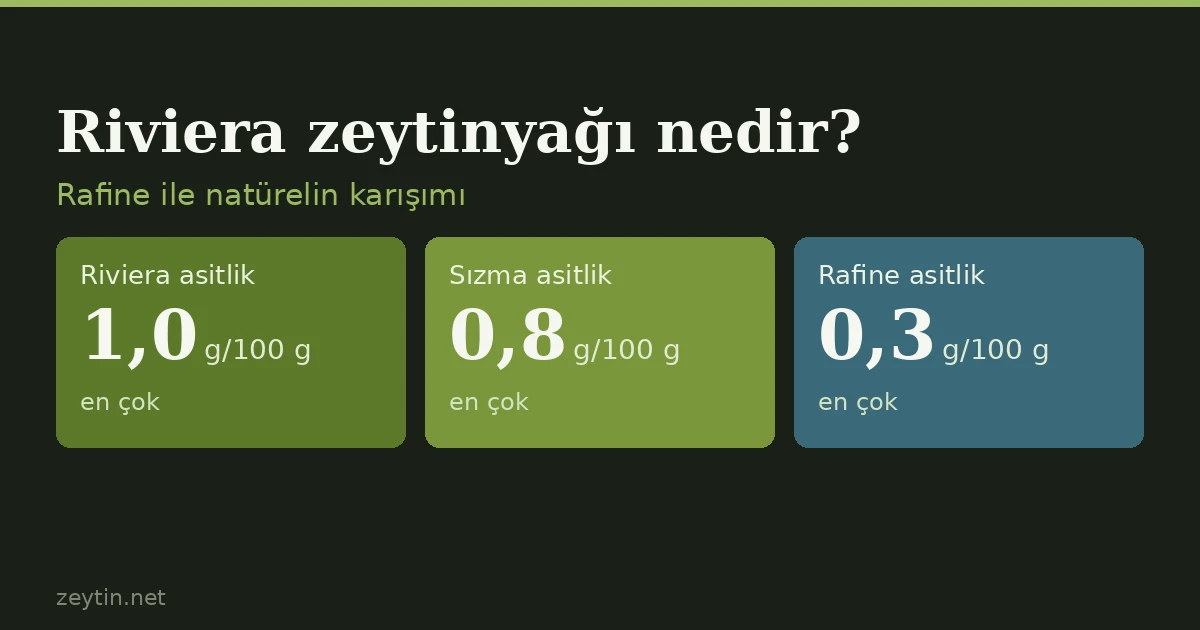
Riviera is not a grade of quality but the name of a blend: refined olive oil mixed with virgin olive oil fit for direct consumption. Under the Turkish Food Codex its free acidity may not exceed 1.0 and its peroxide value 15. What refining removes, what the label is obliged to say, and the real answer to the frying question.
Article
What is riviera olive oil? How it differs from extra virgin, and what the label means
Riviera is not a grade of quality but the name of a blend: refined olive oil mixed with virgin olive oil fit for direct consumption. Under the Turkish Food Codex its free acidity may not exceed 1.0 and its peroxide value 15. What refining removes, what the label is obliged to say, and the real answer to the frying question.
 Article
How to read an olive oil lab report: acidity, peroxide, K232, K270 and ΔK
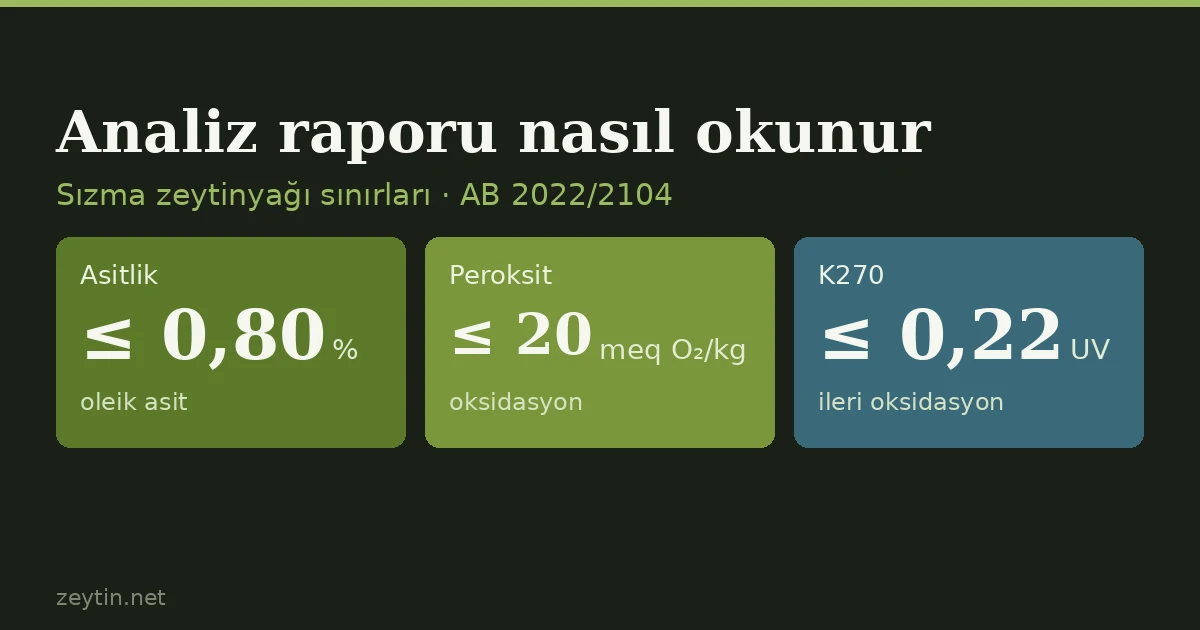
The rows of figures on an olive oil lab report look cryptic at first. What do free acidity, peroxide value, K232, K270, ΔK, ethyl esters and sensory analysis measure, what are the limits for extra virgin and virgin grades, and how do you interpret a report using a worked example?
Article
How to read an olive oil lab report: acidity, peroxide, K232, K270 and ΔK
The rows of figures on an olive oil lab report look cryptic at first. What do free acidity, peroxide value, K232, K270, ΔK, ethyl esters and sensory analysis measure, what are the limits for extra virgin and virgin grades, and how do you interpret a report using a worked example?
 Article
What to check when having your olives pressed at a mill: a grower's checklist
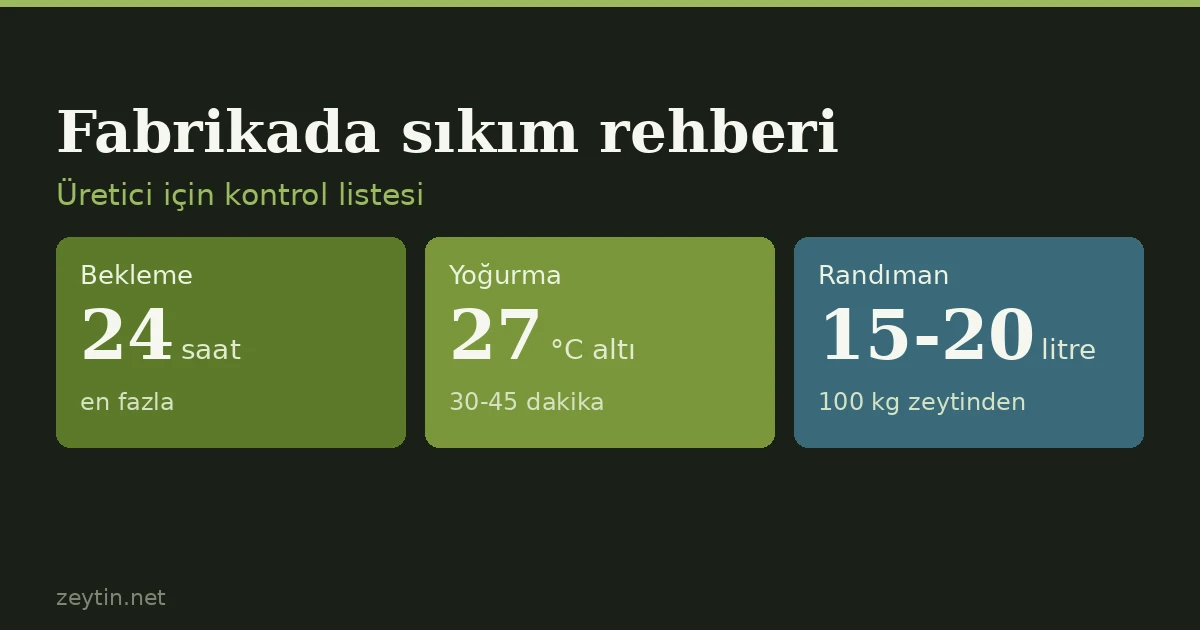
The same olives can give a very different oil when pressed at a different mill under different conditions. From what to do before bringing olives in to two-phase versus three-phase systems, kneading temperature, yield, milling fees and the questions to ask when collecting the oil, here is what a grower having olives pressed needs to know.
Article
What to check when having your olives pressed at a mill: a grower's checklist
The same olives can give a very different oil when pressed at a different mill under different conditions. From what to do before bringing olives in to two-phase versus three-phase systems, kneading temperature, yield, milling fees and the questions to ask when collecting the oil, here is what a grower having olives pressed needs to know.
 Article
Olive Oil Prices: Week 39 of 2026
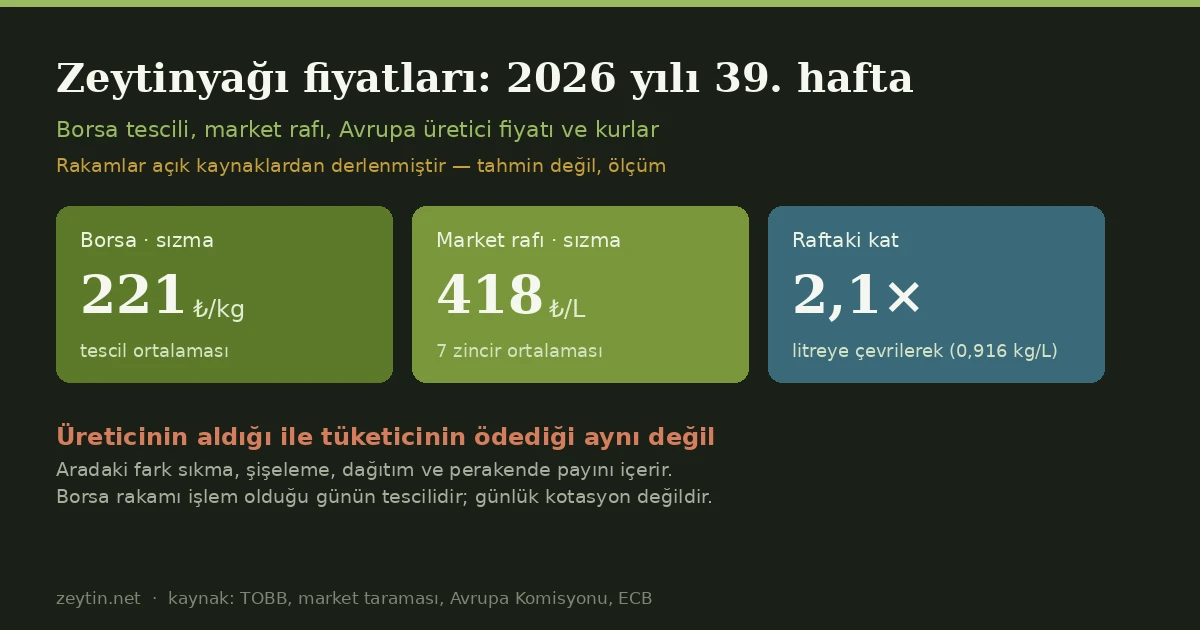
Week 39 of 2026: Turkish exchange prices, European producer prices and exchange rates side by side.
Article
Olive Oil Prices: Week 39 of 2026
Week 39 of 2026: Turkish exchange prices, European producer prices and exchange rates side by side.
 Article
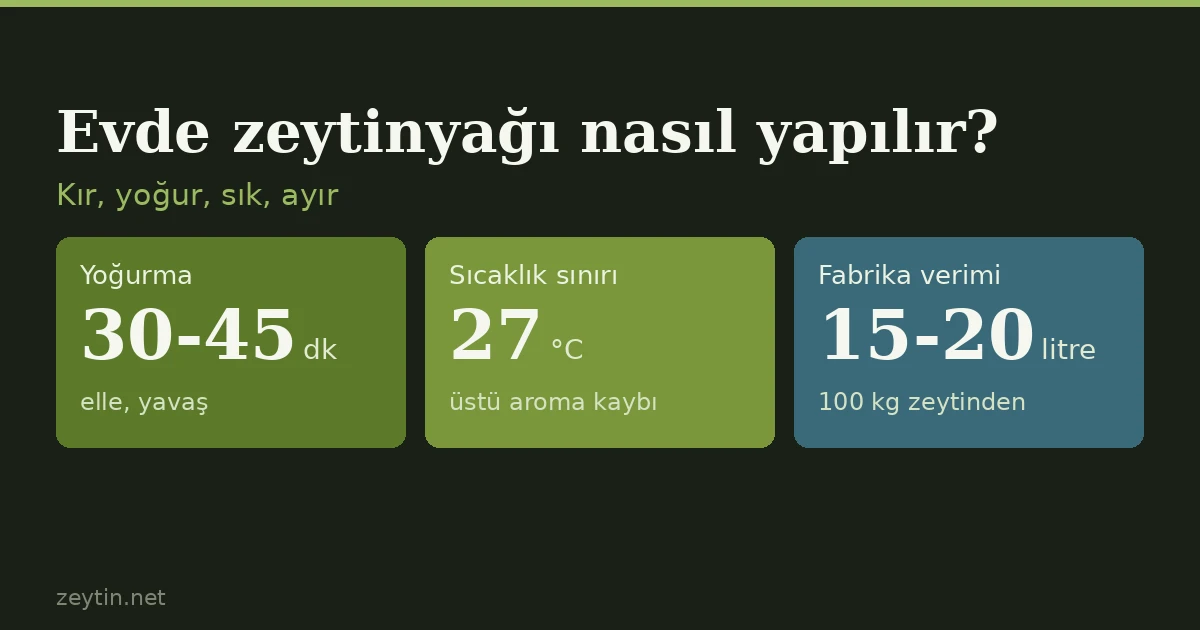
How to make olive oil at home: crushing, kneading, separating and realistic expectations
Pressing oil from a few kilos of olives at home is possible: the olives are crushed with their stones, the paste is kneaded, pressed and left until the oil separates from the water. But yield stays well below a mill's and quality is hard to protect. The steps, the equipment and the limits.
Article
How to make olive oil at home: crushing, kneading, separating and realistic expectations
Pressing oil from a few kilos of olives at home is possible: the olives are crushed with their stones, the paste is kneaded, pressed and left until the oil separates from the water. But yield stays well below a mill's and quality is hard to protect. The steps, the equipment and the limits.
 Article
How to store freshly pressed olive oil: settling, sediment and the right container
Oil fresh from the mill is cloudy and contains water and fruit particles. It is left to settle for a few weeks somewhere cool and dark in a container filled to the top, then the clear oil is separated from the sediment and moved into tins or dark glass. Oil left sitting on its sediment for months spoils.
Article
How to store freshly pressed olive oil: settling, sediment and the right container
Oil fresh from the mill is cloudy and contains water and fruit particles. It is left to settle for a few weeks somewhere cool and dark in a container filled to the top, then the clear oil is separated from the sediment and moved into tins or dark glass. Oil left sitting on its sediment for months spoils.
 Article
What are zeytinyağlılar? The logic of Turkish dishes cooked in olive oil
Zeytinyağlılar are Turkish dishes in which vegetables or pulses are cooked with little water in plenty of olive oil until they absorb their own juices, then eaten cold at room temperature. They contain no meat, can be made a day ahead and taste better the next day. Vegetable dishes, stuffed leaves and vegetables, pilaki beans and Aegean wild greens are the four main families.
Article
What are zeytinyağlılar? The logic of Turkish dishes cooked in olive oil
Zeytinyağlılar are Turkish dishes in which vegetables or pulses are cooked with little water in plenty of olive oil until they absorb their own juices, then eaten cold at room temperature. They contain no meat, can be made a day ahead and taste better the next day. Vegetable dishes, stuffed leaves and vegetables, pilaki beans and Aegean wild greens are the four main families.
 Article
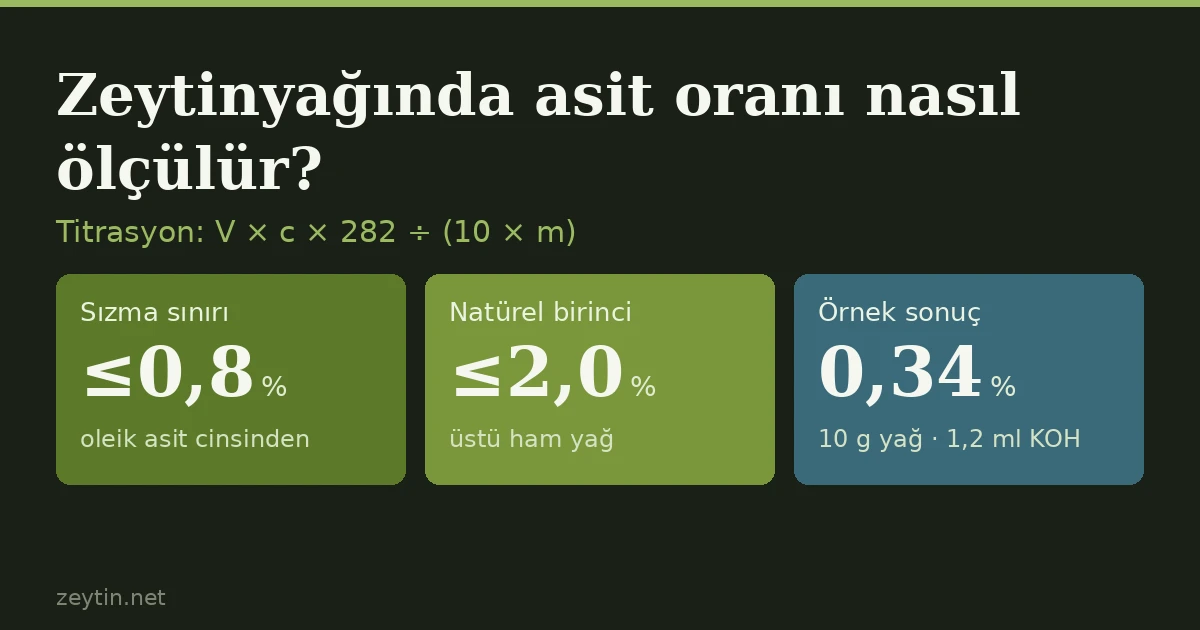
How is olive oil acidity measured? Titration, the formula and taking a sample
Olive oil acidity is measured in a laboratory by titration: the oil is dissolved in a solvent, free fatty acids are neutralised with potassium hydroxide, and the percentage is calculated as oleic acid from the amount used. The formula, a worked example, sampling and the limits of home test kits.
Article
How is olive oil acidity measured? Titration, the formula and taking a sample
Olive oil acidity is measured in a laboratory by titration: the oil is dissolved in a solvent, free fatty acids are neutralised with potassium hydroxide, and the percentage is calculated as oleic acid from the amount used. The formula, a worked example, sampling and the limits of home test kits.
 Article
What is a malaxer? The tank where olive paste is kneaded, and the 27 °C limit
A malaxer is the stainless steel kneading tank where crushed olive paste is slowly mixed so that oil droplets can merge. Time and temperature decide both yield and aroma, and this is also where the limit for "cold extraction" is drawn.
Article
What is a malaxer? The tank where olive paste is kneaded, and the 27 °C limit
A malaxer is the stainless steel kneading tank where crushed olive paste is slowly mixed so that oil droplets can merge. Time and temperature decide both yield and aroma, and this is also where the limit for "cold extraction" is drawn.
 Article
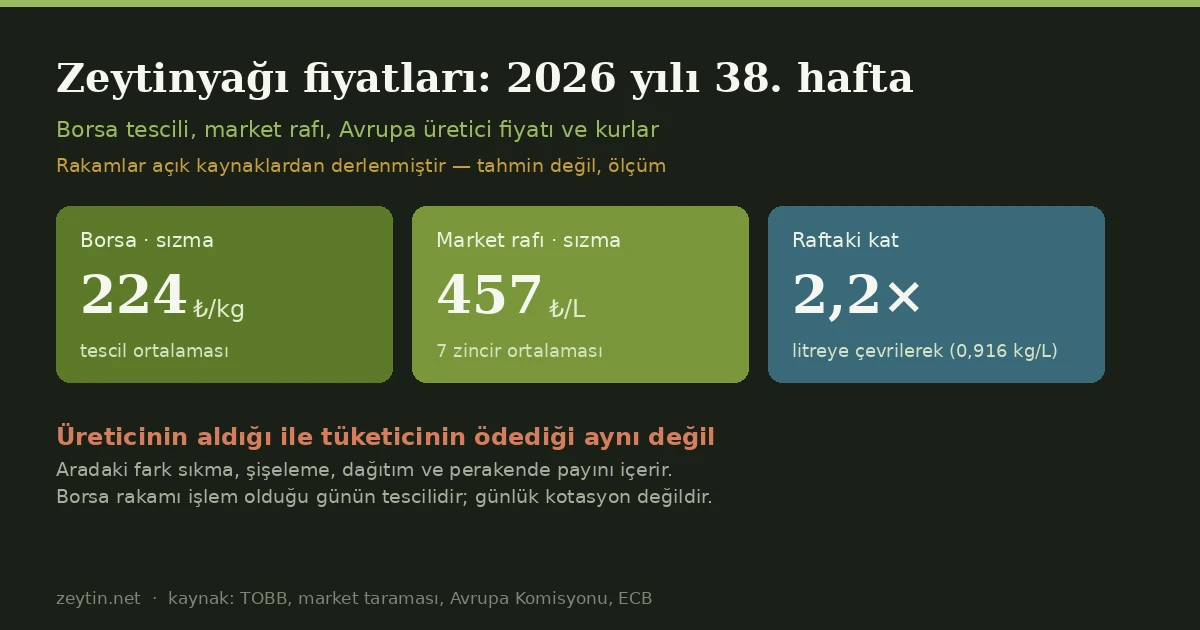
Olive Oil Prices: Week 38 of 2026
Week 38 of 2026: Turkish exchange prices, European producer prices and exchange rates side by side.
Article
Olive Oil Prices: Week 38 of 2026
Week 38 of 2026: Turkish exchange prices, European producer prices and exchange rates side by side.
 Article
Tasting olive oil: defects and positive attributes
Laboratory tests alone do not make an oil extra virgin — it must pass a tasting panel. The three positive attributes, the six defects in the standard, and what each one says about how the oil was made.
Article
Tasting olive oil: defects and positive attributes
Laboratory tests alone do not make an oil extra virgin — it must pass a tasting panel. The three positive attributes, the six defects in the standard, and what each one says about how the oil was made.
 Article
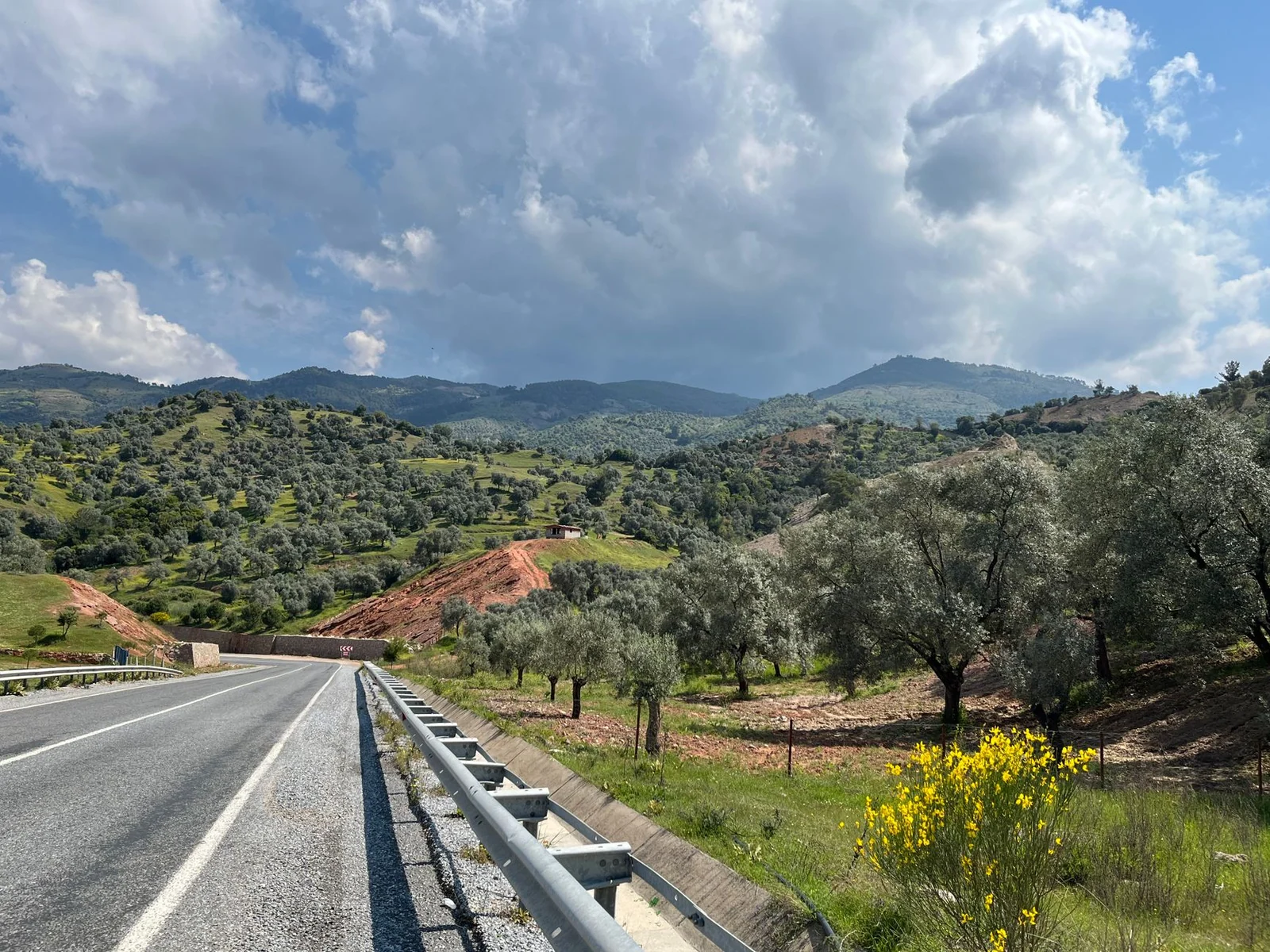
Güney Ege Olive Oils: a designation of origin across three provinces
Registration no 79, published in the Official Gazette in 2004, covers more than thirty-three districts across İzmir, Aydın and Muğla. The reasoning is not administrative but varietal: the region holds almost all of Türkiye's Memecik trees.
Article
Güney Ege Olive Oils: a designation of origin across three provinces
Registration no 79, published in the Official Gazette in 2004, covers more than thirty-three districts across İzmir, Aydın and Muğla. The reasoning is not administrative but varietal: the region holds almost all of Türkiye's Memecik trees.
 Article
Tarsus Sarıulak Olive Oil: milling required immediately after harvest
Registered in 2020. The certificate ties product quality to one condition: the olives must be milled as soon as they are picked. Peroxide averages 8.23.
Article
Tarsus Sarıulak Olive Oil: milling required immediately after harvest
Registered in 2020. The certificate ties product quality to one condition: the olives must be milled as soon as they are picked. Peroxide averages 8.23.
 Article
Ödemiş Çekişte Olive Oil: a separate harvest window called “çakır”
Registered in 2020. The certificate names two harvest windows: early (green, November-December) and “çakır” (green turning pink, mid-December to mid-January).
Article
Ödemiş Çekişte Olive Oil: a separate harvest window called “çakır”
Registered in 2020. The certificate names two harvest windows: early (green, November-December) and “çakır” (green turning pink, mid-December to mid-January).
 Article
Soma Olive Oil: how a cooler climate lifts yield in a lignite basin
Registered in 2023. Mean temperature 15.3 °C; the certificate ties that relative coolness to yields reaching 796 kg/da. Free acidity 0.18-0.55.
Article
Soma Olive Oil: how a cooler climate lifts yield in a lignite basin
Registered in 2023. Mean temperature 15.3 °C; the certificate ties that relative coolness to yields reaching 796 kg/da. Free acidity 0.18-0.55.
 Article
Osmaniye Olive Oil: a registration with sensory thresholds above six
Registered in 2022. Fruitiness ≥6.4, bitterness ≥6.0, pungency ≥6.1 — unusually high thresholds. Milling within 48 hours of harvest is required.
Article
Osmaniye Olive Oil: a registration with sensory thresholds above six
Registered in 2022. Fruitiness ≥6.4, bitterness ≥6.0, pungency ≥6.1 — unusually high thresholds. Milling within 48 hours of harvest is required.
 Article
Geyikli Olive Oil: a registration that names its pollinators
Registered in 2020. From the Ayvalık cultivar; the certificate also records Gemlik and Hanım Parmağı as pollinators in the groves. Limits are set on 16 aroma compounds.
Article
Geyikli Olive Oil: a registration that names its pollinators
Registered in 2020. From the Ayvalık cultivar; the certificate also records Gemlik and Hanım Parmağı as pollinators in the groves. Limits are set on 16 aroma compounds.
 Article
Erdek Kapıdağ Olive Oil: an oil whose grade changes in dry years
Registered in 2024. The certificate admits something rare: in dry periods the oil can fall from extra virgin to virgin grade.
Article
Erdek Kapıdağ Olive Oil: an oil whose grade changes in dry years
Registered in 2024. The certificate admits something rare: in dry periods the oil can fall from extra virgin to virgin grade.
 Article
Nizip Olive Oil: a registration that sets a floor for its raw material
Registered in 2011. The certificate sets conditions on the fruit, not just the oil: 15-17 mm wide, 19-20 mm long, at least 25% oil. Fruit outside that cannot be used.
Article
Nizip Olive Oil: a registration that sets a floor for its raw material
Registered in 2011. The certificate sets conditions on the fruit, not just the oil: 15-17 mm wide, 19-20 mm long, at least 25% oil. Fruit outside that cannot be used.
 Article
Kilis Olive Oil: a cultivar reaching 33% oil
Registered in 2020. The Kilis Yağlık cultivar runs about 33% oil, far above the Turkish average. Small round fruit, thin skin, small stone.
Article
Kilis Olive Oil: a cultivar reaching 33% oil
Registered in 2020. The Kilis Yağlık cultivar runs about 33% oil, far above the Turkish average. Small round fruit, thin skin, small stone.
 Article
Edincik Su Olive Oil: ripening slowed by the sea
Registered in 2024. The certificate attributes aroma intensity to one cause: near the Erdek gulf the olives develop slowly and ripen late.
Article
Edincik Su Olive Oil: ripening slowed by the sea
Registered in 2024. The certificate attributes aroma intensity to one cause: near the Erdek gulf the olives develop slowly and ripen late.
 Article
Edremit Olive Oil: thirteen separate fruity perceptions listed
Registered in 2017. The certificate lists thirteen fruity perceptions, from green almond to banana skin. At least one must be present at low or medium intensity.
Article
Edremit Olive Oil: thirteen separate fruity perceptions listed
Registered in 2017. The certificate lists thirteen fruity perceptions, from green almond to banana skin. At least one must be present at low or medium intensity.
 Article
Derik Halhalı Olive Oil: a burn reminiscent of red pepper
Registered in 2022. Low acidity (0.29-0.60%) and high phenols; the certificate describes the pungency directly — a lasting burn spreading over tongue and lips.
Article
Derik Halhalı Olive Oil: a burn reminiscent of red pepper
Registered in 2022. Low acidity (0.29-0.60%) and high phenols; the certificate describes the pungency directly — a lasting burn spreading over tongue and lips.
 Article
Ceyhan Olive Oil: harvest defined as “no green fruit left on the tree”
Registered in 2022. The certificate defines harvest not by calendar but by the state of the tree: when no green fruit remains and oil content peaks.
Article
Ceyhan Olive Oil: harvest defined as “no green fruit left on the tree”
Registered in 2022. The certificate defines harvest not by calendar but by the state of the tree: when no green fruit remains and oil content peaks.
 Article
Aydın Memecik Olive Oil: bitterness and pungency written into the definition
Registered in 2020. Total phenols > 100 mg/kg, peroxide ≤ 18, defect median 0. Intense fruit aroma with pronounced bitterness and pungency.
Article
Aydın Memecik Olive Oil: bitterness and pungency written into the definition
Registered in 2020. Total phenols > 100 mg/kg, peroxide ≤ 18, defect median 0. Intense fruit aroma with pronounced bitterness and pungency.
 Article
Bayramiç Olive Oil: aroma compounds defined as percentages
Registered in 2022. The certificate defines aroma by compound rather than adjective: hexanal 36.15%, E-2-hexenal 26.14%. Iodine value 80-93.
Article
Bayramiç Olive Oil: aroma compounds defined as percentages
Registered in 2022. The certificate defines aroma by compound rather than adjective: hexanal 36.15%, E-2-hexenal 26.14%. Iodine value 80-93.
 Article
Burhaniye Olive Oil: two thousand years attested by the Adramytteion excavations
Registered in 2021. The certificate grounds two thousand years of olive growing in the excavation of an ancient city, and sets separate sensory thresholds for early and ripe harvest.
Article
Burhaniye Olive Oil: two thousand years attested by the Adramytteion excavations
Registered in 2021. The certificate grounds two thousand years of olive growing in the excavation of an ancient city, and sets separate sensory thresholds for early and ripe harvest.
 Article
Akhisar Uslu Olive Oil: oil from a black table cultivar
Registered in 2017. Uslu is principally a table cultivar; the certificate protects its oil separately. β-sitosterol sits in a very narrow 87.36-87.39% band.
Article
Akhisar Uslu Olive Oil: oil from a black table cultivar
Registered in 2017. Uslu is principally a table cultivar; the certificate protects its oil separately. β-sitosterol sits in a very narrow 87.36-87.39% band.
 Article
Akhisar Domat Olive Oil: stricter limits than its twin
Registered in 2017. Set against the Uslu oil registered the same day the difference is clear: peroxide ≤17 and acidity ≤0.65, both narrower.
Article
Akhisar Domat Olive Oil: stricter limits than its twin
Registered in 2017. Set against the Uslu oil registered the same day the difference is clear: peroxide ≤17 and acidity ≤0.65, both narrower.
 Article
Altınözü Olive Oil: one oil from four cultivars
Registered in 2019. Halhalı, Saurani, Sarı Haşebi and Karamani are processed together. Alpha-tocopherol spans a wide 51.6-387.4 mg/kg.
Article
Altınözü Olive Oil: one oil from four cultivars
Registered in 2019. Halhalı, Saurani, Sarı Haşebi and Karamani are processed together. Alpha-tocopherol spans a wide 51.6-387.4 mg/kg.
 Article
Mut Olive Oil: a landscape that needs no pesticide
The certificate's real claim rests on altitude and humidity: 10-40% relative humidity keeps out both the olive fly and peacock spot. That is why organic production is straightforward here.
Article
Mut Olive Oil: a landscape that needs no pesticide
The certificate's real claim rests on altitude and humidity: 10-40% relative humidity keeps out both the olive fly and peacock spot. That is why organic production is straightforward here.
 Article
Milas Olive Oil: a press bed dated to 2000 BC
Registered in the European Union as well. The certificate's archaeological anchor is a press bed cut into rock at Pilavtepe — four thousand years old.
Article
Milas Olive Oil: a press bed dated to 2000 BC
Registered in the European Union as well. The certificate's archaeological anchor is a press bed cut into rock at Pilavtepe — four thousand years old.
 Article
North Aegean Olive Oils: a registration stricter than the food codex
The mark of ten localities rather than one district — and unusually, it sets tighter limits than the national standard on peroxide, FAEE, waxes and K270.
Article
North Aegean Olive Oils: a registration stricter than the food codex
The mark of ten localities rather than one district — and unusually, it sets tighter limits than the national standard on peroxide, FAEE, waxes and K270.
 Article
The Ayvalık Olive Oil designation of origin: the chemical profile in the certificate
Registered in 2007. The certificate carries tables of fatty acids, sterols and phenolics — the ranges within which an oil counts as Ayvalık Olive Oil are set out in figures.
Article
The Ayvalık Olive Oil designation of origin: the chemical profile in the certificate
Registered in 2007. The certificate carries tables of fatty acids, sterols and phenolics — the ranges within which an oil counts as Ayvalık Olive Oil are set out in figures.
 Article
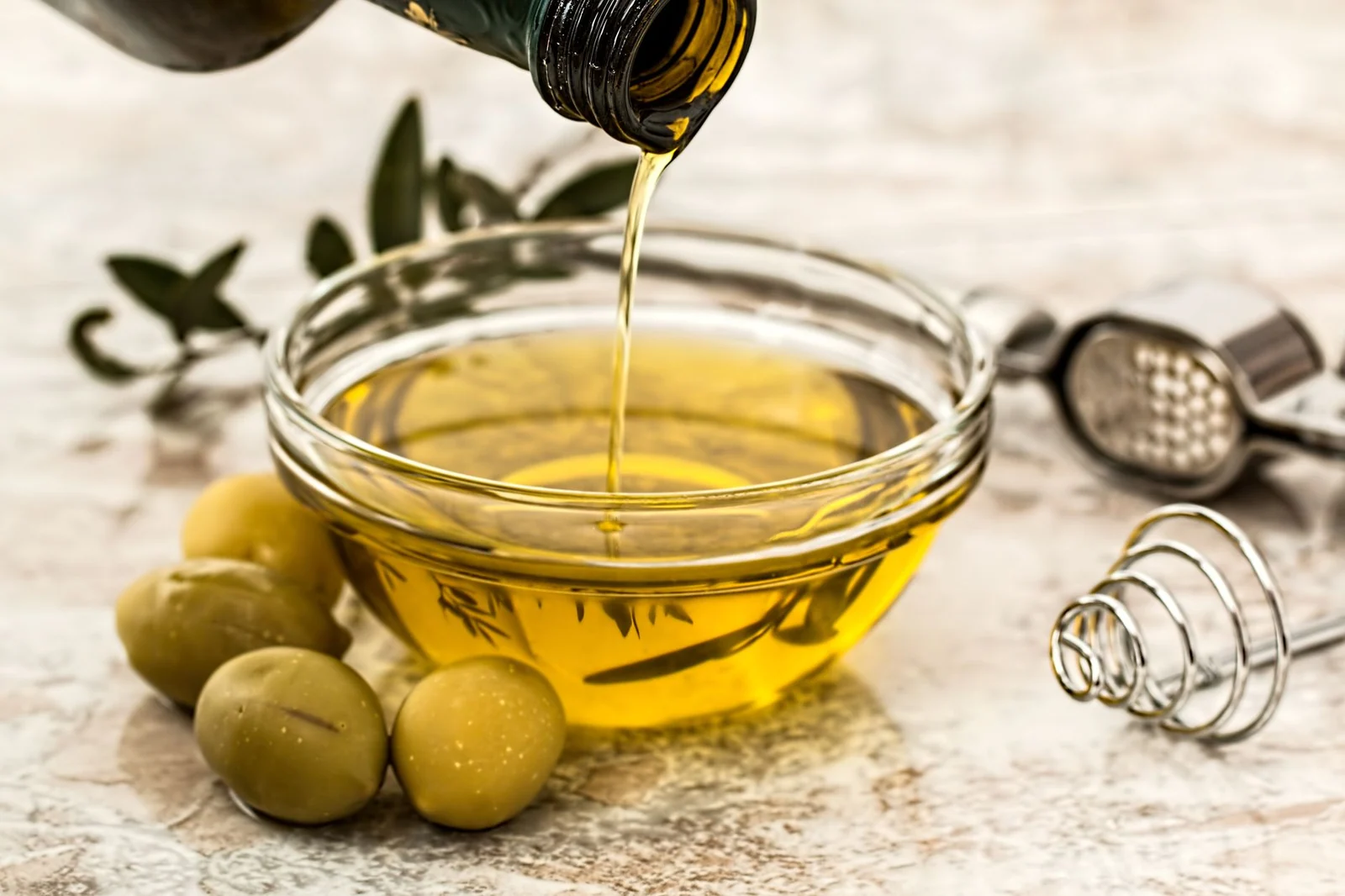
Which olive oil is the best quality?
The three measures that decide olive oil quality: grade, acidity and harvest year, plus how to read a label.
Article
Which olive oil is the best quality?
The three measures that decide olive oil quality: grade, acidity and harvest year, plus how to read a label.
 Article
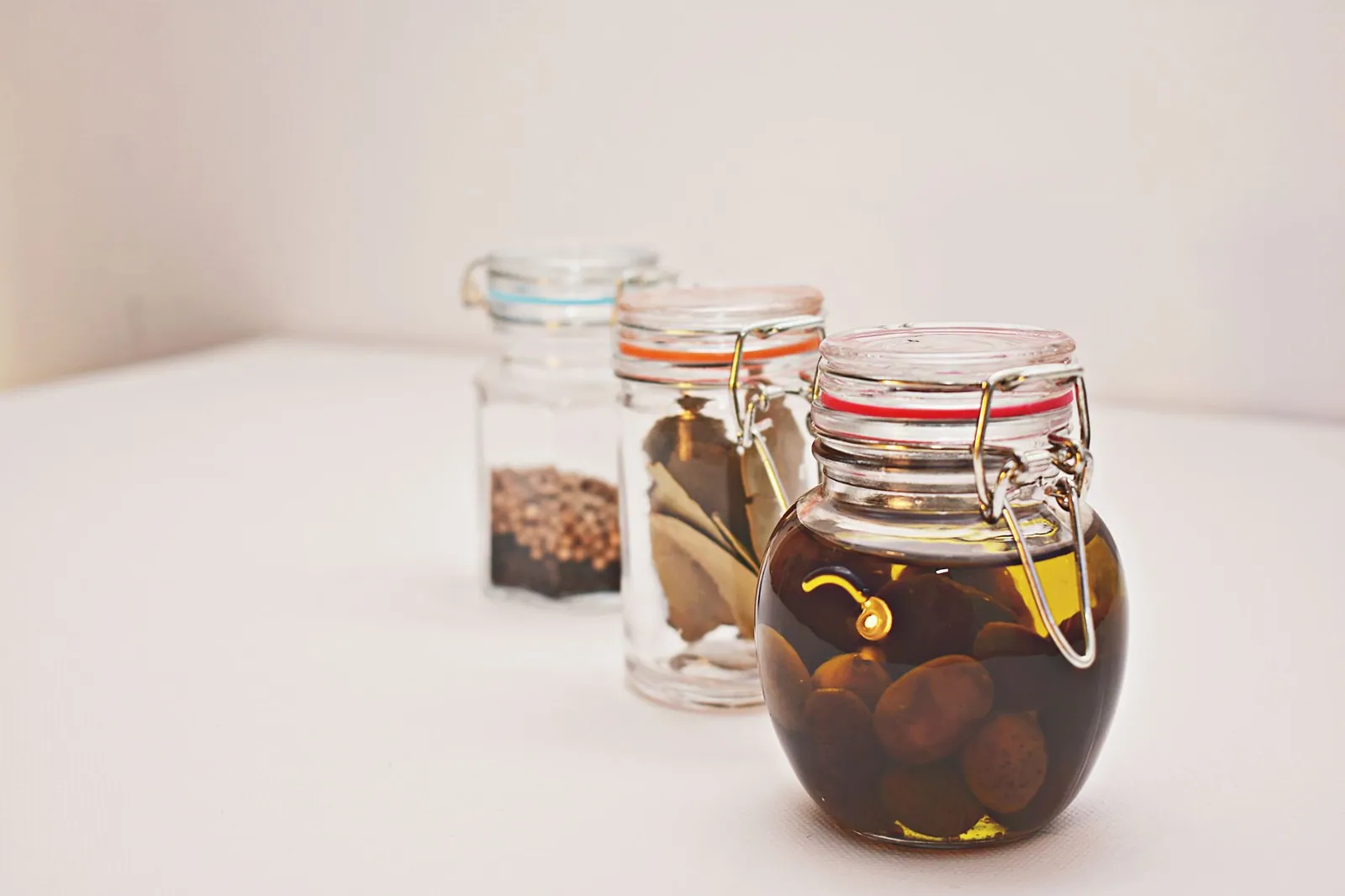
How to Store Olive Oil
Light, heat, air and time — the four enemies of olive oil. Why the bottle next to your stove is in the worst possible place.
Article
How to Store Olive Oil
Light, heat, air and time — the four enemies of olive oil. Why the bottle next to your stove is in the worst possible place.
 Article
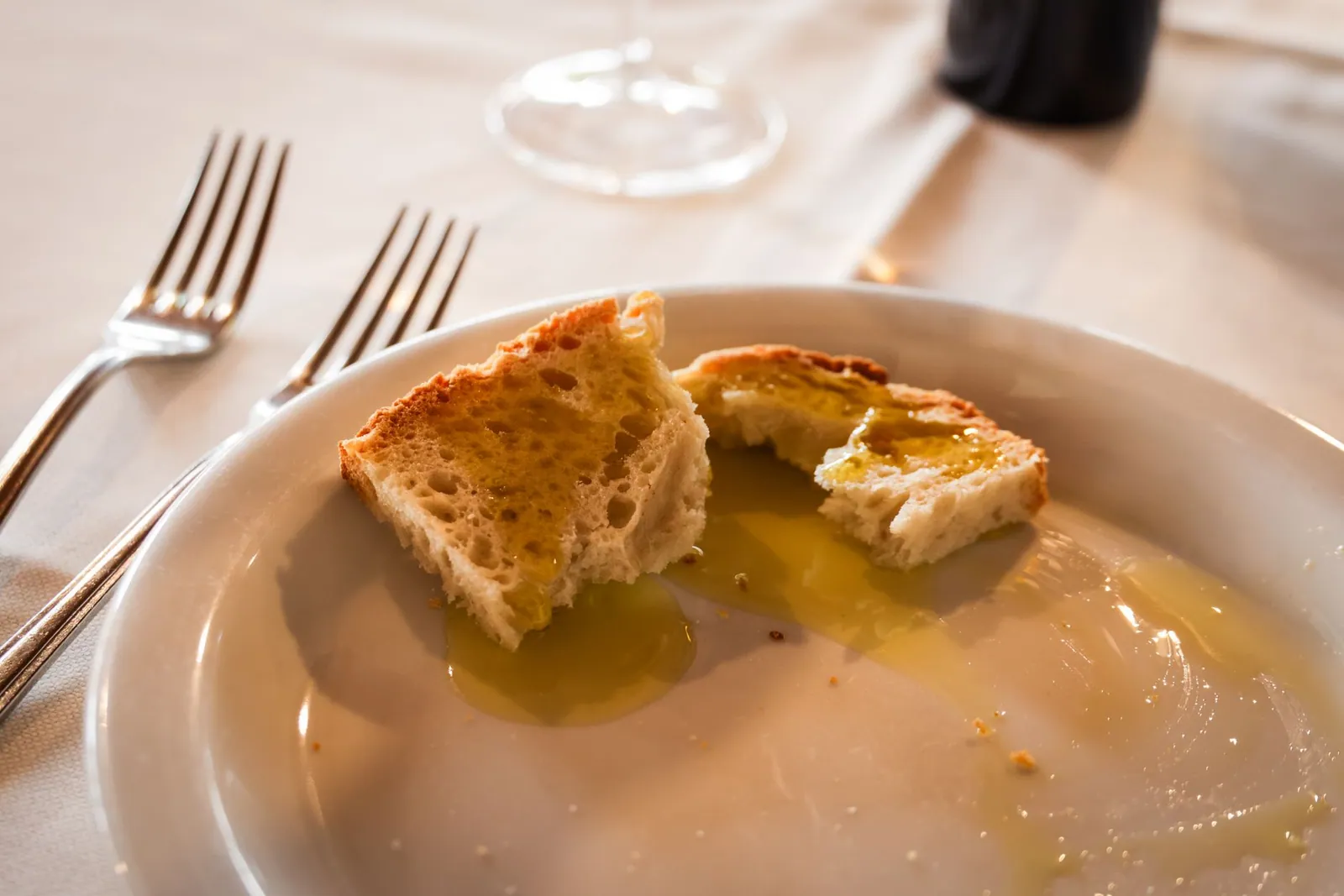
How to Tell Good Olive Oil
Bitterness is a mark of quality, not a defect. Colour tells you nothing. The three attributes tasting panels look for, and a simple test at home.
Article
How to Tell Good Olive Oil
Bitterness is a mark of quality, not a defect. Colour tells you nothing. The three attributes tasting panels look for, and a simple test at home.
 Article
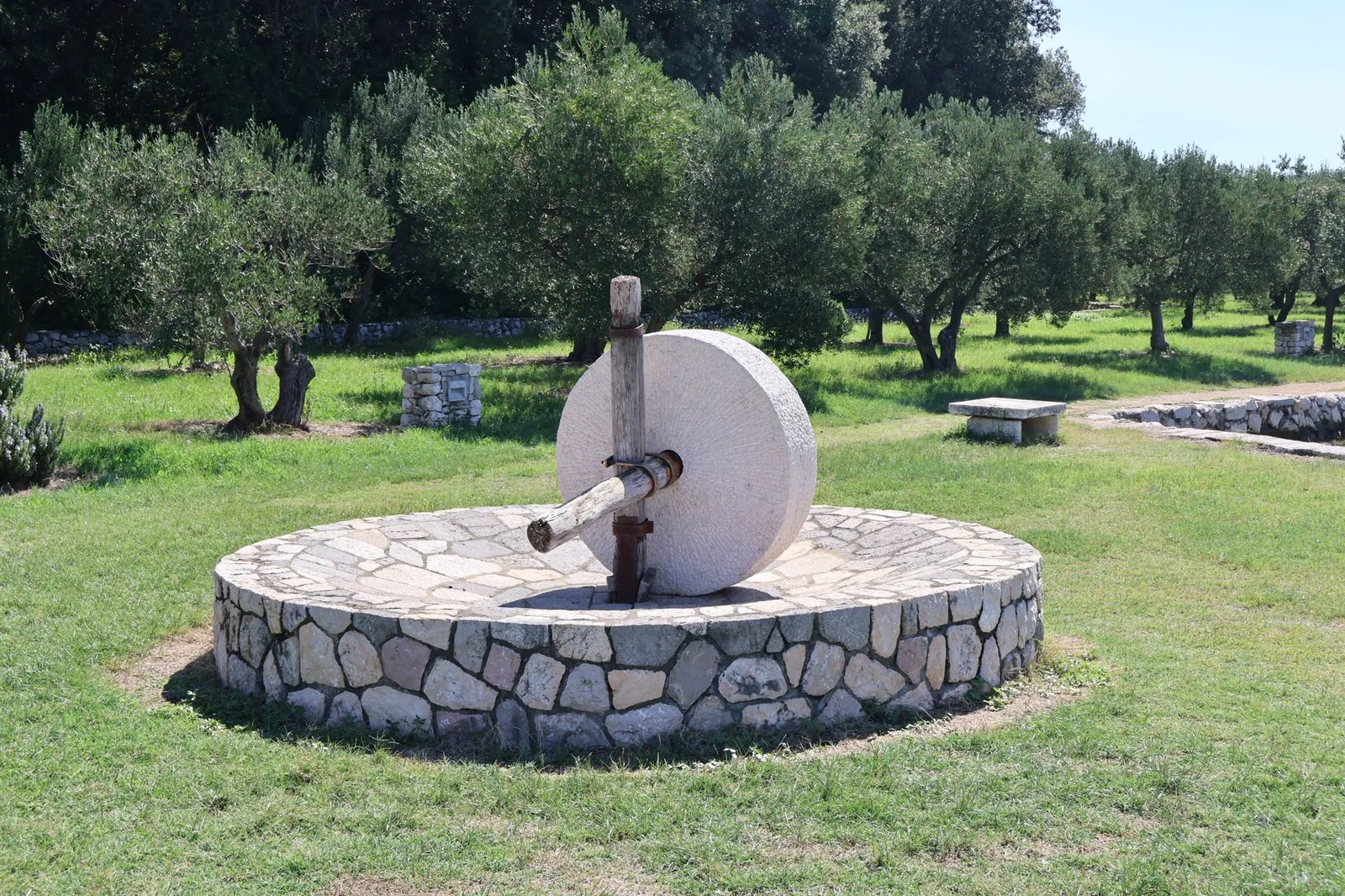
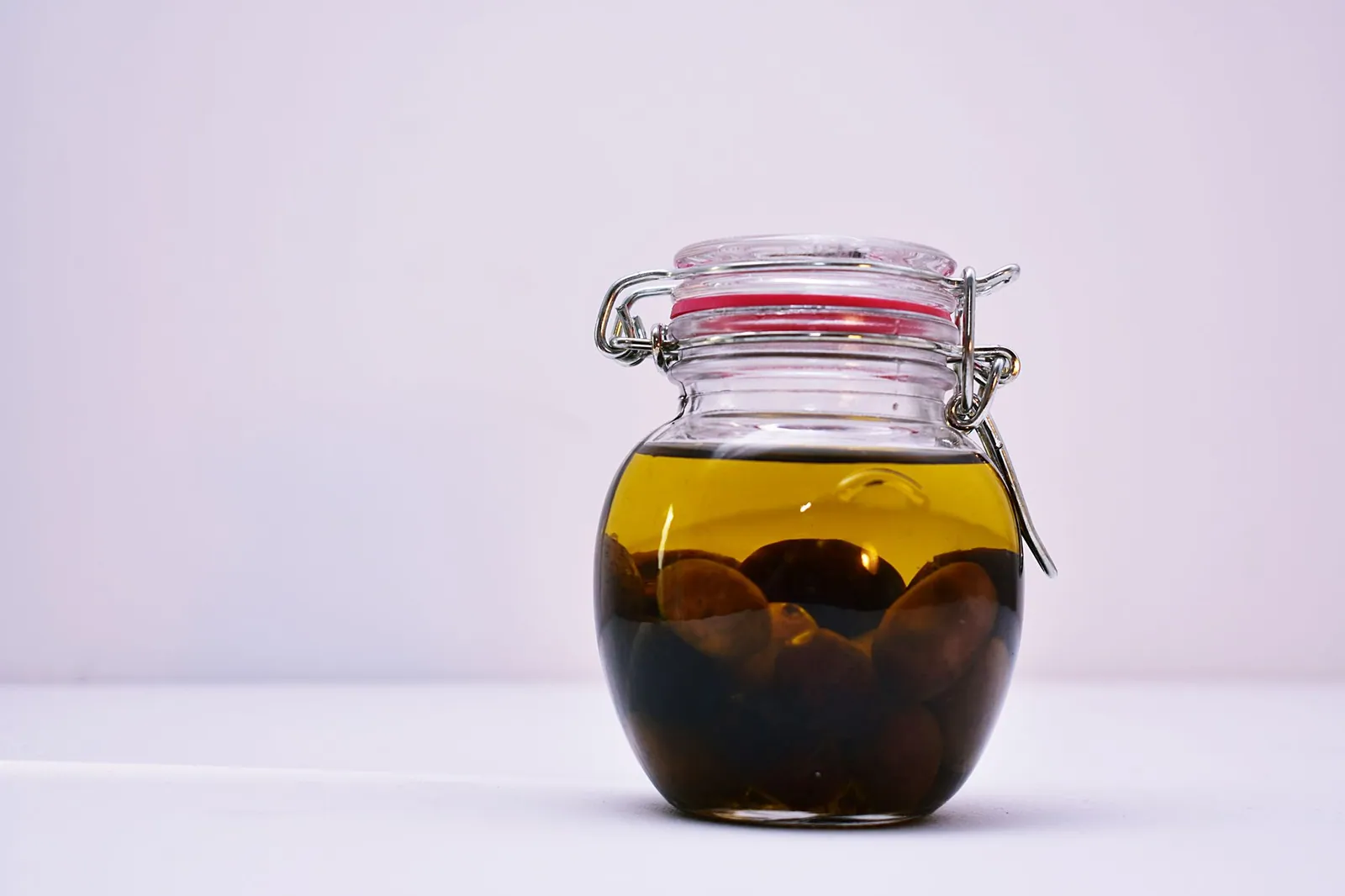
How Cold-Pressed Olive Oil Is Made
From tree to bottle: washing, crushing, malaxation and separation. Why the temperature must stay below 27°C.
Article
How Cold-Pressed Olive Oil Is Made
From tree to bottle: washing, crushing, malaxation and separation. Why the temperature must stay below 27°C.
 Article
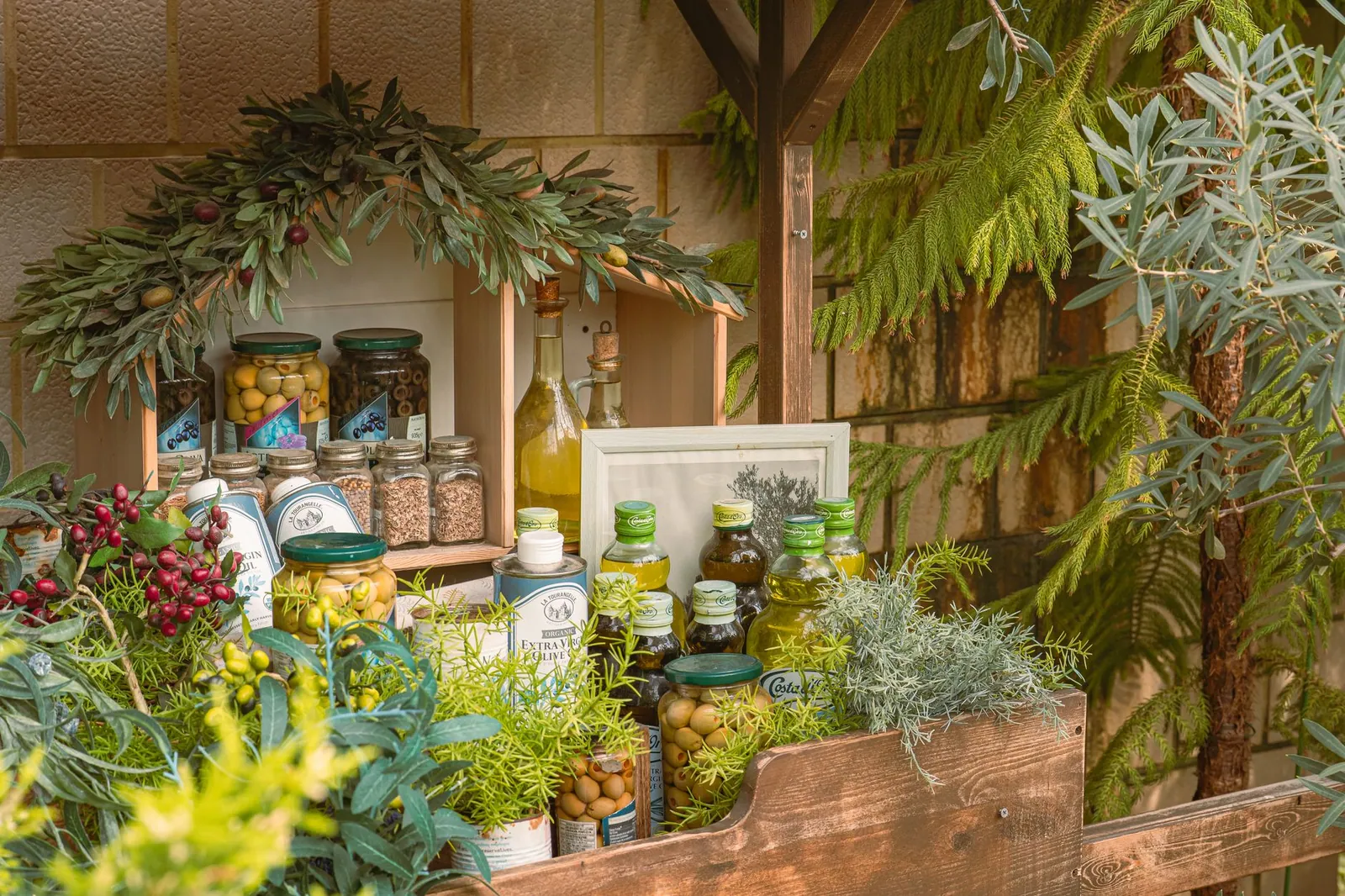
What Does Acidity Mean in Olive Oil?
The 0.3% or 0.8% on the label has nothing to do with sour taste. Acidity tells you the condition of the fruit before pressing.
Article
What Does Acidity Mean in Olive Oil?
The 0.3% or 0.8% on the label has nothing to do with sour taste. Acidity tells you the condition of the fruit before pressing.
 Article
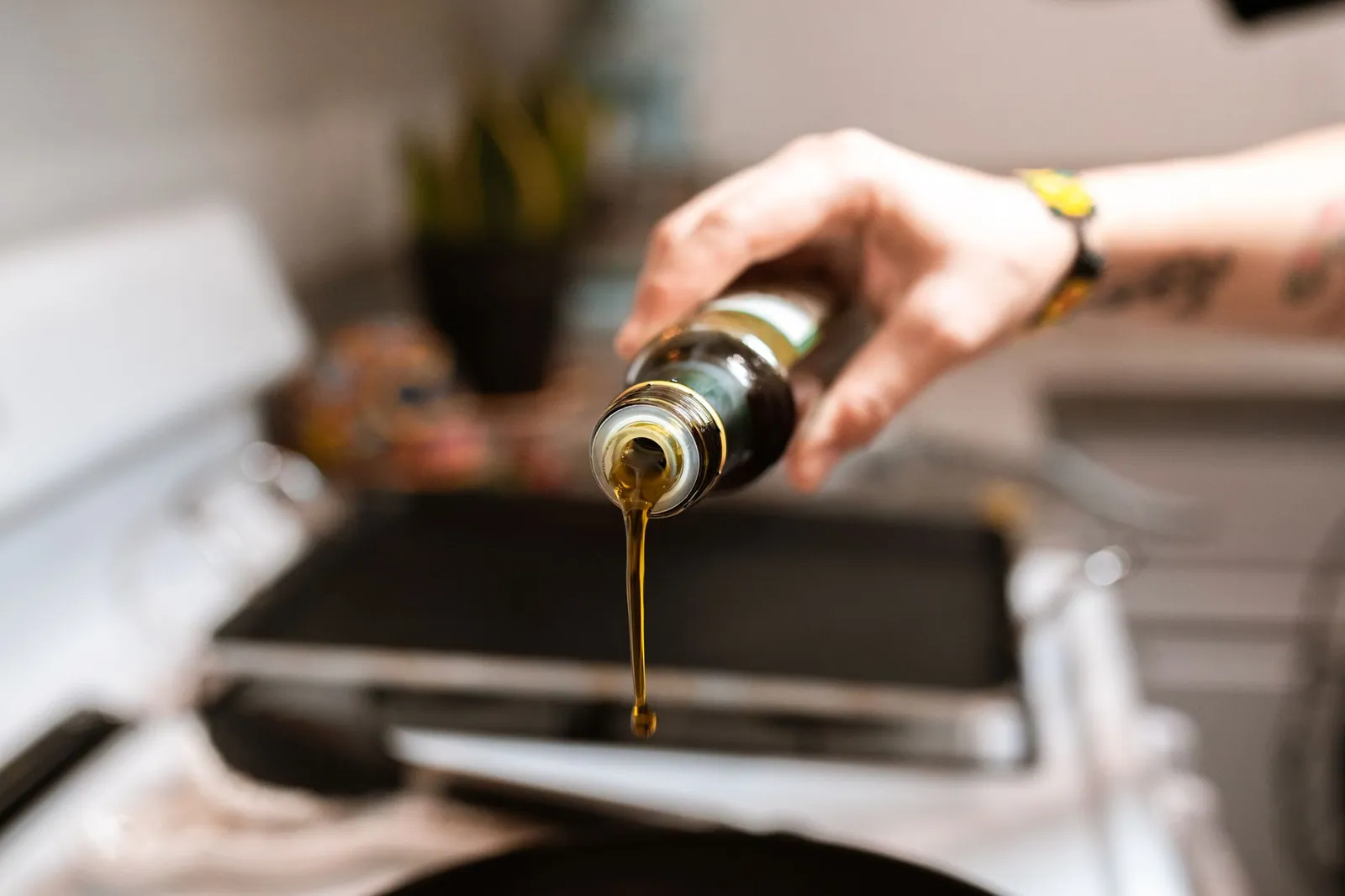
Extra Virgin, Virgin, Riviera: Olive Oil Grades Explained
What do 'extra virgin', 'riviera' and 'refined' mean on the label? The difference lies in the production method and acidity.
Article
Extra Virgin, Virgin, Riviera: Olive Oil Grades Explained
What do 'extra virgin', 'riviera' and 'refined' mean on the label? The difference lies in the production method and acidity.
 Article
Olive Oil
The difference between extra virgin, virgin, refined and riviera; what acidity means, how cold pressing works and how to store oil.
Article
Olive Oil
The difference between extra virgin, virgin, refined and riviera; what acidity means, how cold pressing works and how to store oil.