The Memecik olive: Türkiye's oil variety
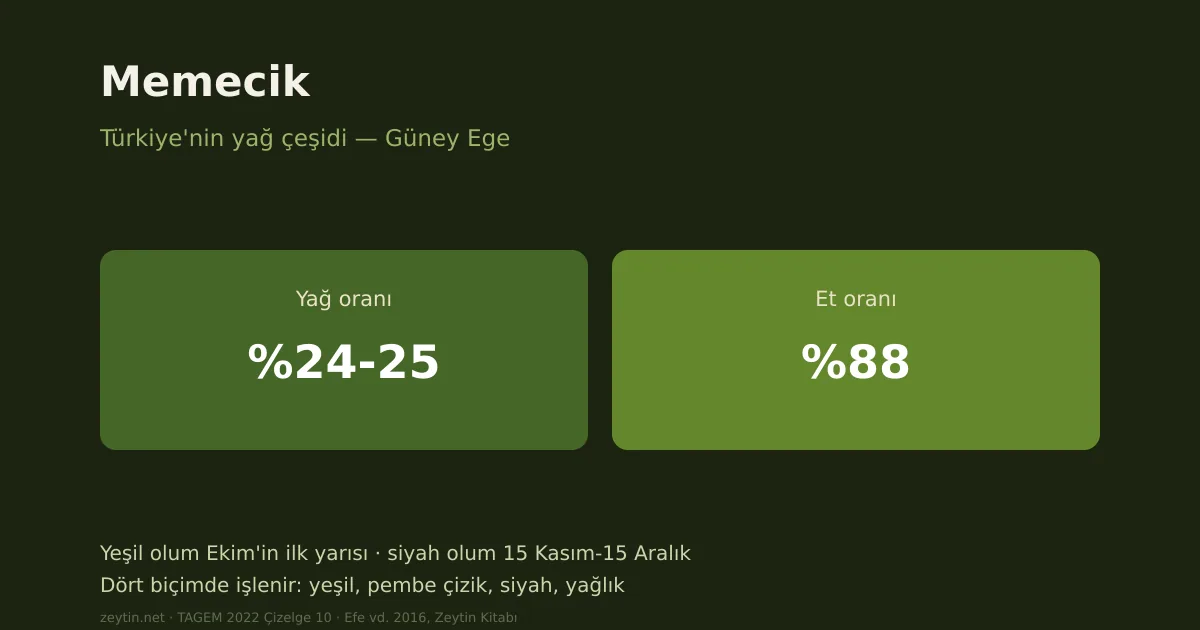
Between 19% and 45% of the tree stock. 24-25% oil, 88% flesh. Green maturity in early October, two months after Gemlik.
Türkiye's olive oil comes largely from a single variety: Memecik. Its share of the tree stock is given as anywhere between 19% and 45% depending on the source, but it sits in the top three either way.
If Gemlik is the variety of the table, Memecik is the variety of the oil.
Identity
| Property | Value |
|---|---|
| Oil content | 25-28% |
| Fruits per kilo | 210 |
| Flesh ratio | 88% |
| Use | Oil + table |
| Region | Aydın, İzmir, Muğla, Denizli, Antalya |
Two figures stand out. A flesh ratio of 88% is among the highest on the list — almost the whole fruit is flesh, and the stone stays small. And 210 fruits to the kilo means an average fruit weight of about 4.8 grams: a large olive.
Together these make Memecik both an oil and a table variety. Its 24-25% oil content puts it in the oil class, but its size and flesh send it to the table as well.
Ripening calendar
| Stage | Dates |
|---|---|
| Flowering | 16 May - 6 June |
| Fruit set | 20 May - 11 June |
| Green maturity | first half of October |
| Black maturity | 15 November - 15 December |
For comparison: Gemlik reaches green maturity on 20 August - 10 September. Memecik ripens roughly two months later, and its black maturity runs into mid-December.
For an oil variety that lateness is not a fault but a choice: oil accumulation continues with ripening. Even so, early harvest has its own case — a late harvest raises oil quantity while lowering polyphenols.
How it is processed
Memecik is, with Edremit (Ayvalık), one of only two varieties that can be processed in four different ways:
- Green table olives
- Pink scored
- Black table olives
- Oil
That flexibility lets the grower decide by the market: to the table when table prices are good, to the mill when oil prices are. The gap between table and oil prices for the same fruit makes that decision meaningful every year.
Where it grows
Memecik is the variety of the southern Aegean: widespread in Aydın, İzmir, Muğla, Denizli and Antalya.
The Aegean supplies more than half of Türkiye's olive production, and the two commonest varieties there — Memecik and Ayvalık — are predominantly oil. That is the mirror image of Marmara's table character.
Irrigation research
Memecik is the Turkish variety most studied for irrigation. Aşık et al. (2011) examined the effect of different irrigation programmes on yield and quality, and concluded:
t; For irrigating Memecik, applying 25% of the evaporation from a Class A pan every five days as drip irrigation is appropriate.
That is an important figure for Turkish olive growing: 85% of the world's olive area is unirrigated and the picture in Türkiye is similar. Of the groves that are irrigated, most are in table production. So even where the irrigation programme for an oil variety like Memecik is known, most groves do not apply it.
The two periods when the olive tree is most sensitive to water:
- Stone hardening — late July to early August
- Colour change in the fruit — late September to early October
Irrigation in these windows raises yield directly.
A second source: the IOC catalogue
The values above come from Turkish sources. The table below is taken from the International Olive Council's world catalogue — the same variety as recorded internationally. We keep the two tables apart because some of the figures do not agree.
| Origin | Muğla |
| Use | Oil; also eaten as green and black table olives |
| Fruits per kilo | 210 |
| Flesh-to-pit ratio | 6.7 |
| Oil content | 25-28% |
| Total phenols | 296-407 mg CAE/kg |
| α-tocopherol | 219-324 mg/kg |
| Ripening | Mid-November to mid-December |
| Vigour | Strong, dense canopy |
| Yield | Shows periodicity, still satisfactory |
| Self-fertility | Partial |
| Drought tolerance | High |
| Cold tolerance | Moderate |
Source: International Olive Council (IOC), World Catalogue of Olive Varieties.
Two lines explain Memecik's hold on the Aegean. Its drought tolerance is high — it survives on unirrigated, stony hillsides, which is exactly what a traditional Aegean grove is. Its cold tolerance is only moderate, which keeps it from moving north.
That it shows periodicity is the root of Türkiye's year-to-year swing in oil output: if the most widespread oil variety alternates, so does the national crop. By contrast Picual bears regularly — the source of Spain's advantage in planning.
On its share of the national tree stock the sources diverge: the Turkish figure used on this page and the catalogue figure differ. Comparison and discussion: olive varieties of Türkiye.
Summary
- Memecik is Türkiye's commonest oil variety; share given as 19-45% depending on source.
- 24-25% oil, 88% flesh, 210 fruits to the kilo.
- Green maturity first half of October, black maturity 15 November - 15 December — two months after Gemlik.
- Can be processed in four ways: green, pink scored, black, oil.
- Its region is the southern Aegean: Aydın, İzmir, Muğla, Denizli, Antalya.
- Irrigation recommendation: 25% of pan evaporation every five days by drip.
- Most water-sensitive periods: stone hardening and colour change.
Sources
t; Republic of Türkiye, Ministry of Agriculture and Forestry, TAGEM. Olive Integrated Pest Management Technical Instruction. Ankara, 2022, Table 10. — Phenological stages
t; Efe, R., Soykan, A., Cürebal, İ. and Sönmez, S. (2016). Characteristics and Geographical Distribution of Olive Varieties Grown in Türkiye. In: Zeytin Kitabı (E. Naskali, ed.), Kitabevi, pp. 37-80. — Composition and distribution
t; Sevim, D., Varol, N. and Köseoğlu, O. (2022). The Effects of Global Climate Change on Olive Growing and Olive Oil. Journal of the Agricultural Faculty of Bursa Uludağ University, 36(2): 415-432. — Irrigation research as reported (Aşık et al. 2011)
Related reading: Olive varieties · The Gemlik olive · The Ayvalık (Edremit) olive · Is early harvest expensive or valuable?
Registered names built on this variety
The registration covers the product of a defined area — not this variety wherever it is grown.
- Güney Ege Zeytinyağları designation of origin · reg. no 79
- Milas Olive Oil designation of origin · reg. no 201 · Milas
- Milas Oil-Cured Olive designation of origin · reg. no 446 · Milas
- Aydın Memecik Zeytinyağı designation of origin · reg. no 535
- Aydın Memecik Zeytini designation of origin · reg. no 749
- Milas Ekşili Zeytini geographical indication · reg. no 1691
Where it stands among measured varieties
Zeytin Kitabı — Efe, Soykan, Cürebal, Sönmez (2016), Kitabevi Yay. s.37-80
çeşit sayfası ölçüm tablosu
Zeytin Kitabı — Efe, Soykan, Cürebal, Sönmez (2016), Kitabevi Yay. s.37-80
Zeytin Kitabı — Efe, Soykan, Cürebal, Sönmez (2016), Kitabevi Yay. s.37-80
Zeytin Kitabı — Efe, Soykan, Cürebal, Sönmez (2016), Kitabevi Yay. s.37-80 — bu çeşidin ölçüm takımı bu çalışmadan (2 kaynak arasından)
Values are those published on each variety's own page; the comparison covers only varieties with a measured figure, so it is a comparison of what is known — not of every Turkish variety. See the full ranking and how it is built →
One rating per visitor; you can change yours at any time. Ratings are real reader votes — no seeded or default scores.
Related
 Article
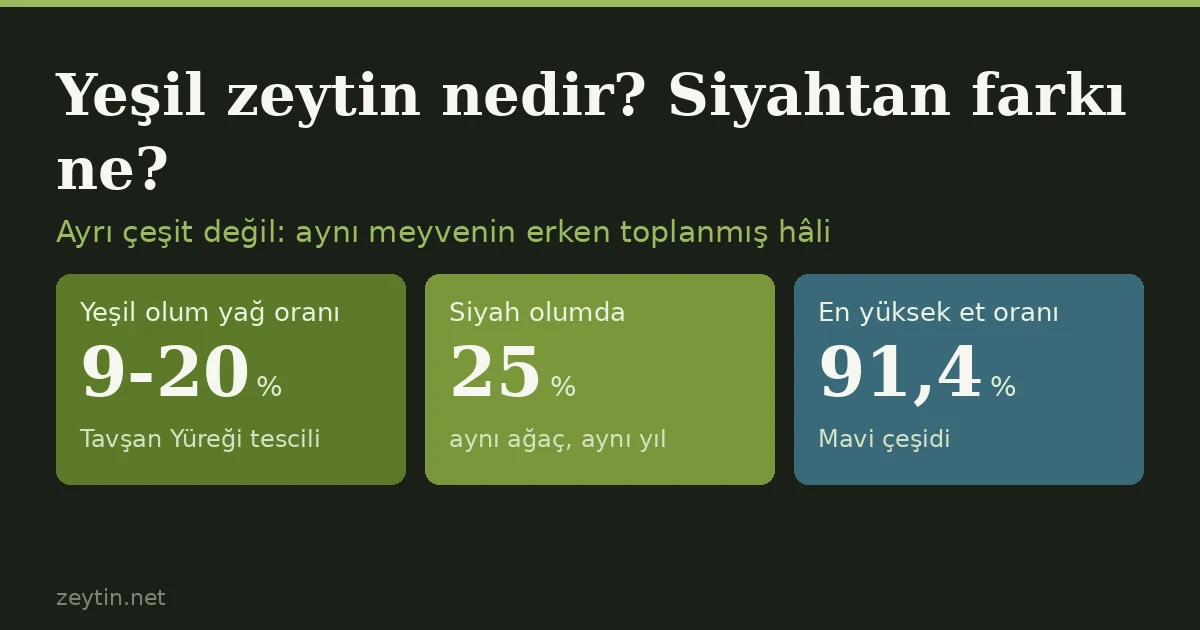
What are green olives, and how do they differ from black?
Green olives are not a separate variety but the same fruit picked early. What sets the colour, why pick green, and where the difference from black begins.
Article
What are green olives, and how do they differ from black?
Green olives are not a separate variety but the same fruit picked early. What sets the colour, why pick green, and where the difference from black begins.
 Article
Gölvala olive
Gölvala is a recorded variety of the Black Sea. No measured pomological data published.
Article
Gölvala olive
Gölvala is a recorded variety of the Black Sea. No measured pomological data published.
 Article
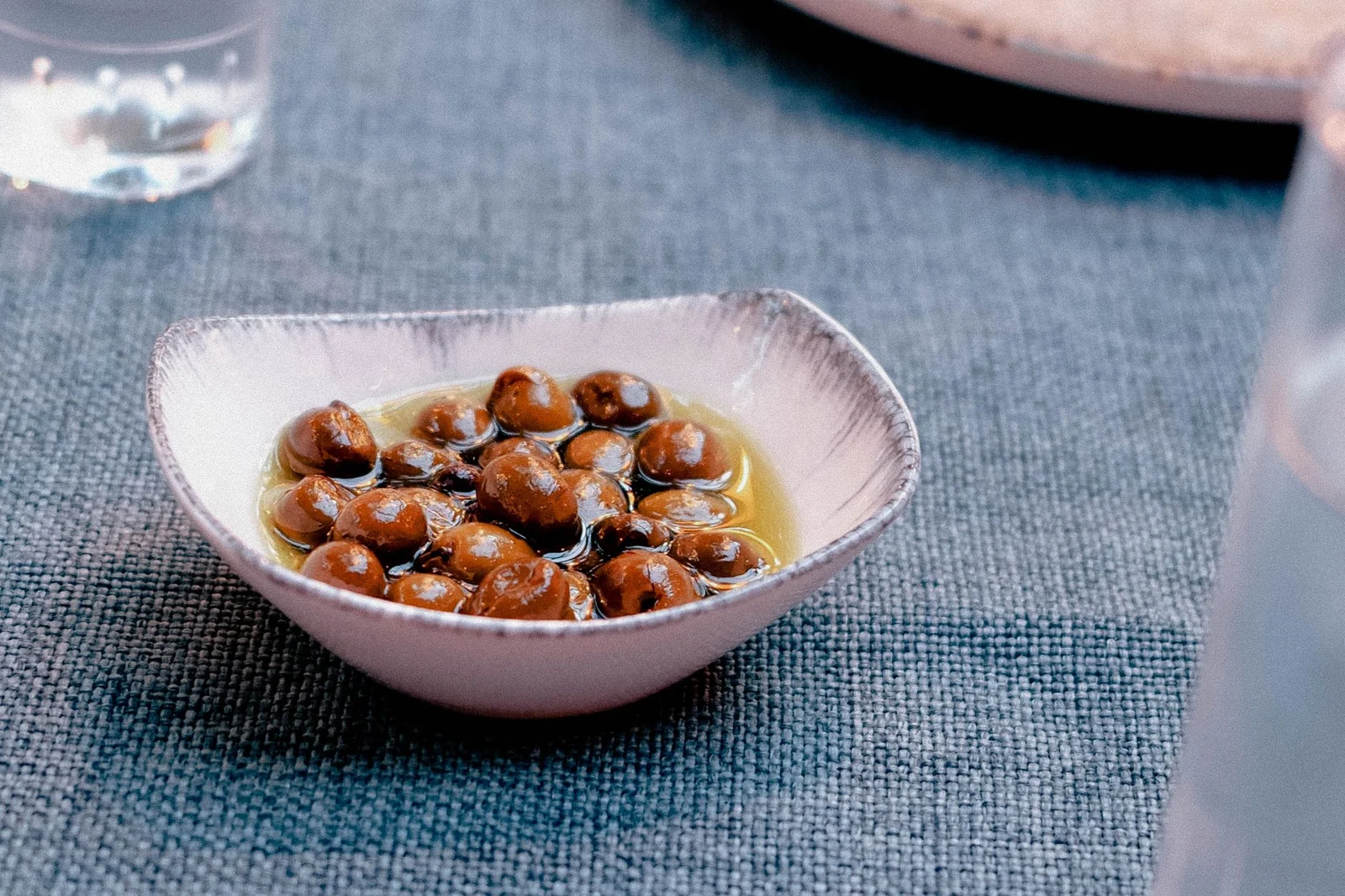
Which table olive variety is best?
The leading varieties for black and green table olives, measured fruit weights, and how curing affects quality.
Article
Which table olive variety is best?
The leading varieties for black and green table olives, measured fruit weights, and how curing affects quality.
 Article
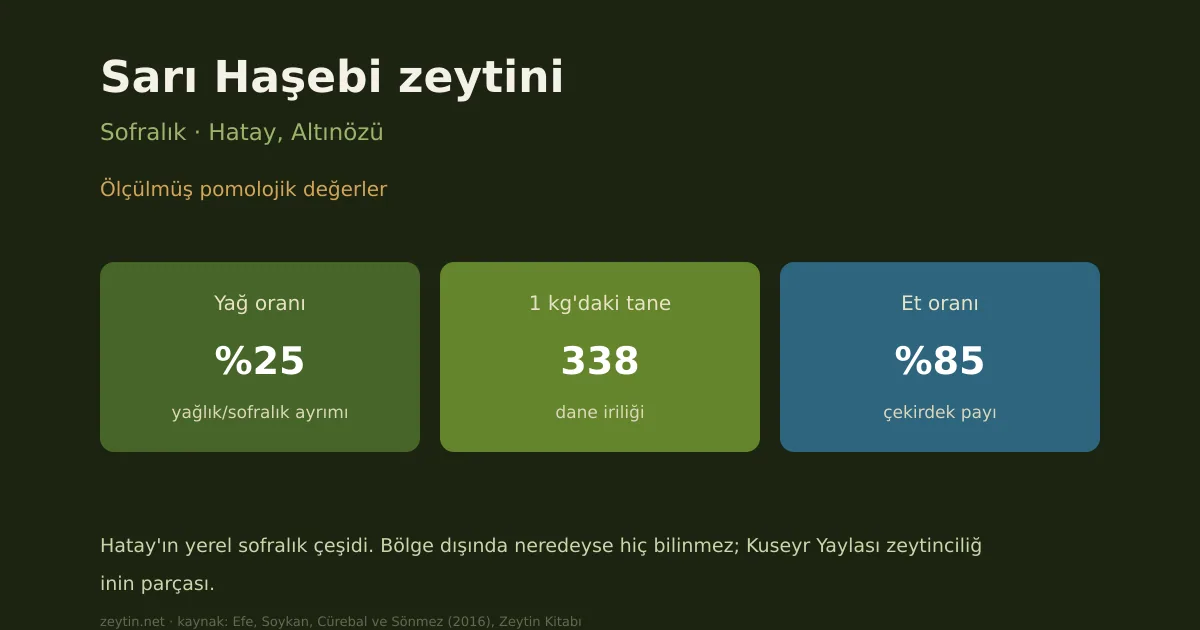
Sarı Haşebi olive: characteristics, oil content and growing areas
Hatay's local table variety, virtually unknown outside the region and part of Kuseyr Plateau olive growing.
Article
Sarı Haşebi olive: characteristics, oil content and growing areas
Hatay's local table variety, virtually unknown outside the region and part of Kuseyr Plateau olive growing.