How do you reduce the salt in olives?
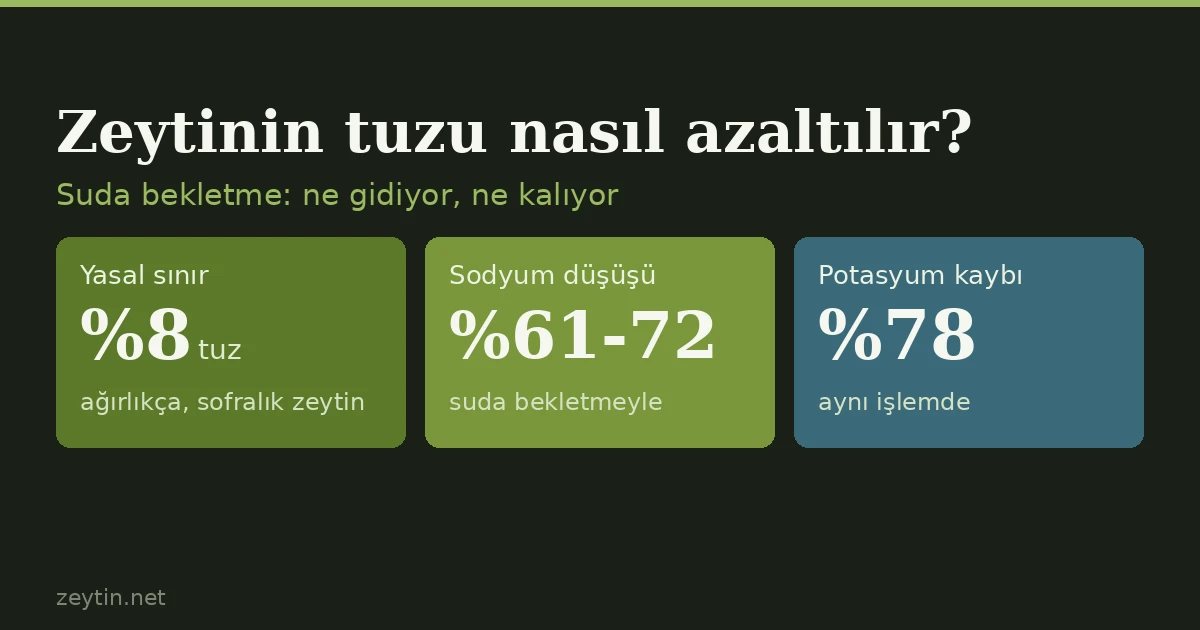
Draining the brine does not remove the salt — it has worked its way into the flesh. A Spanish study measured that soaking in water cuts sodium by 61-72%, but the same process also carries away up to 78% of the potassium and softens the fruit. The legal salt ceiling for table olives is 8% by weight, and the "low salt" claim requires no more than 4 grams per 100. Which method works how well, and what does each one give up?
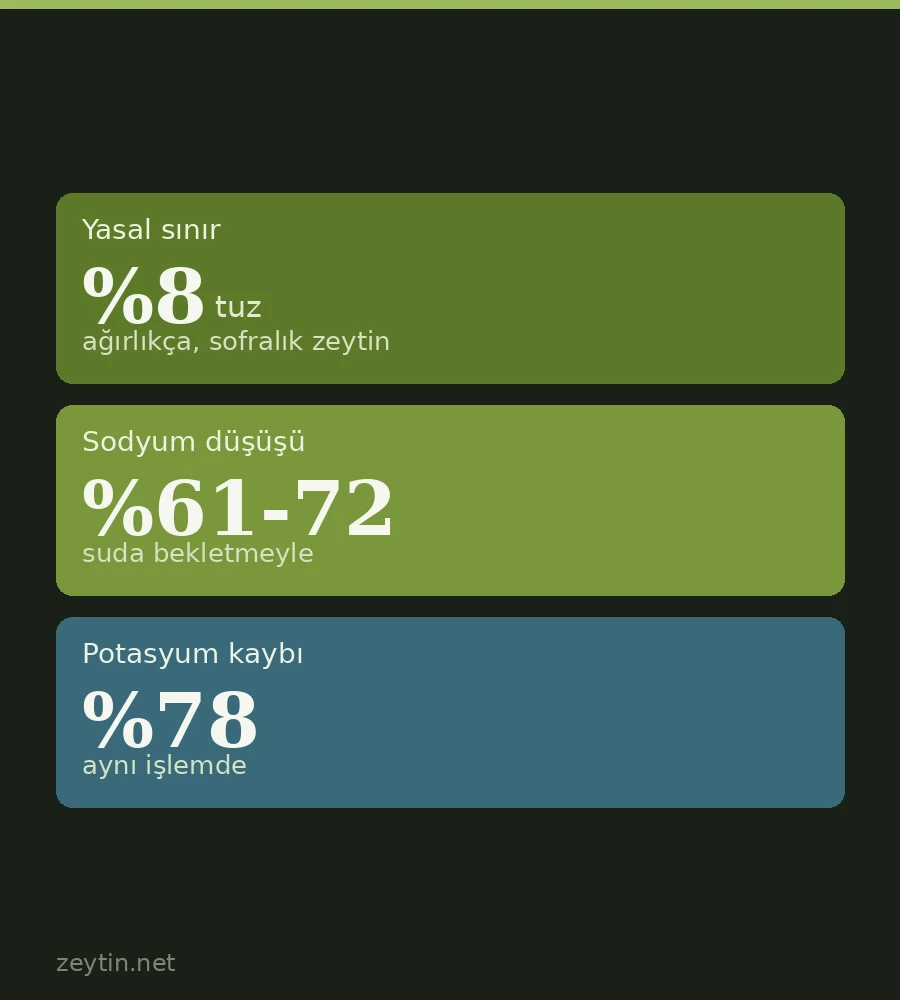
Table olives are a salty food, and that is not a production error: salt both manages the fermentation that removes bitterness and protects the product from spoiling. On the consumer side, though, a question remains — how much of that salt can be reduced, and what do we lose in reducing it?
First, the limits: how much salt is legally there?
Under the Turkish Food Codex Communiqué on Table Olives, salt content in table olives may be no more than 8% by weight. For the words "low salt" to appear on the label, the product must contain no more than 4 grams per 100 grams.
Both numbers are worth keeping in mind, because "low salt" on the shelf does not mean salt-free: an olive that is 4% salt by weight can still carry the claim. The World Health Organization's daily salt recommendation for adults is below 5 grams. So 100 grams of "low salt" olives can, in theory, fill the entire daily salt budget.
We calculated what a reasonable daily portion looks like in how many olives should you eat a day, and the full table for the fruit, sodium included, is in the nutritional profile of olives.
Draining does not work
This is the most common mistake. Pouring off the liquid in the jar removes the brine on the surface of the fruit; the salt itself has worked into the flesh over weeks of curing. Rinsing cleans the outside and does not touch the inside.
The only mechanism that works is diffusion: holding the olives in unsalted water lets the salt in the flesh pass into the water. As the water becomes salty the transfer slows, which is why the water has to be changed.
The measured result: how far does it fall?
There is a study that puts numbers on this. Research by López-López, Moreno-Baquero and Garrido-Fernández, published in Foods in 2023, desalted three different table olive presentations and measured the outcome (the process was run at 8 ± 1 °C):
| Product | Initial sodium | Final | Reduction |
|---|---|---|---|
| Plain green Manzanilla | 27.2 g/kg | 7.5 g/kg | 72% |
| Pepper-stuffed Manzanilla | 21.2 g/kg | 7.3 g/kg | 65% |
| Traditional Aloreña | 18.6 g/kg | 7.2 g/kg | 61% |
Two things stand out. First, the product with the highest starting salt shows the largest fall, yet all three land in roughly the same place (7.2-7.5 g/kg) — meaning the process works towards an equilibrium point, not towards zero.
Second, the time required varies greatly by product. The study gives the time needed to reach a 2.5% NaCl level as 33 hours for plain green Manzanilla, 10 hours for the stuffed Manzanilla and 6 hours for Aloreña. Fruit size, whether the olive has been cracked, and the structure of the flesh set that duration: scored and cracked olives give up their salt quickly, while sound large fruit resists.
What does it cost?
The second half of the same study answers this. As the salt leaves, other things leave with it:
- Potassium loss: 78%, 65% and 66% respectively.
- Magnesium loss: 56%, 61%, 55%.
- Calcium loss: 12%, 45%, 13%.
- Lactic acid loss: 69%, 62%, 58%.
- Firmness: down 26% in plain green Manzanilla and 13% in the stuffed product.
Desalting is therefore a trade: it lowers sodium, but it thins out the mineral profile, reduces the lactic acid left by fermentation, and softens the texture. The loss of lactic acid also has a safety face — acidity is the second barrier protecting the olive.
How to do it at home
The practical method that follows from the data above:
1. Take the olives out of their brine and put them into plenty of unsalted water — at least twice the volume of the olives.
2. Keep them in the refrigerator. Remember that the study ran its process at around 8 °C: cold slows diffusion but also prevents spoilage. Desalted olives left at room temperature become vulnerable.
3. Change the water every four to six hours. Transfer stops as the water turns salty; changing it is the engine of the process.
4. Decide by tasting. Small, cracked fruit may need a few hours; large sound fruit can take more than a day.
5. When you are done, eat the olives straight away or move them into a light brine. Desalted olives do not keep; store them in the refrigerator and finish them quickly.
Warm water is faster but costlier. Heat speeds diffusion; in exchange the texture softens noticeably and aroma loss increases. An option if you are in a hurry, not if you care about quality.
Boiling is the fastest way to remove salt and also the most destructive: the fruit falls apart and the flavour flattens. Not recommended outside cooked dishes.
Which is saltier, black or green?
The common belief is that black olives are saltier, but what decides it is not colour — it is the processing method. The study above shows this itself: the three products differed not along a green-versus-black line but by presentation — plain fruit, stuffed fruit and traditionally prepared fruit each started from a different sodium level.
In practice the ranking works roughly like this. In dry salt curing, salt is applied directly to the fruit; there is no water phase, so salt concentration in the flesh reaches its highest. In brine curing, salt equilibrates through a solution, and the level reached depends on the strength of that brine. Cracking and scoring, meanwhile, open the flesh to water and so speed up both the entry and the exit of salt.
The consumer consequence: what you need to read on the label is not the colour but the processing method and the sodium figure in the nutrition table. We handled the production processes of the two methods separately in how black table olives are made and table olives.
What are desalted olives good for?
Desalted fruit stops being something to eat on its own and becomes a kitchen ingredient, because its flavour balance weakens. It works best in dishes where the salt comes from somewhere else: olive bread dough, baked dishes, salad dressings, pastes. In a paste the loss of texture is not a problem; the softened fruit is in fact easier to work.
One warning here: desalted olives are vulnerable to spoilage. Part of the lactic acid left by fermentation also passes into the water, so the protective barrier weakens from two directions. They should be kept in the refrigerator in a covered container and finished within a few days; this is not a product to leave standing in a jar.
Buying low-salt in the first place
The most efficient route is not to struggle with removing salt afterwards but to choose a low-salt product from the start. The words "low salt" on the shelf guarantee the limit of 4 grams per 100; beyond that, checking the sodium or salt figure in the nutrition table on the pack allows a direct comparison.
One note here: reducing salt makes the producer's job harder, because a product with weaker preservation faces a higher risk of spoilage. Low-salt products therefore tend to arrive with cold-chain handling and a shorter shelf life. We gathered the signs of spoilage in are my olives spoiled, and storage conditions in how to store olives.
If you are curious about the role of salt in production and why it runs this high, how are olives cured and how green table olives are made explain the process from the beginning.
The short answer
Draining does not remove salt; soaking does. The measured reduction lands in the 61-72% range and settles at around 7 g/kg of sodium. The price is most of the potassium, some firmness and some acidity. Do it in the refrigerator, changing the water, tasting as you go — and do not let the olives sit once you are finished.
One rating per visitor; you can change yours at any time. Ratings are real reader votes — no seeded or default scores.
Related
 Article
How to Store Olives: From an Opened Jar to a Winter Batch
How long does an opened jar last, what to do when the brine runs low, how to keep dry-cured olives? Why mould forms and what the white film actually is.
Article
How to Store Olives: From an Opened Jar to a Winter Batch
How long does an opened jar last, what to do when the brine runs low, how to keep dry-cured olives? Why mould forms and what the white film actually is.
 Article
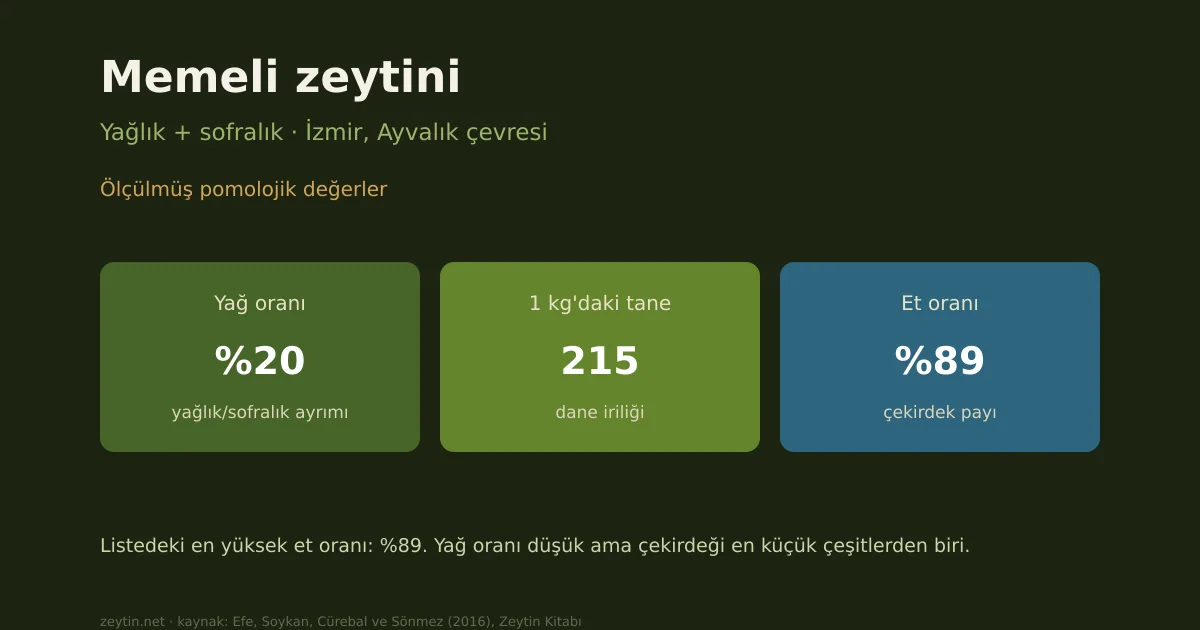
Memeli olive: characteristics, oil content and growing areas
The highest flesh ratio on the list at 89%. Low in oil, but with one of the smallest stones.
Article
Memeli olive: characteristics, oil content and growing areas
The highest flesh ratio on the list at 89%. Low in oil, but with one of the smallest stones.
 Article
Picual olive: Spain's oil variety
The single largest share of world olive oil production. High oleic acid and polyphenols, a pungent and stable oil.
Article
Picual olive: Spain's oil variety
The single largest share of world olive oil production. High oleic acid and polyphenols, a pungent and stable oil.
 Article
Where do olives grow in Türkiye, and where don't they?
What limits the olive is frost, not a provincial border. Where it grows in Türkiye, with cold thresholds and altitude limits.
Article
Where do olives grow in Türkiye, and where don't they?
What limits the olive is frost, not a provincial border. Where it grows in Türkiye, with cold thresholds and altitude limits.