Co-op branding in the adulteration list: one name, four separate announcements
All eight olive oil entries in Turkey's 30 September 2026 food-fraud announcement come from a single province, Aydın, and all eight carry the same finding: seed oil blended into oil sold as extra virgin. The brand names tell a second story — three of them invoke a cooperative or a producers' union. Read as a time series, the live list shows one trader's name across four separate announcements, under a new brand each time.
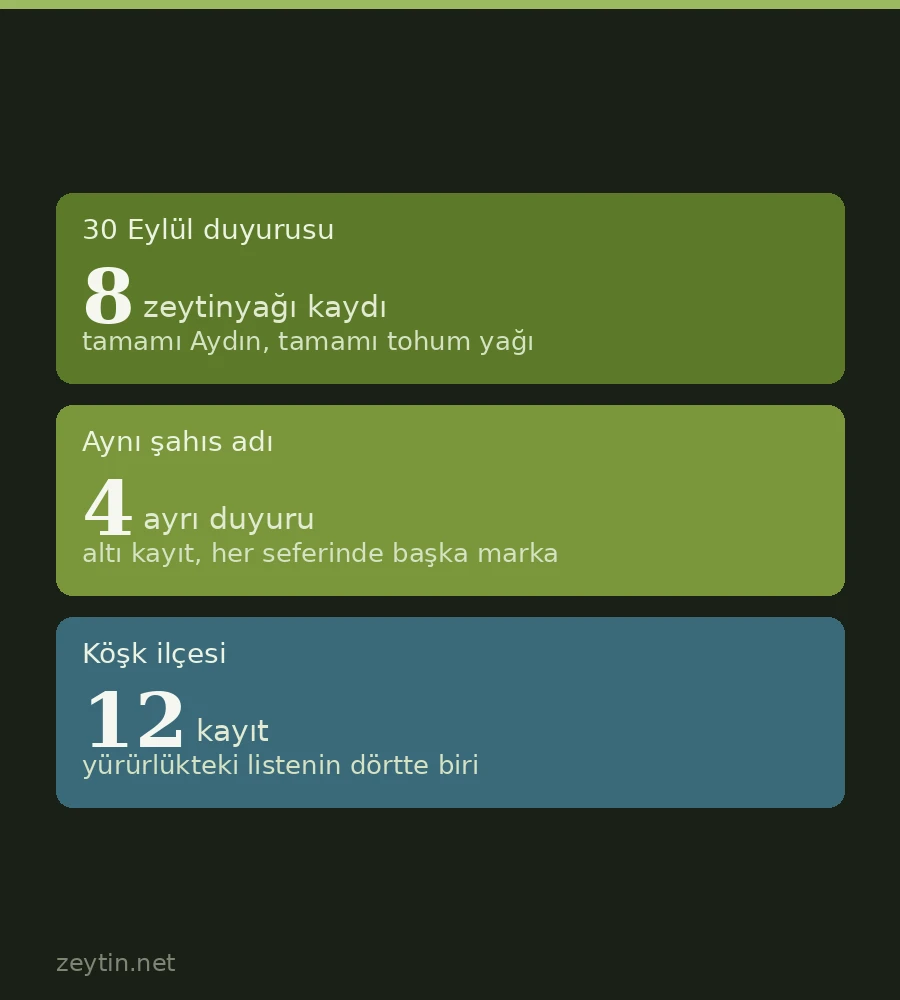
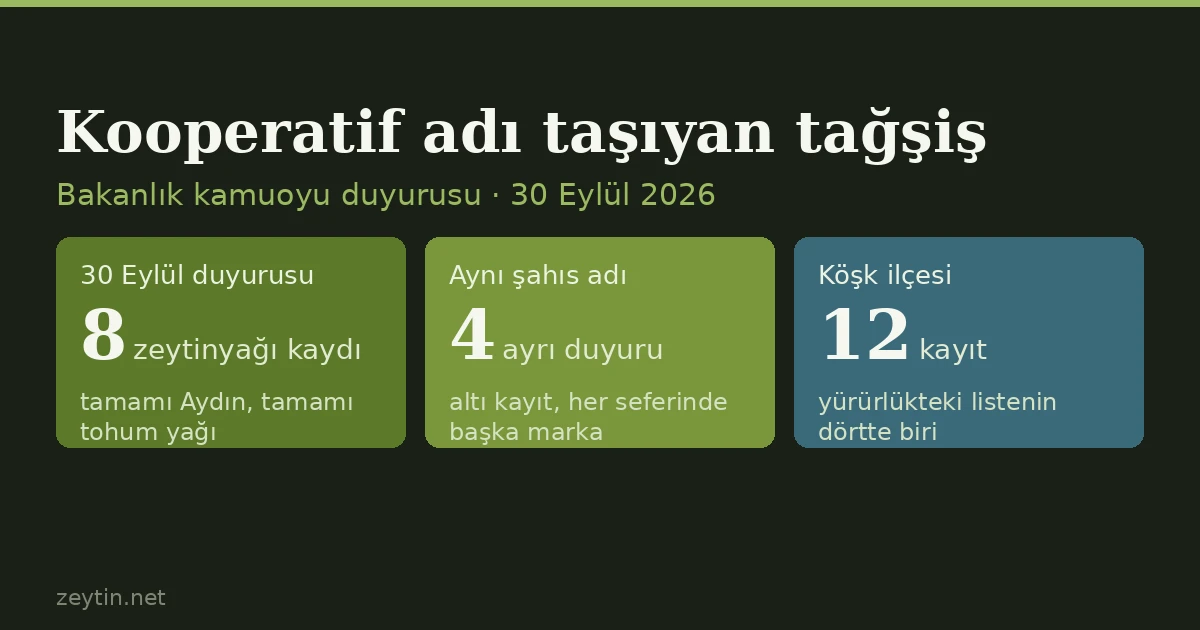
Turkey's Ministry of Agriculture and Forestry added 37 new entries to its public food-fraud announcement on 30 September 2026, published through the ministry's Güvenilir Gıda (Safe Food) portal. Eight of those entries are products sold as olive oil, and all eight carry an identical finding: seed oils blended in. All eight also come from a single province — seven from the Köşk district of Aydın, one from Efeler.
A week earlier, the 23 September announcement had brought 21 olive oil entries, the heaviest single day in the live list. What makes the new announcement worth reading is not its size but the brand names the eight entries carry.
Three brands invoke a cooperative or a union
The brands recorded on 30 September are Ayvalık Köy Kooperatifi (Ayvalık Village Cooperative), Vakıfbirlik, 1988 Vakfıkebir Birlik and Dededen Toruna Gurme Ayvalık. The remaining four entries cover unlabelled products: 1, 2 and 5 litre PET bottles and a 5 litre tin.
The first three names share a feature. Each points to a producers' organisation. Words like köy kooperatifi (village cooperative), birlik (union) and köybirlik carry an immediate trust signal for a Turkish shopper: no middleman, straight from the grower, under the oversight of a collective. The entries themselves, however, are registered to two limited companies and two sole traders.
The suggestion extends to geography. The oil branded "1988 Vakfıkebir Birlik" was recorded in Köşk, Aydın. Vakfıkebir is a district of Trabzon on the Black Sea coast, and it is not an olive-growing region at all.
One name, four announcements, six entries
Read as a time series rather than as a single day, the list reveals a more durable pattern. The version currently published on the portal spans 16 April to 30 September 2026: 291 entries in total, 56 of them in the vegetable oils group, 54 of those products sold under an olive oil name.
Six of those 54 entries belong to one individual trader: Sezgin Çetin. The name appears across four separate announcements. Two entries carry the trade title "VKB Tarım Ürünleri-Sezgin Çetin"; the other four list the personal name alone. The brand, meanwhile, changes every time.
| Announcement | Brand / product name | District |
|---|---|---|
| 01.06.2026 | Asır Tarım Köybirlik | Köşk |
| 22.07.2026 | Ayvalık Vakıf Birlik | Köşk |
| 23.09.2026 | Dr. Şifa Köybirlik | Köşk |
| 30.09.2026 | 1988 Vakfıkebir Birlik | Köşk |
| 30.09.2026 | Dededen Toruna Gurme Ayvalık | Köşk |
| 30.09.2026 | Vakıfbirlik | Efeler |
All six entries carry the same finding, seed oils blended in, and all six are 5 litre packs. The brand name was renewed each time; the non-conformity stayed the same. It is worth being precise about what the records do and do not show: each entry lists a brand name, a product name and a batch number. It does not state who owns the brand, or whether the brand is registered to anyone at all.
The pattern is not confined to one trader
Cooperative and union wording runs through the wider list. In 11 of the 54 olive oil entries, the brand or product name contains kooperatif, köy-koop, birlik or çiftlik (farm). The "Mudanya Köy-Koop" brand sold by a trader in Karapınar, Konya belongs to this group, as do products named "Ayvalık Birlik Taşbaskı" from two separate firms in Efeler, Aydın.
None of this wording is legally binding. These names carry none of the geographical boundary, analysis and inspection obligations that come with a registered designation of origin. They are associations dropped inside a brand name. And the ministry's finding here is not a geographical indication breach — it is adulteration, a statement about what is inside the bottle.
At the other extreme, no label at all
The remaining four entries from 30 September are the reverse side of the same coin. Registered to a sole trader in Köşk, these four products are listed by name as "unlabelled olive oil": 1, 2 and 5 litre PET bottles and a 5 litre tin. The brand field is empty and so is the batch number field. All four carry the same finding, seed oils blended in.
Both extremes come out of the same district. On one side, a brand carrying the name of a cooperative that does not appear to exist; on the other, a tin carrying no name at all. Both achieve the same thing: they cut the trail back to the product. Across the 54 olive oil entries on the live list, 18 have an empty brand field and 12 carry no batch or serial number — close to a third of the recorded products have no number that could be traced back.
Köşk alone accounts for a quarter
The concentration at district level is striking. Aydın leads the live list with 21 olive oil entries, followed by Hatay with 11, İzmir with 5 and İstanbul with 4. Twelve of Aydın's 21 entries come from the single district of Köşk — six different businesses across four separate announcements. Köşk alone accounts for roughly a quarter of every olive oil entry currently on the list.
Set against the adulteration raids that ran through the summer in the same province, the picture is consistent: enforcement keeps returning to the same geography.
What it means for a buyer
Across the 54 olive oil entries, 50 record seed oils blended in, three record lower-grade olive oil blended in, and one records both. On packaging, 30 of the 54 are 5 litres or larger — adulteration clusters in the large format, a tendency also visible on the price side.
The practical conclusion is narrow but useful. The words "cooperative", "union" or a famous region on a label are a claim, not a document. A genuine cooperative can be asked for its registered title, its tax number and its food business registration number; how the oil itself can be judged is a separate question. The ministry publishes these announcements under Article 31(6) of Law No. 5996 and Article 8 of the Regulation on Official Controls of Food and Feed dated 17 December 2011, and only products where imitation or adulteration has been established by laboratory result enter the list.
The figures in this article were calculated from the public announcement records live on the ministry's Güvenilir Gıda portal as of 3 October 2026. The list is a rolling window: older announcements drop off over time, so the totals are not fixed.
One rating per visitor; you can change yours at any time. Ratings are real reader votes — no seeded or default scores.
Related
 Article
The crop is heading for 500,000 tonnes, exports fell to 17,000: the sector wants a premium and an exchange-rate mechanism
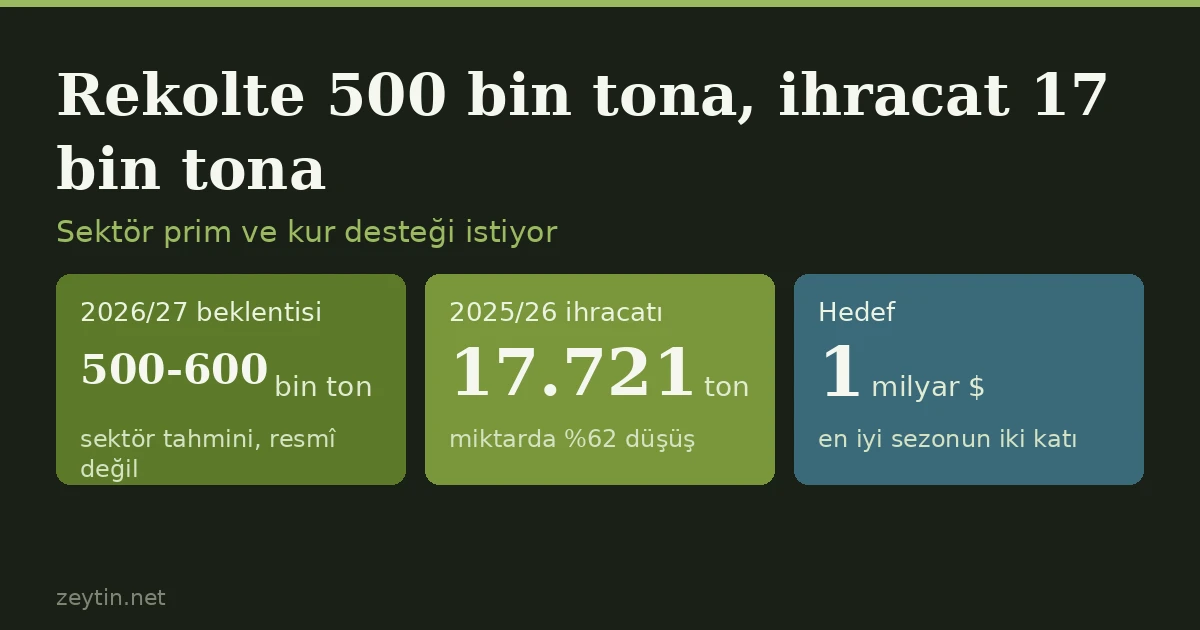
Industrialists and exporters meeting in Izmir put this season's olive oil crop at 500,000-600,000 tonnes. Last season Türkiye shipped 17,721 tonnes of olive oil: down 62% in volume and 59% in value. The crop is not the problem; selling the crop is.
Article
The crop is heading for 500,000 tonnes, exports fell to 17,000: the sector wants a premium and an exchange-rate mechanism
Industrialists and exporters meeting in Izmir put this season's olive oil crop at 500,000-600,000 tonnes. Last season Türkiye shipped 17,721 tonnes of olive oil: down 62% in volume and 59% in value. The crop is not the problem; selling the crop is.
 Article
A 2,000-year-old olive grove endowment in Antalya: 600 trees, “never to be cut or sold”
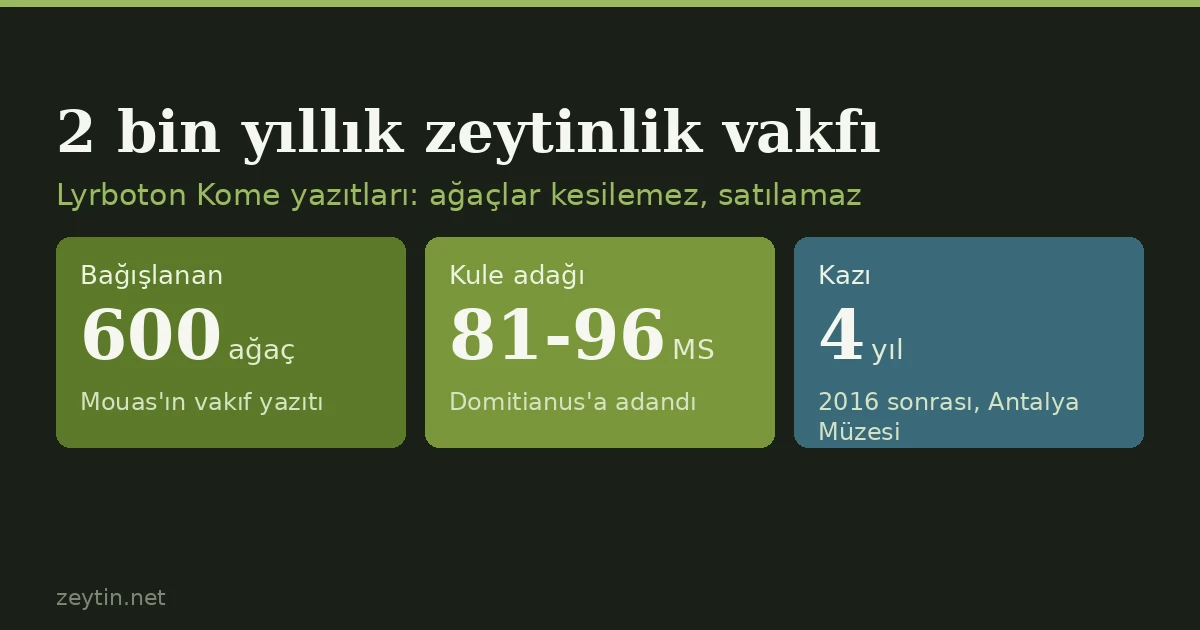
The excavation results from Lyrboton Kome in Antalya have been presented. Inscriptions record a family endowing its farm and 600 olive trees in perpetuity, with an explicit clause: these trees can never be cut, sold or put to another use.
Article
A 2,000-year-old olive grove endowment in Antalya: 600 trees, “never to be cut or sold”
The excavation results from Lyrboton Kome in Antalya have been presented. Inscriptions record a family endowing its farm and 600 olive trees in perpetuity, with an explicit clause: these trees can never be cut, sold or put to another use.
 Article
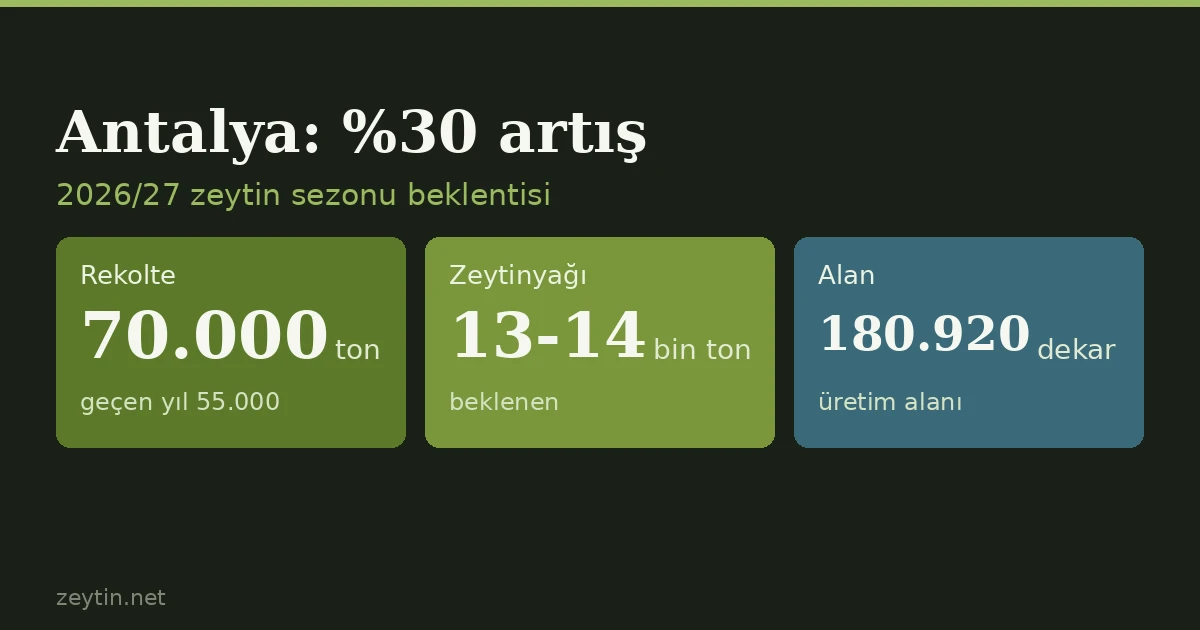
Antalya's crop is up 30%: of 70,000 tonnes of olives, 55,000-60,000 head for the mill
According to the Antalya Commodity Exchange, the province's olive crop is rising about 30% from some 55,000 tonnes last season to around 70,000 tonnes, with 13,000-14,000 tonnes of olive oil and 10,000-15,000 tonnes of brined fruit expected. Harvest opened on 15 September. There is movement on the registration front too: an EU application has been filed for the Tavşan Yüreği olive, and a geographical indication file is under way for the Beylik variety.
Article
Antalya's crop is up 30%: of 70,000 tonnes of olives, 55,000-60,000 head for the mill
According to the Antalya Commodity Exchange, the province's olive crop is rising about 30% from some 55,000 tonnes last season to around 70,000 tonnes, with 13,000-14,000 tonnes of olive oil and 10,000-15,000 tonnes of brined fruit expected. Harvest opened on 15 September. There is movement on the registration front too: an EU application has been filed for the Tavşan Yüreği olive, and a geographical indication file is under way for the Beylik variety.
 Article
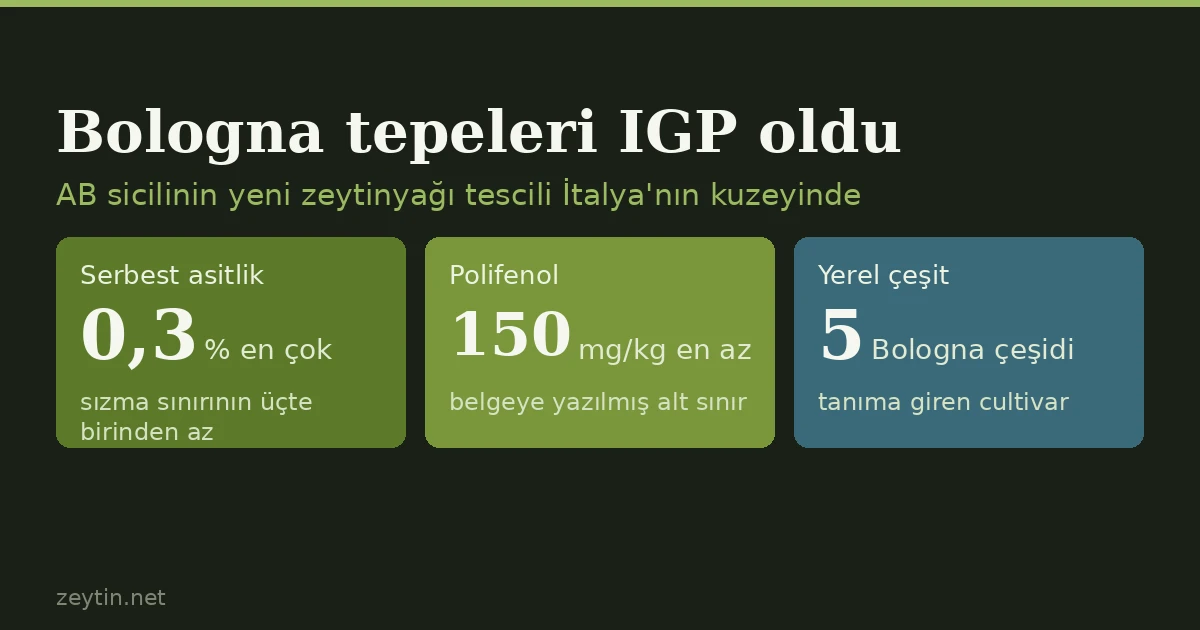
The EU's newest olive oil registration is in northern Italy: Olio dei Colli di Bologna gets PGI status
The European Commission has entered olive oil from the hills of Bologna into the Union register of geographical indications. The specification caps free acidity at 0.3 percent, well under a third of the legal limit for extra virgin, and writes five local Bolognese cultivars into the definition.
Article
The EU's newest olive oil registration is in northern Italy: Olio dei Colli di Bologna gets PGI status
The European Commission has entered olive oil from the hills of Bologna into the Union register of geographical indications. The specification caps free acidity at 0.3 percent, well under a third of the legal limit for extra virgin, and writes five local Bolognese cultivars into the definition.