Artvin's Butko olive harvest begins: 700 tonnes of table olives and 80 tonnes of oil expected
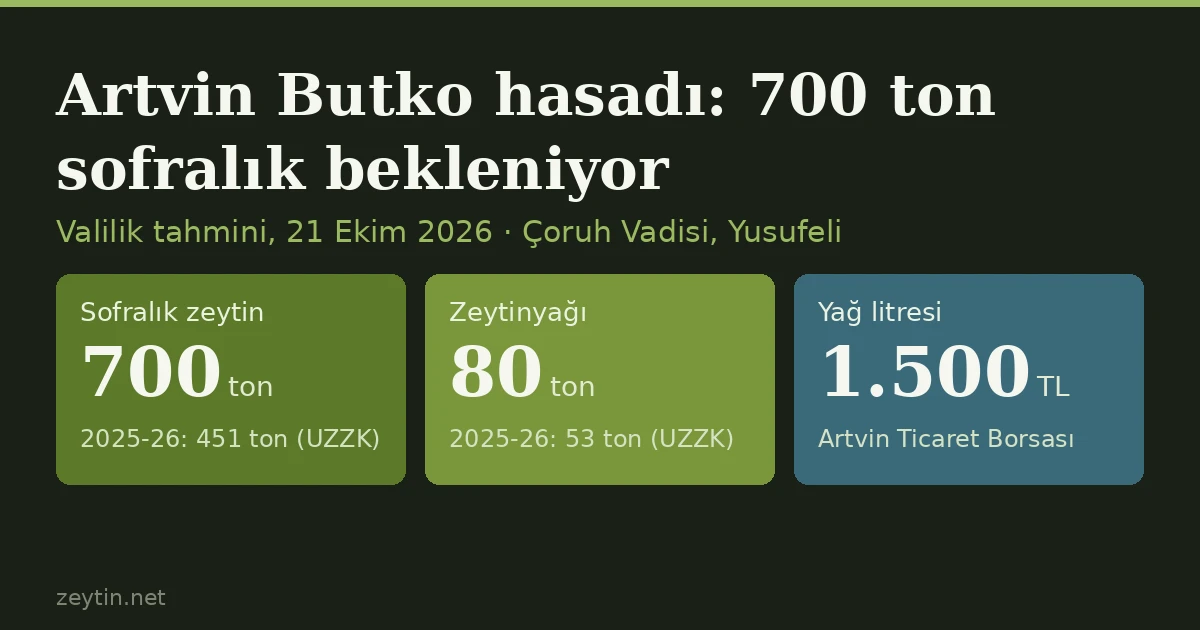
Artvin Governorate expects about 700 tonnes of table olives and 80 tonnes of olive oil from the Çoruh Valley's native Butko olive this season, 55 percent more table olives than last season's UZZK figure. The Artvin Commodity Exchange set prices at 400 lira per kilogram of olives and 1,500 lira per litre of oil; the geographical indication application is in its final stage.
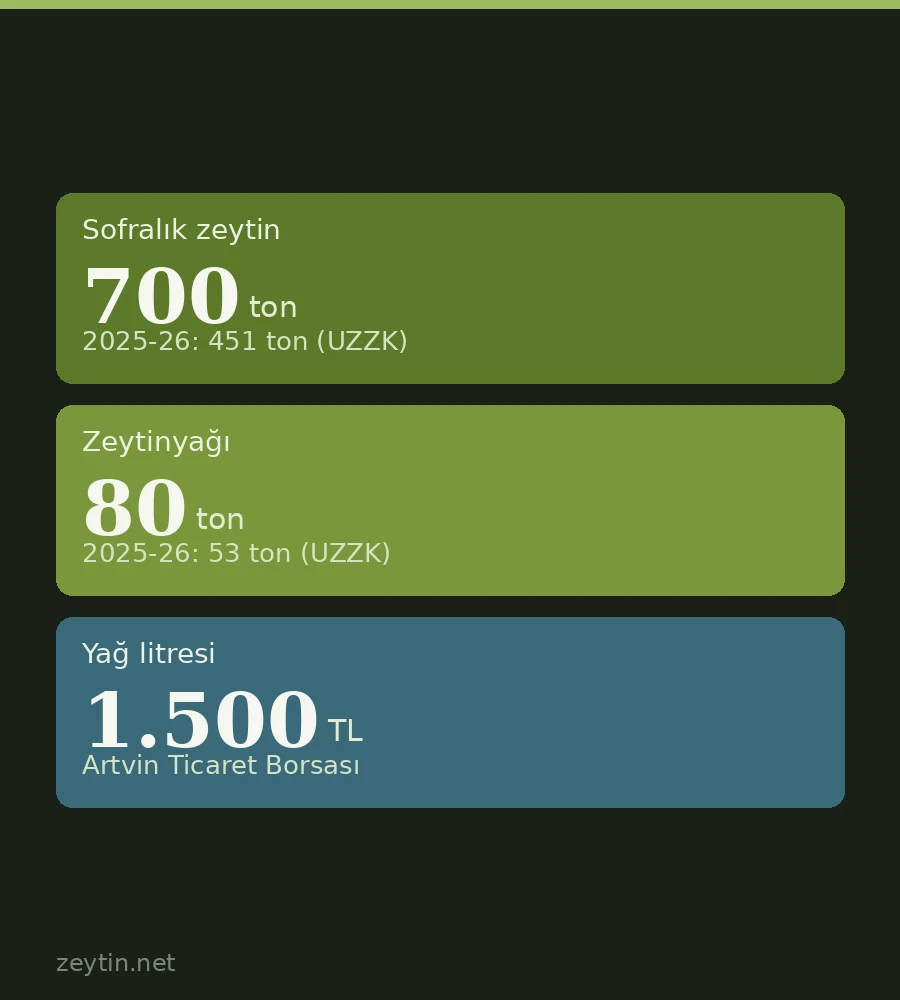
The harvest of Butko, the olive variety native to the Çoruh Valley in Türkiye's north-eastern province of Artvin, is under way. According to the estimate announced by Artvin Governor Turan Ergün at a harvest event in Yağcılar, a village in the Yusufeli district, on 21 October, the province expects about 700 tonnes of table olives and about 80 tonnes of olive oil this season. A week earlier, after its 13 October pricing meeting, the Artvin Commodity Exchange had said it expected the crop to be roughly 55 percent larger than last year's.
Some Turkish headlines have reported this as a "780-tonne" crop. That figure is not a single quantity: it adds 700 tonnes of olives to 80 tonnes of oil. Olives and oil are different products and cannot be summed.
Artvin is a small producer by any measure. Türkiye's olive belt runs along the Aegean, Marmara and Mediterranean coasts, where single provinces harvest hundreds of thousands of tonnes. Artvin's olive groves exist because of a microclimate: the deep, sheltered Çoruh Valley offers conditions that the rest of the Black Sea region largely lacks, and Artvin produces most of that region's olives (see do olive trees grow on the Black Sea coast?).
The numbers
| Item | 2026 estimate | 2025-26 | Change |
|---|---|---|---|
| Table olives | ~700 t | 451 t | +55% |
| Olive oil | ~80 t | 53 t | +51% |
| Total olives | not announced | 717 t | – |
| Olive trees | ~25,000 | 23,000 (bearing) | – |
2026: Artvin Governorate estimate (21 October 2026). 2025-26: provincial series of the National Olive and Olive Oil Council (UZZK). Changes are our calculation; the two sources may not use the same method.
The governorate's table-olive estimate is 55 percent above the 451 tonnes of table olives that the UZZK series records for Artvin last season. That matches the 55 percent increase announced by the exchange, although the exchange did not say which baseline it used for its own comparison.
Last year's opening estimate proved too low
A year ago, at the opening of the 2025 harvest on 21 October 2025, Governor Ergün said the province expected 450-500 tonnes of olives, after about 550 tonnes of olives and 66 tonnes of oil the year before. The UZZK series for 2025-26, published later, shows 717 tonnes of olives and 53 tonnes of oil for Artvin. In other words, last season's opening estimate came in well below the figure that was eventually recorded. At this scale, the yield of a few large groves can move the provincial total noticeably, so this year's 700 tonnes should also be read as an estimate rather than a result.
Explaining why a larger crop is expected, the governor pointed to this year's rainfall. The olive tree's habit of alternating a heavy year with a light one, known as alternate bearing, is another well-known reason for large swings from one season to the next.
The oil arithmetic: how many kilos of olives per kilo of oil?
Governor Ergün said Butko yields on average 1 kilogram of oil from 4 to 4.5 kilograms of olives. Ramazan Yılmaz, a 75-year-old grower in Yağcılar, gave a figure of "one kilo of oil from three kilos of olives" for his own trees. The UZZK series implies a third ratio for Artvin last season: 53 tonnes of oil from 266 tonnes of oil olives, or roughly 5 kilograms of olives per kilogram of oil.
Using the governorate's ratio, 80 tonnes of oil would require about 320-360 tonnes of oil olives. If that is right, the province's total olive crop, table and oil olives combined, could exceed 1,000 tonnes. That total has not been announced officially; it is our own calculation, and it depends heavily on which yield ratio holds in practice (for how oil yield is calculated, see how much olive oil from one kilo of olives).
The two small processing workshops in Yağcılar have a combined capacity of about 150 tonnes of olives and 40 tonnes of oil, according to the governorate. One of them was set up by a local entrepreneur with support from KOSGEB, Türkiye's small business development agency, and was opened during the harvest event.
Prices: 400 lira for olives, 1,500 lira a litre for oil
Prices for the 2026 season were set at a meeting led by the Artvin Commodity Exchange with producer representatives. According to the exchange's acting chairman, Hakan Ermiş:
- Butko black and green olives: 400 lira per kilogram
- Çamiç olives, a local type: 500 lira per kilogram
- Pure olive oil: 1,500 lira per litre
For comparison, extra virgin olive oil was registered at 270 lira per kilogram on the Edremit Commodity Exchange on 22 October. Because a litre of olive oil weighs about 0.916 kilograms, Artvin's litre price is equivalent to roughly 1,640 lira per kilogram, about six times the Edremit figure. The two are not the same market, however: the Edremit figure is a registered bulk exchange trade, while the Artvin price was set as a reference for a small local crop sold in small volumes.
Hand-picked on terraces
Butko is grown in villages in central Artvin, Yusufeli and Ardanuç, on about 900 decares (roughly 90 hectares) in total, with most trees in Yusufeli. The area in Yağcılar alone is 173 decares. The trees stand on steep slopes, on terraces held up by stone walls, and the fruit is picked by hand from ladders up to 12 metres high. Cemal Ermiş, a grower in Yusufeli, said the olives soften early, so they cannot be knocked down with poles or shaken off the tree; the harvest starts around 15 October and runs into January (for the methods used elsewhere, see how olives are harvested).
Osman Akyürek, chairman of the exchange, said some olive trees had been lost to dam and road construction in the valley. Governor Ergün said about 2,000 olive saplings are to be planted this year to rebuild the tree stock.
Geographical indication in its final stage
According to Akyürek, the Artvin Commodity Exchange applied in 2025 to register Butko olives as a geographical indication. He said the process has reached its final stage and the exchange expects registration to be completed by the end of the year; no registration decision has been published yet. Butko olive oil won a Superior Taste Award at an international olive oil fair in Beijing in 2006. For the wider picture of the province, see olive growing in Artvin.
Reading notes
⚠ The 700 tonnes of table olives and 80 tonnes of oil are a governorate estimate; the actual figures will be known only after the harvest. Last year's opening estimate turned out lower than the later series.
⚠ The percentage changes, the 320-360 tonnes of oil olives and the litre-to-kilogram conversion are our own calculations.
⚠ The yield ratios quoted (3 kg, 4-4.5 kg and about 5 kg of olives per kilogram of oil) come from different sources and vary with the grove, the timing of the harvest and the processing method.
One rating per visitor; you can change yours at any time. Ratings are real reader votes — no seeded or default scores.
Related
 Article
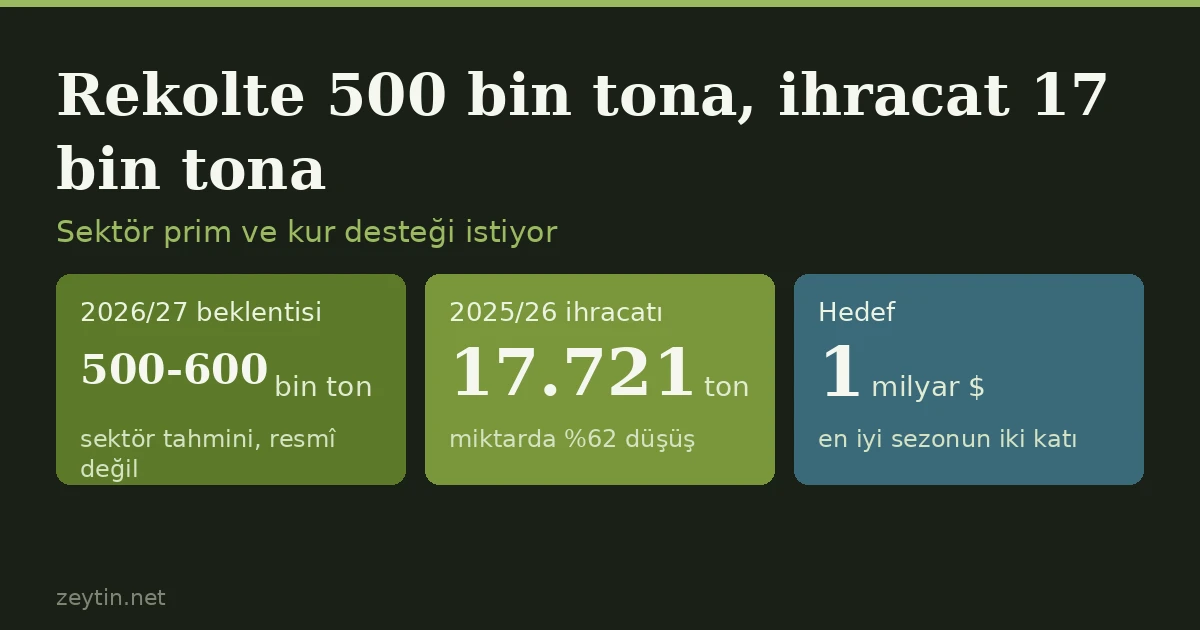
The crop is heading for 500,000 tonnes, exports fell to 17,000: the sector wants a premium and an exchange-rate mechanism
Industrialists and exporters meeting in Izmir put this season's olive oil crop at 500,000-600,000 tonnes. Last season Türkiye shipped 17,721 tonnes of olive oil: down 62% in volume and 59% in value. The crop is not the problem; selling the crop is.
 Article
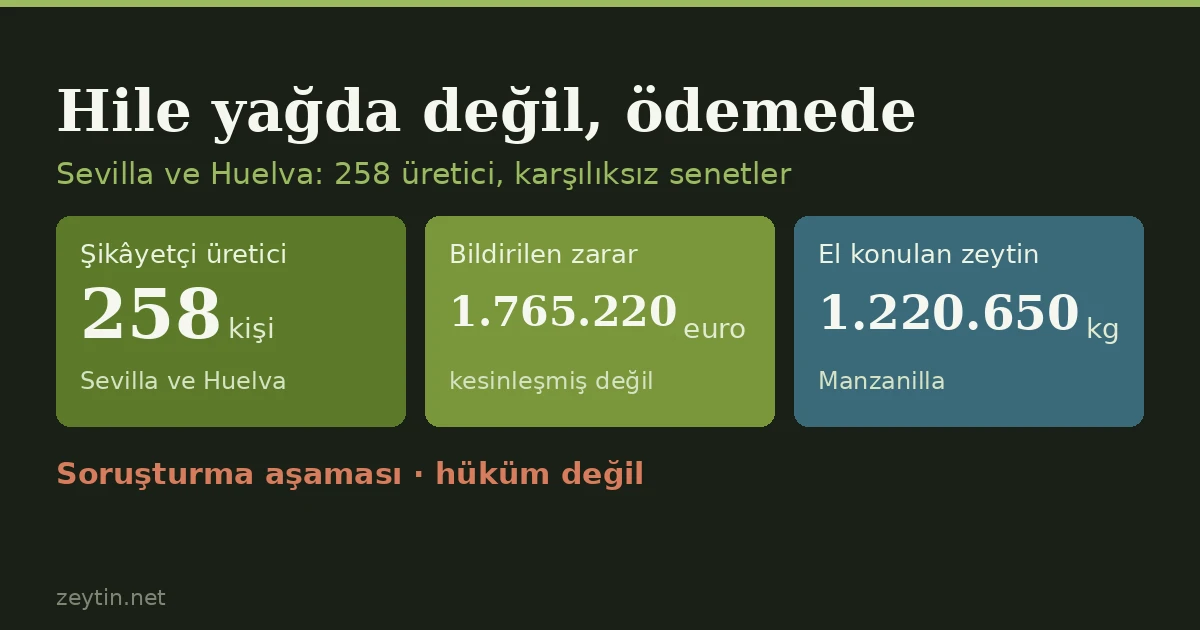
258 growers, €1.77 million: in Spain the fraud was not in the oil, it was in the payment
Spain's Guardia Civil has detained a table olive trader accused of defrauding 258 growers in Seville and Huelva of €1,765,220. The olives were real and the sales were real; the money never reached the producers. Investigators seized 1,220,650 kilos of Manzanilla olives.
 Article
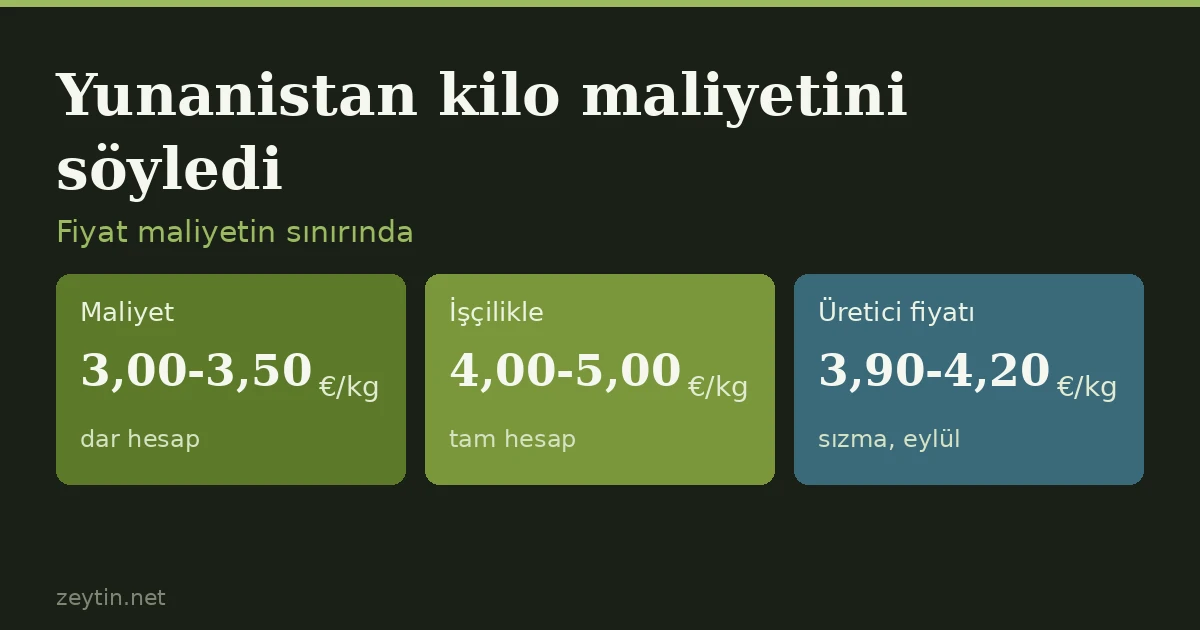
Greece finally puts a number on its cost: €3-3.5 a kilo, up to €5 with labour
For the first time Greece has put a per-kilo figure on its olive oil production cost: €3.00-3.50, rising to €4.00-5.00 once labour is fully counted. The producer price stands at €3.90-4.20, at or below that cost. Spain's €1.70-2.00 for the same item shows where the competitive gap actually sits. Greek output for 2026/27 is estimated at 280,000-330,000 tonnes.
 Article
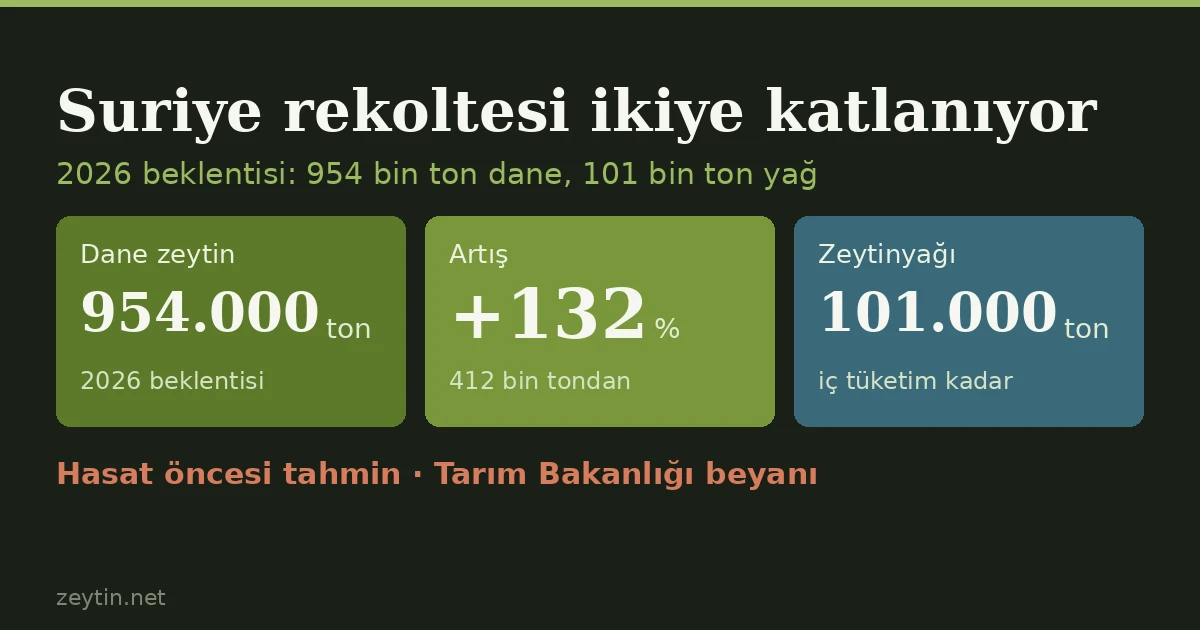
Syria's crop doubles to 954,000 tonnes — and the oil still only feeds itself
Syria's Ministry of Agriculture expects 954,000 tonnes of olives in 2026, up from 412,000 last season. The 101,000 tonnes of oil that implies barely covers domestic consumption — a doubled crop that still produces no export surplus.