Koroneiki olive: Greece's oil variety
The backbone of Greek olive oil. Very small fruit, very high polyphenol content, and one of the three super-high-density varieties.
Most of Greece's olive oil comes from a single variety: Koroneiki. Dominant across the groves of Crete and the Peloponnese, it also yields one of the highest-polyphenol oils in the world.
Small fruit, dense oil
Koroneiki's fruit is very small — with Arbequina, among the smallest-fruited commercial varieties anywhere. Its oil content is nonetheless high.
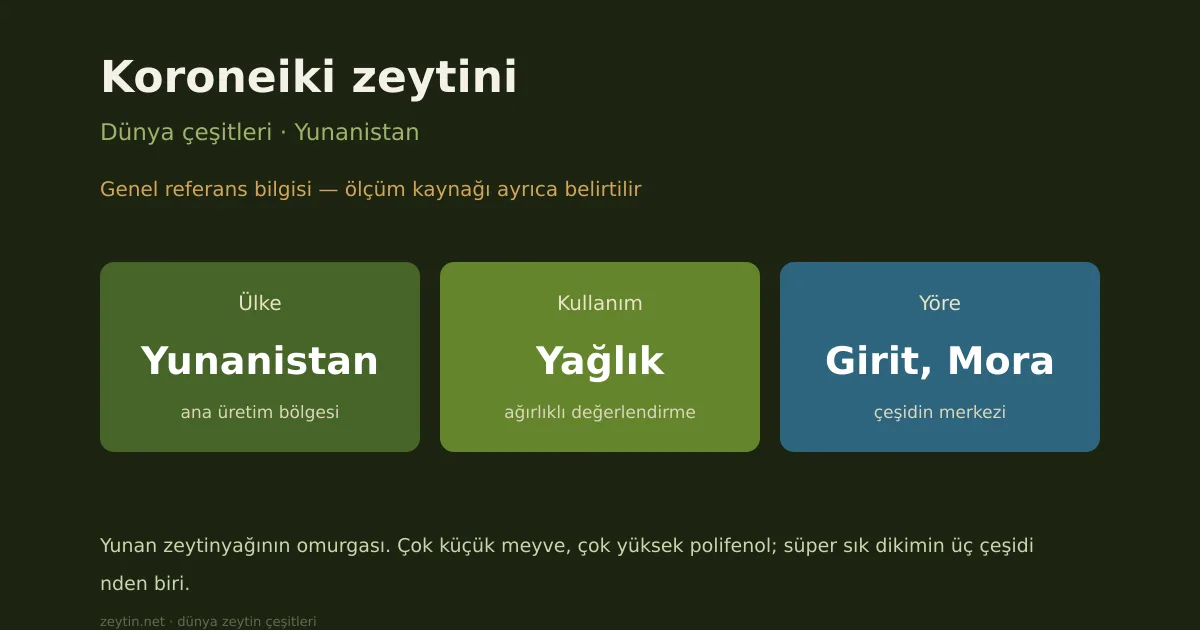
Small fruit means two things: more skin and stone surface per unit weight, hence denser phenolic content; and suitability for mechanical harvest. The second made Koroneiki one of the three super-high-density varieties (the others being Arbequina and Arbosana).
The character of the oil
Green, grassy, distinctly bitter and pungent, with cut grass, green almond and pepper notes commonly described. The combination of high oleic acid and high polyphenols delivers both oxidation resistance and long shelf life.
That composition makes Koroneiki the main source of high-phenolic oils carrying health claims. On what those compounds are: oleocanthal and polyphenols.
Compared with Türkiye
The pairing of small fruit and high oil brings Koroneiki close to Türkiye's Kilis Yağlık: 560 fruits per kilo at 31% oil. Both fall squarely in the "not for the table, purely for oil" class.
The difference is that Koroneiki has been adapted to modern planting systems. Kilis Yağlık remains in traditional groves; Koroneiki is being planted in new orchards worldwide.
The third name in super-high-density planting
Super-high-density planting rests on three varieties: Arbequina, Arbosana and Koroneiki. Koroneiki earned its place as much by how quickly it bears as by its small fruit.
In a Córdoba (Spain) trial setting five varieties side by side:
- Koroneiki was the earliest to bear — three years after planting.
- The highest yields came from Arbequina and Arbosana — six years after planting.
So Koroneiki starts first and the Spanish varieties overtake it later. Given that a traditional grove takes 6-8 years to a first crop, all three do the same job: they shorten the wait.
Source: Córdoba trial (Arbequina, Arbequina IRTA-I.18, Arbosana, Koroneiki, FS-17), cited in Atmaca and Ülger, Zeytin Bilimi.
What the three share is suitability to dense planting; where they part is the character of the oil. Koroneiki gives a sharp, high-phenol oil, Arbequina a soft, low-phenol one. Same planting system, opposite tastes.
Related pages
- World olive varieties: from Picual to Kalamata
- Türkiye's 17 olive varieties
- Chilling requirement in olives
Measured characteristics
| Property | Value | Source |
|---|---|---|
| Fruit weight | 0.96 g | IOC Dünya Kataloğu |
| Flesh ratio | 81.9% | IOC Dünya Kataloğu |
| Flesh-to-stone ratio | 4.51 | IOC Dünya Kataloğu |
| Oil content | 24-28% | IOC Dünya Kataloğu |
Where it stands among measured varieties
et/çekirdek oranı 4,51'ten türetildi — kaynak: IOC Dünya Zeytin Çeşitleri Kataloğu — Avustralya denemesi 19
Vossen, UC Cooperative Extension — IOC World Catalogue (Barranco vd.)
IOC Dünya Zeytin Çeşitleri Kataloğu — Avustralya denemesi 1998-2004 (Tablo 4)
IOC Dünya Zeytin Çeşitleri Kataloğu — Avustralya denemesi 1998-2004 (Tablo 4)
Values are those published on each variety's own page; the comparison covers only varieties with a measured figure, so it is a comparison of what is known — not of every Turkish variety. See the full ranking and how it is built →
One rating per visitor; you can change yours at any time. Ratings are real reader votes — no seeded or default scores.
Related
 Article
Which olive varieties have the highest oil content?
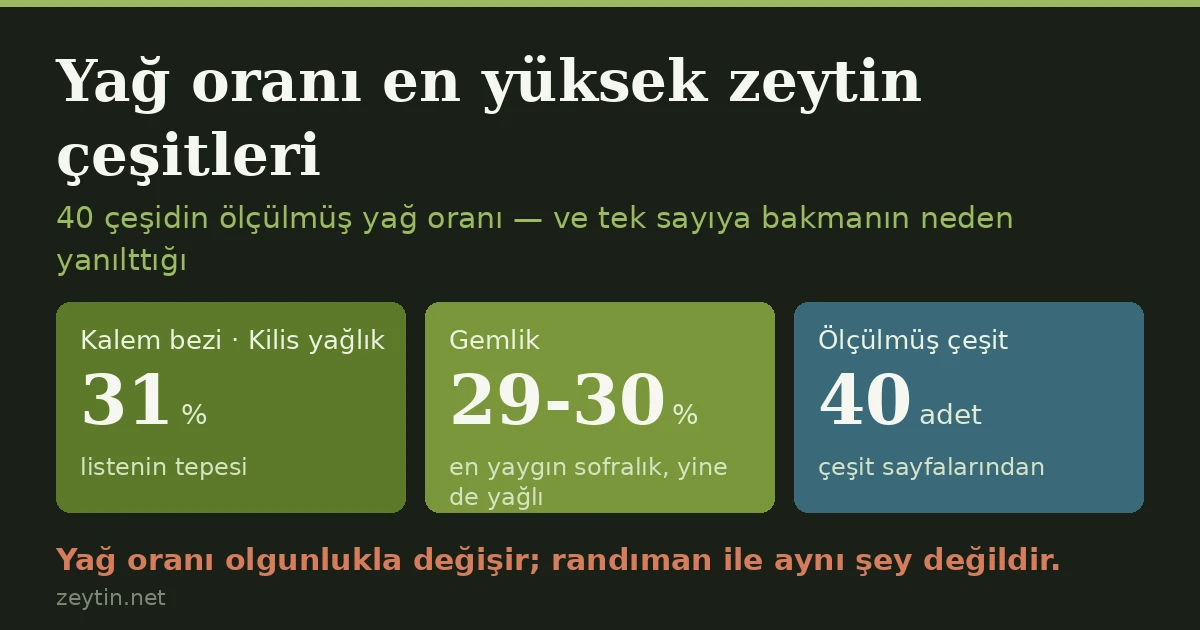
Kalem bezi and Kilis yağlık lead at 31 percent, with Gemlik just behind at 29-30. Measured oil content for 40 varieties — and what the figure does and does not tell you.
Article
Which olive varieties have the highest oil content?
Kalem bezi and Kilis yağlık lead at 31 percent, with Gemlik just behind at 29-30. Measured oil content for 40 varieties — and what the figure does and does not tell you.
 Article
The Memecik olive: Türkiye's oil variety
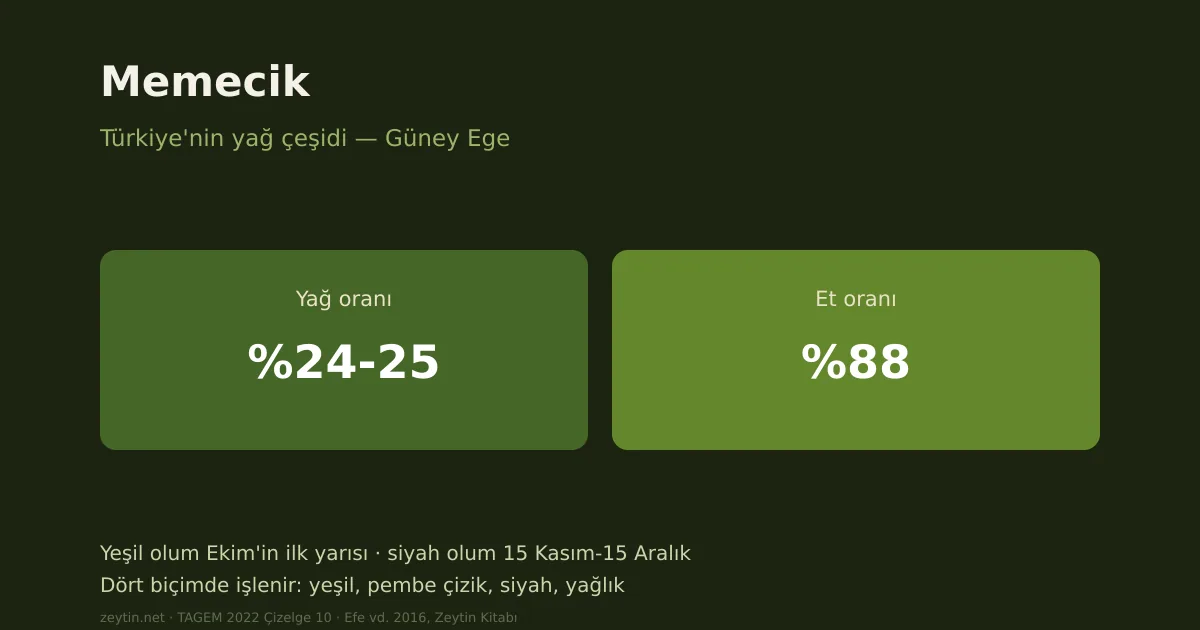
Between 19% and 45% of the tree stock. 24-25% oil, 88% flesh. Green maturity in early October, two months after Gemlik.
Article
The Memecik olive: Türkiye's oil variety
Between 19% and 45% of the tree stock. 24-25% oil, 88% flesh. Green maturity in early October, two months after Gemlik.
 Article
Yağ Çelebi olive: characteristics, oil content and growing areas
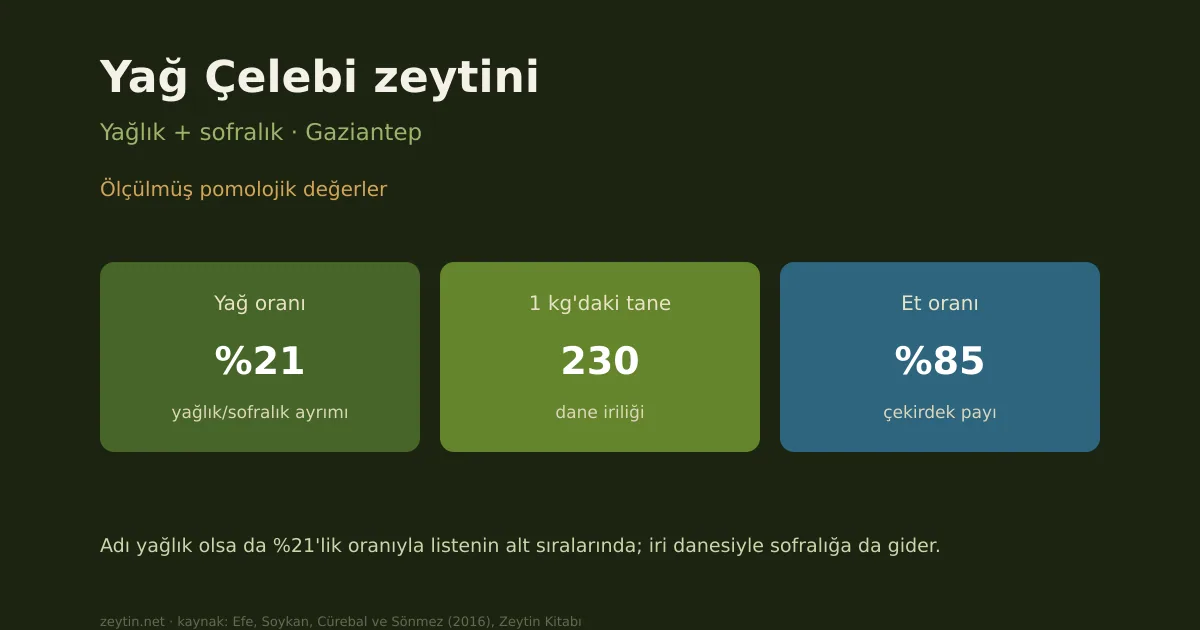
Despite the name, its 21% oil puts it low on the list; its large fruit also serves the table.
Article
Yağ Çelebi olive: characteristics, oil content and growing areas
Despite the name, its 21% oil puts it low on the list; its large fruit also serves the table.
 Article
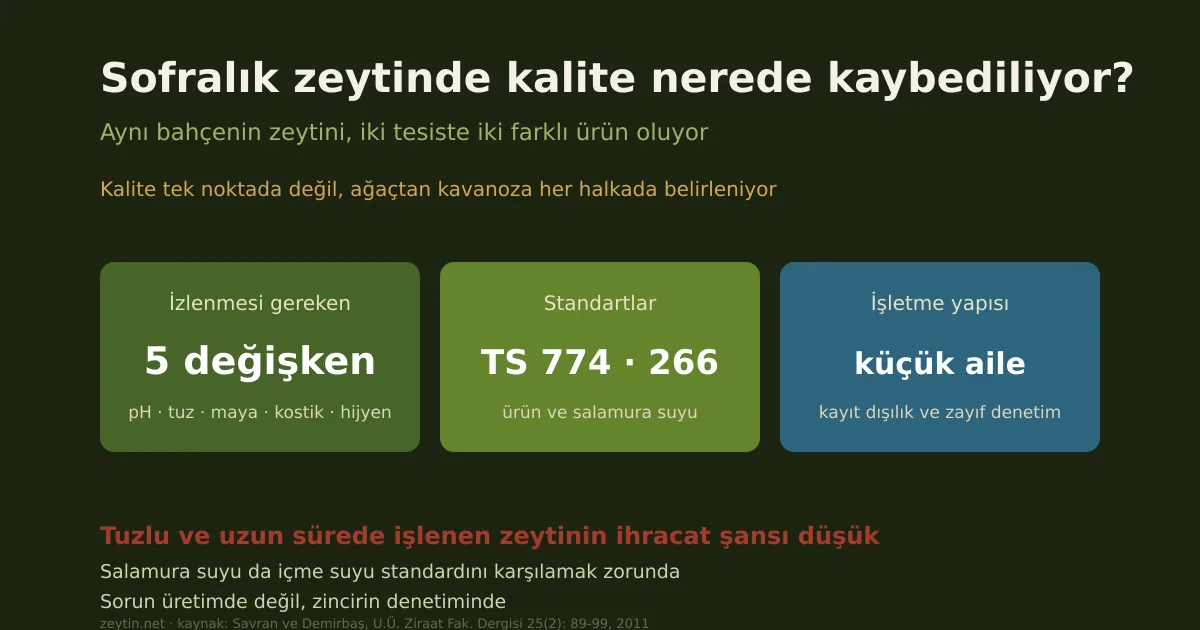
Where is quality lost in table olives?
Variety choice, harvest technique, fermentation control, sterilisation and the pre-packing check are each a separate point of loss. The structural problem is scale and inspection.
Article
Where is quality lost in table olives?
Variety choice, harvest technique, fermentation control, sterilisation and the pre-packing check are each a separate point of loss. The structural problem is scale and inspection.