Spain's competition authority opposes the withdrawal rule: "very negative for competition and consumers"
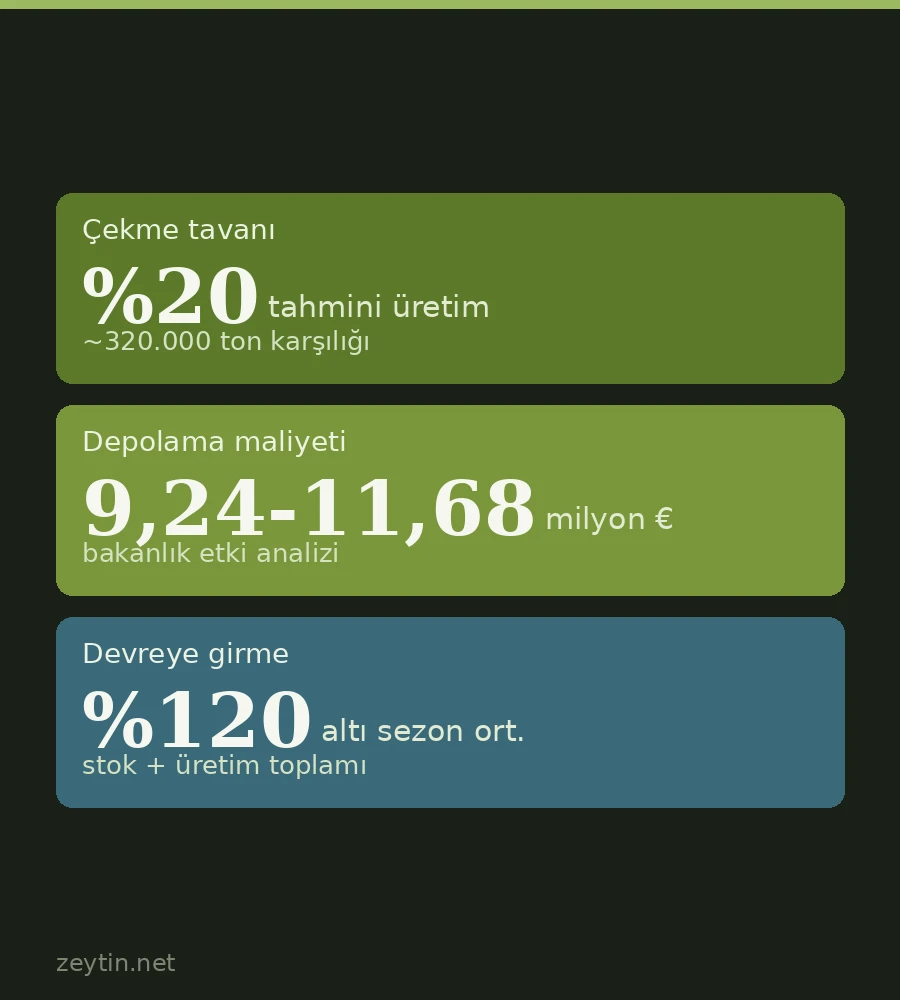
On 5 October the CNMC published its report on the draft rule that would withdraw part of Spain's olive oil from the market in the event of oversupply in 2026/27. The authority says the measure would raise prices and narrow quality and variety. The ministry's own impact assessment puts storage costs at €9.24-11.68 million. The withdrawal cap is 20 percent of estimated production — up to 320,000 tons.
A new document has landed in front of the decision Spain will take in November. The country's competition authority, the CNMC (National Commission on Markets and Competition), published its report on the Ministry of Agriculture, Fisheries and Food's draft olive oil marketing rule for the 2026/2027 season on 5 October. The verdict is short: withdrawing part of the oil from the market in the event of oversupply could produce "very negative effects on competition and consumers."
We have already covered the logic of the draft and the November timetable. The report arrives in the middle of that timetable: to apply in 2026/27, the rule has to be adopted by the end of October.
The rule has two thresholds
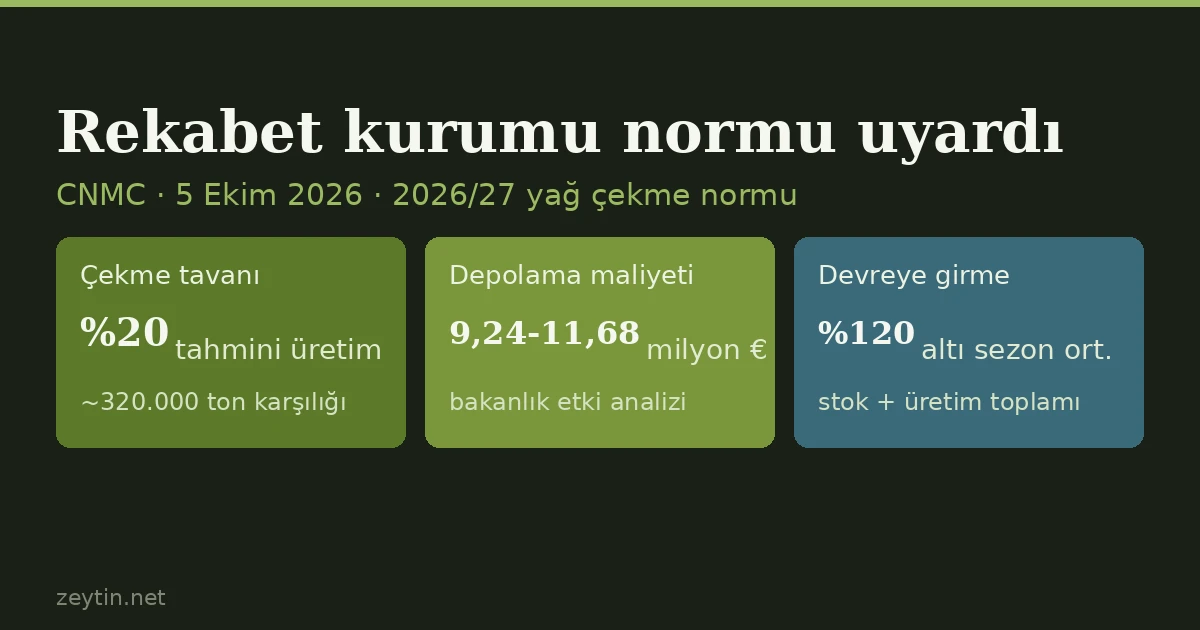
The most useful detail the report opens up is that the mechanism rests not on one calculation but on two. Article 4 of the draft sets out when the measure is triggered: when initial stocks plus the production estimate reach or exceed 120 percent of the average of the same sum over the previous six campaigns.
Article 5 then calculates how much is withdrawn, and here the benchmark changes: the percentage is based on the difference between the resources estimated for 2026/27 and 120 percent of the average of the two highest marketing values of the last six campaigns. The figure will be set by a resolution of the Directorate-General for Agricultural Production and Markets, and it cannot exceed 20 percent of estimated production. Article 6 places the obligation on the mills that produce the oil: they carry out the withdrawal and the storage.
| Draft rule · 2026/27 | Figure |
|---|---|
| Season | 1 Oct 2026 - 30 Sep 2027 |
| Activation threshold | 120% of six-season average |
| Withdrawal cap | 20% of estimated production |
| Spanish forecast (aforo) | 1,602,596 t |
| What 20% amounts to | ~320,000 t |
| Storage cost (ministry estimate) | €9.24-11.68 million |
What the CNMC objects to
The authority's reasoning comes under three headings: the measure would limit the quantity of product available on the market; it would affect prices, quality and the variety of supply; and it would alter the competitive functioning of the value chain. The CNMC also argues that any application of the measure must rest on a complete diagnosis of the market, and asks for its effects to be quantified — on prices, consumption and the profitability of producers and other operators in the chain, with particular regard to lower-income consumers.
The methodological criticism is more technical but more striking. Using a six-campaign average as the benchmark includes no mechanism to filter out the influence of exceptionally high or low production years. In the CNMC's view, a threshold tied to recent historical maxima would identify genuinely extraordinary oversupply more accurately; a 120 percent threshold built on an average may not reflect a sufficiently exceptional deviation from normal market conditions. The calculation also leans almost entirely on supply variables, leaving demand and trade flows out of the equation.
The authority further recalls Article 167a of the EU common market organisation regulation: marketing rules introduced to regulate supply are conditional on not blocking an excessive percentage of normally available production.
Who pays the cost
The obligation to keep the withdrawn oil in storage for a whole campaign generates costs for the operators affected. The figure comes from the ministry's own regulatory impact assessment: under a maximum-application scenario, total storage costs would run between €9.24 and €11.68 million. The assessment argues that this expense could be offset by the income stabilisation the measure delivers.
The CNMC reads that sentence the other way round: the income increase that arises from the higher prices consumers will bear because supply has been withdrawn would, in those amounts, go towards covering the costs the measure itself generates. In other words, the final buyer finances the expense.
Six recommendations
The CNMC does not reject the rule; it asks in six points for it to be narrowed. Reinforce the justification with demand and trade-flow data showing that the withdrawal responds to genuinely extraordinary oversupply. Clarify the methodology for determining the withdrawal percentage so that the 20 percent limit reflects the minimum necessary restriction. Limit the withdrawal to the categories where it is needed, with a detailed justification of the freedom of choice granted to each mill. Clarify which operators are bound, resolving the apparent discrepancy over the exclusion of small mills with objective and non-discriminatory criteria, including for newly established mills. Define the control plan before activating the measure and prevent the exchange of sensitive data between operators. Establish a monitoring process with clear criteria, phases and deadlines, so the measure can be adjusted or revoked if market conditions change.
Reports of this kind are advisory: the CNMC can be consulted by the government, ministries, autonomous communities and trade organisations, or can act on its own initiative. The report therefore does not stop the rule — but it leaves a text that Madrid will have to get past when it writes the reasoning for its November decision.
What it means for Turkey
The size of the cap is the heart of the matter. Twenty percent of the 1,602,596-ton forecast Spain announced on 1 October is roughly 320,000 tons — more than half of the harvest Turkey is discussing for this season, and a quantity a single country could hold off the market.
For exporters there are two scenarios. If the withdrawal goes ahead, part of world supply is shelved for a season and prices look up. If the CNMC's objection carries and the rule is narrowed — or never triggered — then 1.6 million tons of production plus carryover stocks keep pressing prices down. As things stand, extra virgin was registered at ₺298.23 per kilo on the Edremit exchange on 25 September, while the Spanish producer price is €3.45 per kilo; at the European Central Bank's 5 October rate, the gap runs against Turkish oil.
The detail to watch is again the category. Because each mill chooses which quality to immobilise, a withdrawal would not reduce supply evenly across extra virgin, virgin and lampante. The CNMC's recommendation to limit the withdrawal to the necessary categories touches precisely this point — and what Turkish exporters meet in third markets is not total tonnage but that composition.
One rating per visitor; you can change yours at any time. Ratings are real reader votes — no seeded or default scores.
Related
 Article
In Spain the cost sits above the price: €5.31 in a traditional grove, €3.46 at the gate
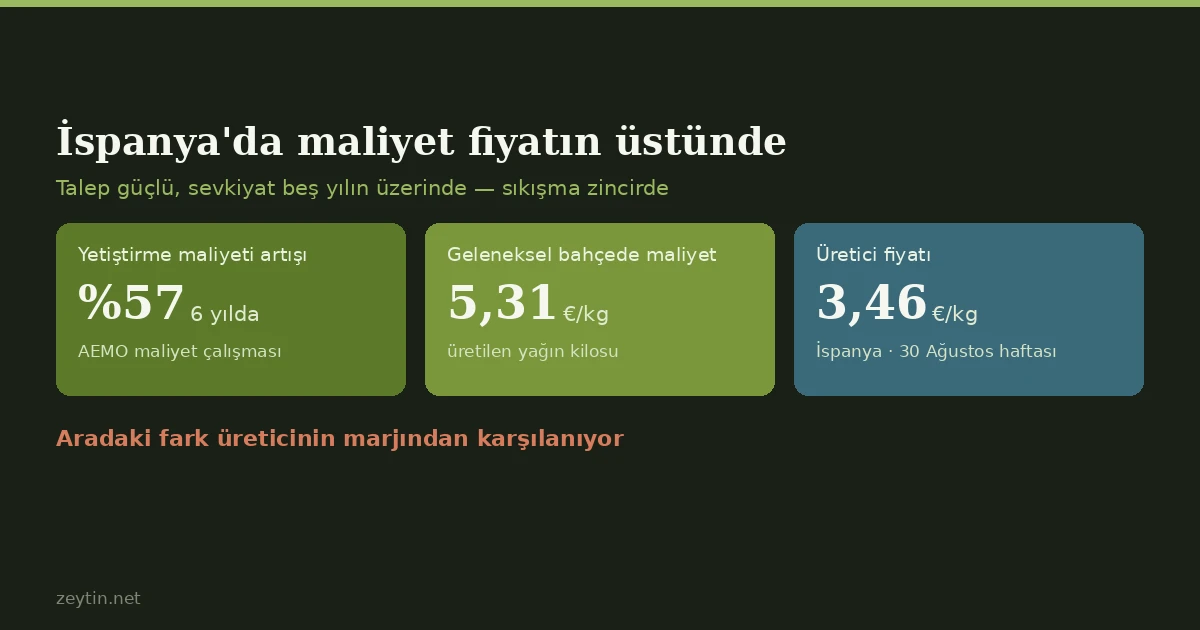
Olive cultivation costs have risen 57% in six years and reach €5.31 per kilogram in the most traditional groves, according to an AEMO study. The same week, Spain's producer price was €3.46. The Andalusian cooperative federation, with 342,000 members, is asking not for aid but for a change to the Food Chain Law.
Article
In Spain the cost sits above the price: €5.31 in a traditional grove, €3.46 at the gate
Olive cultivation costs have risen 57% in six years and reach €5.31 per kilogram in the most traditional groves, according to an AEMO study. The same week, Spain's producer price was €3.46. The Andalusian cooperative federation, with 342,000 members, is asking not for aid but for a change to the Food Chain Law.
 Article
The 2026/27 season opens: first harvests in Ayvalık, Gemlik and Bozcaada
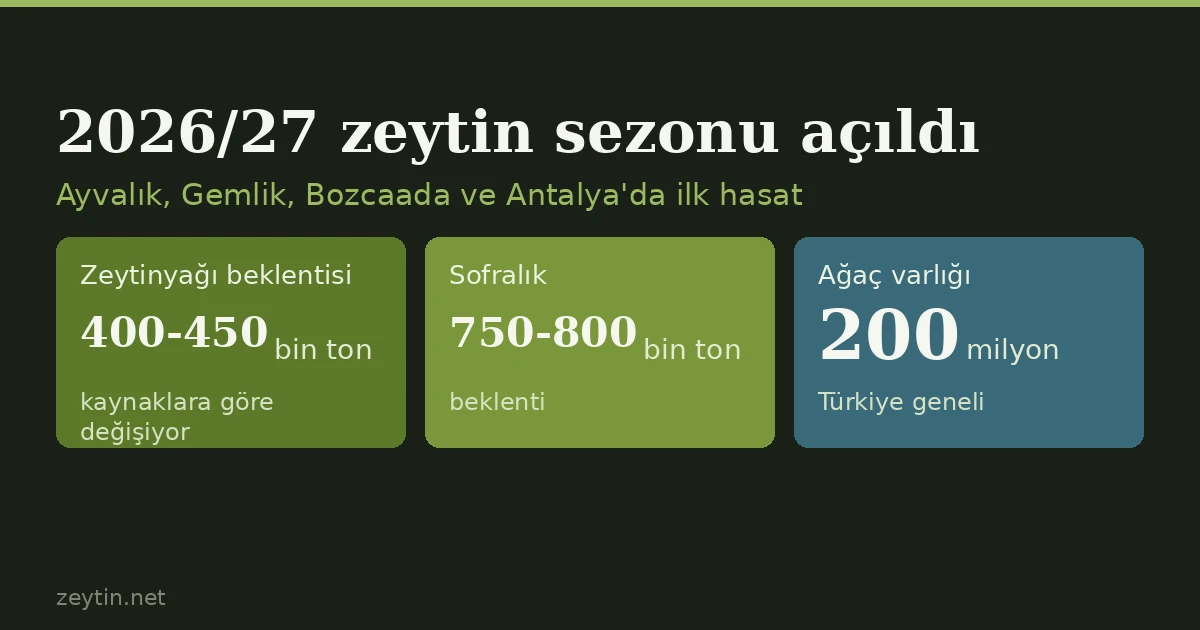
The new olive season opened with three events on 11-13 September. In Ayvalık, an on-year forecast of 400,000-450,000 tonnes of olive oil was voiced; in Gemlik the first olives were picked during the festival; and on Bozcaada the island's first olive oil was pressed with a portable system.
Article
The 2026/27 season opens: first harvests in Ayvalık, Gemlik and Bozcaada
The new olive season opened with three events on 11-13 September. In Ayvalık, an on-year forecast of 400,000-450,000 tonnes of olive oil was voiced; in Gemlik the first olives were picked during the festival; and on Bozcaada the island's first olive oil was pressed with a portable system.
 Article
Co-op branding in the adulteration list: one name, four separate announcements
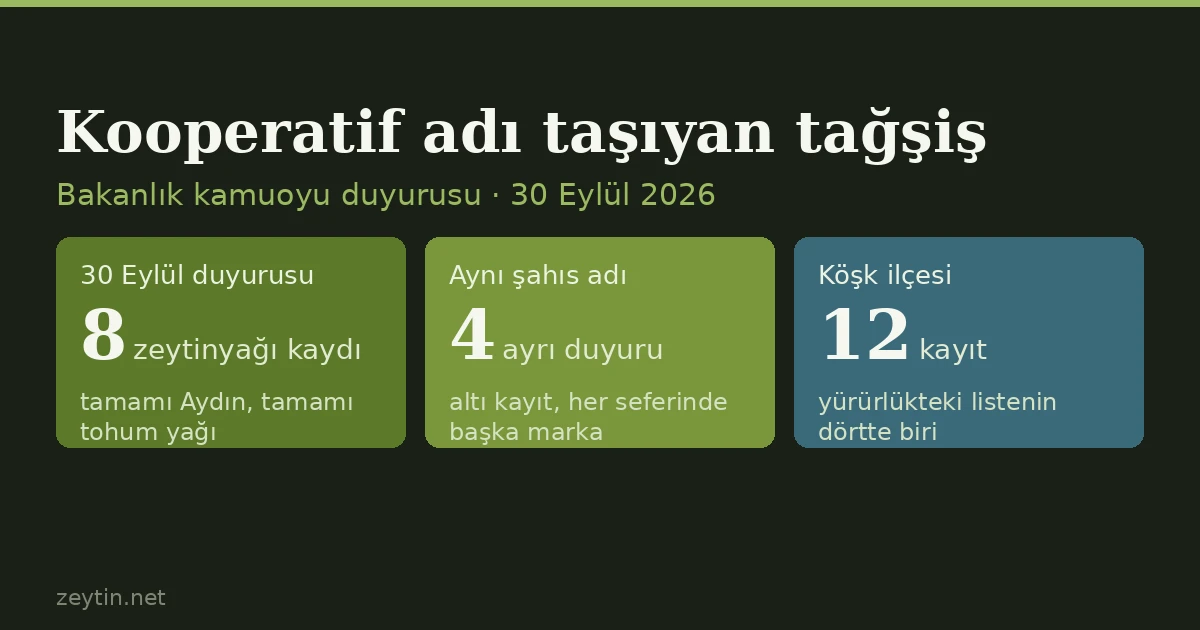
All eight olive oil entries in Turkey's 30 September 2026 food-fraud announcement come from a single province, Aydın, and all eight carry the same finding: seed oil blended into oil sold as extra virgin. The brand names tell a second story — three of them invoke a cooperative or a producers' union. Read as a time series, the live list shows one trader's name across four separate announcements, under a new brand each time.
Article
Co-op branding in the adulteration list: one name, four separate announcements
All eight olive oil entries in Turkey's 30 September 2026 food-fraud announcement come from a single province, Aydın, and all eight carry the same finding: seed oil blended into oil sold as extra virgin. The brand names tell a second story — three of them invoke a cooperative or a producers' union. Read as a time series, the live list shows one trader's name across four separate announcements, under a new brand each time.
 Article
Italy from production giant to trade hub: it exports more olive oil than it produces
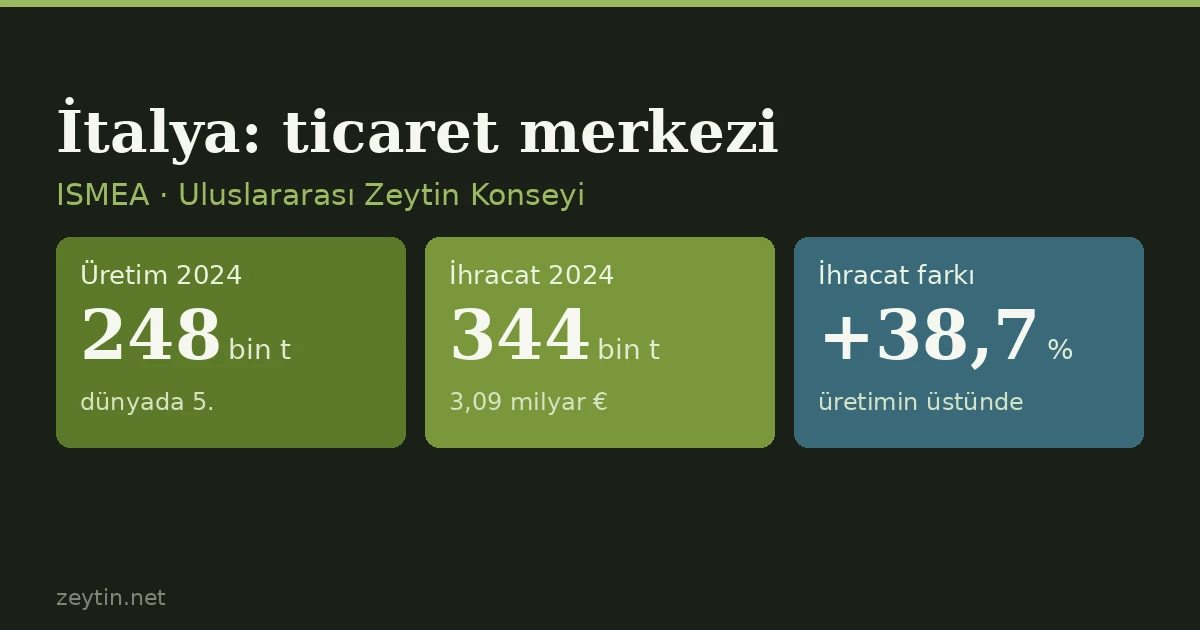
Italy produced 248,000 tonnes of olive oil in 2024 and slipped to fifth place worldwide, yet in the same year it exported 344,000 tonnes worth 3.09 billion euros. The country is now less a production giant than a trade hub that buys oil around the Mediterranean, blends it and sells it to the world.
Article
Italy from production giant to trade hub: it exports more olive oil than it produces
Italy produced 248,000 tonnes of olive oil in 2024 and slipped to fifth place worldwide, yet in the same year it exported 344,000 tonnes worth 3.09 billion euros. The country is now less a production giant than a trade hub that buys oil around the Mediterranean, blends it and sells it to the world.