When can babies have olive oil?
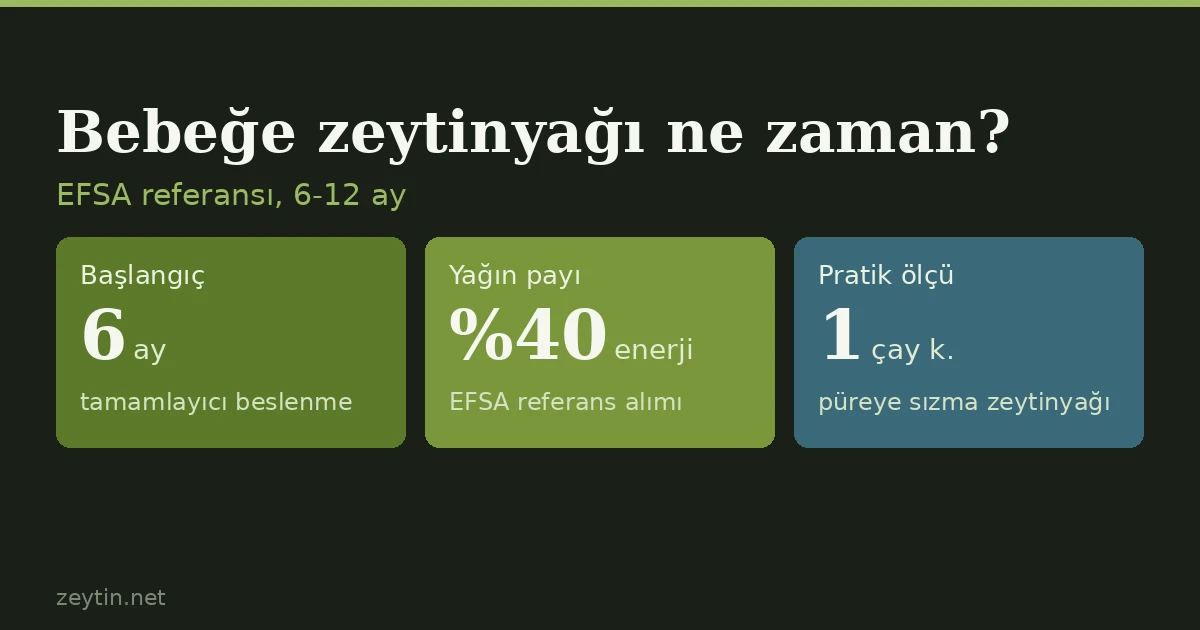
Complementary feeding starts at the end of the sixth month, and olive oil has a place at that table — because a substantial share of an infant's energy has to come from fat. EFSA's reference intake for 6-12 months is 40% of energy. But two separate questions get mixed up: adding oil to a purée is not the same as giving olive oil for constipation, and a table olive is not olive oil as far as a baby is concerned.
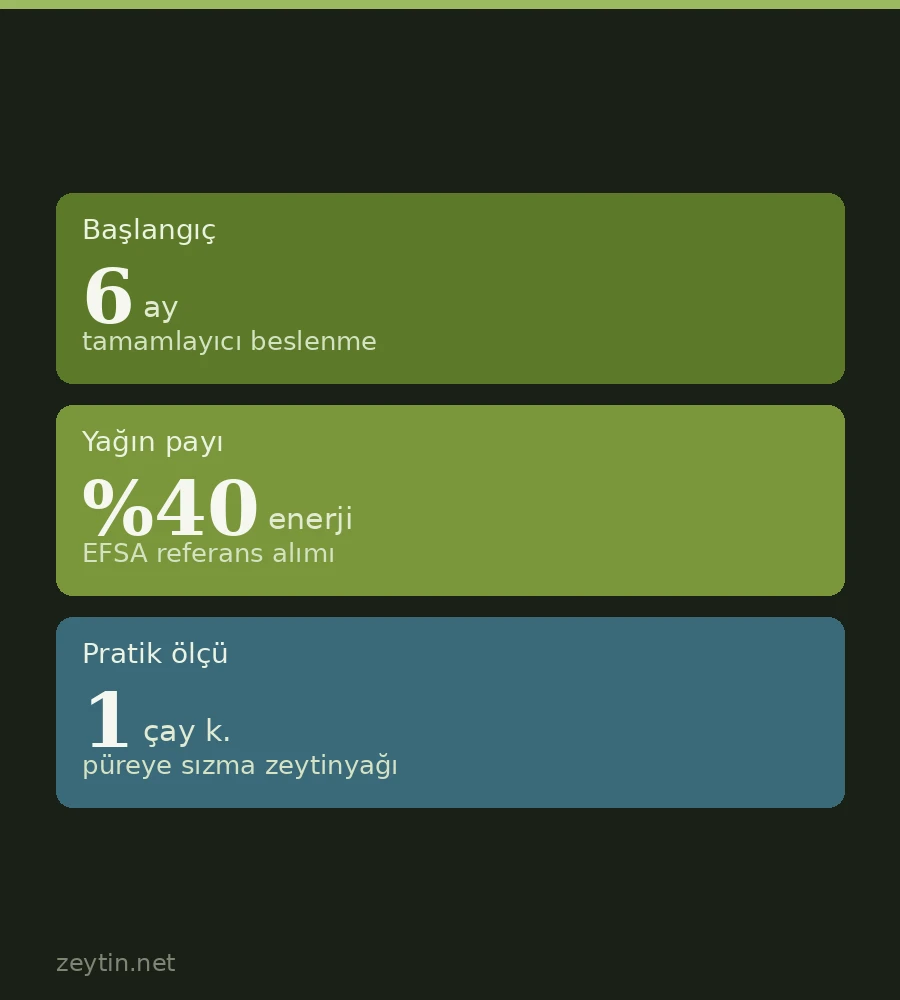
The short answer: with complementary feeding, at the end of the sixth month. Olive oil has no separate starting age of its own; it begins as a component of the food of a baby who is moving on to solids.
Underneath that answer, though, sit three questions that get tangled together: why fat is needed, how much to give, and what exactly the practice called "olive oil for constipation" is. Let us take them one at a time.
Why fat: this is not a flavour item
In infant nutrition, fat plays a very different role from the one it plays in adult nutrition. In the opinion on nutrient requirements of infants and young children published by the European Food Safety Authority (EFSA) in 2013, the reference intake for fat in the 6-12 month range is given as 40% of energy. The same document reports that measured average fat intake among European infants in the second half of the first year ranged from roughly 26-29% to 38-46%.
The reason is straightforward: a baby's stomach is small while energy needs per kilo of body weight are large. Fat delivers the most energy in the same volume. On top of that, the absorption of fat-soluble vitamins (A, D, E, K) and the essential fatty acids needed for nervous-system development come from this same item.
Most of the energy in breast milk comes from fat. As a baby moves to complementary foods, the share coming from milk falls; if vegetable purées and soups do not fill that space, energy density drops. Oil added to the purée closes exactly that gap.
How much, and how
The common practical recommendation is one teaspoon of extra virgin olive oil in a vegetable purée or soup, with the amount rising as portions grow. Infant feeding does not accept a single template — weight gain, how much breast milk the baby takes and the number of meals all shape the amount, so the precise figure should come from the attending physician.
Two practical details matter in the application:
Add the oil after cooking. Boil the vegetable, drain it, mash it, and stir the oil in last. That preserves the components of the oil that change with heat, and keeps the taste milder.
Extra virgin is preferred. The reason is not fashion: extra virgin oil has not been refined or chemically processed. We set out what to look for on the label in how to read an olive oil label, and gathered the ways to tell whether a product really is extra virgin in how to tell good olive oil. In a product where adulteration is widespread, that choice becomes especially important for infant feeding: fraud and adulteration in olive oil shows how serious the picture is.
If you want to see the oil's composition in numbers, the nutritional profile of olive oil gives the detail.
The "olive oil for constipation" question
This is a separate matter and it needs care. Giving a baby olive oil by spoon, or rectally, is a widespread folk practice. It is not the same thing as adding oil to a purée.
Giving liquid oil directly to an infant by spoon, outside a meal, carries a risk of swallowing difficulty and of the oil entering the airway. Rectal application is a medical intervention; and constipation in a baby may stem from the feeding pattern, fluid intake, or some underlying condition. The correct order is therefore: doctor first, practice second. Oil given within complementary food is part of nutrition; oil given as treatment is a clinical decision.
For a baby, a table olive is not olive oil
This is another frequent confusion. From the standpoint of infant feeding, olive oil and table olives are two entirely different products — and the difference is salt.
Under the Turkish Food Codex Communiqué on Table Olives, salt content in table olives may run up to 8% by weight; for the claim "low salt" to be used, the product must contain no more than 4 grams of salt per 100 grams. So even an olive labelled low-salt can carry salt amounting to 4% of its weight.
The shared item across complementary feeding guidance, meanwhile, is that no salt or sugar should be added to food before the age of one. An infant's kidneys cannot handle excess sodium the way an adult's can. Put those two facts side by side and the conclusion is clear: table olives are not food for the first year. Nor are they something to give afterwards without reducing the salt. We described step by step how table olives come to carry that much salt in how are olives cured.
If you want to look at the nutritional profile of the fruit, the nutritional profile of olives gives the table, sodium included.
Olive oil or butter?
During complementary feeding both fats are used, and that is not a contradiction. Their jobs on an infant's plate differ: olive oil brings monounsaturated fatty acids and an unprocessed structure, while butter sits on the saturated fat and vitamin A side. Guidance generally covers both; there is no reason to exclude either outright. In practice a common division is olive oil in vegetable purées and butter in cereal-based meals. If you want to see the composition of the two side by side, olive oil or butter makes the comparison.
If there is no frying in the baby's food — and for the first year there should not be — the argument about an oil's heat stability does not arise at all. For those curious, is olive oil suitable for frying runs that calculation for the adult kitchen.
How long does an opened bottle last?
Because the amount used for a baby is on the order of a teaspoon a day, the bottle stays open for a long time, and here storage conditions bite faster than quality does. Olive oil deteriorates with light, heat and air; an opened bottle left on the kitchen counter, beside the stove, or standing clear in a glass jar begins to turn rancid within weeks. For infant feeding that matters twice over: rancid oil loses nutritional value and spoils the taste, and the baby then rejects a food it has only just met.
The practical answer is to buy small packs and keep the bottle in a dark, cool cupboard. A refrigerator is not necessary; cool and dark is enough. We gathered the detail in how to store olive oil.
Allergy and first reactions
Olive oil does not appear among the foods that commonly cause allergy in infant feeding. Even so, the rule followed with every new food applies here too: introduce items one at a time, advance at two to three day intervals, and if a reaction such as rash, vomiting or diarrhoea appears, stop and consult a physician.
As a separate matter, olive pollen does play a role in respiratory allergies; that has nothing to do with eating the oil. For those curious, olive pollen allergy handles that picture on its own.
Summary
- Start: at the end of the sixth month, together with complementary feeding.
- Form: extra virgin olive oil stirred into a vegetable purée or soup after cooking.
- Amount: typically a share beginning at one teaspoon and growing with the portion; the exact figure from the attending physician.
- Rationale: in the 6-12 month range, fat carries a reference intake of 40% of energy.
- Do not: spoon plain oil into a baby, apply it rectally, or give table olives in the first year — the first is a risk, the second a clinical decision, the third salt.
For the adult side of the question, how much olive oil a day runs a separate calculation.
One rating per visitor; you can change yours at any time. Ratings are real reader votes — no seeded or default scores.
Related
 Article
Olive oil or butter? What a 221,000-person study actually found
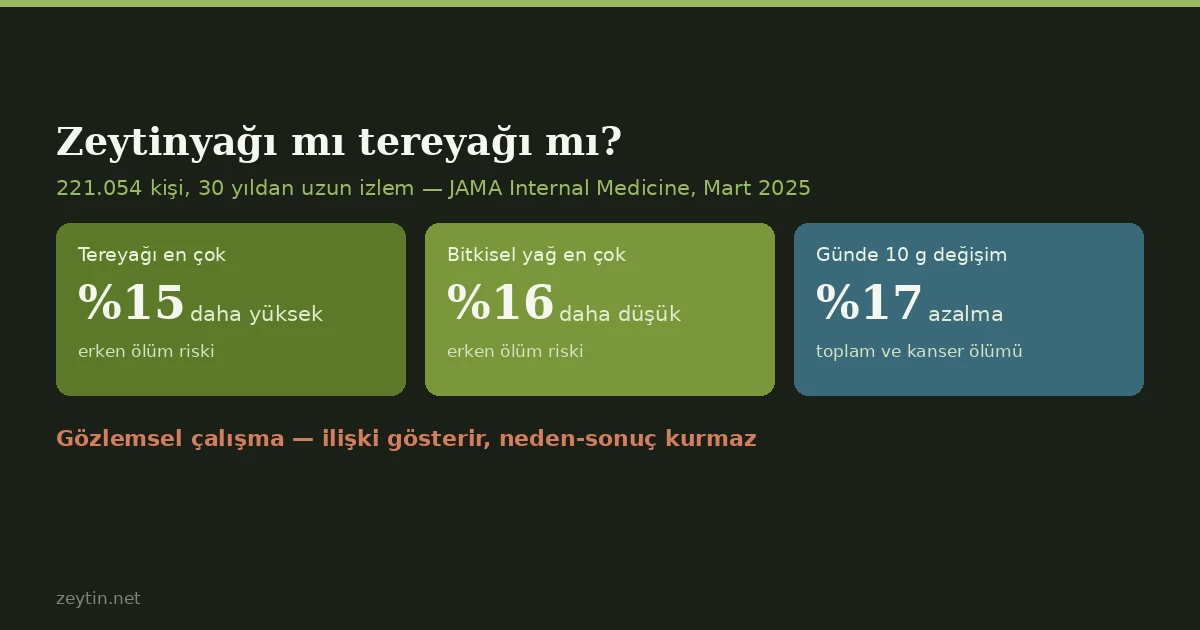
A Harvard-led study followed 221,054 people for over 30 years. Highest butter intake carried 15% higher mortality; highest plant-oil intake 16% lower. We look at what the numbers say — and what they do not.
Article
Olive oil or butter? What a 221,000-person study actually found
A Harvard-led study followed 221,054 people for over 30 years. Highest butter intake carried 15% higher mortality; highest plant-oil intake 16% lower. We look at what the numbers say — and what they do not.
 Article
What are the benefits of olive oil?
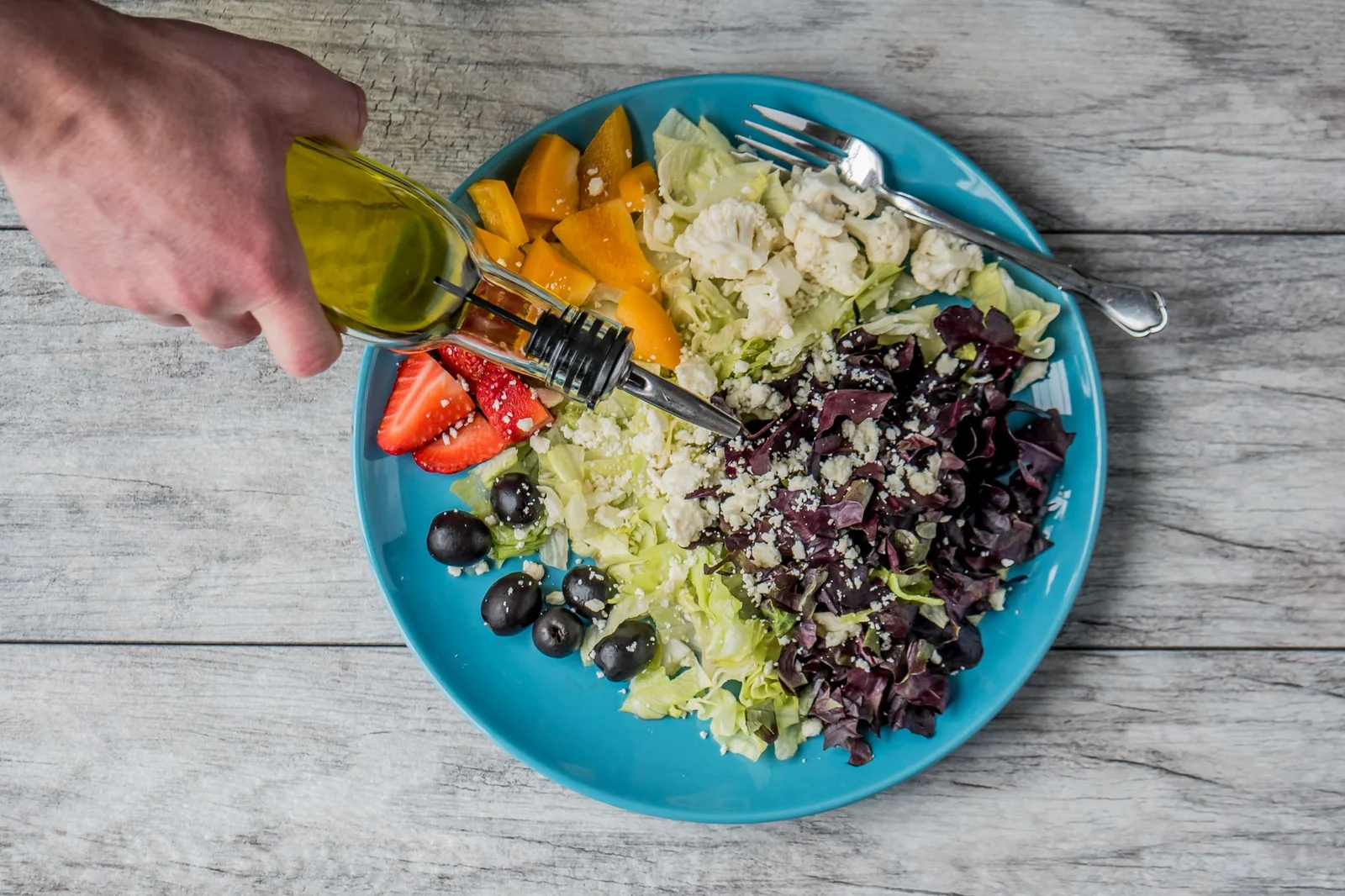
Authorised claims, topics still under research and unproven claims kept apart — including the EFSA claim and PREDIMED.
Article
What are the benefits of olive oil?
Authorised claims, topics still under research and unproven claims kept apart — including the EFSA claim and PREDIMED.
 Article
Is Olive Oil Suitable for Frying?
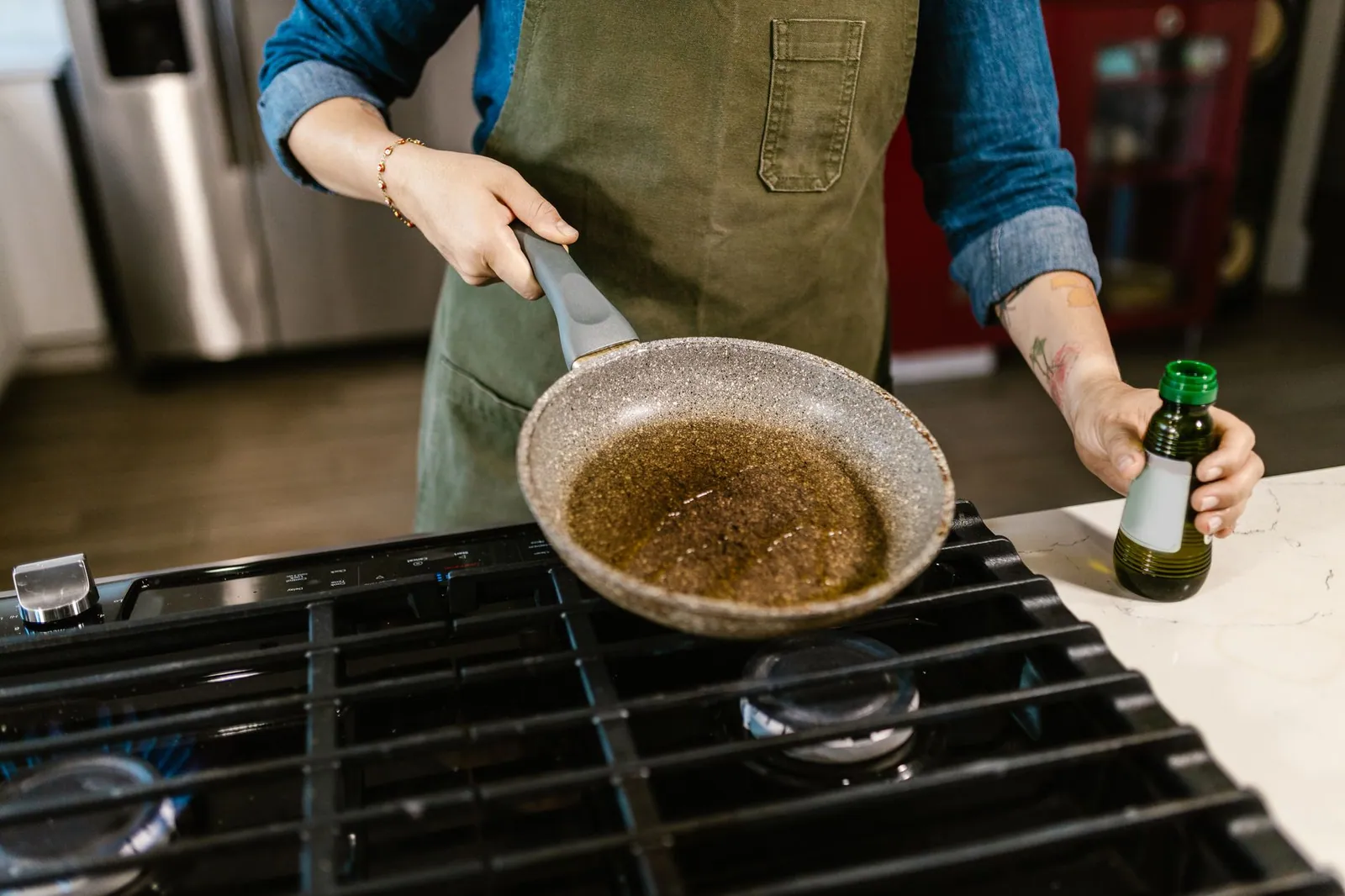
The most argued kitchen question. Smoke point is not the only measure; what really matters is how well the oil resists oxidation.
Article
Is Olive Oil Suitable for Frying?
The most argued kitchen question. Smoke point is not the only measure; what really matters is how well the oil resists oxidation.
 Article
Olive pollen allergy: the quiet cause of May to July
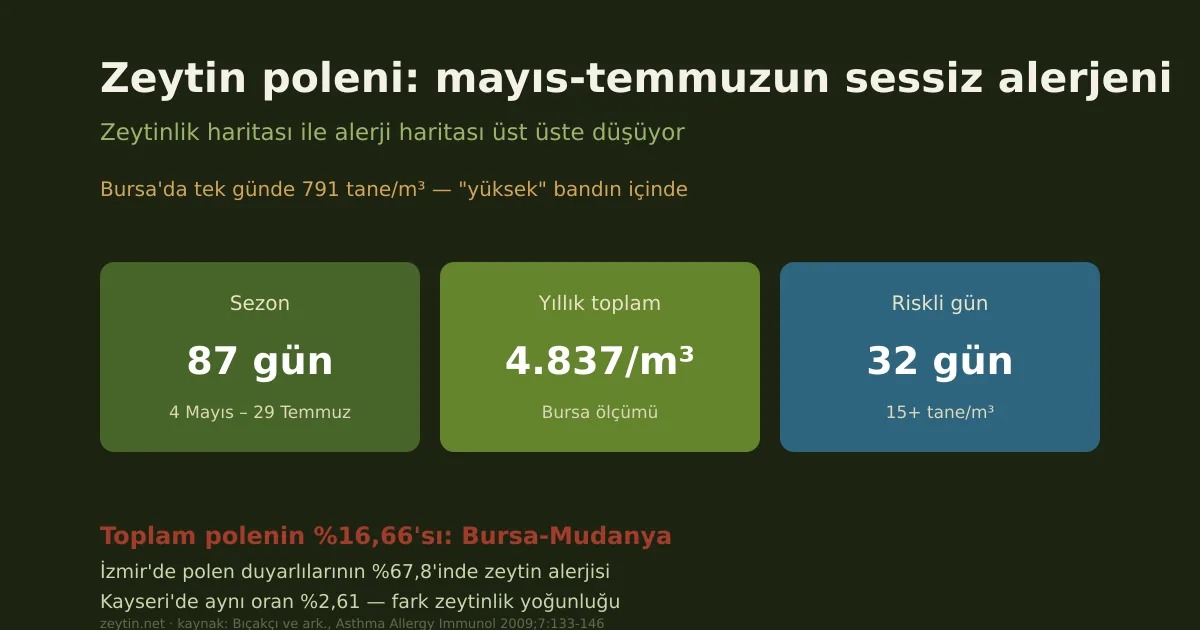
Olive pollen fills the air across western Türkiye from May to July. Bursa recorded 791 grains/m³ in one day over an 87-day season; 67.8% of pollen-sensitised patients in İzmir react to it.
Article
Olive pollen allergy: the quiet cause of May to July
Olive pollen fills the air across western Türkiye from May to July. Bursa recorded 791 grains/m³ in one day over an 87-day season; 67.8% of pollen-sensitised patients in İzmir react to it.