Can people with diabetes eat olives and olive oil?
It looks like one question but contains two: table olives and olive oil. Neither is off limits in type 2 diabetes; olives carry too little carbohydrate to measure a glycaemic index for, and oil carries none. The real limiting factor is not blood sugar but the salt in the brine.
Someone with diabetes usually asks this in a single sentence, but two separate questions are hiding inside it: can I eat table olives, and can I use olive oil? The two differ both in their effect on blood sugar and in where the real caution lies.
The short answer: neither is a forbidden food in type 2 diabetes, and there is clinical evidence that can be read in favour of olive oil. But with table olives the limiting factor is not blood sugar — it is the salt in the brine, and that is the part most often skipped.
How much carbohydrate is in an olive?
Carbohydrate is the nutrient that raises blood sugar. How much do olives contain?
| Per 100 g | Green olives | Black olives |
|---|---|---|
| Carbohydrate | 3.8 g | 6.3 g |
| Fibre | 3.3 g | 3.2 g |
| Fat | 15.3 g | 10.7 g |
| Sodium | ≈1,560 mg | ≈735 mg |
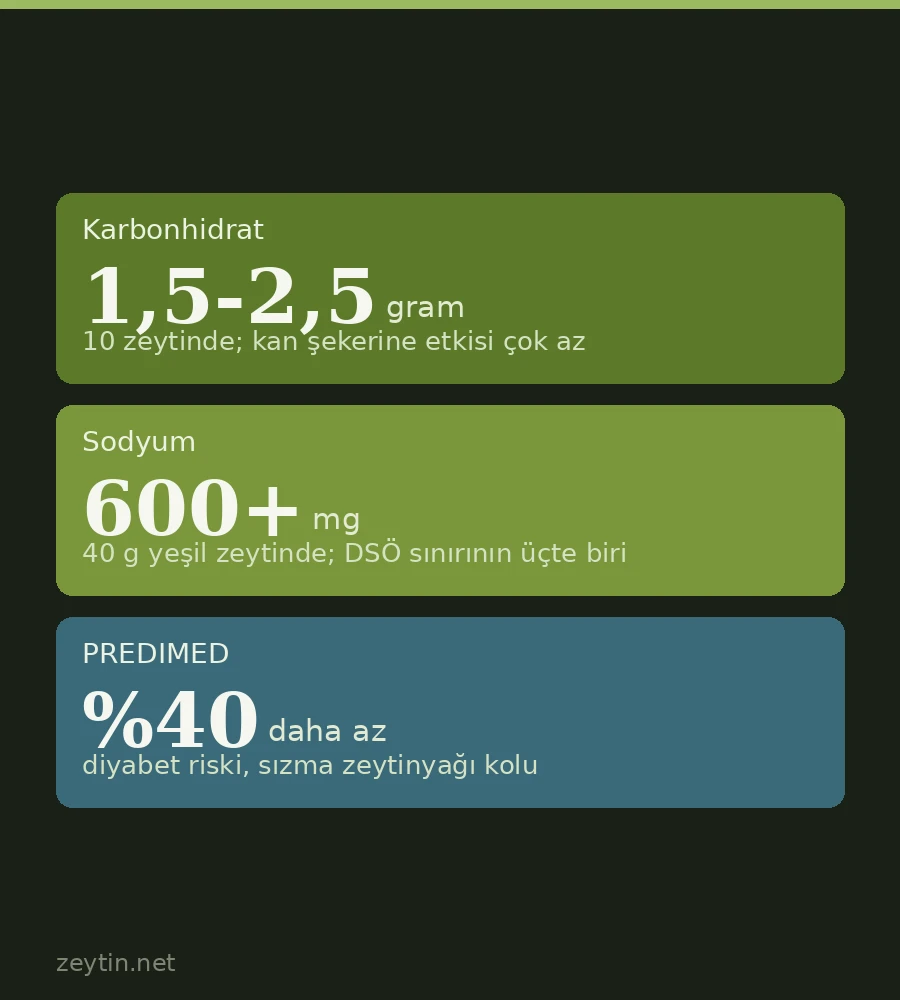
A large share of that carbohydrate is fibre, and fibre does not enter the blood as sugar. Ten medium olives weigh roughly 40 grams, so one serving carries about 1.5-2.5 grams of carbohydrate. Set against the roughly 15 grams in a slice of bread, a dish of olives is close to a zero item for anyone counting carbohydrate. The full nutrient breakdown is in the nutritional profile of olives.
Why olives have no glycaemic index
Glycaemic index values for olives circulate online, but they rest on a methodological problem. The glycaemic index is measured by feeding a portion containing 50 grams of digestible carbohydrate. Getting 50 grams of digestible carbohydrate out of olives would mean eating more than a kilogram — a test nobody performs and nobody has reason to.
So olives are not a food with a "low" glycaemic index; they are a food for which the measure is meaningless. In practice the conclusion is the same: one serving of olives does not by itself produce a meaningful rise in blood sugar.
The real issue: salt
Olives are not edible straight from the tree; they are held in brine to remove their bitterness, and sodium is the consequence. As the table shows, green olives can carry up to 1,560 mg of sodium per 100 grams.
The World Health Organization advises adults to keep sodium intake below 2,000 mg a day. A 40-gram serving of green olives carries more than 600 mg — close to a third of that limit. In black olives the figure falls by roughly half.
This matters particularly in diabetes. Type 2 diabetes and high blood pressure frequently occur together, and diabetes places its own burden on the kidneys. For someone on salt restriction, a dish of olives is innocent in blood-sugar terms but a real item in sodium terms.
There are practical ways to reduce it: soaking olives in water before eating, reading the sodium figure on the label, and counting olives together with the other salty foods on a breakfast table, such as cheese and cured meats. Stuffed and marinated olives need extra attention: sauced and sweetened products may contain sugar or syrup, which again is read off the label. How brining works is covered in how are olives cured.
Does olive oil raise blood sugar?
Olive oil is pure fat: it contains no carbohydrate and so does not raise blood sugar directly. Because fat added to a meal slows gastric emptying, it tends to blunt rather than sharpen the post-meal rise.
Olive oil is, however, energy dense. Since weight control directly affects outcomes in diabetes management, it makes more sense to substitute olive oil for another fat than to add it to a meal. The quantity question is discussed in how much olive oil a day and how many calories in olive oil.
What does the evidence say?
The most cited work here is the Spanish PREDIMED trial. It assigned 7,447 people aged 55-80 at high cardiovascular risk to three arms: a Mediterranean diet supplemented with extra virgin olive oil, a Mediterranean diet supplemented with mixed nuts, and a control diet advised to reduce fat intake.
The diabetes outcome was assessed in the 3,541 participants who were free of diabetes at baseline. Over a median follow-up of 4.1 years there were 273 new diagnoses. In the analysis published by Salas-Salvadó and colleagues in Annals of Internal Medicine in 2014, the risk of developing diabetes in the extra virgin olive oil arm was about 40% lower than in the control arm. The nut arm showed no significant reduction.
An analysis of the same cohort by degree of dietary adherence shows the relationship is graded: as the Mediterranean diet adherence score rises, diabetes risk falls.
| Mediterranean diet adherence score | Diabetes risk (vs control) |
|---|---|
| 8 to 10 | 0.66 |
| 10 to 12 | 0.56 |
| 12 and above | 0.46 |
The limits of the evidence
Honesty is required here. PREDIMED's main paper was retracted and republished by the New England Journal of Medicine in 2018. The reason was not that the findings were wrong but that randomisation was flawed: some household members were enrolled without being randomised individually, at one of the eleven centres clinics rather than patients were assigned to arms, and at another centre randomisation tables were used inconsistently. The assignment of 1,588 participants is known or suspected to have departed from the protocol.
The reanalysis excluded the affected participants and statistically corrected for similarity within households and clinics. The main finding held: cardiovascular events were around 30% lower in the Mediterranean diet arms than in the control arm.
The conclusion should be measured accordingly. PREDIMED is a trial of a dietary pattern, not of a single food, and extra virgin olive oil is the carrier of that pattern. The sentence "olive oil prevents diabetes" does not follow from this data. What does follow is: a Mediterranean style of eating built around olive oil was associated with fewer new cases of diabetes among people at high risk. The pattern as a whole is described in what is the Mediterranean diet, and the cardiovascular side in olive oil and heart health.
Portion size and use in the kitchen
The range generally considered reasonable for a healthy adult is 5-10 olives a day, roughly 15-30 grams. Seen from a diabetes standpoint that portion is comfortable on both counts: the carbohydrate it carries is around a gram, and its sodium amounts to a manageable share of the day's salt budget. Portion size is discussed in how many olives should you eat a day.
How olive oil is used in the kitchen also matters. The smoke point of extra virgin olive oil sits above the temperatures reached in home cooking; it causes no problem in sautéing, pan cooking or a 180-200 °C oven. Oil that has been reused repeatedly and taken past smoking is a different product — a distinction covered in is olive oil suitable for frying.
One detail on composition: the European Food Safety Authority has recognised an approved health claim for the contribution of olive oil polyphenols to protecting blood lipids from oxidative damage. To use the claim, a product must contain at least 5 mg of hydroxytyrosol and its derivatives per 20 grams. This is not a claim about blood sugar; it shows the scale and the component by which the oil is assessed. The detail is in oleocanthal and polyphenols.
In summary
- Table olives: very little carbohydrate, so not a blood-sugar problem. The item to watch is sodium.
- Olive oil: no carbohydrate, no direct rise in blood sugar. The items to watch are calories and the rule of substituting rather than adding.
- Glycaemic index: meaningless to measure for olives; the values found in searches are not reliable.
- Evidence: an olive-oil-centred Mediterranean pattern was associated with fewer diabetes cases in high-risk people; the evidence belongs to the pattern, not to one food.
This page is for information and does not replace individual medical advice. For anyone on medication, adjusting insulin doses or counting carbohydrate, portion decisions should be made together with the doctor and dietitian providing their care.
One rating per visitor; you can change yours at any time. Ratings are real reader votes — no seeded or default scores.
Related
 Article
How many calories are in olives? Nutrition and portion table
What is actually in an olive? Fat, fibre, iron, vitamin E — and the salt you should not ignore.
Article
How many calories are in olives? Nutrition and portion table
What is actually in an olive? Fat, fibre, iron, vitamin E — and the salt you should not ignore.
 Article
Is Olive Oil Suitable for Frying?
The most argued kitchen question. Smoke point is not the only measure; what really matters is how well the oil resists oxidation.
Article
Is Olive Oil Suitable for Frying?
The most argued kitchen question. Smoke point is not the only measure; what really matters is how well the oil resists oxidation.
 Article
The nutritional profile of olive oil: fatty acids, vitamins E and K, polyphenols
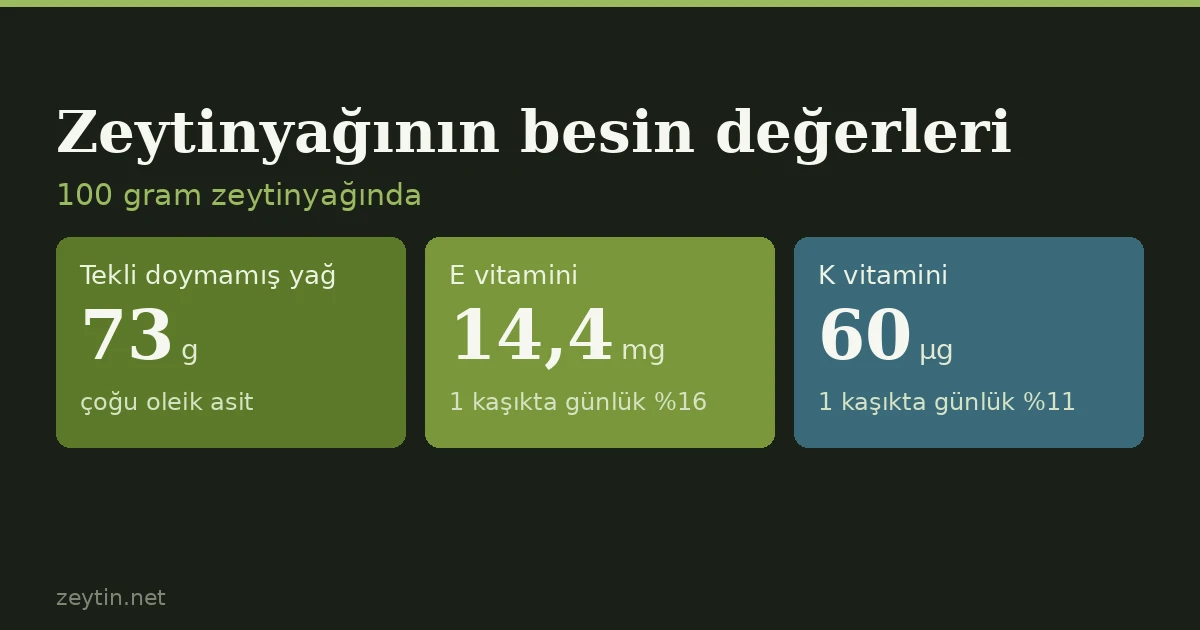
100 grams of olive oil contain 73 grams of monounsaturated fat, 14 mg of vitamin E and 60 micrograms of vitamin K, with no protein, carbohydrate or cholesterol. A per-tablespoon table, and why polyphenols do not appear on the label.
Article
The nutritional profile of olive oil: fatty acids, vitamins E and K, polyphenols
100 grams of olive oil contain 73 grams of monounsaturated fat, 14 mg of vitamin E and 60 micrograms of vitamin K, with no protein, carbohydrate or cholesterol. A per-tablespoon table, and why polyphenols do not appear on the label.
 Article
How many calories are in an olive? By piece, portion and variety
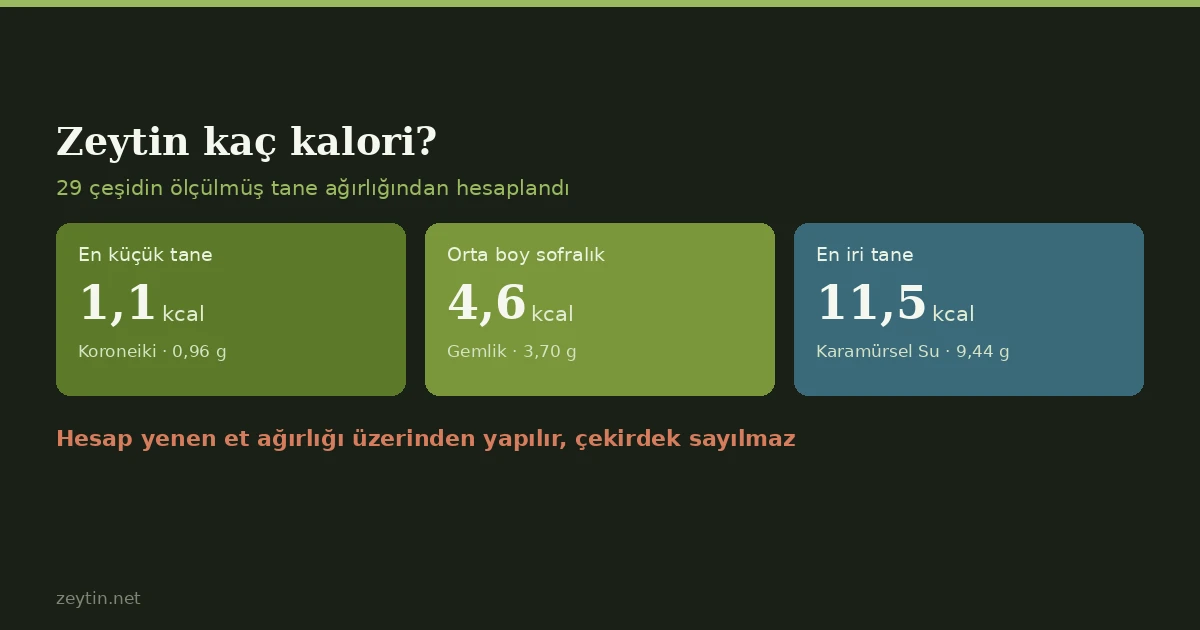
A single olive contains between 1 and 12 calories depending on variety. A table calculated from the measured fruit weight and flesh ratio of 29 varieties, portion equivalents and the calories in olive oil.
Article
How many calories are in an olive? By piece, portion and variety
A single olive contains between 1 and 12 calories depending on variety. A table calculated from the measured fruit weight and flesh ratio of 29 varieties, portion equivalents and the calories in olive oil.