How many calories are in an olive? By piece, portion and variety
A single olive contains between 1 and 12 calories depending on variety. A table calculated from the measured fruit weight and flesh ratio of 29 varieties, portion equivalents and the calories in olive oil.
Search for how many calories are in an olive and you get one answer everywhere: "about 5 calories." That average is not wrong, but on its own it is useless. A Koroneiki olive and a Karamürsel Su olive differ by a factor of ten. The figures below are calculated from the measured fruit weight and flesh ratio of 29 varieties in our own database.
The short answer
A single table olive contains between 1 and 12 calories, depending on variety and size. In practice:
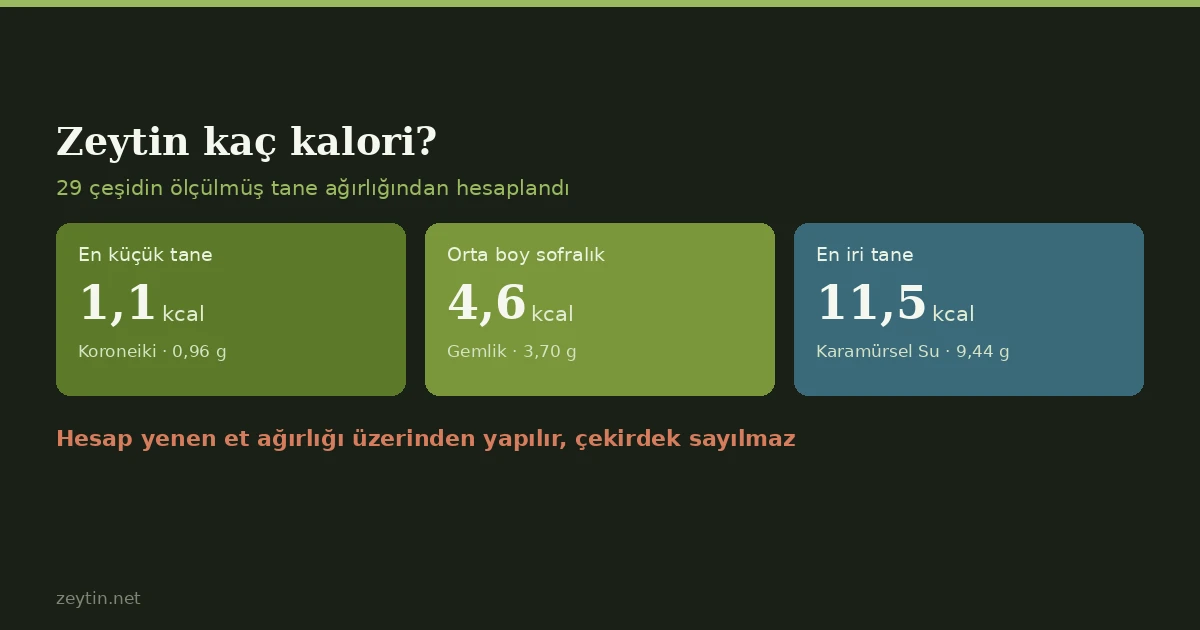
- Small oil varieties (Koroneiki, Arbequina): 1–1.5 kcal
- Medium table varieties (Gemlik, Manzanilla, Uslu): 4–5 kcal
- Large table varieties (Domat, Ayvalık): 6–6.5 kcal
- Very large stuffing varieties (Yamalak Sarısı, Karamürsel Su): 10–12 kcal
For ripe black olives these figures drop by roughly one fifth, because ripe olives carry fewer calories per 100 g than green ones.
You can work out your own portion with the calorie calculator.
Why there is no single number
Calories depend on how much flesh you actually eat. Three things decide that:
1. Fruit weight. Across our measured varieties the smallest fruit is 0.96 g (Koroneiki) and the largest 9.44 g (Karamürsel Su) — a tenfold spread.
2. Flesh ratio. You do not eat the pit. The share of the fruit that is flesh ranges from 67% to 91% by variety. Of two olives of equal weight, the one with more flesh carries more calories.
3. Green or black. Composition changes as the fruit ripens. Pickled green olives supply 145 kcal per 100 g; ripe black olives about 115 kcal.
How the calculation works
The formula is simple:
Calories per olive = fruit weight × flesh ratio × (calories per 100 g ÷ 100)
Take Gemlik: it weighs 3.7 g and is 85% flesh, so you eat 3.15 g. As a green pickled olive at 145 kcal per 100 g:
3.15 × 1.45 = 4.6 kcal
Include the pit and you would get 5.4 kcal — counting something you do not eat. The table below is therefore built on flesh weight.
Calories per olive by variety
These values are calculated from the measurements published on our variety pages. "Green" is pickled green, "Black" is ripe black.
| Variety | Fruit (g) | Flesh | Green (kcal) | Black (kcal) |
|---|---|---|---|---|
| Koroneiki | 0.96 | 81.9% | 1.1 | 0.9 |
| Arbequina | 1.09 | 76.0% | 1.2 | 1.0 |
| Halhalı | 2.75 | 83.0% | 3.3 | 2.6 |
| Uslu | 3.53 | 85.2% | 4.4 | 3.5 |
| Gemlik | 3.70 | 85.0% | 4.6 | 3.6 |
| Manzanilla | 3.90 | 85.0% | 4.8 | 3.8 |
| Picual | 4.26 | 89.3% | 5.5 | 4.4 |
| Kalamata | 4.53 | 89.4% | 5.9 | 4.7 |
| Ayvalık | 4.98 | 85.0% | 6.1 | 4.9 |
| Domat | 5.30 | 83.8% | 6.4 | 5.1 |
| Yamalak Sarısı | 8.27 | 87.3% | 10.5 | 8.3 |
| Karamürsel Su | 9.44 | 84.0% | 11.5 | 9.1 |
What the table says is this: "I ate five olives" can mean 6 calories or 58, depending on the variety. Treating an oil variety and a large table variety as the same thing throws the arithmetic out by a factor of ten.
By portion
Using a medium table olive (about 4 g, 85% flesh):
| Portion | Green (kcal) | Black (kcal) |
|---|---|---|
| 1 olive | 5 | 4 |
| 5 olives | 25 | 20 |
| 7 olives (breakfast plate) | 35 | 28 |
| 10 olives | 49 | 39 |
| 100 g (pitted) | 145 | 115 |
Olive oil is a separate calculation
Olive oil is pure fat and does not compare with the fruit. All fats carry 9 calories per gram:
- 1 teaspoon (5 ml, ~4.6 g): about 41 kcal
- 1 dessert spoon (10 ml, ~9.2 g): about 83 kcal
- 1 tablespoon (15 ml, ~13.7 g): about 124 kcal
- 100 ml: about 900 kcal
Olive oil has a density of 0.916 kg/L, so millilitres and grams are not interchangeable. A "drizzle" over a salad is usually two tablespoons — roughly 250 calories, five times the ten olives on the same plate.
Calories alone are misleading
The nutritional value of olives lies in their composition, not their calorie count: mostly monounsaturated oleic acid, plus vitamin E and polyphenols. See the nutritional profile of olives for detail.
In table olives the figure that deserves attention is not calories but salt. Brined olives can account for a substantial share of a restricted daily sodium allowance on their own. See how many olives should you eat a day for sensible amounts and practical ways to reduce the salt.
Frequently asked
How many grams is one olive? Between 0.96 g and 9.44 g across our measured varieties. Table varieties typically run 3.5–5 g; oil varieties are much smaller.
Are black olives lower in calories than green? Per 100 g, yes (115 vs 145 kcal). But black olives are usually harvested riper and larger, so the gap can close per olive. See the difference between black and green olives.
Does this include the pit? No. The values are calculated on edible flesh. If a package states "100 g" as pitted weight, use 145/115 directly.
Do olives cause weight gain? Per portion they are low in calories — seven olives is about 35. What usually upsets the arithmetic is the olive oil alongside them.
One rating per visitor; you can change yours at any time. Ratings are real reader votes — no seeded or default scores.
Related
 Article
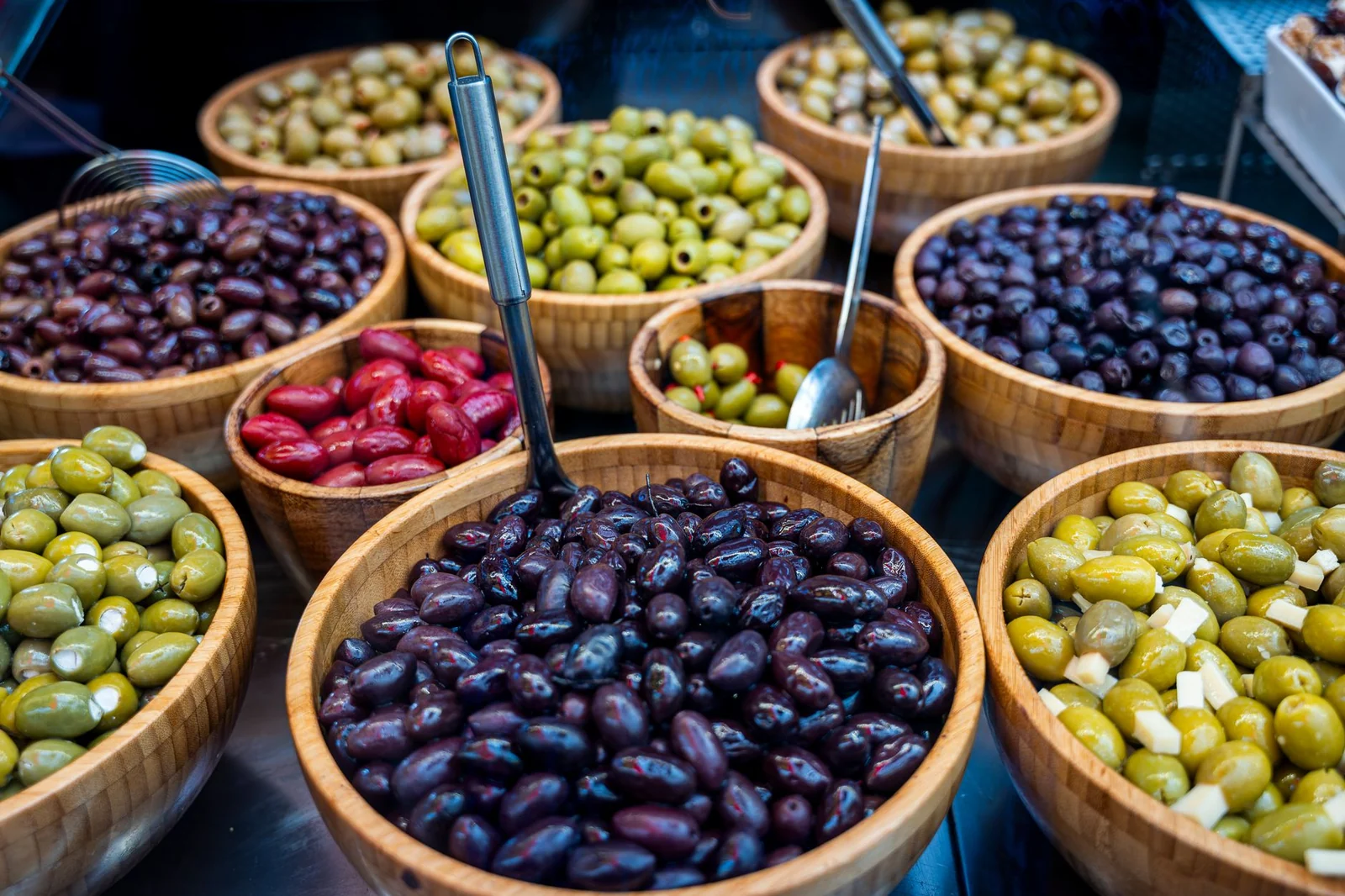
How many calories are in olives? Nutrition and portion table
What is actually in an olive? Fat, fibre, iron, vitamin E — and the salt you should not ignore.
Article
How many calories are in olives? Nutrition and portion table
What is actually in an olive? Fat, fibre, iron, vitamin E — and the salt you should not ignore.
 Article
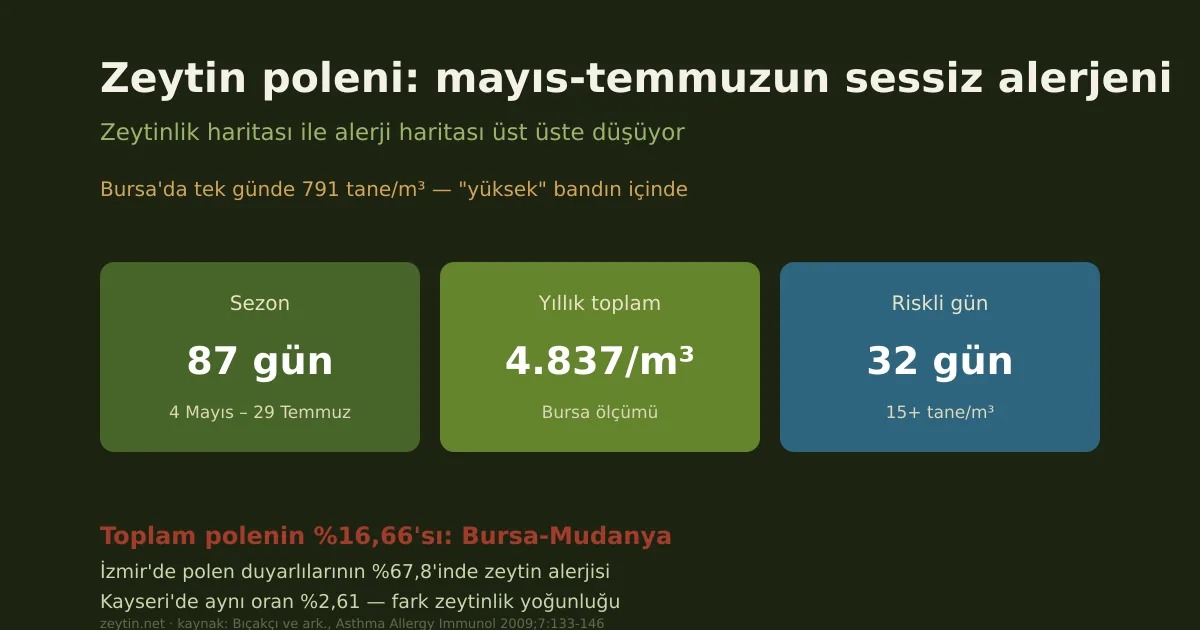
Olive pollen allergy: the quiet cause of May to July
Olive pollen fills the air across western Türkiye from May to July. Bursa recorded 791 grains/m³ in one day over an 87-day season; 67.8% of pollen-sensitised patients in İzmir react to it.
Article
Olive pollen allergy: the quiet cause of May to July
Olive pollen fills the air across western Türkiye from May to July. Bursa recorded 791 grains/m³ in one day over an 87-day season; 67.8% of pollen-sensitised patients in İzmir react to it.
 Article
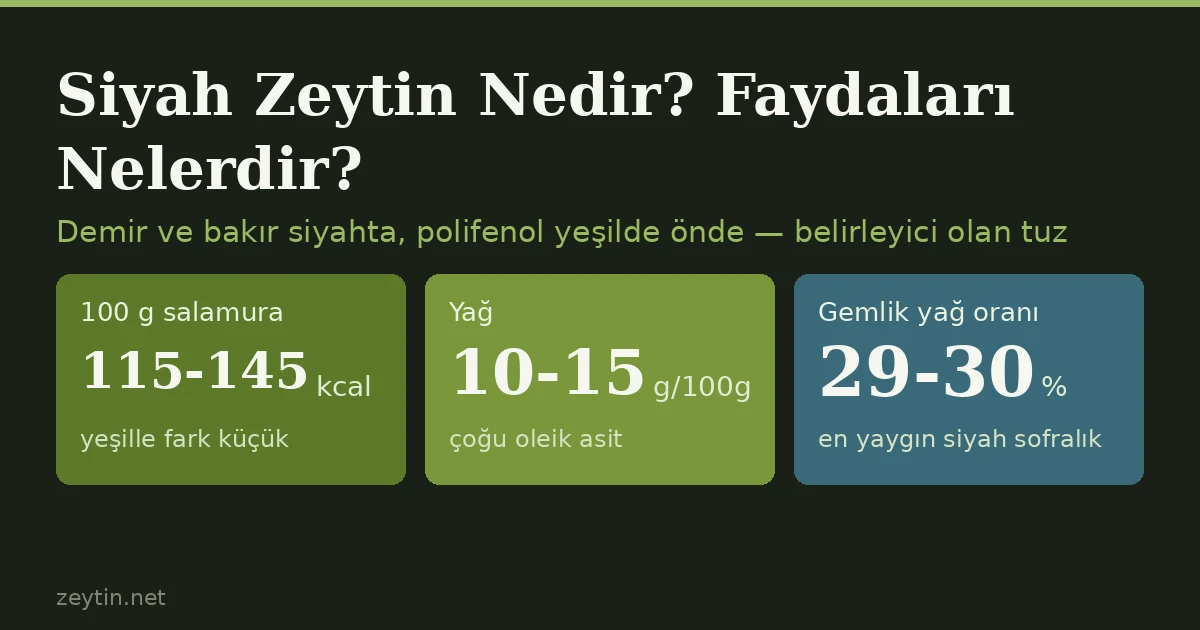
What Are Black Olives? What Are Their Benefits?
What black olives are, how they differ from green, and how many calories. Iron and copper, the polyphenol difference, and the two different black olives on the shelf.
Article
What Are Black Olives? What Are Their Benefits?
What black olives are, how they differ from green, and how many calories. Iron and copper, the polyphenol difference, and the two different black olives on the shelf.
 Article
How Much Olive Oil a Day?
Olive oil being healthy does not make it unlimited. A practical look at portions, calories and the logic of replacement.
Article
How Much Olive Oil a Day?
Olive oil being healthy does not make it unlimited. A practical look at portions, calories and the logic of replacement.