How much olive oil comes from one kilo of olives?
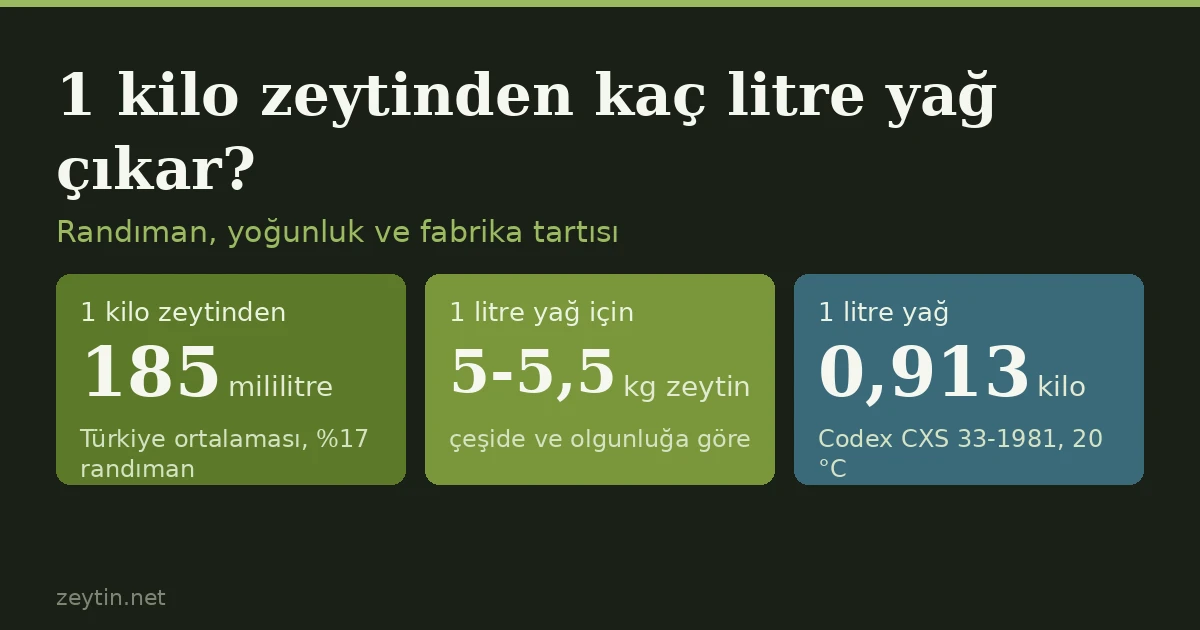
On the Turkish average, one kilo of olives gives around 170 grams of oil — about 185 millilitres. Put the other way round: a litre of oil needs 5 to 5.5 kilos of olives. Almost all the confusion in the calculation comes from treating kilos and litres as the same thing.
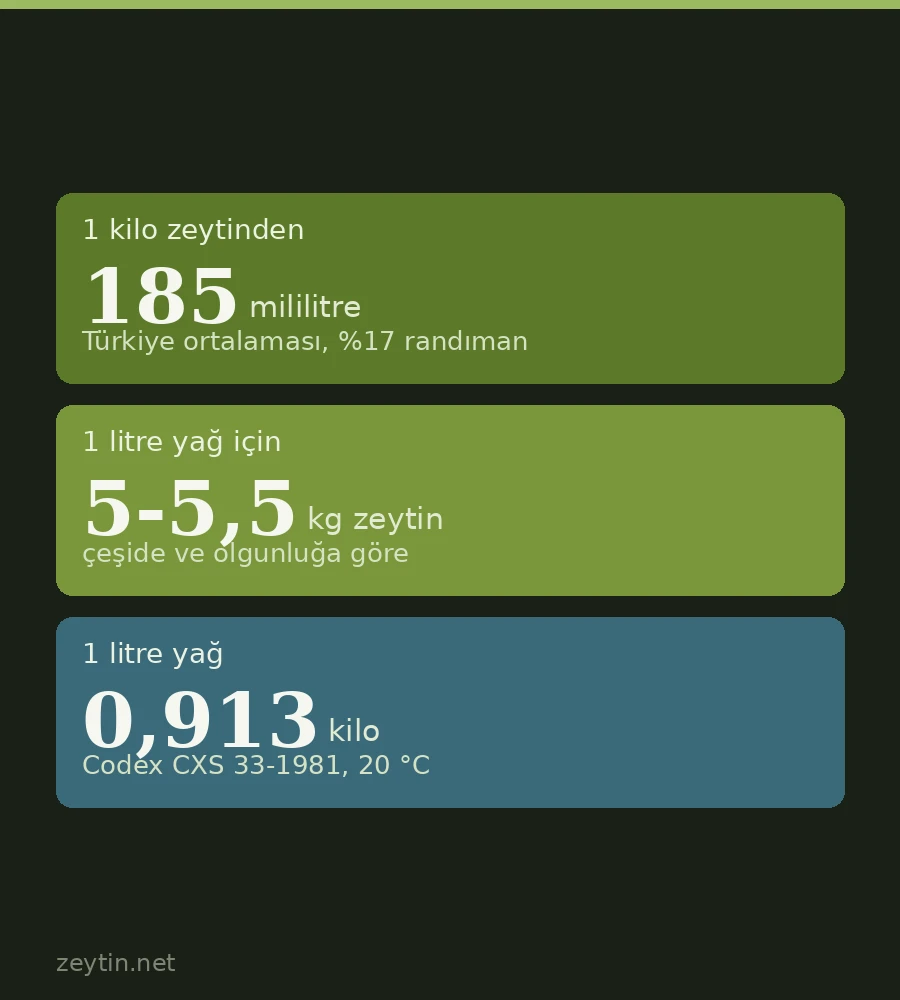
Short answer: on the Turkish average, one kilo of olives gives about 170 grams of oil. Because olive oil is lighter than water, that works out to roughly 185 millilitres by volume. Asked the other way round: a litre of olive oil needs 5 to 5.5 kilos of olives.
That is an average. With a good variety, a late harvest and a well-run mill, a kilo of olives can give up to 220 grams; at an early harvest, or with watery fruit, it can fall below 140.
Where the average comes from
Türkiye carries out an official crop assessment at the end of every season, recording separately the quantity of olives pressed and the oil obtained. Two seasons on the record:
| Season | Olives pressed | Oil obtained | Yield |
|---|---|---|---|
| 2024/25 | 2,850,000 t | 475,000 t | 16.7% |
| 2025/26 | 1,710,000 t | 310,000 t | 18.1% |
The midpoint of the two sits a little above 17%. This is a national average covering every variety, every district and every plant — not your own grove's number, but a baseline you can measure your own number against.
The higher yield in the second season is no accident: 2025/26 was an off year, there was less fruit on the tree, and less fruit accumulated more oil.
How much oil comes from one tree?
The question is often asked about a tree rather than a kilo. The same official assessment measures that too: average production per tree was 21.0 kilos in 2024/25 and 13.9 kilos in 2025/26. The difference between the two is the difference between an on year and an off year.
The share set aside for the table has to come off that fruit first. Across the two seasons on record, 70-79% of the total crop went to pressing. Applying each season's yield to what remains gives this:
| Per tree, national average | On year | Off year |
|---|---|---|
| Total fruit | 21.0 kg | 13.9 kg |
| Pressed | 16.6 kg | 9.7 kg |
| Oil | ≈ 2.8 kg | ≈ 1.8 kg |
| In litres | ≈ 3.0 L | ≈ 1.9 L |
So in a good year an average tree gives about three litres, and in a weak year about two. That figure averages all ages and all varieties together: a newly planted sapling gives nothing at all, while a mature, well-tended tree can give several times as much.
Kilos and litres are not the same thing
This is where the calculation goes wrong most often. The relative density of olive oil is defined in the FAO/WHO Codex Alimentarius standard for olive oils (CXS 33-1981) as 0.910-0.916 at 20 °C. In practice:
- 1 litre of olive oil ≈ 0.913 kilos
- 1 kilo of olive oil ≈ 1.095 litres
So there is a gap of about 9.5% between kilos and litres. A hundred kilos of oil is more than 109 litres. That difference does not look small, and every pressing season it leads someone to say the mill shortchanged them — when in fact the same oil is being measured in two different units.
It is also why mills speak in kilos. Volume changes with temperature — warm oil takes up more room than cold oil — but weight does not. Trade done on a scale is not open to argument.
Conversion table
For anyone who knows their yield, the conversion is simple. The table below gives, for each yield level, what comes out of 1,000 kilos of olives and how many kilos of olives a litre of oil requires (at 0.913 kg per litre):
| Yield | From 1,000 kg olives | In litres | Olives per litre |
|---|---|---|---|
| 14% | 140 kg oil | 153 L | 6.5 kg |
| 16% | 160 kg oil | 175 L | 5.7 kg |
| 18% | 180 kg oil | 197 L | 5.1 kg |
| 20% | 200 kg oil | 219 L | 4.6 kg |
| 22% | 220 kg oil | 241 L | 4.2 kg |
The table is also useful for testing a claim that circulates widely. Saying "four kilos of olives make a litre of oil" means a yield of 23%. Such a yield is possible but exceptional: it takes a high-oil variety, fully ripe fruit and a well-adjusted plant. It is four and a half points above the national average and cannot be expected as a rule.
Why the same olives give different yields
Yield is not a constant attached to a variety. Five things decide it.
Variety. The oil present in the fruit ranges from 17% to 31% between varieties. What leaves the mill is never that much, but a high-oil variety starts from a higher floor.
Ripeness. Oil accumulates throughout the harvest season. Fruit picked at the green stage carries markedly less oil than fruit taken from the same tree three weeks later. Early harvest is a deliberate choice to lower the yield in exchange for higher polyphenols.
Moisture. The wetter the olives, the greater the share of water on the scale. Fruit from an irrigated grove is large and heavy, but gives less oil per kilo. Harvesting straight after rain has the same effect.
Waiting. Olives begin to deteriorate the moment they are picked. Fruit left to heat up in sacks loses on both acidity and yield. In an on year the queue at the mill lengthens, which raises the risk.
The plant. Malaxing time and temperature determine whether the oil droplets coalesce; if the time is too short, part of the oil stays in the paste. Two-phase and three-phase systems also behave differently — the distinction has its place on the list of questions to ask when having olives pressed.
One more detail: leaves and thin twigs in the weighed load count as olive weight and drag the yield down. Cleaning the load of leaves as it goes into the crates affects the number directly.
Where the oil that does not come out goes
Not all of the oil in the fruit can be recovered. Some remains in the pomace left after separation and in the liquid waste, the vegetation water. Pomace and vegetation water are the raw material of an industry in their own right; pomace oil is extracted from that residue with solvents and sold as a separate product.
This is why the calculation "the variety is 28% oil, so I will get 280 grams from a kilo" is wrong. The oil present in the fruit and the oil leaving the plant are two different numbers, and the difference goes to the pomace and the vegetation water.
What to ask at the mill
A grower needs only two numbers to work out their own yield: the weight of olives that went on the scale, and the weight of oil taken away. Dividing the second by the first gives the yield.
If the oil is handed over by volume, the question to ask is which density was used for the conversion. Even a choice between 0.91 and 0.92 makes a difference of nearly ten kilos on a one-tonne batch. A weighbridge slip that shows both numbers separately makes every later argument unnecessary.
Summary
One kilo of olives gives about 170 grams, or roughly 185 millilitres, of olive oil. Budgeting 5 to 5.5 kilos of olives per litre is safe. But to find your own grove's number, the place to look is not the average — it is the mill's weighbridge slip.
One rating per visitor; you can change yours at any time. Ratings are real reader votes — no seeded or default scores.
Related
 Article
How to store freshly pressed olive oil: settling, sediment and the right container
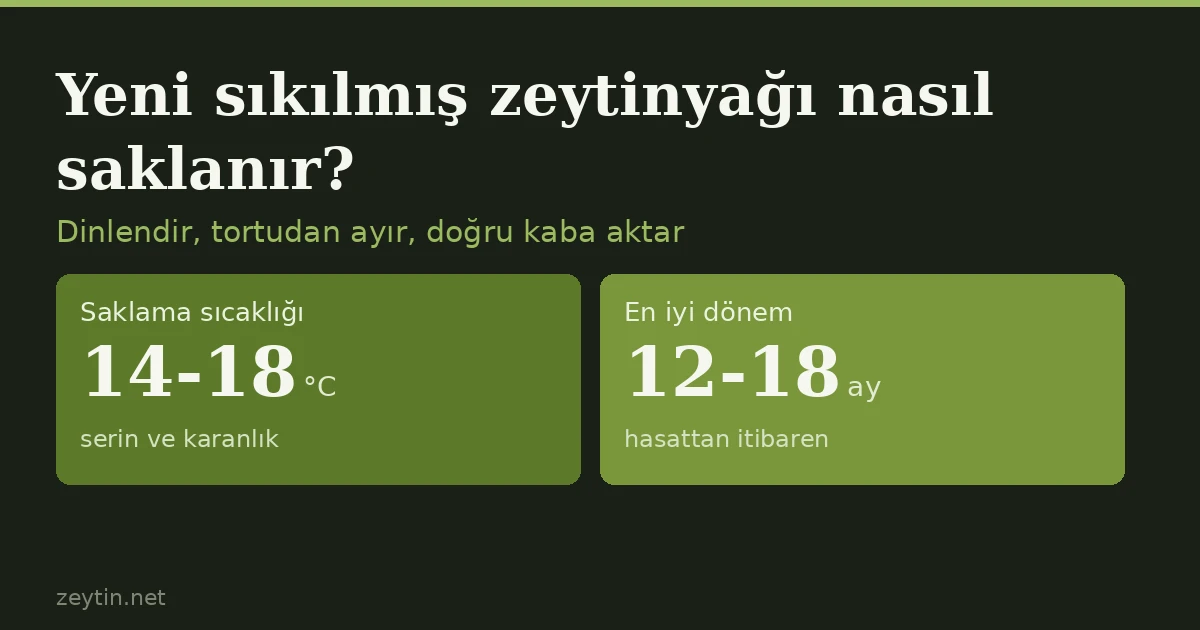
Oil fresh from the mill is cloudy and contains water and fruit particles. It is left to settle for a few weeks somewhere cool and dark in a container filled to the top, then the clear oil is separated from the sediment and moved into tins or dark glass. Oil left sitting on its sediment for months spoils.
Article
How to store freshly pressed olive oil: settling, sediment and the right container
Oil fresh from the mill is cloudy and contains water and fruit particles. It is left to settle for a few weeks somewhere cool and dark in a container filled to the top, then the clear oil is separated from the sediment and moved into tins or dark glass. Oil left sitting on its sediment for months spoils.
 Article
What are zeytinyağlılar? The logic of Turkish dishes cooked in olive oil
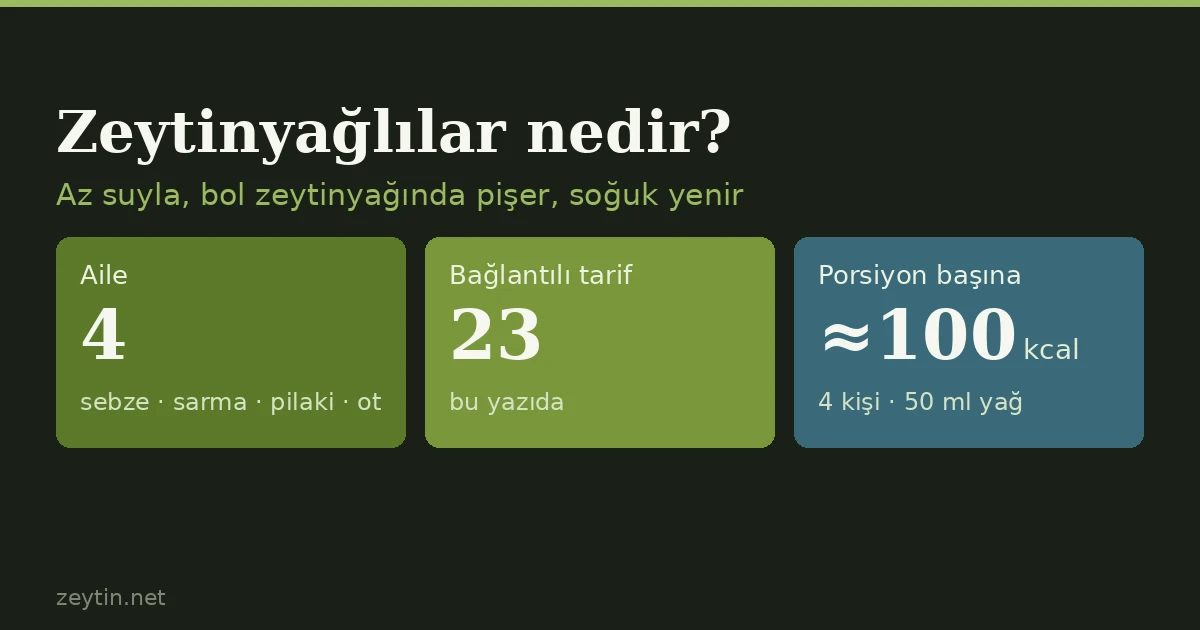
Zeytinyağlılar are Turkish dishes in which vegetables or pulses are cooked with little water in plenty of olive oil until they absorb their own juices, then eaten cold at room temperature. They contain no meat, can be made a day ahead and taste better the next day. Vegetable dishes, stuffed leaves and vegetables, pilaki beans and Aegean wild greens are the four main families.
Article
What are zeytinyağlılar? The logic of Turkish dishes cooked in olive oil
Zeytinyağlılar are Turkish dishes in which vegetables or pulses are cooked with little water in plenty of olive oil until they absorb their own juices, then eaten cold at room temperature. They contain no meat, can be made a day ahead and taste better the next day. Vegetable dishes, stuffed leaves and vegetables, pilaki beans and Aegean wild greens are the four main families.
 Article
Olive Oil Fraud and Adulteration: How It Is Done and How It Is Caught
Seed oil blending, refined oil sold as extra virgin, soft deodorisation… The economics of fraud, the laboratory methods, and the home tests that do not work.
Article
Olive Oil Fraud and Adulteration: How It Is Done and How It Is Caught
Seed oil blending, refined oil sold as extra virgin, soft deodorisation… The economics of fraud, the laboratory methods, and the home tests that do not work.
 Article
How is olive oil acidity measured? Titration, the formula and taking a sample
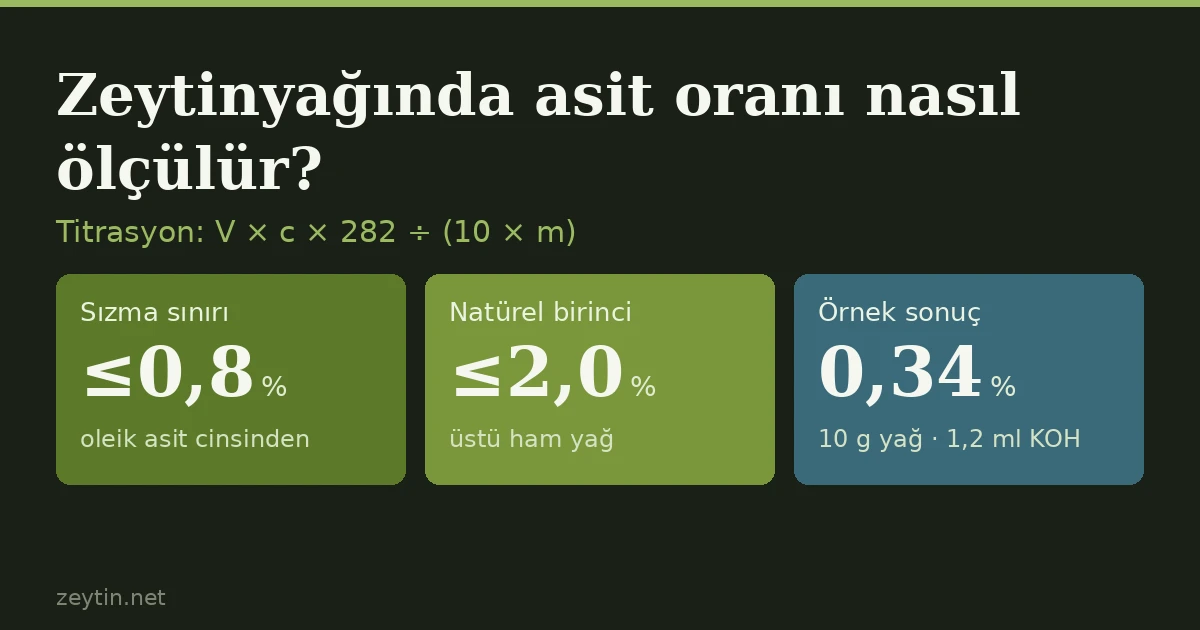
Olive oil acidity is measured in a laboratory by titration: the oil is dissolved in a solvent, free fatty acids are neutralised with potassium hydroxide, and the percentage is calculated as oleic acid from the amount used. The formula, a worked example, sampling and the limits of home test kits.
Article
How is olive oil acidity measured? Titration, the formula and taking a sample
Olive oil acidity is measured in a laboratory by titration: the oil is dissolved in a solvent, free fatty acids are neutralised with potassium hydroxide, and the percentage is calculated as oleic acid from the amount used. The formula, a worked example, sampling and the limits of home test kits.