The gap between extra virgin and riviera is only 4% at wholesale
At wholesale, extra virgin is only 4-23% dearer than cooking oil; the seven-year average is 13%. The shelf gap comes from packaging.
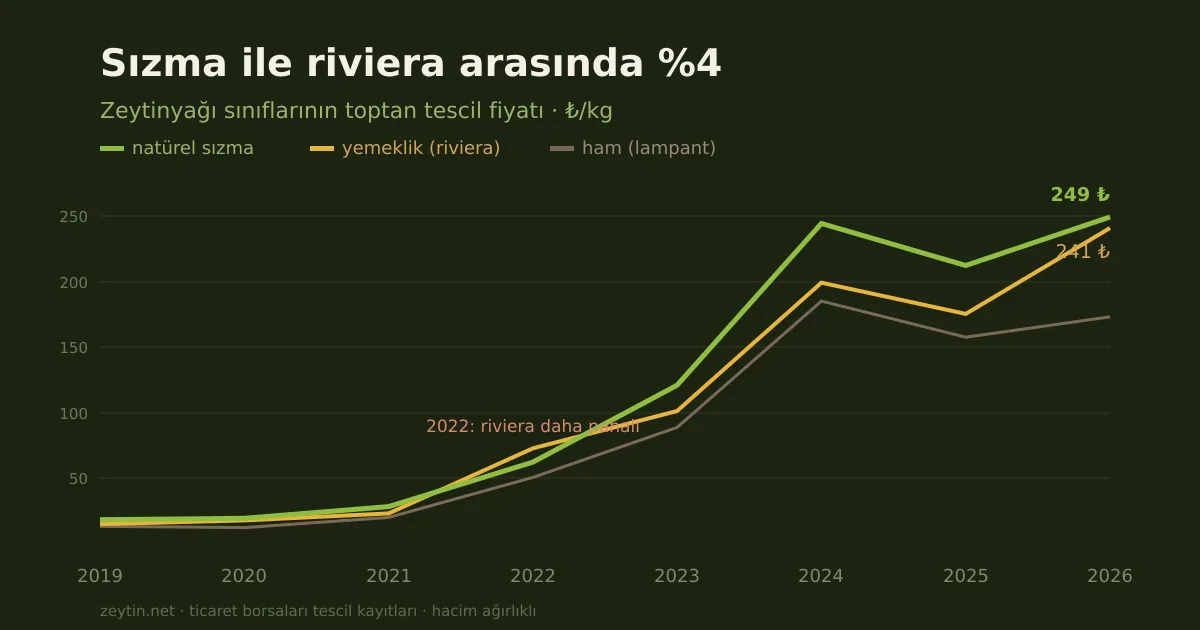
Three names appear on an olive oil shelf: extra virgin, riviera (often labelled simply "olive oil" or "for cooking"), and occasionally refined. The price difference between them decides most purchases — it is where "I'll buy riviera for frying and save the extra virgin for salad" comes from.
But at the source, in the wholesale market, how large is that gap really?
Seven years of exchange registrations give a surprising answer.
The wholesale gap is very small
| Year | Extra virgin | Riviera (cooking) | Crude | Virgin / riviera |
|---|---|---|---|---|
| 2019 | 18.53 | 15.20 | 13.46 | 1.22× |
| 2020 | 19.59 | 18.01 | 12.52 | 1.09× |
| 2021 | 28.51 | 23.36 | 20.30 | 1.22× |
| 2022 | 62.46 | 73.00 | 50.81 | 0.86× |
| 2023 | 121.09 | 101.47 | 88.92 | 1.19× |
| 2024 | 244.45 | 199.27 | 185.30 | 1.23× |
| 2025 | 212.41 | 175.53 | 157.72 | 1.21× |
| 2026 | 249.44 | 240.99 | 173.28 | 1.04× |
Source: sales registered at the Aydın, Edremit, Nazilli, Gaziantep and Bandırma commodity exchanges. The riviera series holds 25-71 records a year, extra virgin 96-219. "Crude" (lampante) is oil not fit for direct consumption; it goes to refining.
The result: extra virgin is only 4% to 23% dearer than cooking-grade olive oil.
The seven-year average is 1.13×, roughly 13%. And something odd happened in 2022: riviera came out dearer than extra virgin (0.86×).
The "riviera is cheaper" logic does not hold at wholesale
There is a common calculation on the consumer side: extra virgin is expensive, riviera is cheap, riviera will do for frying.
Wholesale prices do not support it. In 2026 the gap is 8.45 lira per kilogram — 4%. That year a kilo of extra virgin traded at 249.44 and cooking grade at 240.99.
Two conclusions follow.
The shelf gap does not come from wholesale. If you see a serious price difference between riviera and extra virgin in a shop, that difference comes not from the raw material but from bottling, branding, positioning and shelf strategy. The gap in input cost is 4-13%; the gap on the shelf can be a multiple of that.
Refining does not make oil cheaper. Cooking-grade oil is made by refining crude (lampante) oil. Crude traded at 173.28 lira in 2026; cooking grade at 240.99. The 67 lira between them is the cost and margin of refining. The intuition that "the processed one is cheaper" inverts here: processing adds cost, it does not remove it.
What happened in 2022?
The one inverted row is 2022: riviera at 73.00, extra virgin at 62.46. Processed oil dearer than unprocessed.
The plausible explanation lies on the supply side. 2022 was when supply began tightening across the Mediterranean, which we measured separately. When crude oil for refining runs short, the cost of cooking-grade rises, while extra virgin continues to price off its own supply. Brief inversions like this follow from the two products moving through different chains.
One caution: the riviera series holds 33 records that year. The anomaly may be real, or exaggerated by a thin sample.
Which oil is which?
Short definitions, to clear the confusion:
| Grade | How it is obtained | Consumed directly? |
|---|---|---|
| Extra virgin | Mechanical means only; no heat or chemicals | Yes |
| Virgin | Same method, slightly higher acidity | Yes |
| Crude / lampante | Mechanical but defective in taste or chemistry | No — goes to refining |
| Refined | Refined from crude oil | Not sold on its own |
| Riviera / cooking | Refined oil blended with some virgin oil | Yes |
So riviera is not "lower-quality extra virgin"; it is a different product: refined oil with virgin oil blended in. Its polyphenol content is low, its taste neutral, its smoke point slightly higher.
We covered whether olive oil is suitable for frying and what acidity means in separate articles.
What this means for a shopper
If the wholesale gap is small, watch a large shelf gap. When the raw material differs by 4-13% and the shelf differs by far more, what you are paying for is packaging and brand, not oil.
Extra virgin is within reach. At 2026 figures the wholesale gap is 8 lira a kilogram. That weakens the economic case for buying riviera to fry with — the preference may stand, but not on price.
Do not buy oil labelled "crude" or "lampante". That grade is not fit for direct consumption and cannot legally be sold under that name at retail. It trades on the exchange because it goes to industry.
Limits
These are wholesale, bulk, registered prices. They cannot be compared directly with a shop label; we discussed that gap in our value chain article — retail is the one link we cannot measure.
The riviera series is thin. 25-71 records a year against extra virgin's 96-219; read the trend, not a single year.
Quality within a grade is invisible. "Extra virgin" is a broad category; oils from 0.2% to 0.8% acidity register under the same heading.
Summary
- At wholesale, extra virgin is only 4-23% dearer than cooking-grade oil; the seven-year average is 13%.
- In 2026 the gap is 8.45 lira per kilogram — 4%.
- A large shelf gap comes from packaging and brand, not the raw material.
- Refining adds cost: crude 173 TL, cooking grade 241 TL.
- In 2022 cooking grade came out dearer than extra virgin — a trace of the supply squeeze, on a thin sample.
- Riviera is not "poor extra virgin" but a blend of refined and virgin oil, a separate product.
Related reading: Is olive oil suitable for frying? · What does acidity mean? · Tree to shelf: the value chain · Prices exchange by exchange
One rating per visitor; you can change yours at any time. Ratings are real reader votes — no seeded or default scores.
Related
 Article
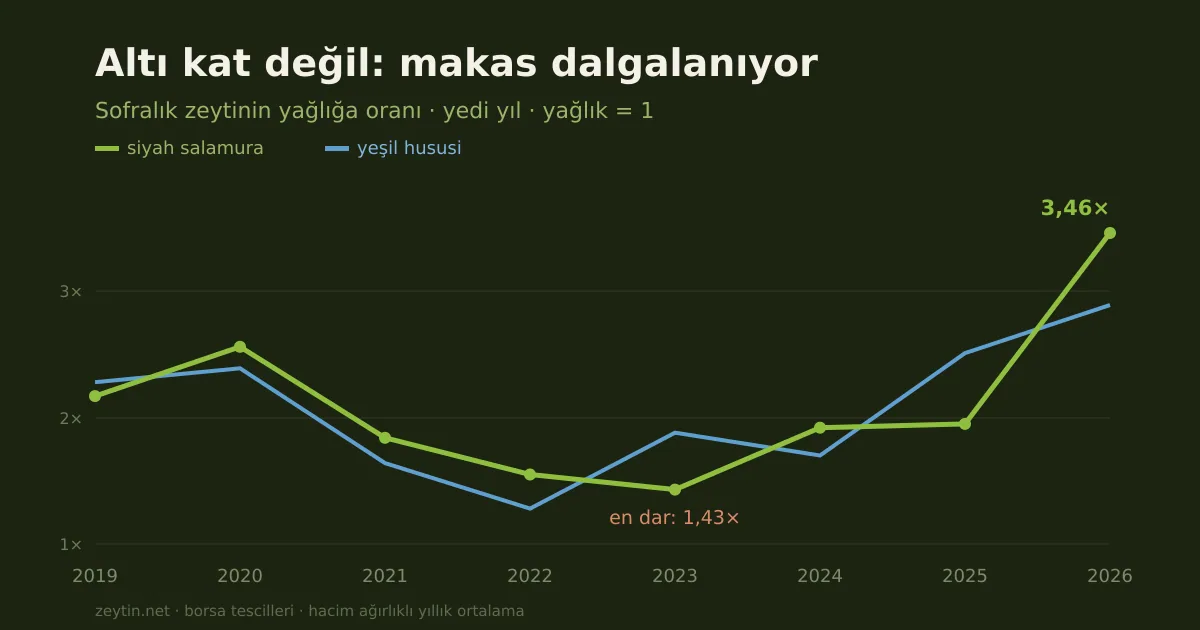
Was it six times? Seven years of the table olive gap
How many times the oil price does a table olive fetch? Over seven years the ratio ranged 1.43 to 3.46, never below 1.
Article
Was it six times? Seven years of the table olive gap
How many times the oil price does a table olive fetch? Over seven years the ratio ranged 1.43 to 3.46, never below 1.
 Article
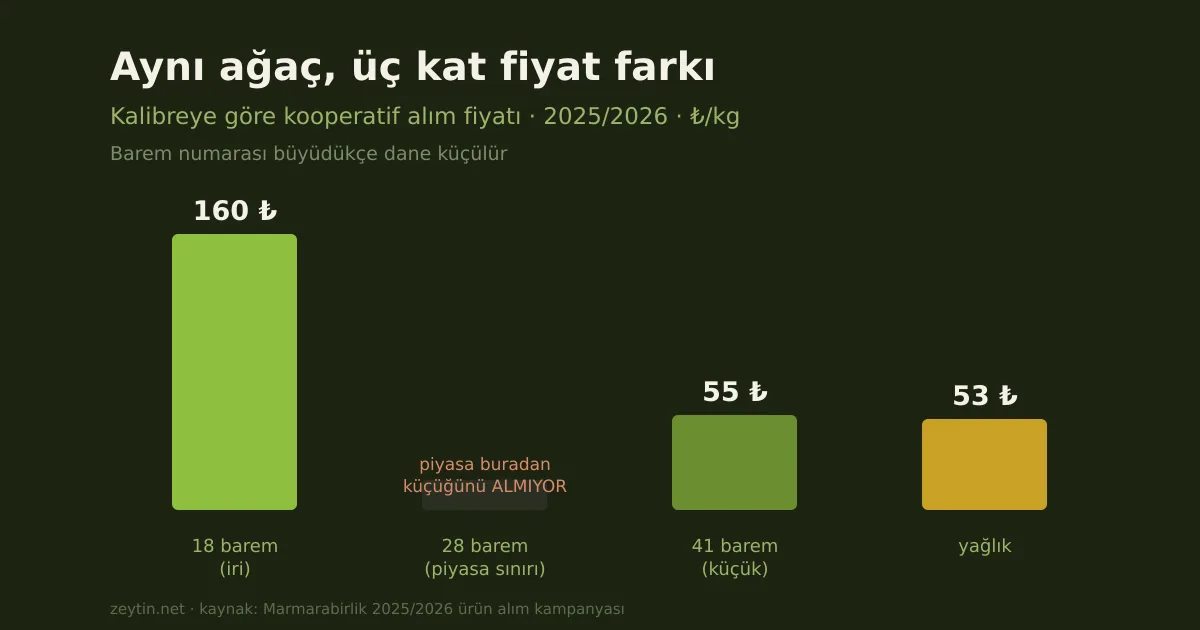
The economics of caliber: how fruit size triples the price
160 TL at caliber 18, 55 TL at caliber 41. Fruit size is price — and the cooperative pays 16% above the exchange average.
Article
The economics of caliber: how fruit size triples the price
160 TL at caliber 18, 55 TL at caliber 41. Fruit size is price — and the cooperative pays 16% above the exchange average.
 Article
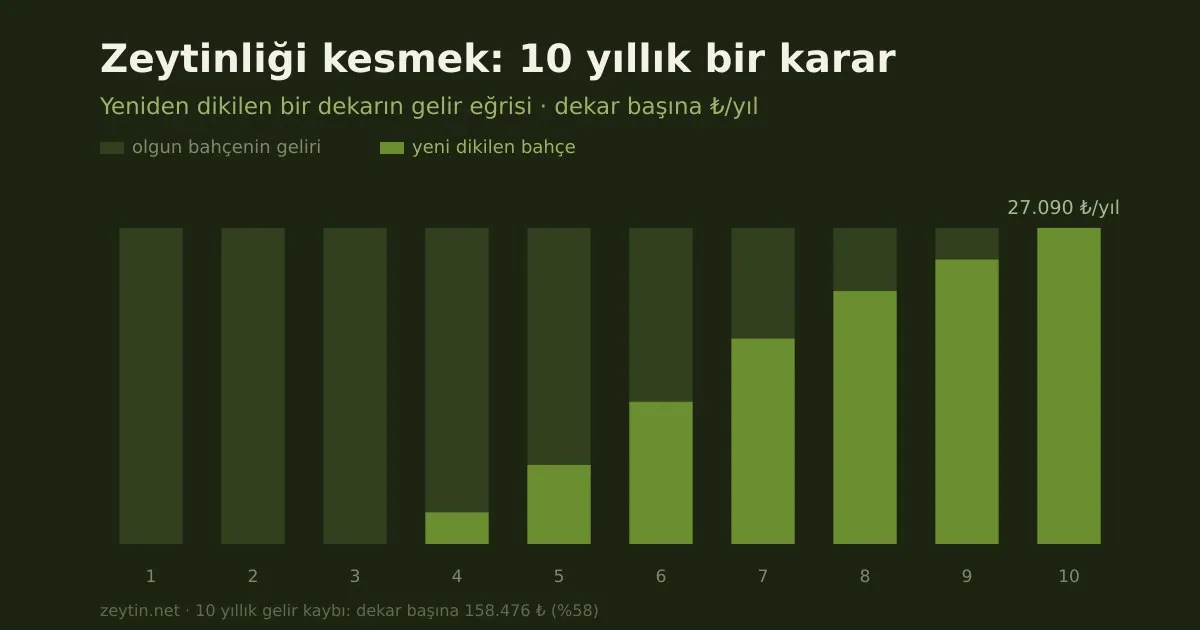
Felling an olive grove: the arithmetic of a ten-year decision
The ten-year cost of clearing a grove for another crop: establishment, years to bearing and forgone income, per decare.
Article
Felling an olive grove: the arithmetic of a ten-year decision
The ten-year cost of clearing a grove for another crop: establishment, years to bearing and forgone income, per decare.
 Article
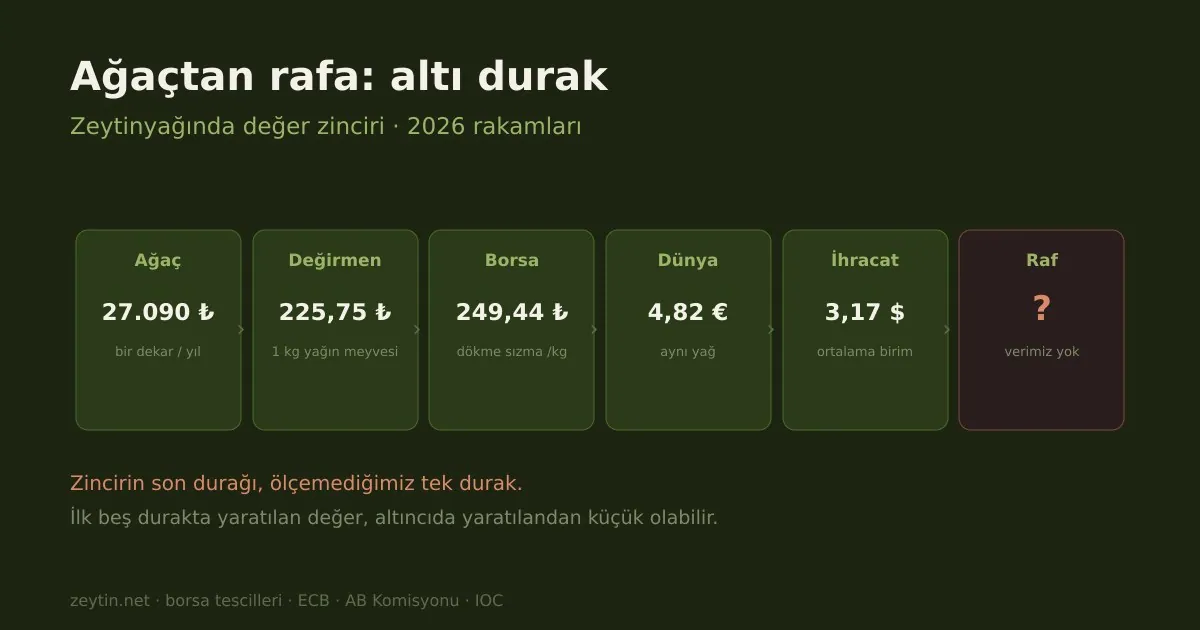
Tree to shelf: the olive oil value chain in six stops
From fruit on the tree to bottle on the shelf: how much the price multiplies at each step, and where the added value stays.
Article
Tree to shelf: the olive oil value chain in six stops
From fruit on the tree to bottle on the shelf: how much the price multiplies at each step, and where the added value stays.