Olive harvest begins in Tekirdağ: about 18,000 tonnes expected, fruit small in Şarköy but fruit set good
About 18,000 tonnes of olives are expected across Tekirdağ as the harvest begins. The report says Şarköy has about 950,000 trees, fruit set is good and disease and pests are rare, but drought and falling groundwater left the fruit small. The oil-table split, oil yield and price are not in the report.
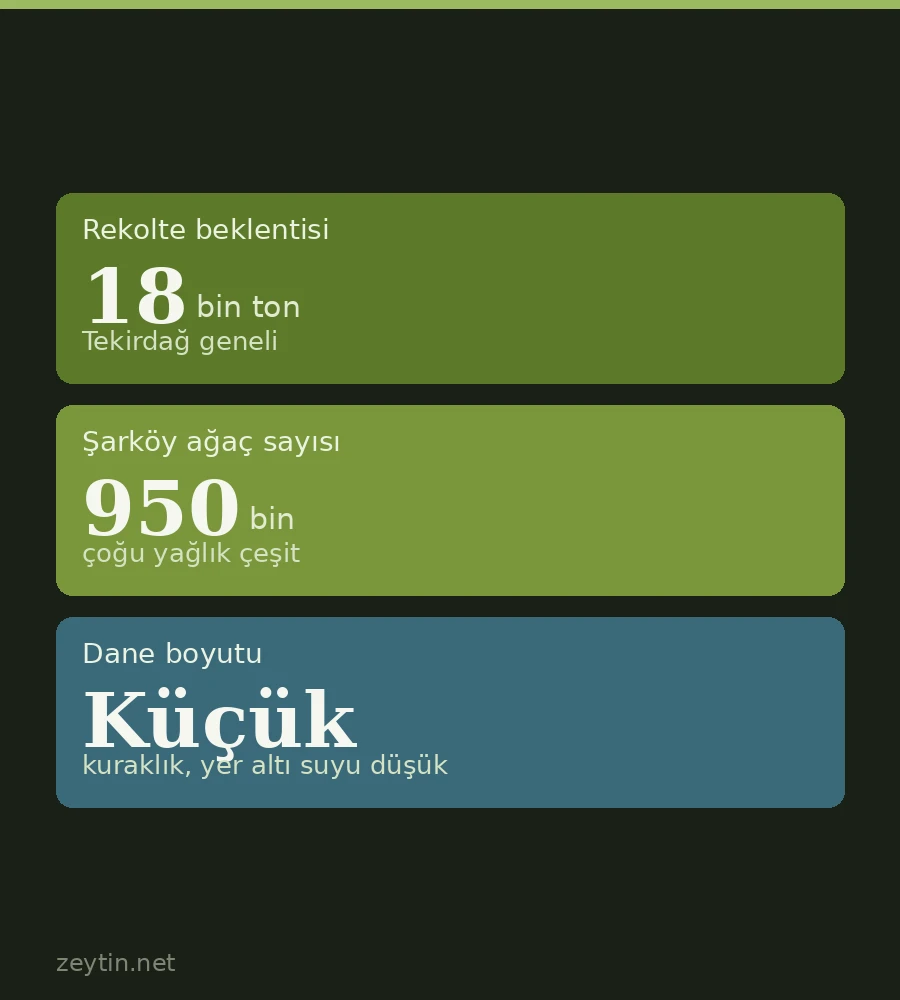
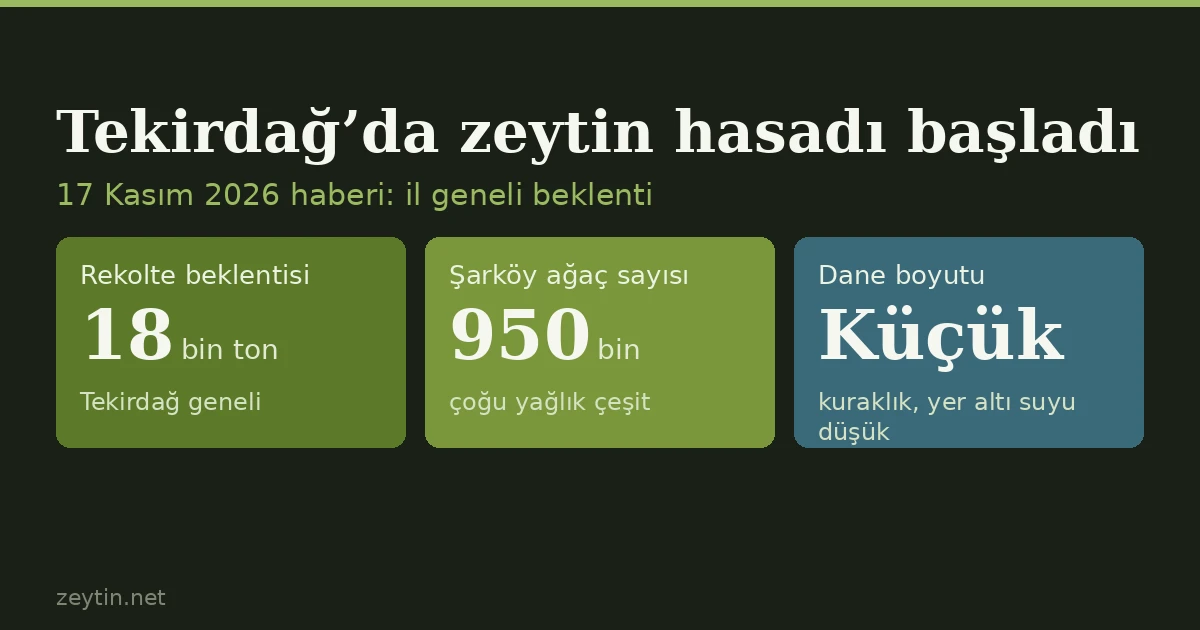
The olive harvest has begun in Tekirdağ. According to a report dated 17 November 2026, about 18,000 tonnes of olives are expected across the province. The report says the Şarköy district has roughly 950,000 olive trees, most of them oil varieties. The outlook looks good, but the most striking detail in the report is not the tonnage but the size of the fruit: because of drought and a fall in the groundwater level, the olives have stayed small.
What the report contains
| Item | As stated in the report |
|---|---|
| Expected crop | About 18,000 tonnes across Tekirdağ |
| Trees in Şarköy | About 950,000, mostly oil varieties |
| Fruit set | Good |
| Disease and pests | Seen only rarely this season |
| Fruit size | Small, because of drought and the fall in groundwater |
| Example grower | 600 decares, a crew of about 30, harvesting by hand and by machine |
One of the growers, Can Gürsoy, described working 600 decares (about 60 hectares) with a crew of roughly 30 who harvest both by hand and with machines. The olives are taken to a mill for oil extraction. According to Gürsoy, fruit set is good and disease and pests were rare this season; on the other hand, drought and the fall in groundwater left the fruit small. The report also quotes the Tekirdağ Provincial Director of Agriculture and Forestry, Mehmet Aksoy, whose remarks convey that yields in the region are high and disease control has been good, and who stresses that branding and marketing need more emphasis.
Good fruit set, small fruit
Good fruit set means the trees are carrying enough crop; small fruit means that crop is below the expected size. This is our reading: the report gives no figure for what small fruit means for oil yield or price. In table olives, size grade feeds directly into price, so small fruit is the clearer problem. In oil olives the real question is how much oil comes out per kilogram of fruit, and only the milling season will show that. So how much of the 18,000-tonne expectation will go to oil and how much to the table, and what the yield will be, is not yet clear.
How big is 18,000 tonnes?
The comparison below is our own arithmetic and sets forecasts from different bodies side by side, so it should be read as approximate. Set against the national expectation of 4 million 30 thousand tonnes for 2026/27 voiced by Mustafa Tan, president of the National Olive and Olive Oil Council, Tekirdağ's share is about 0.45 percent. The 290,000-tonne forecast that the Gemlik Chamber of Agriculture shared for Bursa is roughly 16 times Tekirdağ's figure. Tekirdağ is therefore a small producing area on a national scale; but Şarköy, the most visible olive district in Thrace, is here.
Şarköy over the past few weeks
Şarköy has been in the news three times in recent weeks. According to the entry in the Turkish Patent and Trademark Office bulletin, Şarköy Olive Oil was registered as a designation of origin on 23 October 2026 under number 1912; the document defines the product as extra virgin and virgin oil from the Gemlik variety grown in the district. A report dated 11 November 2026 described how growers were picked at random for a pre-harvest pesticide inspection and how the samples go to ministry laboratories. Today's report says the harvest has actually started.
The three reports do not refer to one another. Because today's report does not name the variety, it also does not say how much of the crop will go into production that fits the registered name; we have no data to make that link.
What the report does not say
- The split of the 18,000 tonnes between oil and table olives.
- The expected quantity of olive oil and the oil yield.
- Last season's crop, or the percentage rise or fall.
- Any measurement of how much drought reduced fruit weight.
- The purchase price or the mills' pressing fee.
- Which body made the crop forecast, and by what method.
What to watch
As the milling season advances, the oil yield per kilogram and the figures announced by the mills will show how much of this report's "good fruit set" message turns into oil. If it is also disclosed which body the crop forecast came from and whether it can be compared with last season, Tekirdağ's place in this year's picture will be easier to read.
One rating per visitor; you can change yours at any time. Ratings are real reader votes — no seeded or default scores.
Related
 Article
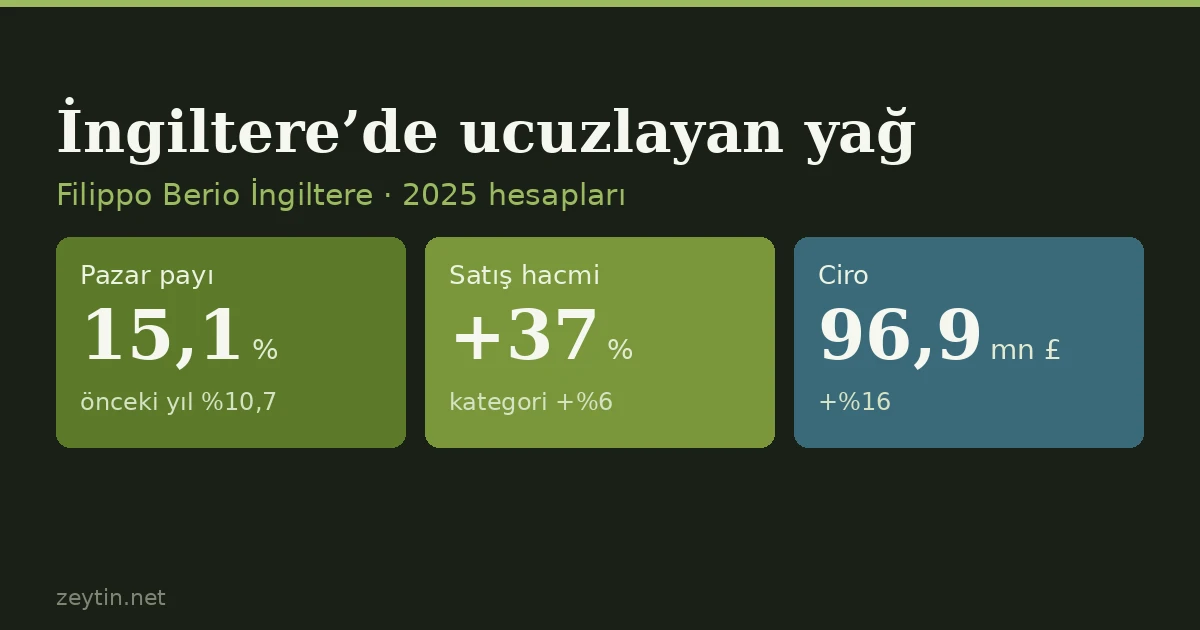
Olive oil got cheaper in the UK and Filippo Berio lifted its share to 15%
The 2025 accounts of Filippo Berio's UK company show how falling prices reached the shelf: volumes up 37%, revenue up 16%, market share from 10.7% to 15.1%. The category grew 6% and lower wholesale costs were passed on to shoppers.
 Article
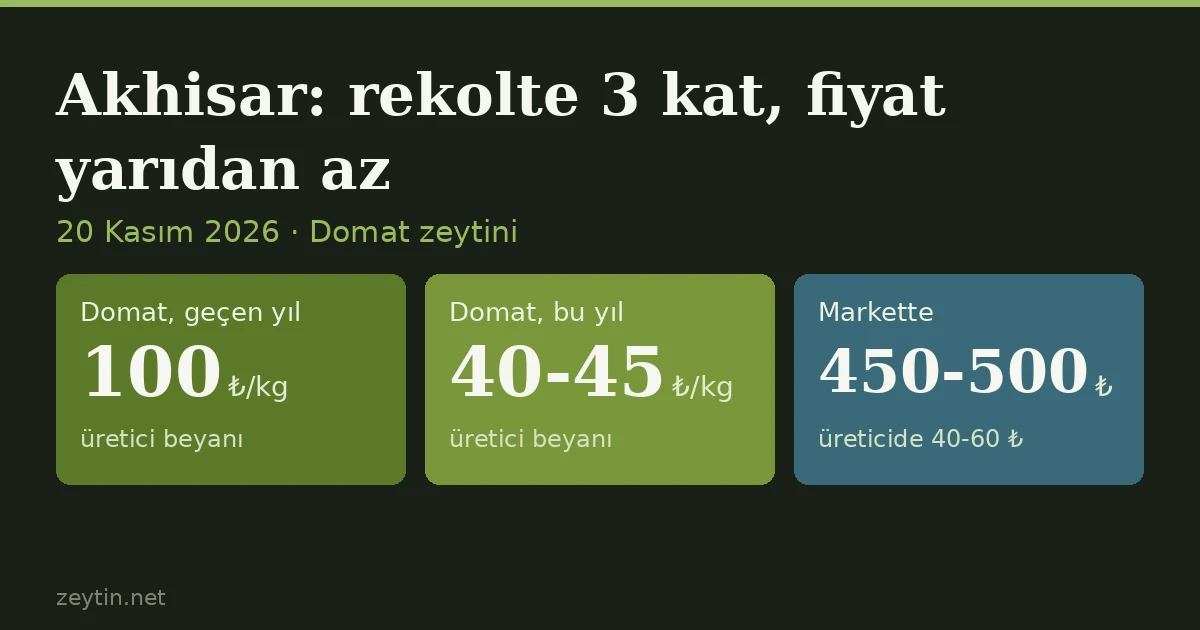
Akhisar's crop tripled and Domat olives fell from 100 to 40-45 lira: 40-60 lira at the producer, 450-500 lira on the shelf
According to a 20 November 2026 report, the olive crop in Akhisar has tripled on last year; a producer says Domat olives fell from 100 to 40-45 lira per kilogram. Olives at 40-60 lira at the producer reach 450-500 lira on shelves; a sector representative expects no rise in olive oil prices soon.
 Article
Agriculture in the EU budget bargain: allocations kept, the four big olive oil producers still object
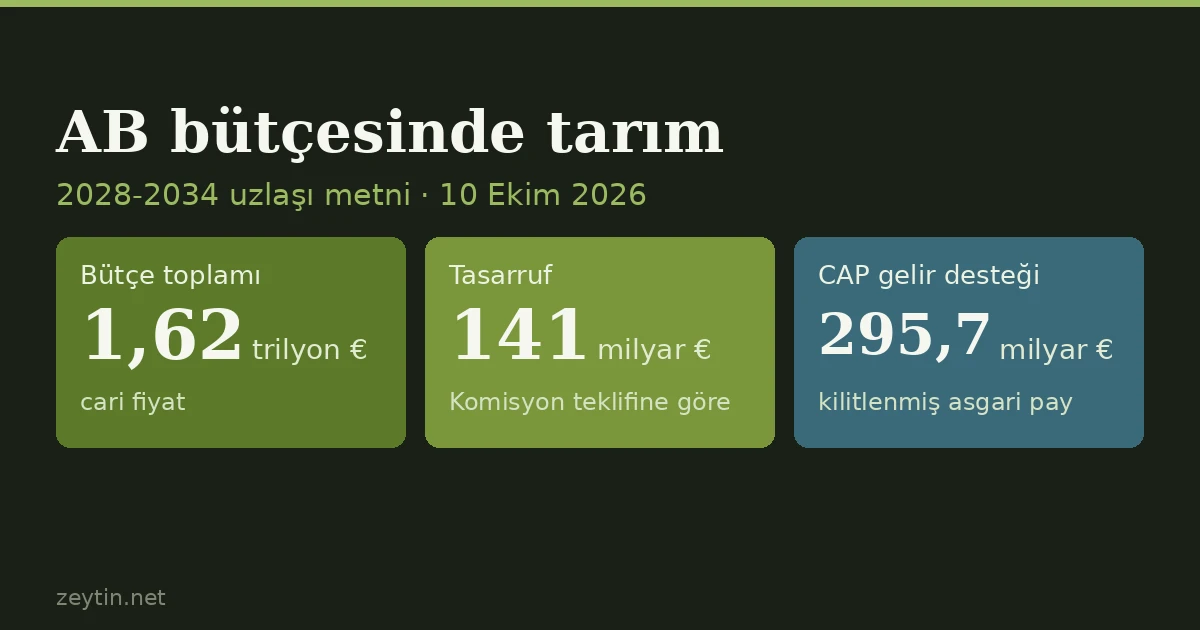
Ireland, holding the Council presidency, circulated a revised compromise text for the 2028-2034 budget on 10 October: 1.62 trillion euros in current prices, savings of 141 billion euros (8%) against the Commission proposal, with agricultural and cohesion allocations retained. The objections have not stopped, because under the Commission proposal the income support of the Common Agricultural Policy is ring-fenced at 295.7 billion euros inside a single 865 billion euro fund, against 387.8 billion euros allocated to that policy for 2021-2027. All four of the Union's big olive oil producers sit in the group of 17 states resisting the cut.
 Article
Spain decides in November: will part of a 1.6 million tonne crop be withdrawn from the market?
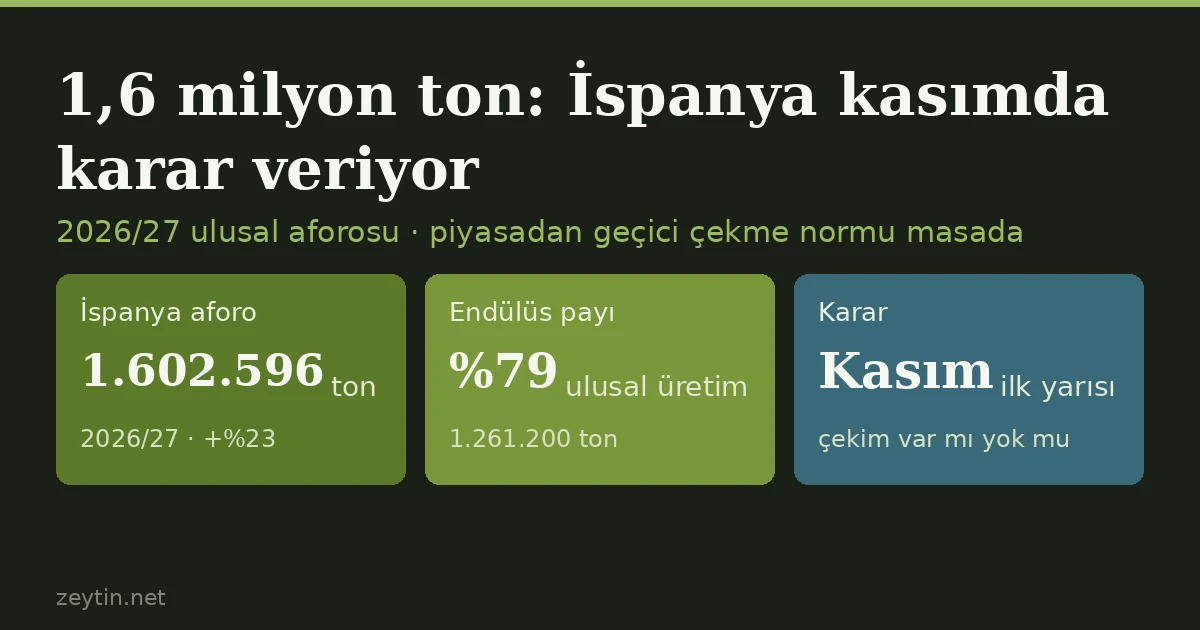
Spain's first national aforo for 2026/27 was presented in Jaén on 1 October: 1,602,596 tonnes of olive oil, 23% above last harvest. With carry-over stock, total availability approaches two million tonnes, and the Ministry of Agriculture will decide in the first half of November whether to activate a temporary withdrawal mechanism that has never been used. The ceiling on the world price Turkish exporters will face is being set here.