Şarköy Olive Oil registered as a designation of origin: Thrace's first olive GI bans fallen olives
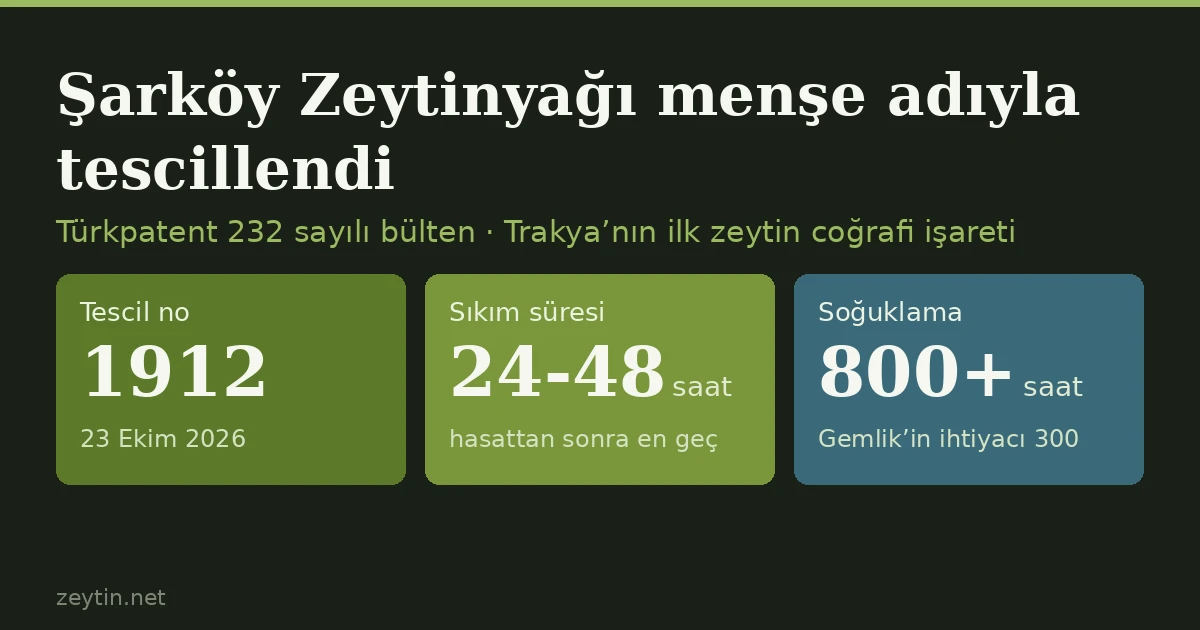
Per TÜRKPATENT's 2 November bulletin, Şarköy Olive Oil became a designation of origin on 23 October 2026 under no. 1912. Gemlik olives only, pressing within 24-48 hours, malaxation under one hour; chemical limits match the food codex. Turkey's 24th olive oil registration.
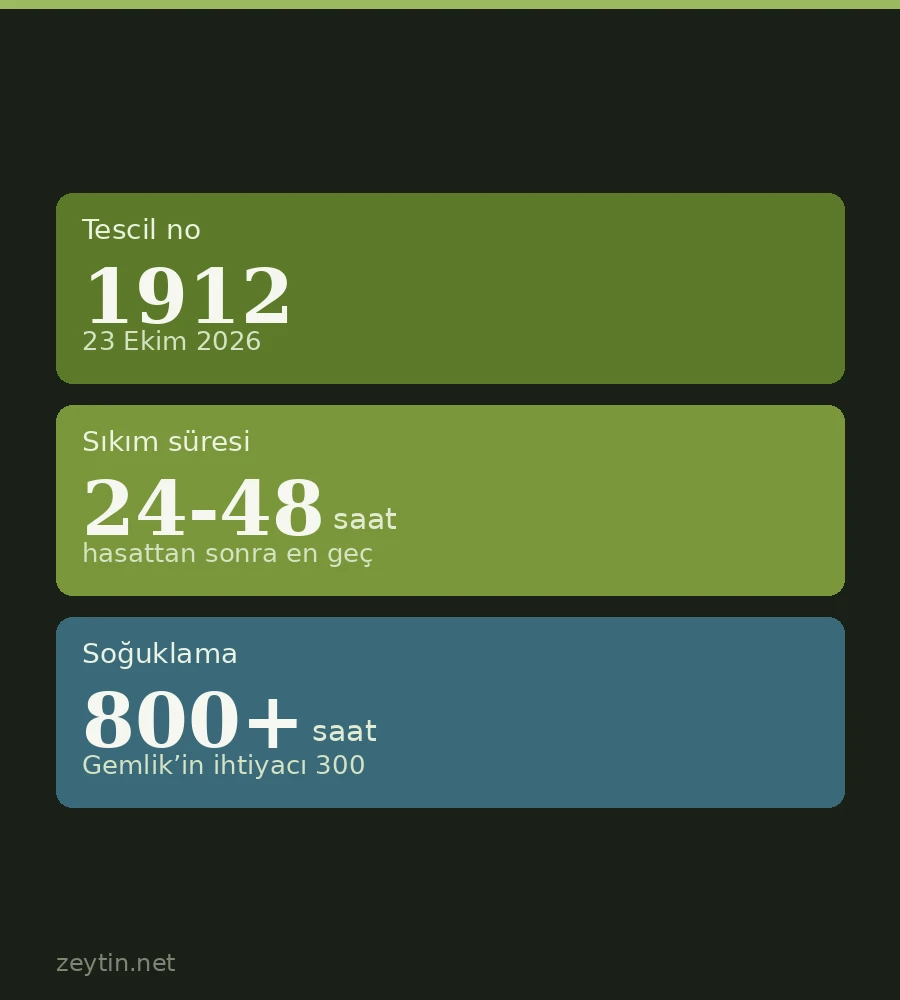
Thrace now has a protected olive oil name. According to issue 232 of the Official Bulletin of Geographical Indications and Traditional Product Names, published by the Turkish Patent and Trademark Office (TÜRKPATENT) on 2 November 2026, Şarköy Olive Oil was registered as a designation of origin on 23 October 2026 under registration number 1912. The application had been filed on 25 March 2025, and under Article 41 of Turkey's Industrial Property Law the protection runs from that filing date.
The registration is held jointly by the Thrace Development Agency and the District Governorship of Şarköy, a district of Tekirdağ province on the northern shore of the Sea of Marmara. According to the agency's announcement, the name is Tekirdağ's 15th geographical indication and the 40th for the TR21 Thrace region, which covers the provinces of Edirne, Kırklareli and Tekirdağ. The office's register lists no other entry with "olive" in its name from any of those three provinces, which makes Şarköy the region's first geographical indication for an olive product.
When we covered the field study carried out for Şarköy olive oil in September, we noted that the product had no registration yet. Some local outlets had already reported in April 2026 that the name had been registered; the official registration date given in the bulletin, however, is 23 October.
How does the registration define the product?
The registration document describes Şarköy Olive Oil as natural extra virgin and natural virgin olive oil made from olives of the Gemlik variety grown within the district. Its colour ranges from yellow to green and it generally carries aromas of fresh-cut grass and mint. On tasting it leaves a light bitterness in the mouth and a mild pungency in the throat. The document links this character to the fact that the olives are grown largely under rain-fed conditions with limited water.
The geographical boundary is the district of Şarköy alone. The document explains the product's link to the place through three main factors:
- The Ganos Mountains shelter the groves from the prevailing northerly winds, while the humid sea breeze from the Marmara softens drought stress on the trees even in dry years and creates a microclimate on the southern slopes.
- Annual rainfall is between 600 and 900 mm, and the average temperature between 13 and 16 °C. The sea keeps winters mild and protects the groves from frost and hoarfrost.
- The Gemlik variety needs at least 300 hours of winter chilling a year; Şarköy averages more than 800 hours, which the document says strengthens the variety's flavour, aroma and oil content.
The soils are described as sandy-loam and calcareous, developed over soft and clayey limestone, with a pH generally between 7 and 8. The document also notes that local growers begin harvesting before full ripeness to obtain a fresh, fruity oil with balanced bitterness and pungency, and that early-harvested olives in these conditions carry more phenolic compounds. The variety itself is covered on our Gemlik olive page.
What do the chemical limits say?
The first table in the document sets limits for the two quality grades:
| Parameter | Extra virgin | Virgin |
|---|---|---|
| Free acidity (% oleic acid) | 0.2-0.8 | 0.9-2.0 |
| Peroxide value (meq O₂/kg) | 0-20 | 0-20 |
| K232 | 0-2.5 | 0-2.60 |
| K270 | 0-0.22 | 0-0.25 |
| Delta K | 0-0.01 | 0-0.01 |
These upper limits are identical to those the Turkish Food Codex sets for the same two grades. In other words, the registration does not impose a stricter chemical threshold than general food law. Its distinctiveness rests on the variety, the geography and the production rules rather than on tighter laboratory numbers. In the fatty acid table, oleic acid is defined within a range of 55-83%, palmitic acid 7.5-20% and linoleic acid 2.5-21%.
Which production rules are binding?
Any producer who wants to use the protected name must follow the method written into the registration. The main points are:
- Harvest starts in mid-October and may continue until the end of February. Olives are picked by hand or with machinery that does not damage the fruit. Olives that have fallen to the ground on their own, or that have deteriorated after long waiting, may not be used.
- Olives are carried in clean, ventilated crates, preferably plastic, and must be pressed within 24 to 48 hours of picking.
- Washing water must be of drinking quality and is to be changed at least twice a day.
- During malaxation, the paste temperature should be 25-30 °C, and malaxation should not exceed one hour. Any water added must not exceed 10% of the weight of the olives.
- The oil is recommended to be stored at no more than 20 °C in stainless steel tanks, with contact with air kept to a minimum through inert gas or floating lids.
We have looked separately at how soon harvested olives need to be pressed; the Şarköy registration turns that question into a binding rule.
Who will carry out inspections?
Inspections will be coordinated by the District Governorship and the Thrace Development Agency and carried out by a board of at least three experts drawn from the Faculty of Food Engineering at Tekirdağ Namık Kemal University, the Tekirdağ Provincial Directorate of Agriculture and Forestry, the Şarköy District Directorate of Agriculture and Forestry and the Şarköy Municipality. The board will inspect once a year on a regular basis, and at any time when it deems necessary or when a complaint is received.
During inspections, producers will be asked for a farmer registration certificate from the district agriculture directorate proving that the olives were grown inside the boundary, producer receipts and mill invoices showing which mill pressed the olives and how much oil was obtained, and, where bottling is outsourced, the contract-filling agreement. The use of the name, logo and designation of origin emblem will be checked, as will the use of a geographical indication hologram on the packaging and compliance with labelling rules. Where needed, the oil can be sent to a public or private laboratory for analysis against the purity and quality criteria of the Turkish Food Codex.
Where does it stand in Turkey?
Before Şarköy, the office's register listed 23 registrations whose names end in "Zeytinyağı" or "Zeytinyağları" (olive oil): 13 designations of origin and 10 geographical indications. Şarköy becomes the 24th olive oil name on that list and the 14th designation of origin. Eight further olive oil files are still at the application stage: Salihli, Manavgat, Fethiye, Karaman, Eceabat, Ermenek, Adıyaman and Antalya Tavşan Yüreği. Previously registered olive products are listed on our geographical indication olive products page.
During the application period, the agency's secretary general Mahmut Şahin said the district had around one million olive trees, that about 30% of the crop went to table olives, and that roughly 3,000 tonnes of oil were produced a year, with a target of 4,000-5,000 tonnes. Şarköy olive oil is also Tekirdağ's focus product under the Ministry of Industry and Technology's "Anadoludakiler: 81 Provinces, 81 Products" programme. At a product analysis workshop the agency held in Şarköy, attended by around 80 people, Şahin said the registration was not a goal in itself: the main aim was to spread production that meets the standards, raise producer incomes, improve processing and marketing capacity and bring the oil to wider markets through sustainable sales channels.
Whether the name becomes visible on shop shelves depends on producers entering the inspection system and obtaining the emblem. The registration is now in force; how many businesses will take that route is not yet known.
Related reading: What do geographical indications actually do? · Olive growing in Tekirdağ
One rating per visitor; you can change yours at any time. Ratings are real reader votes — no seeded or default scores.
Related
 Article
Agriculture in the EU budget bargain: allocations kept, the four big olive oil producers still object
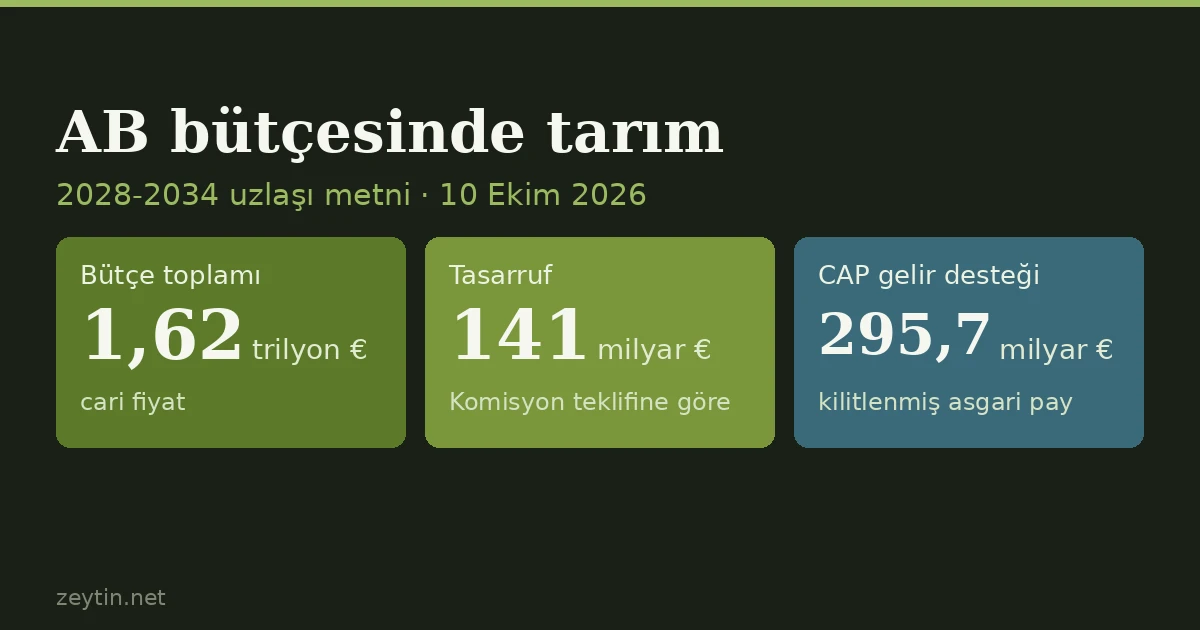
Ireland, holding the Council presidency, circulated a revised compromise text for the 2028-2034 budget on 10 October: 1.62 trillion euros in current prices, savings of 141 billion euros (8%) against the Commission proposal, with agricultural and cohesion allocations retained. The objections have not stopped, because under the Commission proposal the income support of the Common Agricultural Policy is ring-fenced at 295.7 billion euros inside a single 865 billion euro fund, against 387.8 billion euros allocated to that policy for 2021-2027. All four of the Union's big olive oil producers sit in the group of 17 states resisting the cut.
 Article
Tavşan Yüreği olive crop seen at 10,000 tonnes: output up 67%, but a litre of oil takes 14 kg of fruit
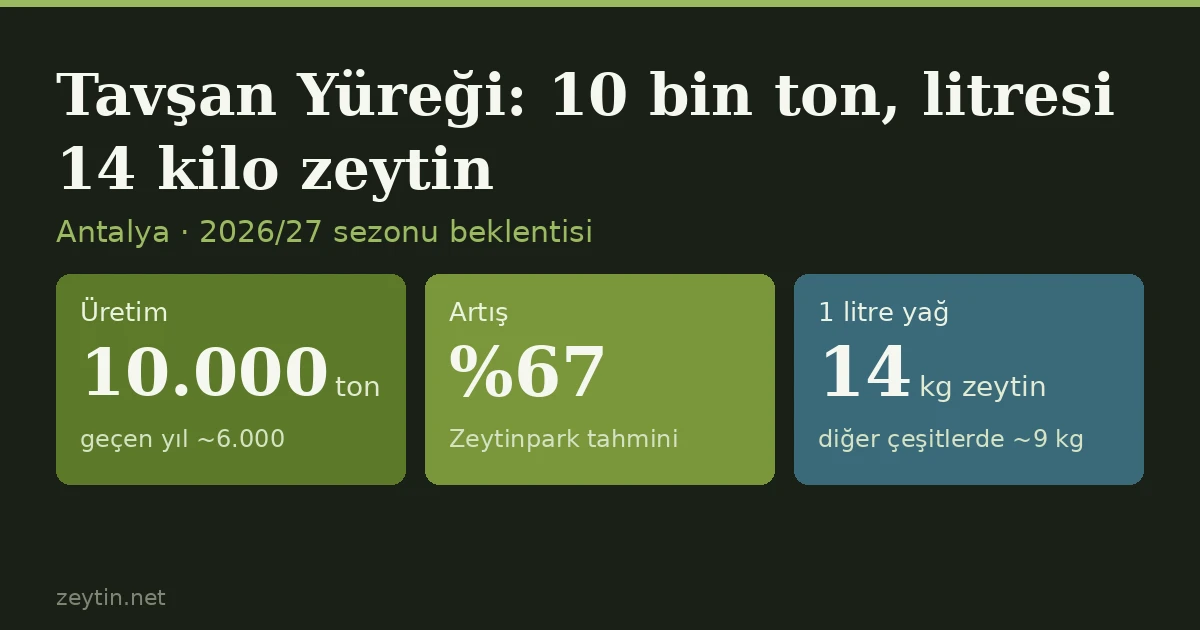
Zeytinpark general manager Bayram Çarkçıgil says output of Antalya's geographically protected Tavşan Yüreği olive will rise from 6,000 to about 10,000 tonnes. Table olives sell at 80-100 lira a kilo. Other varieties give a litre of oil from 9 kg of fruit; Tavşan Yüreği needs 14 kg, a yield of roughly 6.5 per cent.
 Article
Italian extra virgin has halved in a year: growers in Puglia set a Monday noon deadline
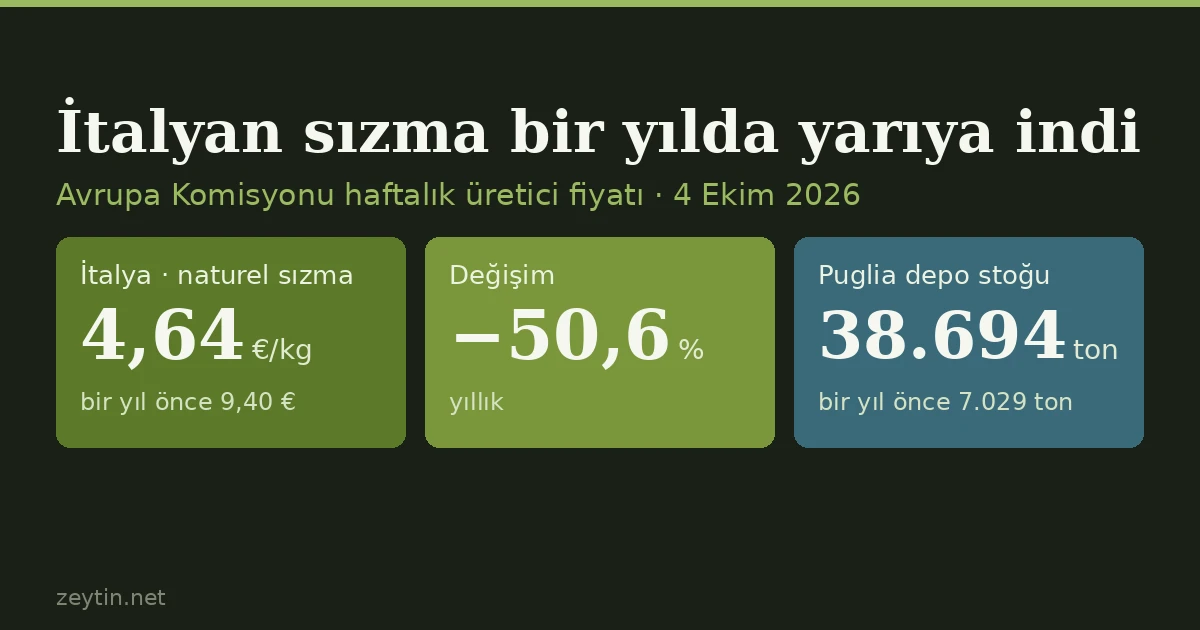
According to the European Commission's weekly producer prices, Italian extra virgin olive oil fell to €4.64 a kilo in the week of 4 October; a year earlier, in the same week, it was €9.40. Growers in Puglia have taken to the streets in the opening days of the harvest, holding sit-ins in Corato and Bitonto and giving the government until noon on 12 October to respond. Italian extra virgin stored in the region's warehouses has risen fivefold in a year.
 Article
Antalya's crop is up 30%: of 70,000 tonnes of olives, 55,000-60,000 head for the mill
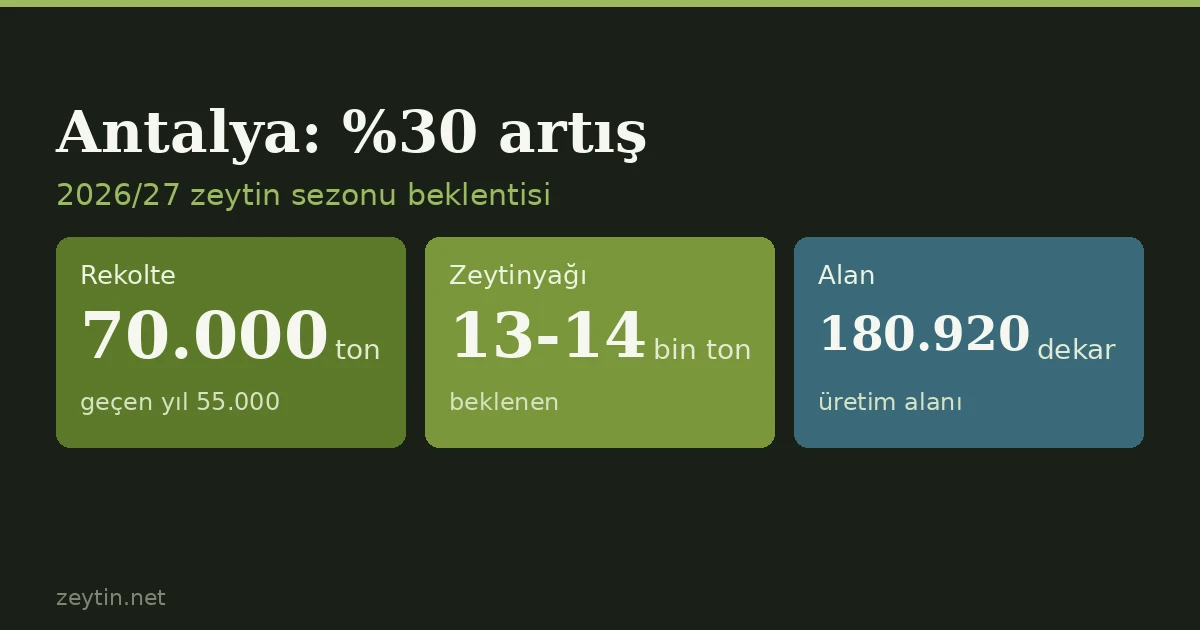
According to the Antalya Commodity Exchange, the province's olive crop is rising about 30% from some 55,000 tonnes last season to around 70,000 tonnes, with 13,000-14,000 tonnes of olive oil and 10,000-15,000 tonnes of brined fruit expected. Harvest opened on 15 September. There is movement on the registration front too: an EU application has been filed for the Tavşan Yüreği olive, and a geographical indication file is under way for the Beylik variety.