How much sun does an olive tree need? What happens to flowers, fruit and oil content when light inside the canopy drops
In a measured study of large olive hedgerows in Argentina, flower and fruit numbers fell when light reaching the inside of the canopy dropped below about 18-20% of that in the open; fruit set, fruit weight and oil content rose with light. The study's limits and its link to pruning.
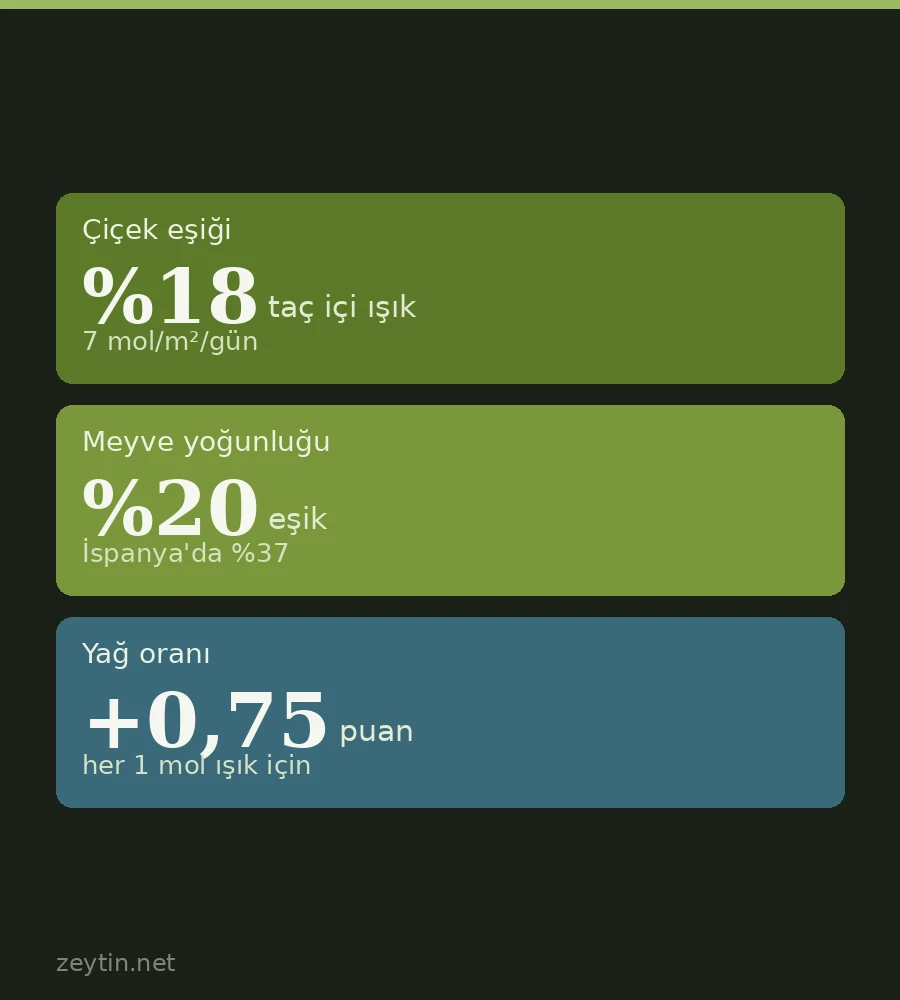
The olive is a sun-loving tree, but "loves sun" does not mean every part of the tree gets it. The real question is: what happens to flowers, fruit and oil if the branches inside the tree do not get enough light? A measured study in large olive hedgerows in Argentina answers with numbers: when the light reaching the inside of the canopy falls below about 18-20% of the light arriving above the orchard, the number of inflorescences and fruit drops; fruit set, fruit weight and oil content, meanwhile, keep rising as light rises.
This article covers that study (Cherbiy-Hoffmann, Searles, Hall and Rousseaux, Scientia Horticulturae, 2012) and the other findings it cites. The study was not carried out in Türkiye; we set out its limits under a separate heading below.
How is "light" measured?
The researchers measured the light used in photosynthesis, photosynthetically active radiation (PAR). Its unit is moles per square metre per day (mol/m²/day); we also give each value as a percentage of the light arriving above the orchard. "20%" means one fifth of the light reaching an open area reaches that point in the tree. At the study site, the monthly mean daily PAR above the orchard was about 20 mol/m²/day in winter and about 40 in summer.
How was the study done?
| Item | In the study |
|---|---|
| Place | Miraflores, Catamarca province (Argentina); average annual rainfall 423 mm, drip irrigation |
| Variety and age | Arbequina, 8 years old |
| Planting | 5 m x 7 m, rows north-south; grown as a hedgerow |
| Duration | Two seasons (2005-06 and 2006-07) |
| Measurement | Three trees, light measured at 60 positions inside each canopy |
| Intervention | At the end of winter one side and the top of the row were machine-pruned; the other side was left unpruned |
In the first season, a severe late-winter frost of about -7 °C shortly before flowering damaged most of the inflorescences, so production measurements could be made only in the second season.
Why does the inside of the canopy go dark?
Just after pruning, a little over half of the measurement positions received a high (above 60%) or intermediate (20-60%) light level. But the branches grew back fast: within two seasons the hedgerow grew from 3 m x 3.5 m (width x height) to 4.6 m x 5.5 m. By the end of the first season, most of the original canopy volume received 20% or less of the light. Most of the growth took place in the first season, on the pruned side and the top.
What happens at which light level?
The table below sets the thresholds measured in the study next to the Spanish study the paper cites in its discussion (Connor and colleagues, 2009; the same Arbequina variety, a hedgerow orchard). The two studies measured differently: vertical light intervals in Spain, positions inside the canopy in Argentina; the authors themselves say a direct comparison is difficult.
| Measure | Argentine study | Spanish study (as cited in the paper) |
|---|---|---|
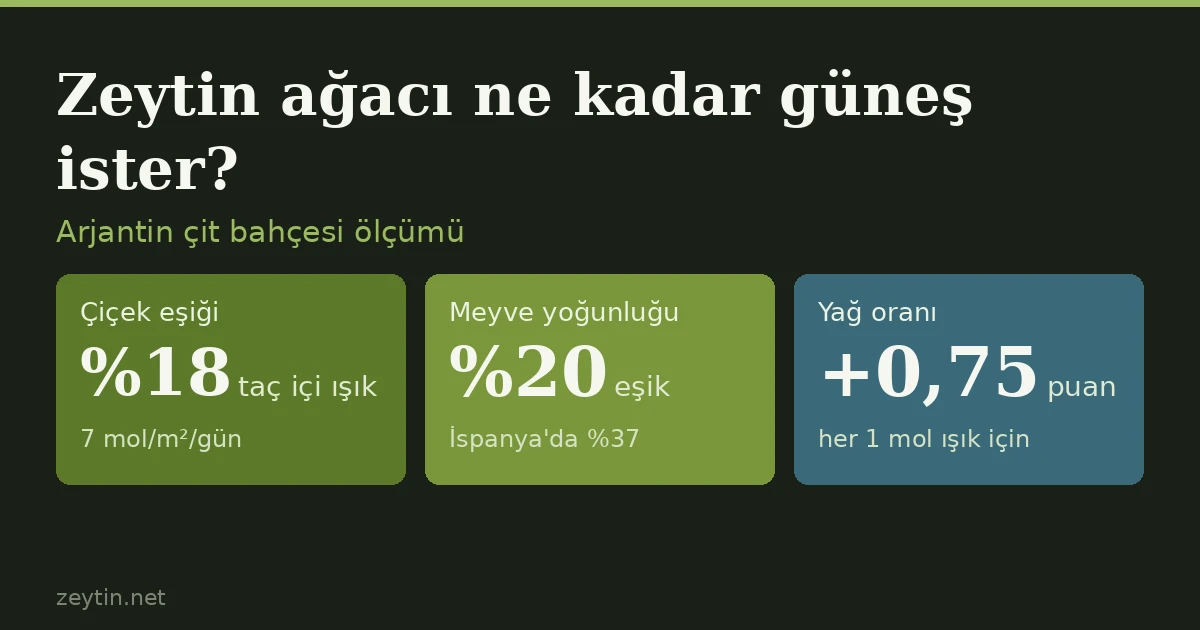
| Inflorescence density | Rises up to about 18% (7 mol/m²/day), then levels off | Not cited |
| Fruit density (fruit per litre of canopy volume) | Rises up to about 20% (8 mol) | Rises up to about 37% (15 mol) |
| Fruit set (fruit per inflorescence) | Linear rise across the observed 0-50% range | Not cited |
| Fruit dry weight and oil content | Linear rise up to the highest observed light level (22 mol, about 50%) | Rises up to about 60% (25 mol) |
Three things can be read from the table.
The flowering threshold is low. At positions where light inside the canopy is above about 18%, inflorescence density does not increase further, meaning that beyond this level light no longer limits the number of flowers. The paper also notes that in shading trials where less than 10% of light got through, inflorescence density fell markedly.
Fruit set and fruit size show no threshold. In the Argentine data, fruit set and fruit dry weight rise like a straight line across the measured light range. The authors say more than 50% light is needed for maximum fruit set. For dry weight, each 1 mol/m²/day increase in light adds about 0.02 grams; for oil content, about 0.75 points.
Oil content rises with light. The line fitted to oil content (dry-weight basis) in the study is y = 15.69 + 0.75x. By this line, a position receiving 5 mol/m²/day has an oil content of about 19.4%, and one receiving 20 mol/m²/day about 30.7% (these two values are our calculation). Since 45.7 mol/m²/day of light arrived above the orchard on the measurement day, these two points correspond to about 11% and 44% of the light.
Does pruning increase light?
The expected answer is "yes", but the study did not quite turn out that way. The machine-pruned side and top produced many new shoots and leaves in the following season: leaf density (leaves per litre of canopy volume) reached at most 12.5 on the pruned side and at most 6.9 on the unpruned side. But this dense green growth did not show up as productive buds: the share of axillary buds that turned into inflorescences was 40% on the pruned side, 70% on the unpruned side and only 20% on the pruned top.
The authors link this to something known in fruit trees: pruning that shortens young branches wholesale can raise light in the short term, but it strongly stimulates new shoot growth and can lower light inside the canopy in the long run. In conclusion, the paper says oil production in large hedgerows is limited by low light inside the canopy, and that the dense shoot growth triggered by mechanical pruning may contribute to this.
What does it mean for Türkiye?
This study's data cannot be applied directly to orchards in Türkiye: different climate, one variety, one orchard, a hedgerow system. But the result shows that the distribution of light inside the canopy is a factor in yield in olive and supports the general approach: shape the tree so light gets in, and keep the inside bright while the canopy volume grows. Our own articles on this:
- For the purpose, timing and method of pruning, How is olive pruning done?
- For tree spacing and canopy growth, Guide to setting up a high-density orchard
- For the light needs of a potted tree, Caring for an olive tree in a pot.
Limits of the study
- One variety (Arbequina), three trees, two seasons (production measured in the second only).
- Besides light, factors such as crop load and temperature may also affect fruit density; the authors say so. At the same light level, oil content came out higher in Spain.
- Measurements were taken only up to 3.5 m of canopy height.
- The study measured flower, fruit and oil yield, not the tree's survival.
Summary
In olive, flower and fruit numbers fall when the light reaching inside the canopy drops below about one fifth; fruit set, fruit size and oil content rise with light across the measured range. In large hedgerows, pruning does not automatically raise light; dense shoot growth can shade the inside again.
One rating per visitor; you can change yours at any time. Ratings are real reader votes — no seeded or default scores.
Related
 Article
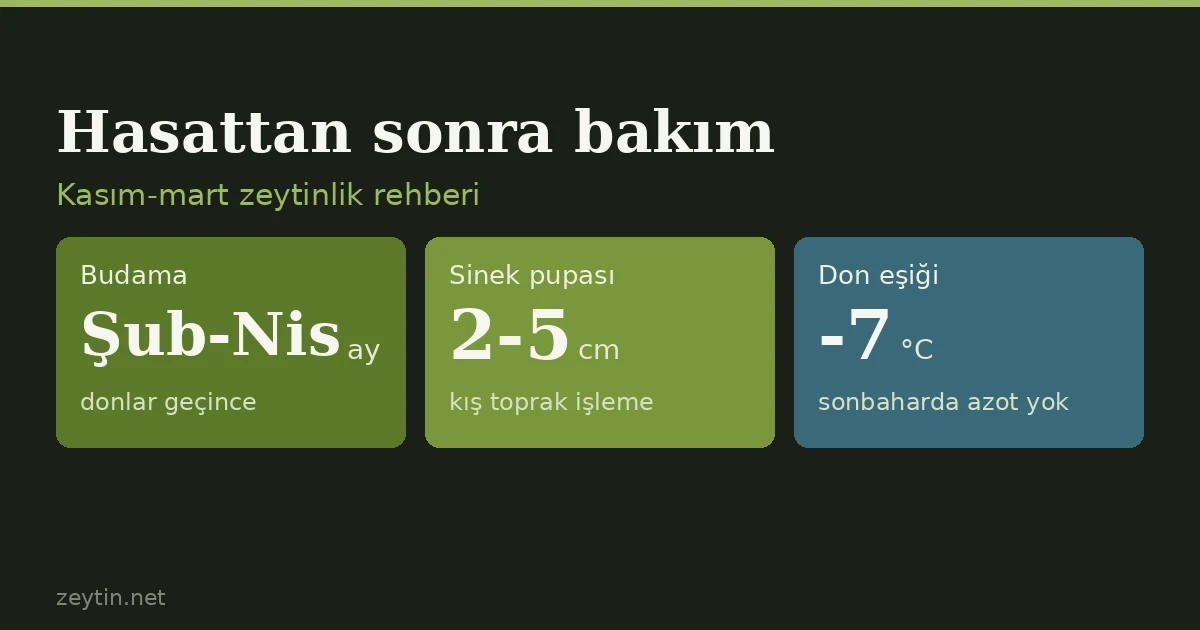
What to do for olive trees after harvest: a November-to-March care guide
The work in the grove does not end with the olive harvest; next year's crop is prepared in exactly these months. From collecting fallen fruit and protecting harvest wounds to region-specific peacock spot sprays, the right pruning time, autumn feeding and winter soil work, here is what needs doing after harvest.
 Article
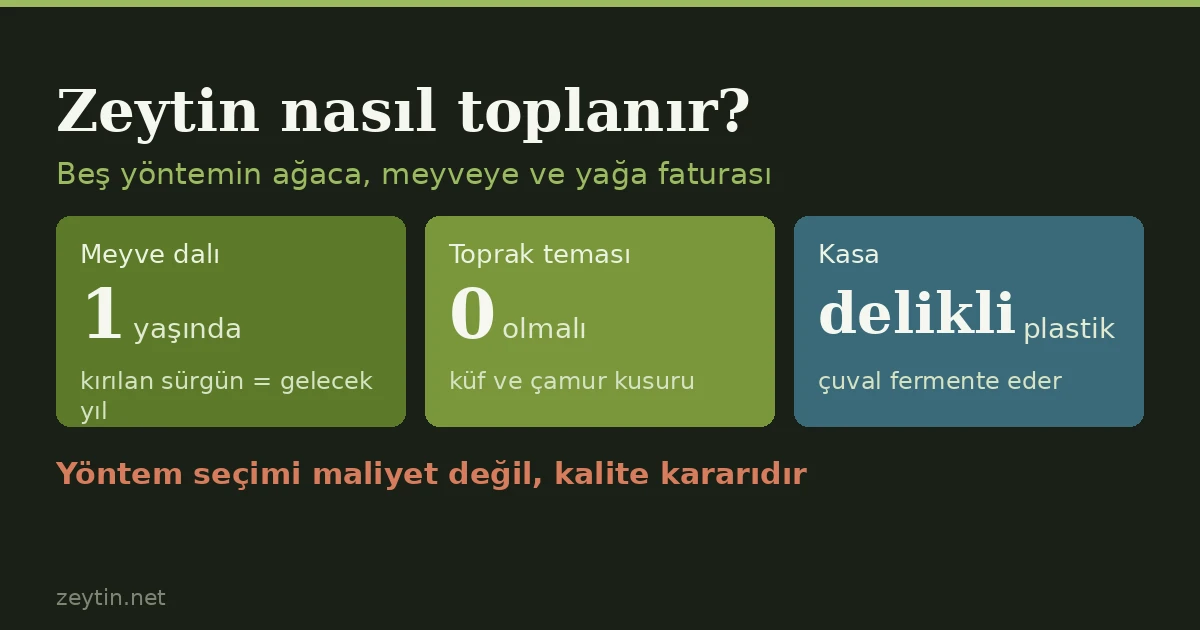
How are olives harvested? What five picking methods cost the tree and the oil
Hand picking, poles, combs, trunk shakers and straddle harvesters each charge a different bill — to the fruit, to the tree and to the acidity of the oil. Which method suits which grove, and what goes wrong on harvest day.
 Article
Does a harvesting machine damage the olive tree?
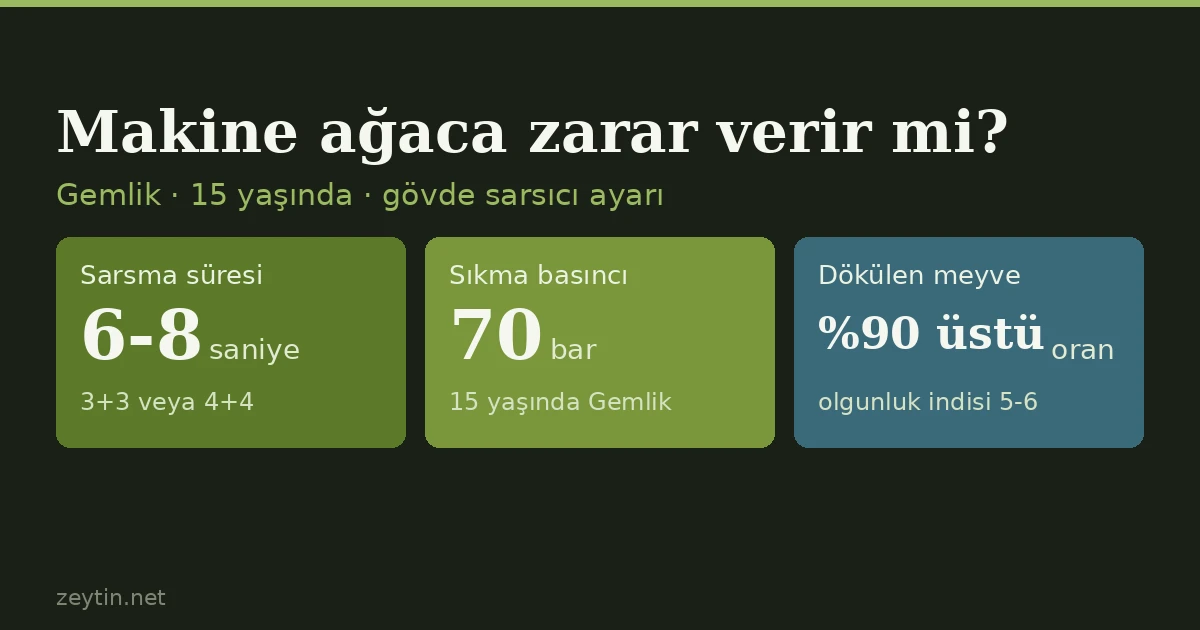
Trunk shakers, branch shakers and hand picking: the damage comes not from the machine itself but from its settings and duration. The figures the Turkish agriculture ministry's research institute gives for the Gemlik variety — 70 bar clamping pressure, 20 Hz, a 6-8 second shake — and what falls off the tree once that window is exceeded. Why grove spacing, slope limits and operator training are technical requirements.
 Article
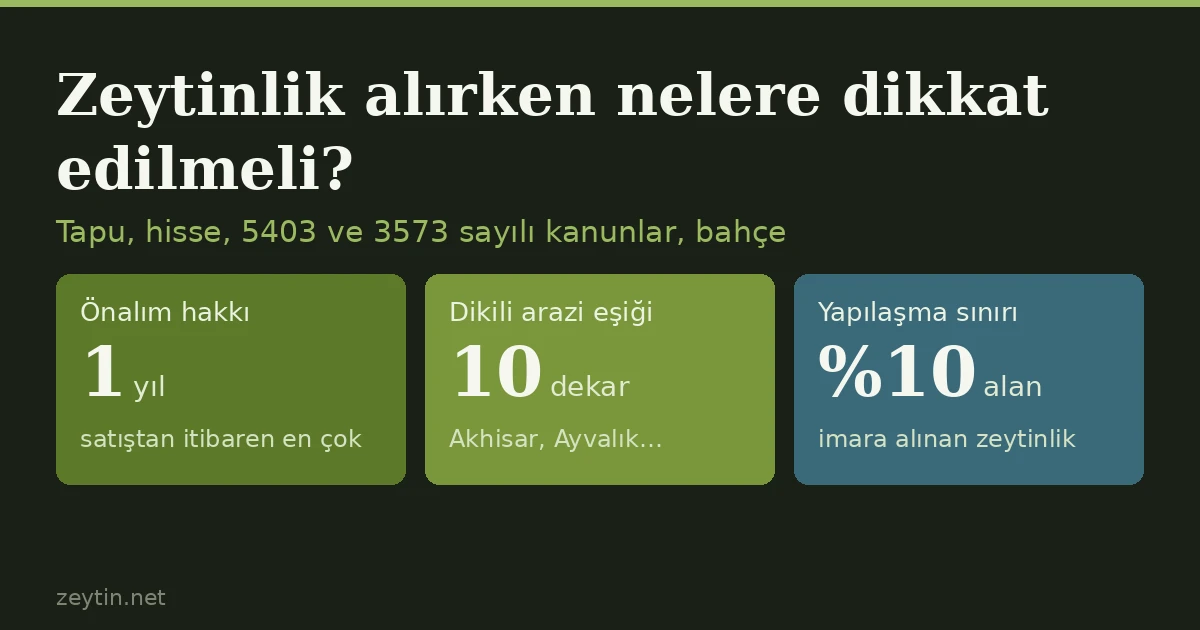
What to check when buying an olive grove: title deed, shares and the trees
In Türkiye, an olive grove sale is valid only at the land registry, and a share-cropper's lease continues with the new owner. In co-owned groves, the pre-emption right can last up to a year and, since a 2025 amendment, is decided on market value; transfers of shares need ministry permission. Law 3573 bars reducing olive-growing areas. Trees, grafting, disease, water, frost and real yield from several seasons' receipts: a point-by-point checklist.