What happens if an olive tree goes without water? Signs of drought stress, what it costs at each stage and what to do in a dry year
The olive copes with drought by halting canopy growth and narrowing its stomata, but pays in flower buds, fruit set, fruit size and oil content. Drawing on three sources, the article covers the effect of water stress by growth stage, rainfall needs and measures for a dry year, and states plainly that no reliable figure exists for how many days an olive can last without water.
The olive is known as a drought-tolerant tree, and that is true; but "tolerant" is not the same as "without loss". Without water the tree chooses to stay alive and pays for it with its crop. This article rests on the 2015 review in Zeytin Bilimi by Ayaz and Varol of the Olive Research Institute (Bornova, İzmir), a review of drought and the olive published in 2019 in the journal Plants by Portuguese researchers, and an interview with a researcher at the Marche Polytechnic University in Italy. One thing up front: we found no reliable figure for how many days or weeks an olive tree can last without water, and which variety is the most tolerant changes from study to study. We therefore give no such figures.
How does the tree cope with drought?
The Portuguese authors' review lists several structural features that help the olive against drought:
- Small stomata, found only on the underside of the leaf. The olive controls its stomata tightly; under water shortage they become smaller and denser.
- A thick cuticle and waxy layer. The underside of the leaf is covered by wax and star-shaped hairs; these structures increase under drought and slow the loss of water from the leaf.
- Strong osmotic adjustment. Thanks to dissolved substances that build up in leaves and roots, the tree can draw water from the soil even well below the level normally regarded as the wilting point. The review gives the wilting point as −1.5 MPa for some species and about −2.5 to −3.5 MPa for the olive, and writes that the olive can tolerate values below −8 MPa.
- Root system. Trees grown without irrigation develop a larger root system than irrigated ones; as water falls, canopy growth slows while assimilates accumulate in the roots.
Ayaz and Varol give the same summary in Turkish: the olive copes with dry conditions by stopping canopy growth while keeping up photosynthesis and transpiration. But the Portuguese review also notes an important cost: these mechanisms are expensive in energy; they lower the current season's production and, by disturbing growth, also harm the following year's production.
What shows on the tree when it goes without water?
In the interview with the Italian researcher Lodolini, curled leaves and shrivelled fruit are given as signs of advanced water stress; Lodolini says it should not come to that. According to the same interview, the plant may dry and drop its fruit to conserve water. In young trees growth stays stunted and the start of production is delayed. The Portuguese review writes that when a water deficit starts early the leaf area becomes smaller, and when it starts after enough leaf area has formed the leaves may age and fall; this section is general plant knowledge, not specific to the olive. Leaf drop has other causes as well, so do not judge drought from a single symptom.
What does a shortage of water cost, and when?
The table in the Ayaz and Varol review summarises the effect of water stress by growth stage of the olive:
| Phenological event | Period | Effect of water stress |
|---|---|---|
| Shoot growth | Late winter-early summer | Shoot growth declines |
| Flower bud formation | February-March | Fewer flower buds |
| Flowering | April-May | Aborted (abortive) flowers form |
| Fruit set | May-June | Fruit set falls, alternate bearing increases |
| Fruit development, stage 1 | June-July | Fruit stays small |
| Fruit development, stage 2 | July-August | Fruit stays small |
| Fruit development, stage 3 | August-harvest | Fruit stays small |
| Oil formation | September-harvest | Fruit oil content falls |
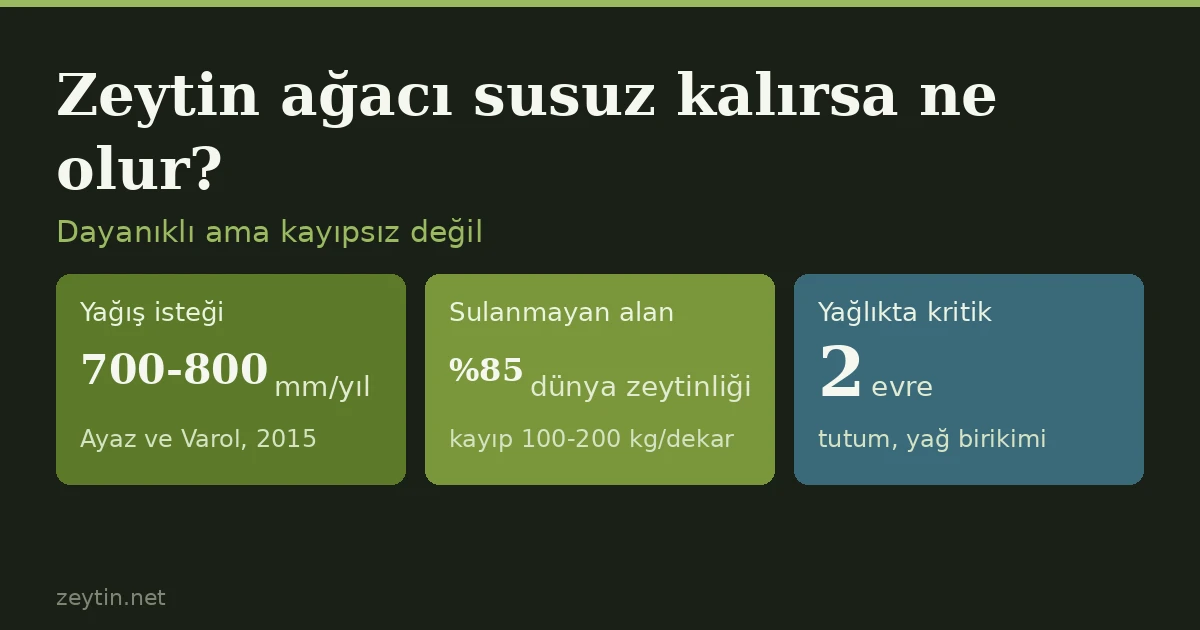
The review separates the most critical periods for avoiding water stress as follows: for oil olives, fruit set and oil accumulation; for table olives, fruit set, the first stage of fruit development (cell division) and the third stage (cell expansion). The phrase "alternate bearing increases" in the table matters: water shortage can reinforce not only this year's crop but also the tree's tendency to bear heavily one year and rest the next. We explain alternate bearing separately in our article on why trees do not bear fruit.
How much rain is enough?
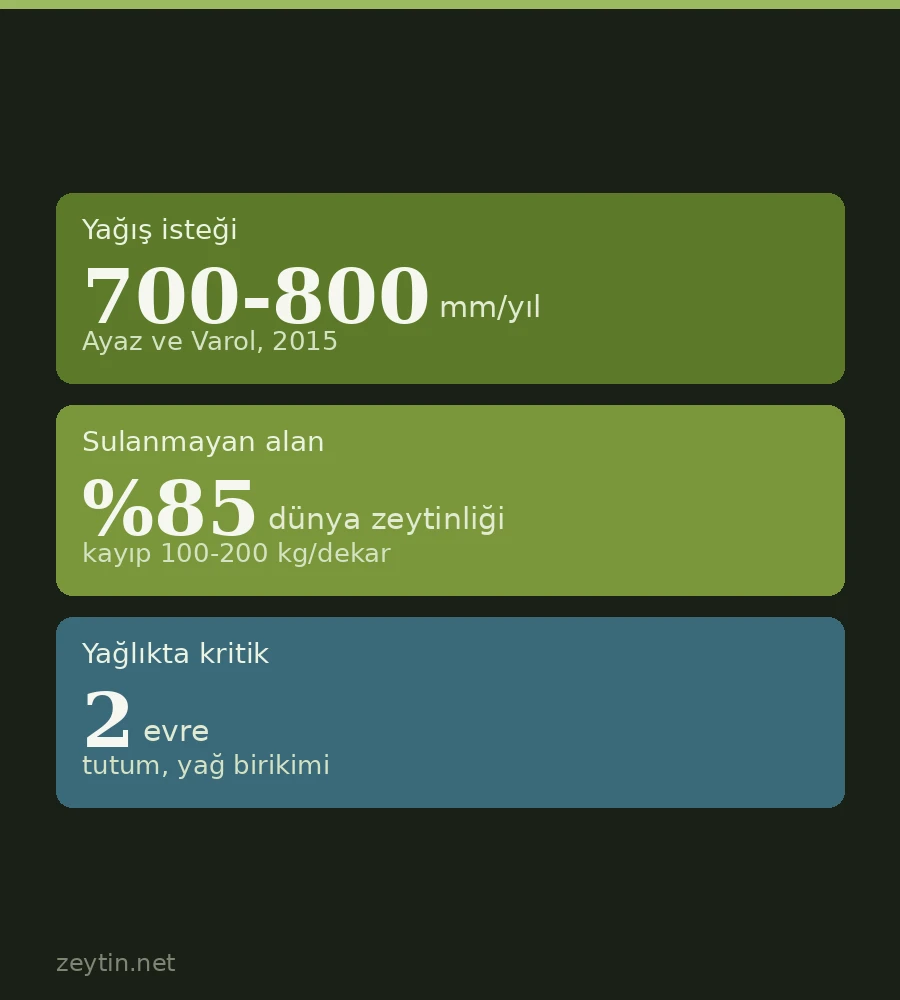
The sources differ, so let us give both. Ayaz and Varol give the olive's annual rainfall requirement as 700-800 mm, and write that winter and spring rains stored in the soil secure flawless blossoming, raise fruit set and reduce the June drop. The Portuguese review says the olive can grow on as little as 200 mm a year, though more than 400 mm is needed, that 600, 800 and 1000 mm are regarded as sufficient, moderate and good respectively, and that the lower limit for commercial yield without irrigation is 500 mm a year. The two answer different questions: one describes what the tree wants, the other the limit at which it can survive.
On irrigation, the worldwide picture is this: Ayaz and Varol write that 85% of the world's olive area is not irrigated, that 100-200 kg per decare of crop loss occurs every year in unirrigated areas, and that cultivation generally depends on rainfall. This is a global generalisation; do not apply it to your own orchard.
Effect on fruit and oil
The Portuguese review writes that a water deficit generally lowers yield, fruit dry weight and oil accumulation and speeds up ripening. Phenolic compounds tend to rise with the severity of drought; oils can sometimes be excessively bitter. The review says that beyond a threshold the quality gain from extra phenols does not make up for the loss in quantity, and that deficit irrigation is the better option. The effect on peroxide value and free acidity is generally small. Lodolini likewise says that under dry conditions oil accumulation in the fruit falls and the oil is more bitter and pungent, which could be seen as a quality gain but may also lead to an unpleasant defect, "straw-wood". We explain what bitterness means in our article on bitter and pungent oil.
Does the tree recover when the drought ends?
The Portuguese review writes that on re-irrigation the olive's water status recovers quickly but stomatal conductance recovers more slowly, and adds that in trees previously exposed to drought photosynthesis recovers faster than stomatal conductance. The same review notes that recovery studies have been neglected and little researched. So there is not enough data either to say "one irrigation fixes everything" or to say "the tree suffers lasting harm".
What can be done in a dry year?
Ayaz and Varol list these measures for making better use of rainfall:
- Regular irrigation in the periods of need and in summer, with drip irrigation, which uses water most economically (irrigation article).
- Avoid tillage if possible, or keep it shallow.
- Build terraces on sloping land.
- Weed control and mulching (weed management article).
- Prune away unnecessary branches and train the trees low from the bottom.
- Spread drought-tolerant varieties.
For traditional orchards with no possibility of irrigation, Lodolini recommends raising soil organic matter, describing it as a "sponge" that holds 10-15 times its own weight in water. For this he lists leaving a grass cover in the orchard, shredding pruning residues, and using compost or other plant residues. For young trees, he says irrigation is particularly useful, and the Portuguese review also writes that young orchards need irrigation to establish roots.
Drought has a price side as well: we explain how Spain's drought set prices in Türkiye in our article on the Andalusian drought, and the long-term effect of climate on olive growing in our climate change article.
Summary
The olive copes with water shortage by stopping canopy growth, narrowing its stomata and enlarging its roots, but the price is paid in flower buds, fruit set, fruit size and oil content. The most critical periods are fruit set and oil accumulation; for table olives, the stages of fruit development are added. Curling leaves and shrivelling fruit are signs of advanced stress. In a dry year, summer irrigation, mulch, weed control, removing unnecessary branches and soil organic matter stand out as measures; as for what happens after a given number of days without water, the sources give no figures.
One rating per visitor; you can change yours at any time. Ratings are real reader votes — no seeded or default scores.
Related
 Article
Does a harvesting machine damage the olive tree?
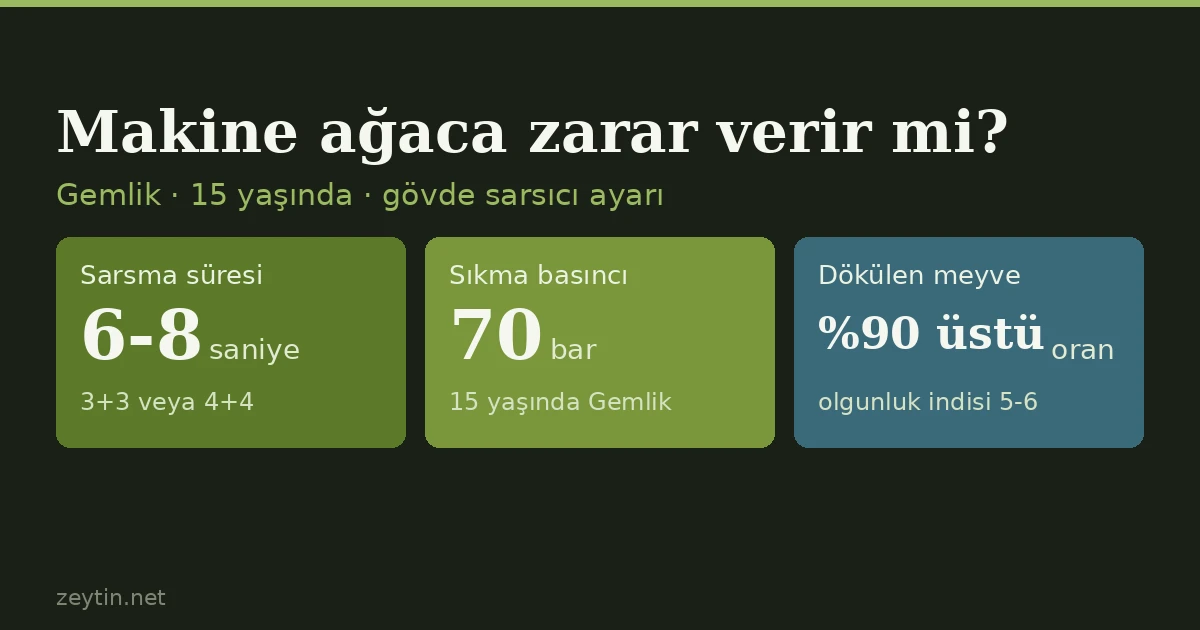
Trunk shakers, branch shakers and hand picking: the damage comes not from the machine itself but from its settings and duration. The figures the Turkish agriculture ministry's research institute gives for the Gemlik variety — 70 bar clamping pressure, 20 Hz, a 6-8 second shake — and what falls off the tree once that window is exceeded. Why grove spacing, slope limits and operator training are technical requirements.
 Article
Which olive variety is the most productive? Regular crops, early bearing and alternate bearing
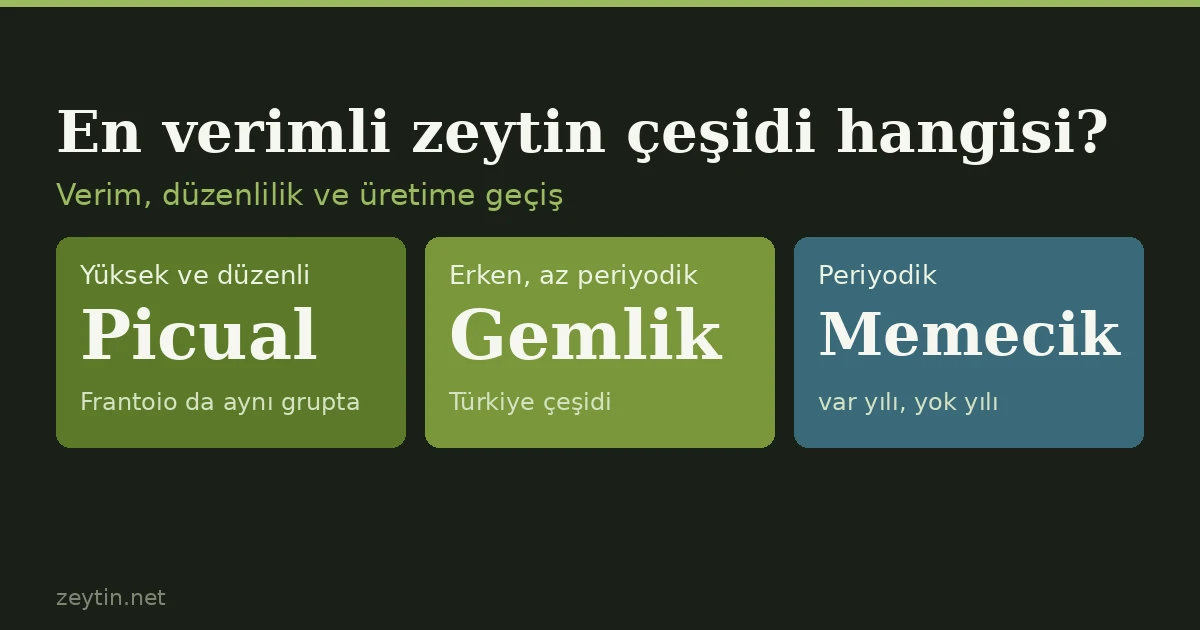
There is no single "most productive olive". Productivity depends on whether a tree bears regularly every year, how early it starts cropping and pollination. In our variety data, Picual and Frantoio are high and regular, Gemlik is early with low alternate bearing, while Kalamata, Hojiblanca and Memecik swing between on and off years.
 Article
Building a high-density olive grove: five requirements
High-density planting is not a choice of variety but a five-component system — miss one and it performs worse than a traditional grove. Spacing, yields, the overlooked oil-content trade-off, and who it does not suit.
 Article
How to plant an olive sapling
Planting season, hole dimensions, removing a potted sapling, planting depth and the graft union, the basin and settling water — why settling water is given even in rain, first-year care and five common mistakes.