Opening prices in Akhisar: 60 lira for double Domat, 10 lira for milling olives
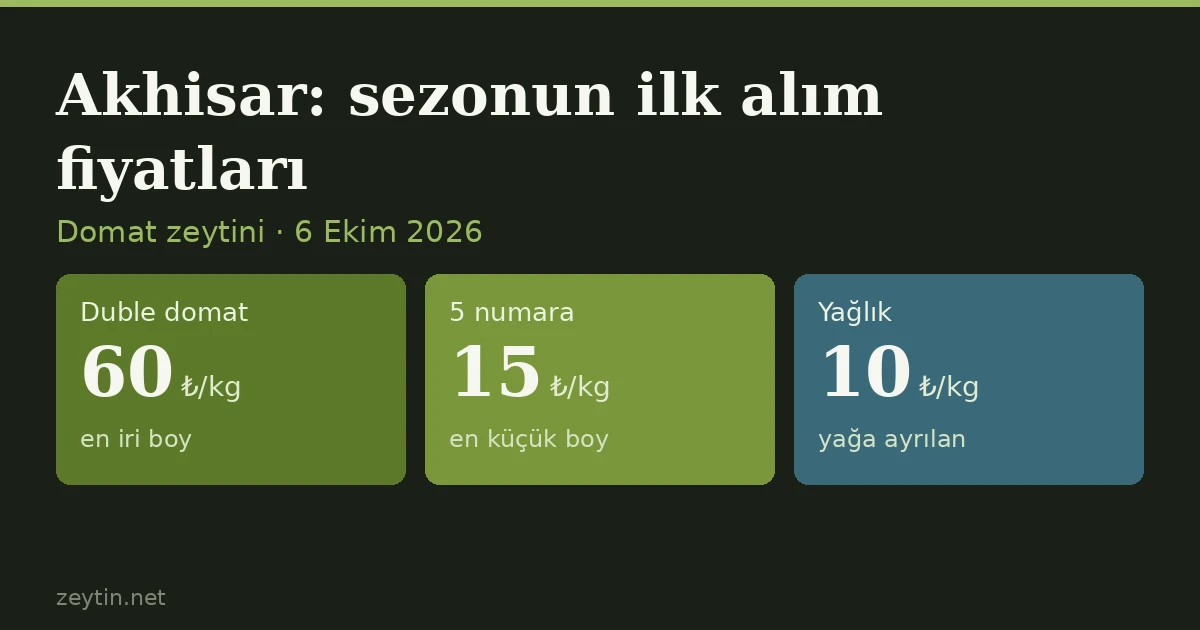
The season's first purchase prices for Domat olives have formed in Akhisar: 15 to 60 lira a kilo by size, and 10 lira for fruit sold for milling. The local chamber of agriculture says prices are below last year's and has called for a joint table. Farm input costs rose 27.6% over the same period.
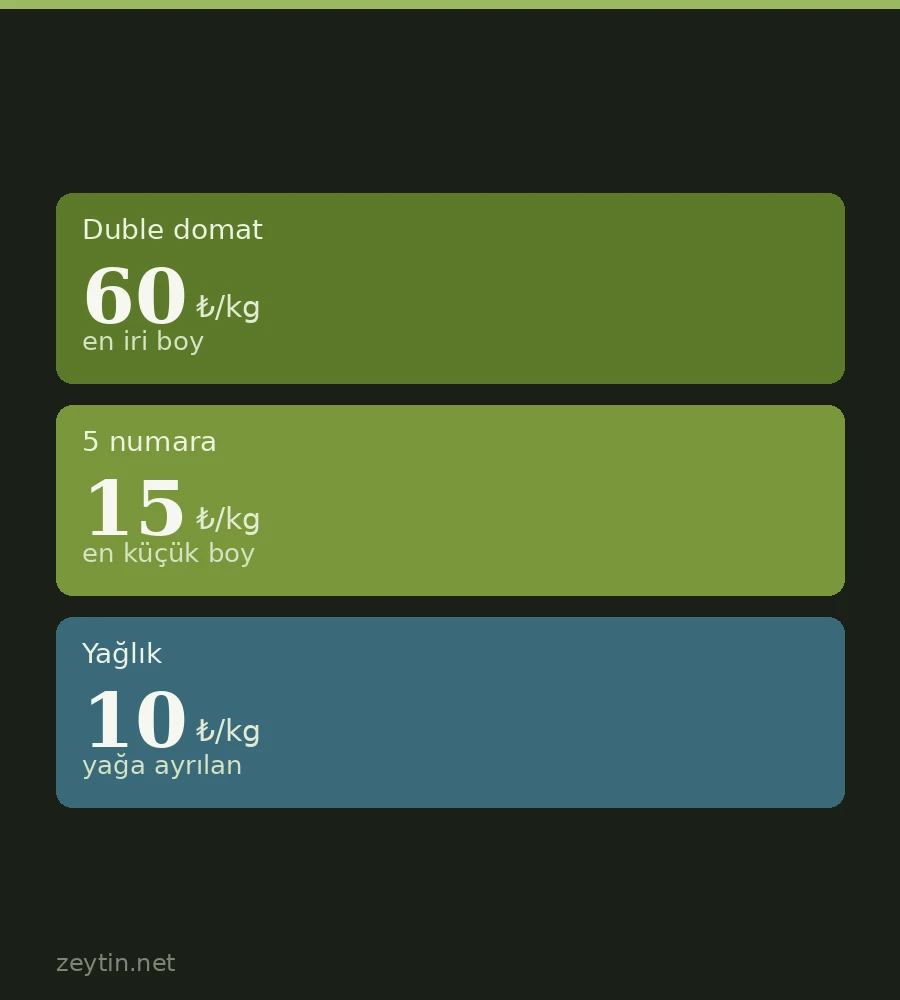
Harvest has begun in Akhisar, Türkiye's centre for table olives, and the season's first purchase prices have formed. According to the list published on 6 October, Domat olives — the first variety to be picked — are being bought at between 15 and 60 lira a kilo, depending on fruit size.
Opening prices by size
| Grade | Purchase price |
|---|---|
| Double | 60 ₺/kg |
| Grade 1 | 50 ₺/kg |
| Grade 2 | 40 ₺/kg |
| Grade 3 | 35 ₺/kg |
| Grade 4 | 25 ₺/kg |
| Grade 5 | 15 ₺/kg |
| For milling | 10 ₺/kg |
The spread shows why size governs everything in this variety: there is a fourfold difference between double and grade 5. Domat has a large fruit and a stone that is small relative to the flesh, which makes it the raw material of the stuffed-olive industry. Fruit too small to be pitted and stuffed falls into a far cheaper market even though it came off the same tree. Olives diverted to milling sit at the very bottom, because Domat is a table variety and was never an economic choice for oil.
The chamber calls for a joint table
A day before the prices appeared, on 5 October, the chairman of the Akhisar Chamber of Agriculture, Ahmet Akbuğa, issued a written appeal. He describes a generous year in both yield and quality, with many groves in an on-year — and then states that the abundance in the grove is not reaching the grower's income.
The most concrete sentence concerns the price level itself: purchase prices are below even last year's and beneath what production costs require. The chamber wants every institution involved to meet before the harvest advances, and lists six demands: production costs to be set out transparently; the financing squeeze during harvest to be eased, so that growers are not forced to sell cheaply purely for immediate cash; purchasing, processing and storage capacity in cooperatives to be strengthened; domestic consumption and exports to be developed together; predictability in export markets; and a long-term olive programme.
The appeal carries a warning as well. Young groves that have not yet come into bearing will enter production in the coming years, so the processing and storage infrastructure that a growing capacity will demand needs to be prepared now rather than after the fruit leaves the grove. A comparable call came from the oil side in September, when the Edremit Chamber of Commerce asked for support of at least 50 lira a litre.
What happened on the cost side
A low price says little on its own; it has to be set against cost. According to the Turkish Statistical Institute's agricultural input price index, input prices rose 27.62% year on year in July, with the sharpest increase — 33.07% — in the fertiliser and soil improvers group. The agricultural producer price index rose 21.91% year on year in August.
The gap of roughly six points between those two indices sums up the grower's position this season: inputs are rising faster than the crop they produce. A large harvest does not close that gap, because the abundance itself is what pushes the price down.
The distance between grove and shelf
In this site's retail survey on 8 October, green table olives on supermarket shelves ranged from 194 to 1,470 lira a kilo across 24 products, averaging 380 lira. In the same days, grade 5 Domat was being bought in the grove at 15 lira and double Domat at 60.
⚠ These are not two prices for the same thing. Between them sit brining, losses, sorting, packaging, cold chain, distribution and tax, and the shelf product is usually differentiated by brand, stuffing or size class. Even so, the size of the distance explains why domestic consumption and added value appear near the top of the chamber's list of demands.
The reference price is still missing
In the Marmara basin the reference price for table olives is set by the cooperative union, and no purchase price announcement appears to have been made for this season yet. Declarations, meanwhile, keep coming in: in Orhangazi, growers' crop declarations passed 4,200 tonnes in the first ten days, with roughly 70,000 tonnes of production expected in the district.
When the union does publish its price, it will also shape the floor under the prices merchants offer on the open market. The Akhisar list is the photograph taken before that moment: prices formed in the first days of harvest, before supply has fully arrived.
Why the world market matters here
The 10-lira milling price is not only a function of the variety. It also reflects where the oil market is heading. Spain expects 1.6 million tonnes of olive oil in 2026/27, and Spanish extra virgin had slipped to €3.43/kg in the week of 4 October. When the largest supply in the world is abundant, every kilo diverted to milling in Türkiye negotiates from a weaker position.
As harvest accelerates in the coming weeks, more fruit will reach the market. The direction of prices will depend on how deeply the buying side — the union, merchants and industry — purchases while supply loads in. As for Domat's geographical indication, the privilege a registration confers only becomes real when the registered product is priced separately; the opening list shows no sign of that distinction.
One rating per visitor; you can change yours at any time. Ratings are real reader votes — no seeded or default scores.
Related
 Article
Pakistan to plant 2 million olive trees in three years to cut edible oil imports
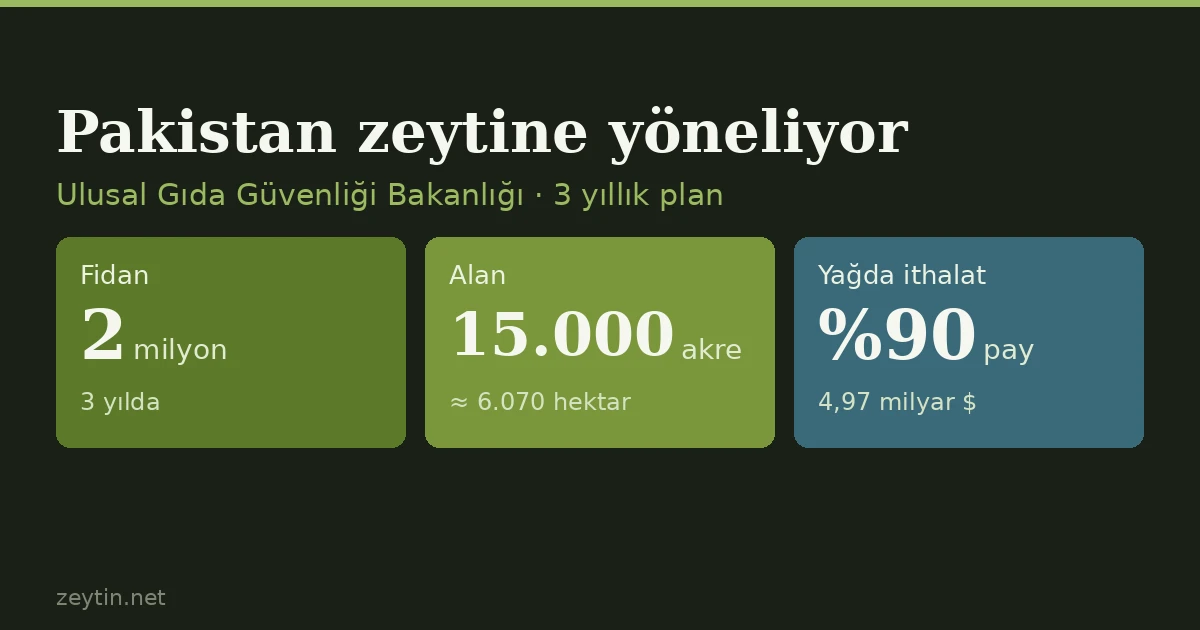
Pakistan's Ministry of National Food Security and Research plans to establish olive groves on 15,000 acres (about 6,070 hectares) over three years and supply 2 million plants in that period. The country imports roughly 90 per cent of its edible oil; the import bill reached 4.97 billion dollars in 2024-25.
Article
Pakistan to plant 2 million olive trees in three years to cut edible oil imports
Pakistan's Ministry of National Food Security and Research plans to establish olive groves on 15,000 acres (about 6,070 hectares) over three years and supply 2 million plants in that period. The country imports roughly 90 per cent of its edible oil; the import bill reached 4.97 billion dollars in 2024-25.
 Article
Skilled operators for olive mills: training ends in Milas, Muğla trains women operators
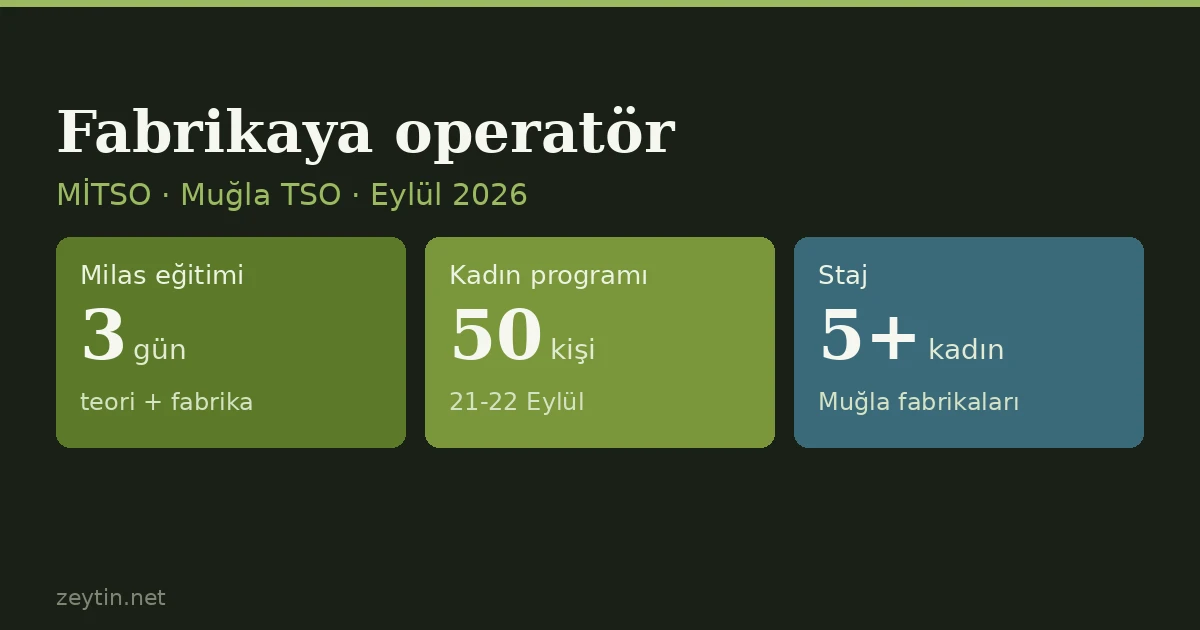
Ahead of the harvest, two training programmes in Muğla focus on operators, the most critical link in olive mills. A three-day operator course run by MİTSO, Milas Tariş and HAUS Makine has ended in Milas, and the Muğla Chamber of Commerce and Industry is launching a 50-place "Women's Hands in Industry" programme to train women as mill operators.
Article
Skilled operators for olive mills: training ends in Milas, Muğla trains women operators
Ahead of the harvest, two training programmes in Muğla focus on operators, the most critical link in olive mills. A three-day operator course run by MİTSO, Milas Tariş and HAUS Makine has ended in Milas, and the Muğla Chamber of Commerce and Industry is launching a 50-place "Women's Hands in Industry" programme to train women as mill operators.
 Article
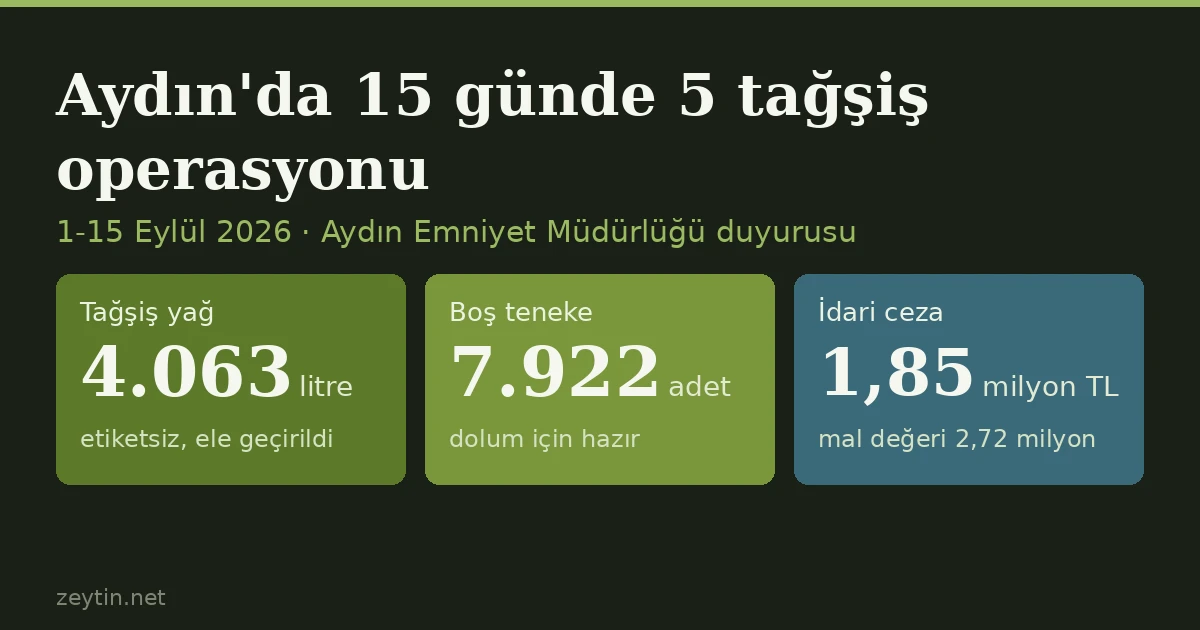
Five adulteration raids in 15 days in Aydın: 4,063 litres of oil, 7,922 empty tins
Police in Aydın say five operations between 1 and 15 September 2026 seized 4,063 litres of unlabelled adulterated oil and 7,922 empty tins. The goods were valued at about 2.72 million lira and the administrative fines totalled 1.85 million lira. The number of empty tins was nearly double the litres of oil seized.
Article
Five adulteration raids in 15 days in Aydın: 4,063 litres of oil, 7,922 empty tins
Police in Aydın say five operations between 1 and 15 September 2026 seized 4,063 litres of unlabelled adulterated oil and 7,922 empty tins. The goods were valued at about 2.72 million lira and the administrative fines totalled 1.85 million lira. The number of empty tins was nearly double the litres of oil seized.
 Article
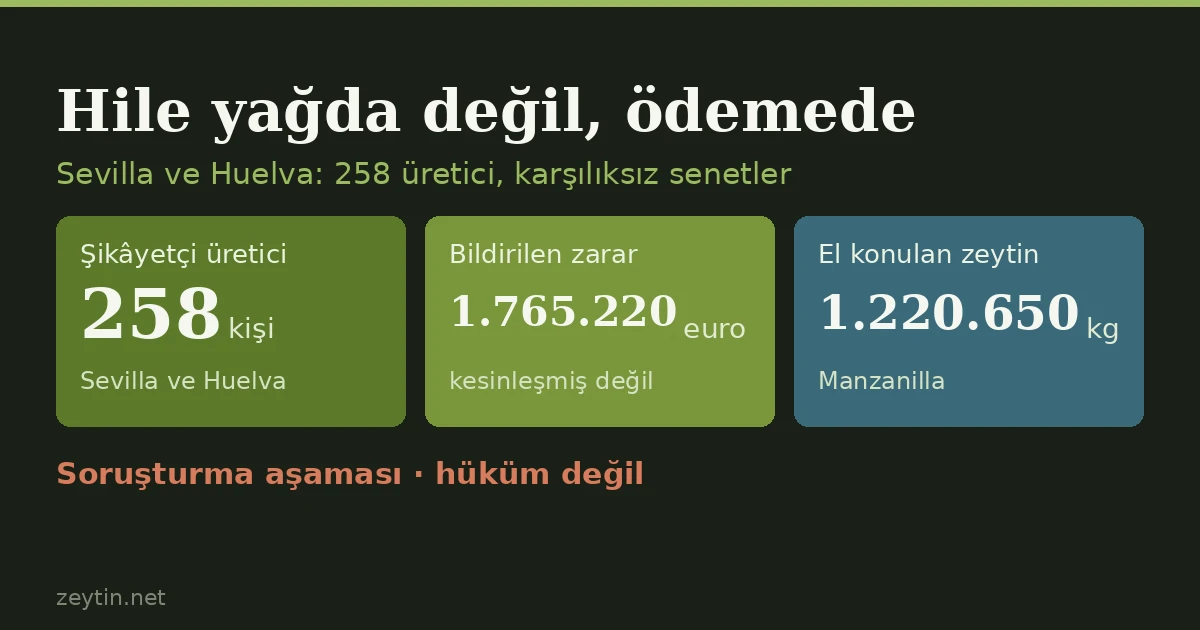
258 growers, €1.77 million: in Spain the fraud was not in the oil, it was in the payment
Spain's Guardia Civil has detained a table olive trader accused of defrauding 258 growers in Seville and Huelva of €1,765,220. The olives were real and the sales were real; the money never reached the producers. Investigators seized 1,220,650 kilos of Manzanilla olives.
Article
258 growers, €1.77 million: in Spain the fraud was not in the oil, it was in the payment
Spain's Guardia Civil has detained a table olive trader accused of defrauding 258 growers in Seville and Huelva of €1,765,220. The olives were real and the sales were real; the money never reached the producers. Investigators seized 1,220,650 kilos of Manzanilla olives.